


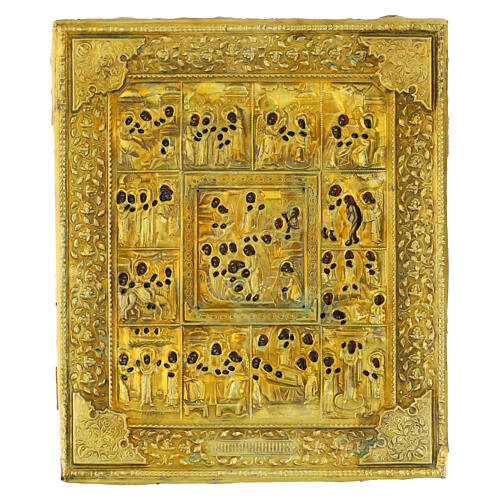
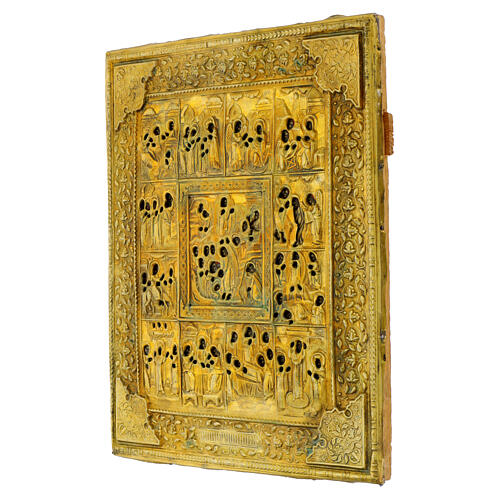
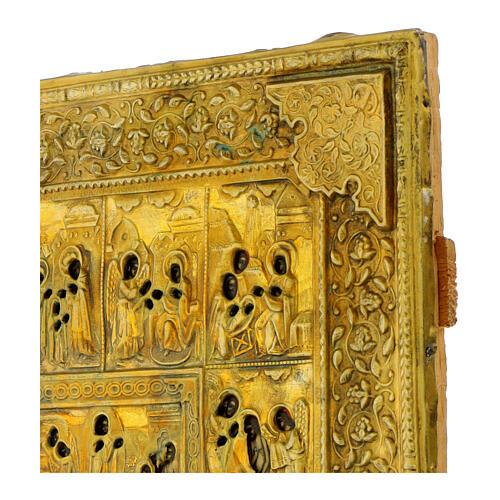
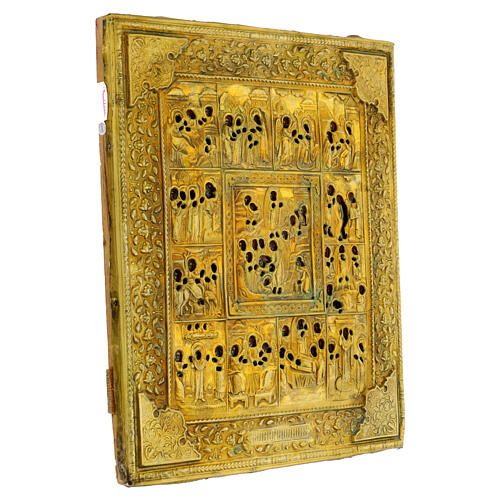
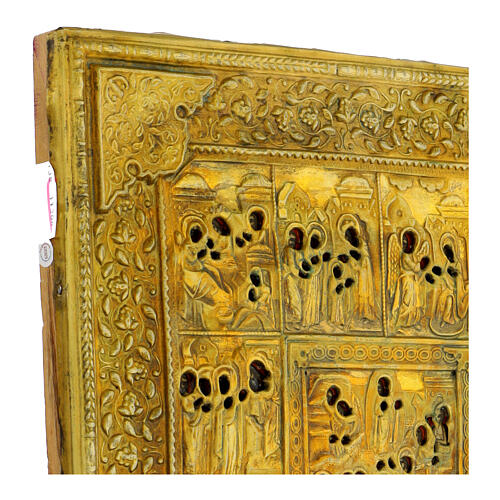
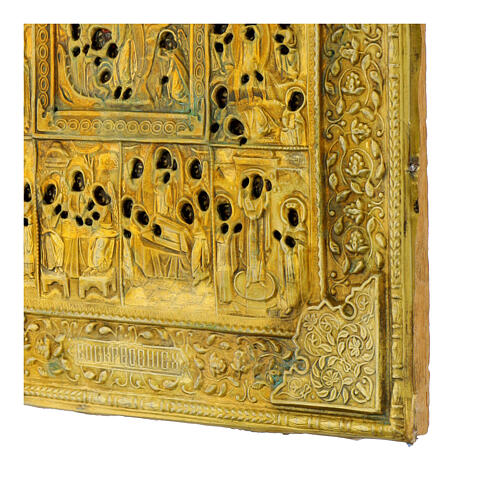
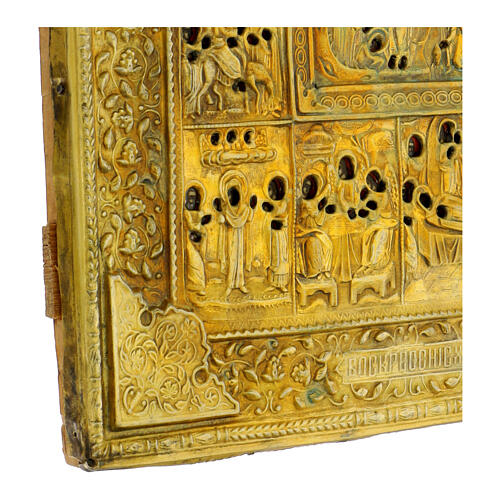

Antique Icon Twelve Feasts Brass Riza 19th Century, Russia 31x26 cm
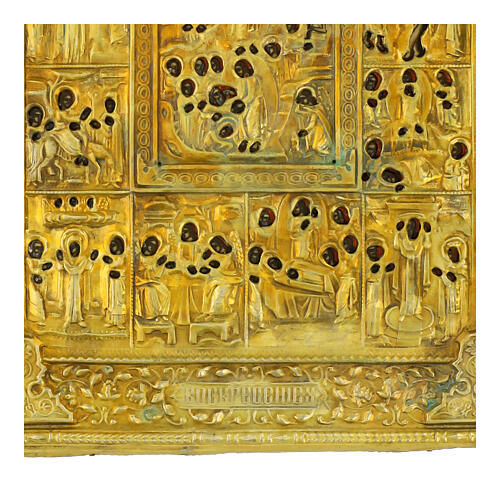
Russian antique orthodox icon depicting the 12 feasts of the liturgical year with a brass riza. The twelve main feasts that proclaim the faith of the Church are iconographic representations always present before the eyes of the faithful, placed in the front row of the iconostasis as a continuous liturgical-biblical catechesis. Some of these festivities have fixed dates: the Nativity of Mary (September 8), the Exaltation of the Cross (September 14), the beginning of Holy Week, the Ascension, and ...
Info and features
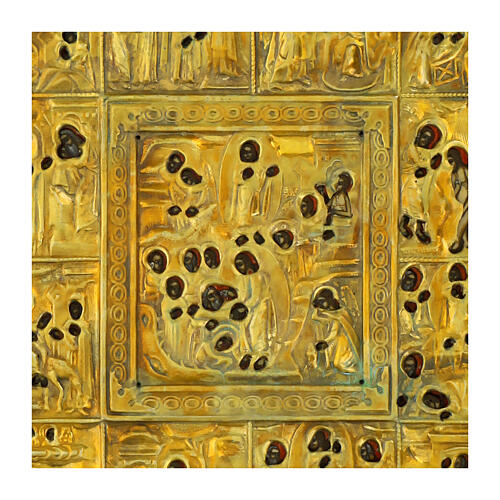
Russian antique orthodox icon depicting the 12 feasts of the liturgical year with a brass riza. The twelve main feasts that proclaim the faith of the Church are iconographic representations always present before the eyes of the faithful, placed in the front row of the iconostasis as a continuous liturgical-biblical catechesis. Some of these festivities have fixed dates: the Nativity of Mary (September 8), the Exaltation of the Cross (September 14), the beginning of Holy Week, the Ascension, and Pentecost. Russian iconography has enriched this cycle with four other important feasts inspired by sacred scriptures. Starting from the 18th century, especially in Russia, iconographic schemes have been developed that group all twelve feasts in a single composition centered around the representation of Easter, the 'mother of all feasts' symbolizing its synthesis and fulfillment. In these representations, the central scene dedicated to Easter holds paramount importance, including various elements expressing the theological and biblical meaning of the event: Christ's descent into hell, the procession of the blessed to Paradise led by the good thief, Christ's resurrection from the tomb, and his appearance at the Sea of Tiberias. The cycle of the Church's twelve main feasts includes a series of events marking the history of salvation and the lives of Mary and Jesus. It begins with the Nativity of Mary, followed by her Presentation at the Temple, and the Annunciation, when the angel Gabriel announces to Mary her divine motherhood. This is followed by the Birth of Jesus and his Presentation at the Temple, symbolizing consecration. The cycle continues with the Baptism of Jesus and the Triumphal Entry into Jerusalem, followed by the Transfiguration, where Jesus is revealed in his divine glory. Next, we find the Ascension, celebrating Christ's return to the Father, and the representation of the Trinity according to the Old Testament. Among the Marian events is the Dormition of Mary, commemorating her earthly end. Finally, the cycle concludes with the Exaltation of the Cross, honoring the instrument of redemption. This 12 Feasts icon is delivered with a blue velvet case and delivered with an evaluation carried out by a specialized expert. Origin: Moscow. Technique: egg tempera. Materials: wood, levkas, brass. Actual measurements: 31.3x26.5 cm. Era: late 19th century.
Customer Reviews
 Lucjan S.3/19/2026
Przepiękna rosyjska ikona - opatrzona bogatą koszulką, z certyfikatem i dobrze zapakowana. Wspaniała pamiątka wschodniej kultury i religii. Każda taka ikona ma jakby "duszę" - polecam warto mieć choćby jedną w swoim domu.
Translate