Author: Redazione

The patron saint of animals: Saint Anthony the Abbot

The patron saint of animals: Saint Anthony the Abbot

Contents1 Why is Saint Anthony Abbot represented with a fire and a pig?2 Prayer to Saint Anthony Abbot3 Temptations of Saint Anthony4 Saint Anthony the Abbot and Saint Francis: what do the two saints have in common? Saint Anthony the Abbot is remembered as the…


Argan oil and the innumerable properties of this precious oil

Argan oil and the innumerable properties of this precious oil

Argan oil: an everlasting beauty elixir. Let’s discover its amazing properties Argan oil excels among the products of the monasteries whose qualities we will never tire of praising. Berber women call it liquid gold and have used it since ancient times to protect their skin…

What happened to the fourth Wise Man?

What happened to the fourth Wise Man?

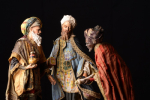
The Three Wise Men have always had a great fascination, although nothing is known about them. Today we want to tell you about a character whom we know even less: the fourth Wise Man.

Before telling you who the fourth Wise Man was, it is good to remember who the three ‘canonical’ Magi Kings were. They are said to be Sages, who came from Babylon, or priests of Zoroaster. Some legends want them Kings from distant lands, Arabia, India and even China. And yet there is no definite information that they were really rulers. They came following a comet star, and so it is presumed that they were astronomers, or otherwise knowledgeable in the science of the sky.

Of the Three Wise Men, it was said and written all and the opposite of all. We also dedicated to them a very exhaustive article.

What happened to the fourth Wise Man

Read more:

Who were the Wise Men and their names
We all know the Three Wise Men as the three men who faced a long journey chasing a star with the sole purpose of paying homage.

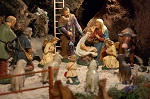
You can not talk about Christmas without mentioning them. They are protagonists of the Nativity scene, in a sense mark the crowning of the coming of the Child Jesus, because their arrival in front of the hut, with the famous gifts, celebrates the recognition of Jesus not only by humble pastors but also in the eyes of the world of men of knowledge. Their coming coincides with the end of the Feasts, the Epiphany, and with the beginning of a much larger and more important story.

Today we want to tell you an even different story, tell you about a character almost never mentioned, just to thicken even more a mystery two thousand years old. Yet the fourth Wise Man has been present in the Christian tradition for a long time, although he has not been mentioned in any Gospel. Many legends tell of this fourth Wise Man, who never reached Bethlehem, never met Jesus, because he did not arrive in time to meet his companions and got lost along the way. It is said that his vain search has continued forever, that throughout his life he has continued to wander in search of that unique and special Child.

But let’s take a step back.

Three or four wise men?

Among all the evangelists only Saint Matthew mentioned the Three Wise Men in his Gospel: Jesus was born in Bethlehem of Judea, at the time of King Herod. And some of the wise men came to Jerusalem from the east, and asked: <Where is the king of the Jews who were born? We saw his star rise, and we came to worship him.>” (Matthew 2,1-2)

In fact, he did not express himself on how many were the Three Wise Men, nowhere is attested that they were only three. Only later legends have identified three, and have also given them names, although they change from tradition to tradition: Gaspare, Melchior and Balthasar.

It is likely that the number of Magi was defined by the desire to code these characters according to their symbolic value. The number 3 often occurs in Scripture and like other numbers is invested with a precise meaning. As the number 1 symbolizes for example the uniqueness of God, the number 7 the totality and completeness, the number 12 the human fullness, so the number 3 refers to the Most Holy Trinity, and not only. Like the number 7 or the number 10, the number 3 is also a symbol of perfection and completeness. Three travellers visited Abraham’s tent. Three days elapse between the death and resurrection of Jesus, and in this sense, the number 3 becomes a symbol of new life, of completeness, understood in an even higher sense.

The fourth Magio, according to legends, was called Artaban. He came from Persia and like the other three Magi, he saw the comet Star in the sky and recognized in it the sign of a great prodigy.

The gifts of the Magi

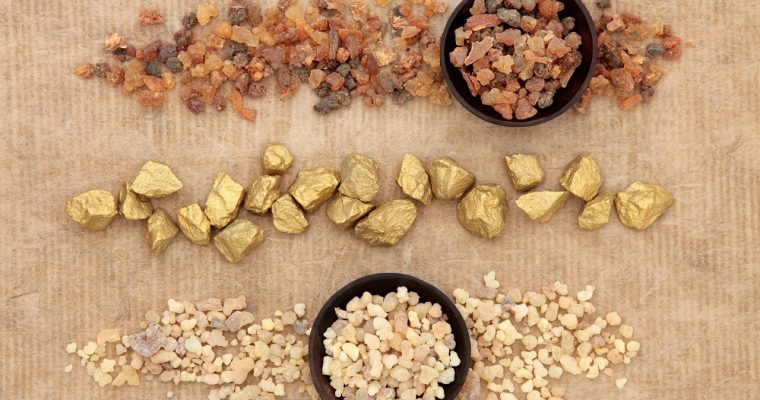
Returning to our Magi, we know that they offered the Child three gifts: gold, incense and myrrh. Even with regard to gifts, the choice is not dictated by chance. Gold was one of the most precious metals, an exclusive prerogative of the Kings, and with it, the Magio Melchior recognized the kingship of Jesus.

Gold, incense and myrrh

Read more:

Gold, incense and myrrh: the gifts that the three Magi Kings brought to the Infant Jesus
The Magi, fascinating and evocative figures of the Christmas tradition.

As for the gift of Gaspare, it was common to use essences and incense to honour the gods, so the incense he offers to Jesus is a way to affirm his divine nature.

Finally, Balthasar carried myrrh, used to produce a precious ointment used for aesthetic purposes, but also for the cult of the dead. It represents the investiture of Jesus to King and God, and in a certain sense His eternity, since the same ointment that is given to him at birth will be the one with which His body deposed from the Cross will be composed.

And what gift would the fourth wise man bring?

The fourth wise man, Artaban, brought with him three pearls to give to Jesus, as large as pigeon eggs and as white as the moon, or, according to other traditions, a pearl, a sapphire and a ruby.

three pearls

But what did happen? Artaban was unable to meet with the other Magi at the scheduled time of departure, so he set out on his own to find Jesus. But along the way, I met many poor and distressed people, and he gave them the precious treasure that should have been given to the King of Kings.

A pearl he gave to an old dying man, after having assisted and treated him.

A pearl was used to redeem a young woman enslaved.

A pearl I use to save a child who was about to be killed by a soldier of King Herod.

Artaban, the fourth King

One of the authors who devoted his attention to the story of Artaban is Henry Van Dyke, pastor of the Presbyterian Church, who in 1896 wrote the book Artaban, the fourth King. In this book he tells the story of the fourth Magio King and his pearls, accompanying him on his long and untiring journey in search of Jesus. Throughout his life Artaban continued to travel, collecting clues and searching for information about that Child to whom he would like to pay homage, guided by a star.

Finally, after thirty-three years, Artaban, now old and exhausted from his wanderings, arrived in Jerusalem. It was the time of Easter, and the city was traversed by a particular ferment, because a man, Jesus of Nazareth, was about to be executed for proclaiming himself the Son of God. Thus, when he believed that he had failed, that he had dedicated his whole life to pursuing an unattainable dream, Artaban found himself in front of the Child he had so sought, and at the highest and most dramatic moment of His mission in the world.

Artaban, on his deathbed, thus dialogues with a very sweet voice that is addressed to him in his last moments:

Artaban: “Ah, Master, I have been looking for you. Forget me. I once had precious gifts to offer you. Now I have nothing.”

Jesus: “Artaban, you have already given me your gifts.”

Artaban: “I don’t understand, my Lord.”

Jesus: “When I was hungry, you fed me, when I was thirsty, you gave me a drink, when I was naked, you dressed me. When he was homeless, you took me in.”

Artaban: “It is not so, my Savior. I have never seen you hungry, nor thirsty. I have never dressed you. I have never brought you into my house. For 33 years I have sought you, but I have never seen your face and I have never helped you, my King. I have never seen you until today.”

Jesus: “When you did these things for the last, for the smallest of my brothers – you did them for me.”

It is clear the reference to Matthew 25,35-40: 35 Because I was hungry and you fed me, I was thirsty and you gave me a drink; I was a stranger and you hosted me, 36 naked and you dressed me, sick and you visited me, imprisoned and you came to see me. 37 Then shall the righteous answer him, Lord, when have we seen thee hungry, and fed thee, thirsty, and given thee a drink? 38 When we saw you a stranger, and we took you in, or naked, and dressed you? 39 And when we saw you sick or in prison and came to see you? 40 And the king will say to them, Verily, I say unto you, every time ye have done these things to one of my younger brethren, ye have done it to me.

Thus ends the journey of Artaban, the fourth Magian King, who never arrived in Bethlehem, but who showed for his whole life such generosity as to make Jesus proud of him.

Other traditions about Artaban see him wandering the world, tormented with shame for not having been able to keep the gifts for Jesus, but even in these alternative versions the voice of the latter sooner or later comes to him in a dream to reassure him and thank him for all the good he has been able to do.

The meaning of his story does not change: every gesture of generosity made towards those who are poor, unhappy, desperate is a gesture of love towards Jesus. Artaban, the fourth Wise Man, is a role model for all of us, and not just at Christmas.


Gold, incense and myrrh: the gifts that the three Magi Kings brought to the Infant Jesus

Gold, incense and myrrh: the gifts that the three Magi Kings brought to the Infant Jesus

The Magi, fascinating and evocative figures of the Christmas tradition, brought gold, incense and myrrh as a gift to the Child Jesus. But what lies behind the choice of these particular gifts? The Three Kings and their gifts have for thousands of years been the…
Christmas wreaths, the perfect decoration for your Christmas

Christmas wreaths, the perfect decoration for your Christmas

Contents1 Where to put the Christmas wreath?2 Christmas Wreath: Which to Choose?3 DIY Christmas Wreath: Ideas and Tips Round, colourful and gorgeous, Christmas wreaths can be a perfect decoration for both indoors and out. How to use them? Where to place them? Customise them or…

Decorating the Christmas tree: rules and advice

Decorating the Christmas tree: rules and advice

December 8th is the day when traditionally people gather to kick off the Christmas holidays with the assembly and preparation of the tree. This year we have decided not to let you arrive unprepared. Here is a little guide to not making mistakes and decorating the best tree ever.

Many are probably thinking that it is not that difficult to put lights and balls on a synthetic tree. But will it be true?

We will guide you step by step, from choosing the Christmas tree to selecting the right lights and decorations, on what are the best solutions to obtain a result worthy of the best furniture magazines.

Choose the Christmas tree

Small, large, tall, low, narrow, wide, snow-covered or not, the range of Christmas trees is vast and being able to navigate the infinite possibilities of choice can be complicated.

If you have a large house and a lot of space, the advice is to get a tall tree with a fairly wide base that touches the floor so as not to show the feet that support it. By far the most scenic type of tree.

If, on the other hand, there is not a lot of space available, try to take advantage of the height, perhaps bet on slim Christmas trees, not bulky but still impactful.

Obviously, the measurement of the room is fundamental, the rule requires that the tip of the tree reaches a maximum of 50 cm from the ceiling, not higher.

Another thing to take into consideration is the number of branches of which the tree is composed, it will seem trivial but, the more branches there are, the more beautiful the tree will be. Short needles and lots of twigs at the tips are the extra touches that will make your tree look thicker.

What to put on the foot of the Christmas tree

The base of the Christmas tree is the most “unsightly” part that can sometimes distract us from the magical atmosphere that the lights and the glitter of the decorations try to create, if you want to obtain an optimal final effect it would perhaps be appropriate to cover it with small and simple expedients.

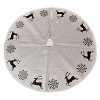
If you are looking for something ready to use, an idea could be to buy special Christmas tree base covers, which blend perfectly by taking up the basic colour of the tree or perhaps themed, with drawings of reindeer and puppets of snow to make children happy too.

Does it seem trivial to you? do you prefer more creative solutions? your only limit is your imagination. Fake packages, wicker baskets and wood logs can be placed on the lower part of the tree in order to obtain a modern and playful effect.

Finally, you can choose to combine modernity and tradition by inserting a hut with the Nativity scene at the base of your tree.

Building a nativity scene under the Christmas tree will allow you to combine the two most important symbols of Christmas, giving each one the right relevance.

How to put the lights on the Christmas tree

Putting lights on the Christmas tree is perhaps the most complicated and also the most underestimated thing.

lights on the Christmas tree

So let’s see together what are the basic steps:

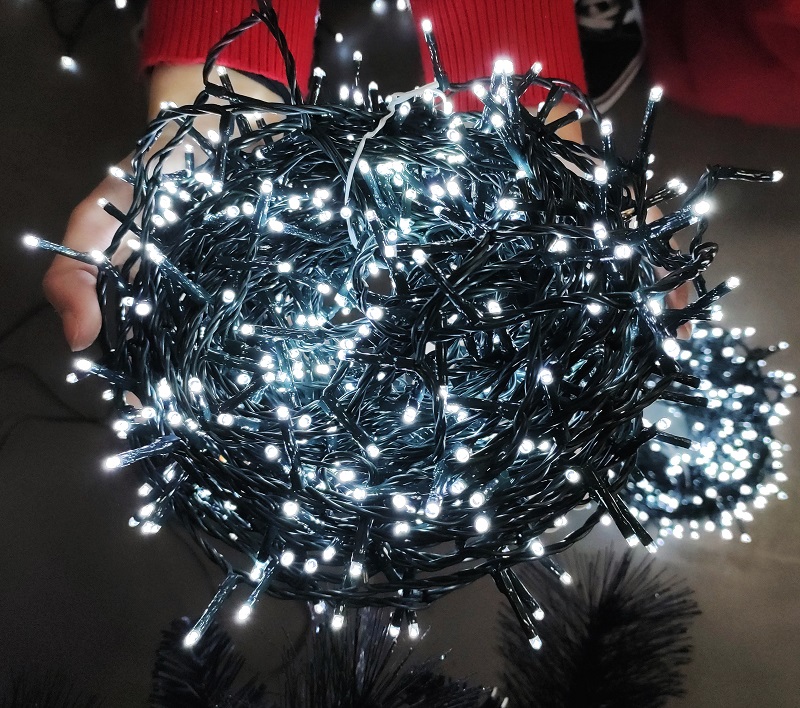
  1. Choose the type of light that you prefer and that best matches the other decorations you already own or want to buy. You can choose monochrome lights or coloured lights, warm coloured lights or cold coloured lights. For example, if your decorations turn towards shades of blue and silver it will be better to choose a string of lights with a cold tone, a bright white or a blue, and different speech if your decorations tend towards warmer colours such as gold or red.
  2. Purchase a sufficient number of threads of light for the tree to be well-covered. The biggest mistake you can make is to save on the purchase of lights and then leave empty areas here and there. If for the decorations you can choose to decorate little or nothing the back of the tree, for the lights is not the same.
  3. The techniques for positioning the lights are different, we have selected the two that we believe give the best final effect. The first mode, the most classic one, provides that the lights are placed from top to bottom, just turn the wire all around the fir tree until the lights are well distributed, for an even more scenic effect you can think to insert a thread in the part of the tree closest to the trunk and a second one instead in the outermost part on the branches. The other method, which requires a higher number of lights, is that which involves wrapping the branches one by one starting from the base up to the top.

Christmas tree decorations, how and where to put them

We have reached the last stage of Christmas tree decoration, the one most awaited by children: the moment when the decorations are hung from the branches and everything takes shape.

After choosing the tree, covering the base and fixing the lights, all you have to do is hang the decorations. Which ones? How many? Where? Difficult to give an answer that suits everyone, a lot depends on the style you have chosen for your fir, its size and a number of other factors.

However, we can give you three simple tips to avoid making mistakes:

  1. Never place decorations in a row, neither vertically nor horizontally. All the Christmas balls or decorations that you are going to place must, apparently, have a random order.
  2. Avoid placing the larger balls at the bottom of the spruce and the smaller ones at the top. The decorations, large and small, must be distributed evenly over the entire length.
  3. Use a base of the same decorations to make everything uniform and break the monotony with unique pieces, particularly precious decorations or hand-made blown glass balls.

Christmas tree, the colours that never fade and the news

Christmas tree, the colours that never fade and the news

Contents1 Red and gold Christmas tree2 White and gold Christmas tree3 Blue and silver Christmas tree4 Multicolour Christmas tree5 Pastel Christmas tree6 Black Christmas tree We have put together ideas to help you choose the combinations and colours, from the most classic to the most…

Water pump DIY nativity scene: maintenance and replacement

Water pump DIY nativity scene: maintenance and replacement

The water effects such as fountains, rivers or waterfalls make the DIY nativity scene special. But what to do if the water pump stops working? Two ways: clean the pump of limescale and debris or replace the pump. For Christmas lovers, it is never too…

Rock paper for nativity scene: how to use it and which one to choose

Rock paper for nativity scene: how to use it and which one to choose

Lovers of the DIY nativity scene, dive into the world of rock paper! Which one will you choose: traditional or modelable rock paper?

Christmas is approaching and, while the mass market focuses on sequins and glitter decorations, there are some who are thinking of stocking up on pebbles, twigs and moss for this year’s nativity scene. For all lovers of the DIY nativity scene, this is the time to get information and choose the best materials, statues and settings. And get the most original idea to create a unique nativity scene that helps to grasp the meaning of Christmas.

How to build a DIY nativity scene

Read more:

How to build a DIY nativity scene: a mini guide
We want to carry on, offering you a little guide on how to build a DIY nativity scene.

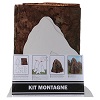
One of the first aspects to which attention is paid is the creation of the backgrounds for the crib and the setting in which to insert the Nativity and the other characters. It is precisely in this phase of the construction of the DIY nativity scene that the rock paper enters the scene. Now very popular among nativity professionals and amateurs alike, rock paper is used to create realistic backgrounds, reliefs and landscapes. On Holyart you will find two types of rock paper for nativity scenes: traditional and moldable. Let’s see what are the characteristics and the ideal uses of each type of crib paper.

Traditional rock card

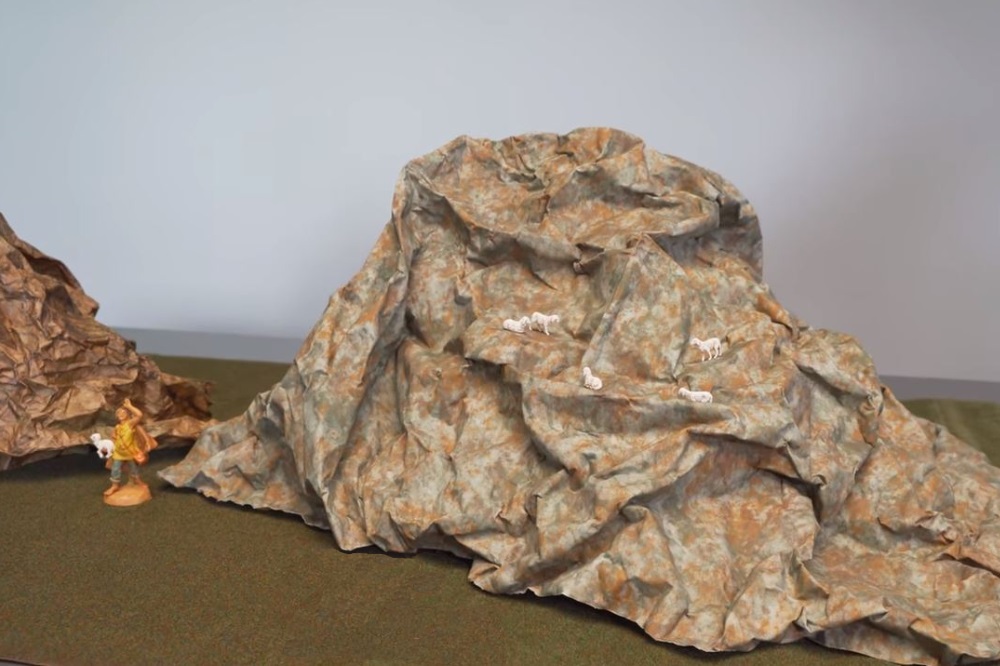
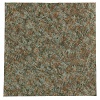
Traditional rock paper looks like light sheets of paper with prints that reflect the colours of natural elements. It is a very simple material and can be used for different purposes, such as creating mountains or filling the empty spaces between the elements of the nativity scene. The textures of the prints are varied and adapt to different needs: in addition to the rock, you will find grass, water, and bark-effect paper.

Traditional rock paper is ideal for solving imperfections and aesthetic problems that may arise in the construction of a DIY nativity scene. To obtain a realistic result, the sheet is crumpled so as to make the surface irregular and is positioned in the crib shaping it with your hands. For example, it can be suitable to cover the cables of the crib movements and lights or to hide the defects of the surface on which the crib is located. It is also useful for creating reliefs on the background: in this case, it is necessary to have supports that hold the paper in place (in some cases, together with the sheet of rock paper, cardboard shapes are also included for the creation of the mountains). A useful tip is to use tape or a stapler to fix the paper and keep it stable. The only weak points of traditional rock paper are the low resistance and the fact that once fixed with tape and staples, it cannot be used for other purposes. In any case, since it is a cheap product, it can be replaced without major expenses.

Mouldable rock paper

The mouldable rock paper has a different composition from the traditional one: it is made with an aluminium layer that makes it malleable and resistant. It maintains the shape given to it and, being modelable, once the mountain has been created it can be used again by easily changing the shape of the relief. Also in this case, different prints are available to create different scenographies (water, wood, rock, lawn …). The print is made on a matte surface which creates an even more realistic effect, and the material is waterproof.

It is ideal for creating realistic reliefs quickly and for reuse as needed. The material allows you to give a more realistic shape to the relief and get the desired result faster than traditional rock paper. No need for supports, tape or staples: your mountain will remain stable thanks to the material it is made of. Furthermore, if the paper is shaped in such a way that it has enough flat space, the nativity statues can be placed on it as on any rigid support. For all these characteristics, mouldable rock paper is less economical than the traditional one. On the other hand, it is also more durable and reusable.

You can see the difference in making a mountain with traditional mountain rock paper and mouldable bark paper in this video:

Who do you think won?

Christmas lights: how to use them all year round

Christmas lights: how to use them all year round

Contents1 A wall with lights and photos2 Glass vases with Christmas lights3 Christmas Lights for Outdoors: a must-have for the whole year4 Christmas lights in the bedroom, a magical touch for children5 Bookcase with Lights6 Safety, an aspect not to be underestimated Christmas lights are…

Day night crib control unit: everything you need to know

Day night crib control unit: everything you need to know

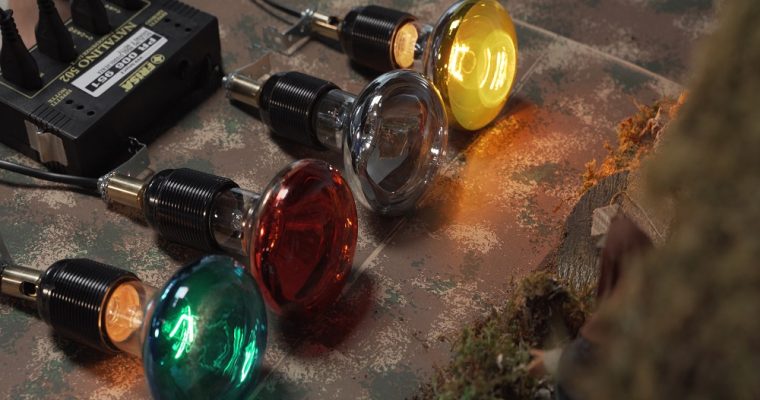
Contents1 Control units for cribs2 Day/night effect for the nativity scene3 Nativity scene lights and accessories A nativity scene control unit can make your Christmas truly special. Here’s how to make your nativity scene unique and original with the right devices. At Christmas, the nativity…

Nativity Pumps: how to choose the right one

Nativity Pumps: how to choose the right one

Pumps for nativity scenes, essential accessories to create suggestive effects of moving water for our nativity scene. Let’s find out how to choose the one that best suits our needs.

Time to think about the Nativity scene, how to make it, how to make it unique and truly special. And if we plan to enrich it with a river with flowing water, or a waterfall, a whispering fountain, or any element with moving water, do we know how to move among the many crib pumps available on the market?

What are they?

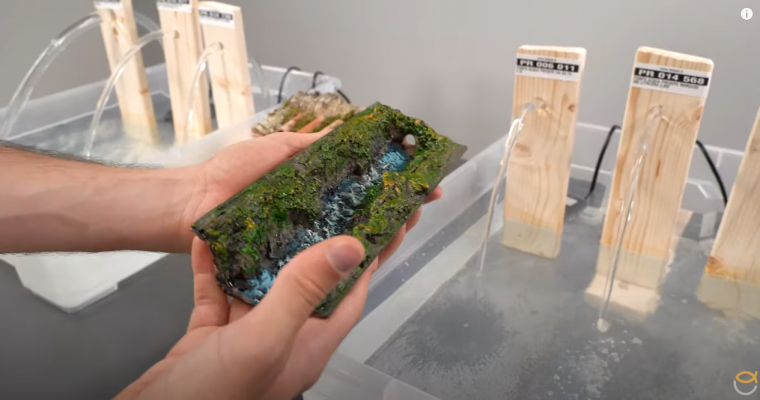
First of all, let’s try to clarify what nativity pumps are. These are small motor pumps that draw water from a tank and allow it to be recycled in a defined circuit. They are available in different sizes and with different performances.

There are immersion pumps, usually smaller, which are positioned directly inside the container that will accommodate the water to be moved, or larger external pumps, which can create much more complex and evident aquatic effects.

The water pumps for Nativity are essential for the construction of fountains, streams, and waterfalls.

In our catalogue, in addition to a wide range of pumps, you will also find gear motors, motors and pulleys for mills and moving statues, as well as accessories of all kinds to create your realistic nativity scene.

Why is water so important for the Nativity scene?

Those who choose to make a do-it-yourself nativity scene usually do so moved by the desire to represent an ideal place, a fairytale setting and yet inspired by real places of antiquity, well-known settings. In the tradition of our country, the nativity scene is usually set in an ancient village, which in the Neapolitan nativity scene, in particular, takes on the connotation of a village of the 1700s.

Just talking about the Neapolitan nativity scene, and in particular explaining how to create a nativity scene with a waterfall in a few simple steps, we focused on the symbolic importance of water in the nativity scene. In fact, everything in the Neapolitan crib has a very deep and important symbolic meaning, and even water is no exception. Whether represented by a river, a waterfall, a pond, it refers to the origin of everything. Water contains the power of life and that of death, and the eternal cycle that involves both, purification and rebirth, the passage of time, the passage of souls from the world of matter to that of the spirit. This gives us a measure of how useful water pumps can be in creating the Nativity scene!

Inserting water into our Nativity scene can become something much more significant than wanting to add a simple setting detail. Even if we choose to place our Nativity more realistically in Bethlehem, located in desert territory, we could decide to enrich the Nativity with a small oasis, using a simple pond pump.

How to choose the Nativity scene pumps?

But how to choose the nativity pump that best suits our needs? What characteristics need to be kept in mind? What is the difference between fountain pumps and pond pumps?

When we choose the pump for our Nativity scene we have to look at two things: the pump flow rate and the pump head.

Flow rate is simply how much water the pump can push. In fact, there are pumps with a lower or higher flow rate, which can handle very different quantities of water. Depending on whether we want to feed a fountain or a waterfall this feature will become very important to consider. Our pumps are equipped with a flow regulator, which allows you to increase or decrease the flow rate of the pump itself.

The prevalence of a pump is instead the maximum height in which we can place our scenographic element, be it a stream, a waterfall, a fountain, compared to the basin that contains the water, to ensure that the water continues to flow. without problems. For example, if we use a pump that has a head equal to 50 cm and we position the water pipe at a height of less than 50 cm, the water will flow smoothly, but the higher we get up, the more difficult the water will flow. Beyond 50 cm it will no longer be able to rise and therefore the flow will stop.

So we will have to choose our pump on the basis of our actual needs, considering how much water we want to move. For example, to move a fountain, a small fountain pump, with a low pump capacity, will be sufficient. On the other hand, to feed a waterfall, we should choose a pump with a higher flow rate and also evaluate at what height to place the fountain itself based on the prevalence of the pump.

Our crib pumps are all very quiet: by turning them on you will not hear the noise of the engine, but only that of the flowing water.

Water pump maintenance

The nativity scene pumps in our catalogue are equipped with a mechanism that is difficult to break.

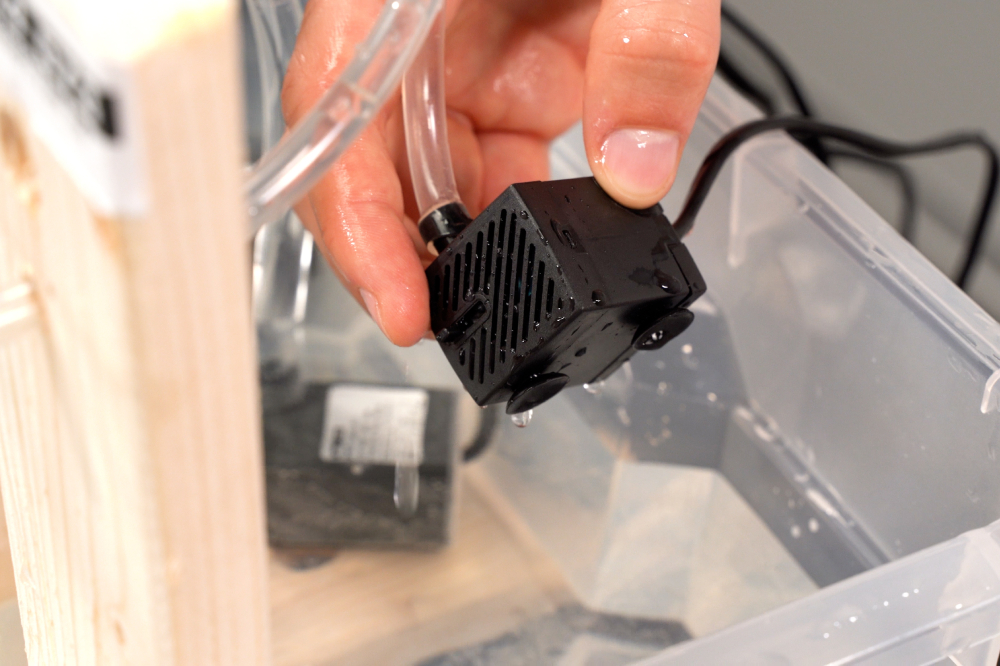
To ensure that the pumps always work in the best way, they must be completely immersed in water when they are used. They are in fact made specifically to be used in this way, and only by doing so, we can be sure that they do not overheat. By immersing them in water, the pumps will not burn, will not break and will always continue to work. For this purpose, our pumps are equipped with small suction cups that allow them to adhere perfectly to the bottom of the tray and not move while they are operating.

Another precaution that will be good to take is to make sure that the limescale and debris do not get stuck in the fan.

Finally, very important for your safety: do not plug in or unplug the pump with wet hands!


Holy Martyrs: sacrificing one’s life in the name of God

Holy Martyrs: sacrificing one’s life in the name of God

Contents1 Martyrdom of Saint John the Baptist2 Saint Stephen3 Saint Agnese4 Saint Sebastian5 Saint Lawrence6 Saint Barbara7 Cosmas and Damian8 Saint Lucia The Holy Martyrs are men and women, often very young, who sacrificed their lives for the love of God, and for this reason,…

Holyart hardstone rosaries: technical characteristics

Holyart hardstone rosaries: technical characteristics

Contents1 Hardstones2 Amethyst3 Hematite4 Pumice5 Fossil stone6 Angelite7 Agate8 Coral Semi-precious stones have always been used to imitate semi-precious stones. Let’s discover together the suggestion of semi-precious stone rosaries, sacred jewels of great beauty and value. Hardstone rosaries have always been a less expensive, but…

The history of the lights: from Southern Italy to the United States

The history of the lights: from Southern Italy to the United States

Christmas lights are a suggestive and essential tradition during the holidays, and not only in our country. This is how they were born.

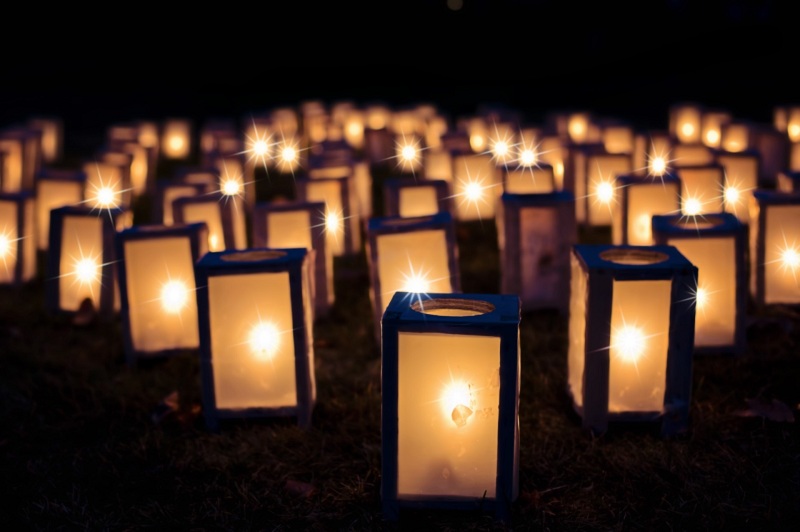
The custom of lighting the house on the occasion of Christmas has ancient origins and that sink in the profound religious sense of Christian countries. Originally, light sources were torches and candles, with which furniture, window sills and the first Christmas trees were decorated, very different from those we are used to today. We talked about it in an article, some time ago, dedicated to Christmas decorations for the outdoors: the lights.

The meaning of those lights that lit up the nights, then really dark and frightening, was twofold. On the one hand, there was the desire to make the house warmer and more welcoming, leaving out the rigours of winter and the horrors of the night. On the other hand, immediately emerges the powerful symbolism that light has always been covered in the context of the Christian religion. Light as the essence of God and the first element created by Him.

Light as the essence of God

Light as the personification of Christ who defeats death and by resurrecting brings the promise of eternal life to all men. Just think of the light that constantly illuminates the tabernacle, or the paschal candle, as well as the baptismal candle. From childhood, they teach us that it is a sign of affection and devotion to light a candle in the church, in front of the statue of the Madonna or of the favourite saint.

Here, then, is that the light of a simple candle takes on profound meanings, and imagining the flames that on Christmas Eve lit up the houses and streets of our country, or of the villages of Germany immersed in the dark forests of the north, evokes the perception of an ancient and strong religiosity.

This is how the Christmas lights are born, as a sign of devotion, as the desire to welcome the light into one’s home and project it outside, so that everyone can see it, so that everyone can enjoy it, in those magical and joyful nights.

How was this tradition born, which still today characterises the holidays in our cities and much of the world?

History of the illuminations

Starting from Italy, the Christmas lights are born as part of the celebrations dedicated to the saints that have always been held in our country.

History of the illuminations

If it is true that the lights as we know them today, the electric ones, were born only in the 1930s, and developed hand in hand with the diffusion and increased accessibility of electricity for all segments of the population, knowing a true boom only in the 1950s, it is also true that, previously, Italian cities and towns had already been able to make spectacular the feasts dedicated to their patron saints, to the Madonna and in general to every aspect of religion. We just think that great artists of the past, such as Michelangelo or Bernini, contributed to the staging of great popular festivals, together with famous architects and writers. This is because this kind of party has always involved everyone, from religious to rulers, to the last of peasants or artisans. The feast day was not just an occasion to pay homage to God or a saint. It was the moment in which everyday life, made up of work and effort, was left, suspended, and this made it necessary for the city or town, or even just the churchyard to be transformed, to become a new place, dedicated to something special.

We are therefore talking about traditions that were already widespread in the sixteenth century, almost everywhere in Italy, even if, in some respects, their evolution was concentrated above all in the South, where, even today, immense importance is given to processions and at feasts in honour of the saints or of the Madonna.

statues of the Madonna

Read more:

The Annunciation of the Blessed Virgin Mary
The Council of Trent was one of the largest meetings of Bishops that history can remember …

Indeed, in those regions, the festivals became a real form of art, especially linked to the Baroque culture, to which it has always been close. In this context, the decorations set up on the occasion of the party are called parations, which can be internal or external, and which are often enhanced with the use of torches and lamps. Arches, pediments, candelabra, but also thrones, altars, draperies, liturgical crowns, were often illuminated in the evening to add wonder to wonder. It is no coincidence that another typical element of these patronal feasts were the fireworks, which brought more light to illuminate the night, which was so momentarily banned.

The profound historical and social changes will lead to the inexorable decline of this art form, but the tradition of baroque parations has evolved and adapted to modernity. We find it precisely in the Christmas lights, which every year transform the cities into a different and wonderful place, giving them a magical atmosphere and recalling all the past splendour.

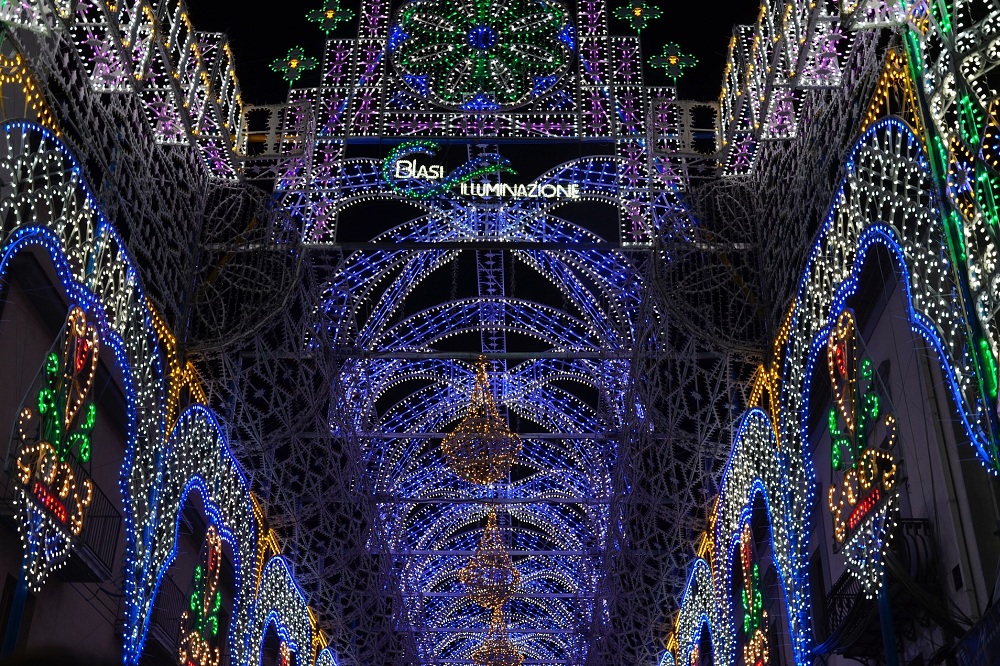
An example to everyone? Scorrano, in the province of Lecce, is considered the world capital of lights. We are talking about a small town of only 7,000 inhabitants, but where three companies that supply lights set up public lighting for Christmas and the feast of Santa Domenica, in the first half of July.

If we want to talk about the trees lit up at Christmas, there is a beautiful legend linked to Martin Luther, who wandered in a snowy forest on a Christmas night. Seeing the branches and leaves of ice-covered trees twinkling in the moonlight, he thought it would be wonderful to make the tree branches that adorned the houses shine in the same way during the holidays, using candlelight. But it was not until the eighteenth century that it became common among Protestants to light the tree during holidays. The trees were decorated with trinkets, ribbons, fruits, and even with candles or oil lamps.

A less legendary tradition has it that it was Edward Hidden Johnson, the equal partner of Thomas Edison, father of electricity, who decided to use electricity to decorate his own Christmas tree, in 1882. He replaced the classic candles with eighty of the bulbs produced by his company, connected to an electric wire in a single series, and encased in small glass globes. We are already talking about the Christmas lights as we know them! But at the time only an eccentric billionaire like Johnson could afford enough energy, and for such an exquisitely aesthetic purpose. However, his idea was very popular and soon followed in several cities in the USA.

The Christmas lights today

And today? We live in the digital age, of often exasperated modernity, to the point of making us lose sight of what in the past aroused emotion and wonder. Yet modern LED lights and laser effects still manage to evoke the Christmas atmosphere, in new and evocative ways.

We have dedicated many articles to Christmas lights, from the various types available on the market, to how to use Christmas lights in complete safety. It would be really terrible to ruin the Christmas holidays with a fire! Yet it happens more often than we think that lights get hot, especially if they are non-standard lights, or if they are placed on a tree and left on at night or when no one is home.

But we prefer to keep on happier topics, reminding you for example how, in recent years, Christmas decorations with lights have reached the dimensions of a real phenomenon of fashion and costume in the United States. Just think of what happens every year in the New York district of Dyker Heights, where since the mid-1980s the inhabitants have given birth to a real decoration race. The goal is to make your home, starting well in advance of Christmas, as ‘Christmas’ as possible and worthy of the admiration of the neighbours and the many tourists who visit the neighbourhood every year. The neighbourhood is transformed into an enchanted place, populated by animated mannequins, moving sets, balloons, coloured wooden sculptures, and of course lights, lots of lights that illuminate the houses and the streets of day, transforming Dyker Heights into a magical Christmas village.

Sacred statues in plaster, the excellence of Italian craftsmanship

Sacred statues in plaster, the excellence of Italian craftsmanship

Contents1 The tradition of plaster statues2 The production phases3 Casting4 Drying5 Cleaning up6 Refinishing7 Dyeing8 The choice of chalk Plaster sacred statues have belonged to the Italian artisan tradition since antiquity. Let’s discover this ancient and always current art. Sacred statues and figurines of the…
Cosma and Damian: the medical saints who treated for free

Cosma and Damian: the medical saints who treated for free

Contents1 Martyrdom of Cosmas and Damian2 Three dates for two saints3 Worship Diffusion4 Basilica of Saints Cosmas and Damian in Rome5 The first limb transplant in history (and other miracles) Doctors, twins, martyrs. Saints Cosmas and Damian shared an extraordinary life, an unwavering faith and…

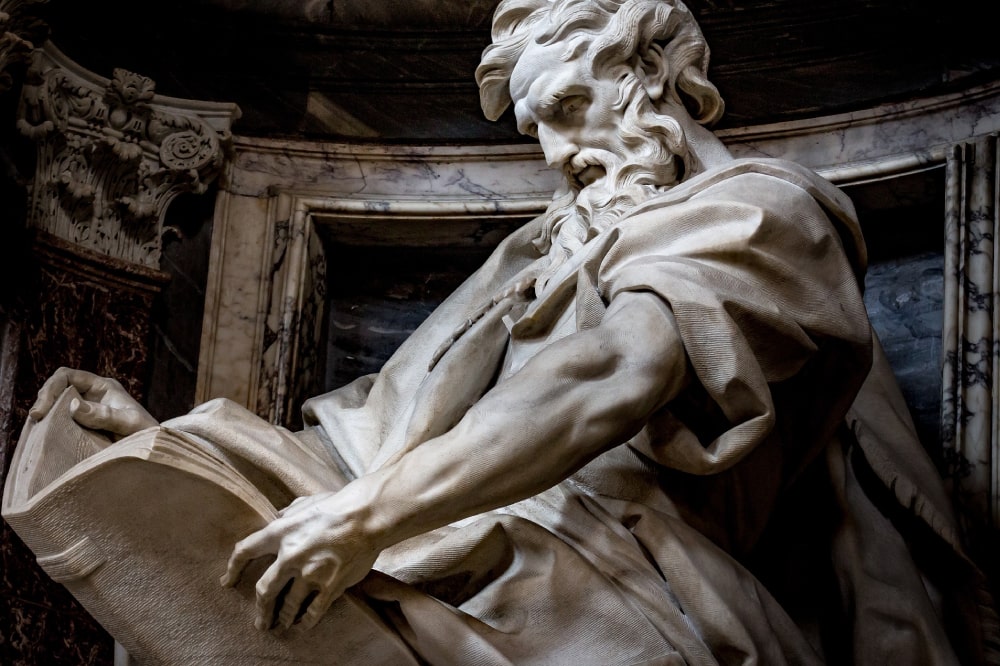
Saint Matthew, apostle, evangelist and martyr

Saint Matthew, apostle, evangelist and martyr

On 21 September, Saint Matthew is celebrated evangelist, apostle and martyr. Who was he and how did he become an apostle?

Saint Matthew the Evangelist is considered the author of one of the four canonical Gospels, namely the Gospels recognised by the Christian religion. In particular, his Gospel is called, together with those of Mark and Luke, also the “Synoptic” Gospel. If we take the texts of the three synoptic Gospels and put them on three parallel columns, we will notice many similarities in the narration of the Gospel episodes, sometimes even the same phrases and the same words.

But who was this man so close to Jesus that he could make himself the herald of His message of salvation and His Word?

Saint Matthew the Evangelist is considered the patron saint of bankers, accountants, customs officers, accountants and the finance guard. These curious patrons derive from his life prior to Jesus’ call, from the trade he practised before becoming one of the twelve apostles. In fact, Saint Matthew was what in his time was called a publican, or a tax collector. In Jewish society, handling Roman money was considered a grave sin. To overcome this problem, the tax collectors advanced the tax money to the imperial officials sent for this purpose, and then demanded tribute from the people. This made them very hated usurers, and also sinners despised by all because by touching the gold of the Romans, on which the effigy of the Emperor was imprinted, they became in a certain sense idolaters.

So Matthew was a tax collector, and he lived in Capernaum, an ancient city of Galilee, located on the northwestern shores of Lake Tiberias, in Israel, where Jesus lived after leaving Nazareth. Not much is known about him, the biographical information is very scarce. What we know dates back to after the encounter that would have changed his life: that with Jesus.

Saint Matthew the Apostle

The Gospels of Mark and Luke recount the encounter between Jesus and a publican.
And passing by, he saw Levi the [son] of Alphaeus sitting at the tax office, and says to him, Follow me. And he rose up and followed him. And he arose, and followed him. (Mark 2,14)
 After this he went out and saw a tax collector named Levi sitting at the tax office, and said to him, “Follow me.” (Luke 5:27)

But behold, in the same episode recounted in the Gospel of Saint Matthew we read: Going from there, Jesus saw a man sitting at the tax office, named Matthew, and said to him, “Follow me.” And he arose and followed him. (Matthew 9:9)

It is plausible that Levi and Matteo are actually the same person. Probably, when he received from Jesus the call to become an apostle, the tax collector Levi changed his name, as did Simon, who became Peter, and Saul, who became Paul. The meaning of the name Matthew, which means Gift of God, only supports this hypothesis.

It was enough for Jesus to completely change the life of a man accustomed to being oblivious to his fellow men, forced by circumstances to an odious job. It was enough to follow me, perhaps accompanied by a smile, by an outstretched hand, and the whole life of Levi/Matthew no longer had any value, any meaning. Without a word, he rose from his desk and followed the extraordinary man, only because he had asked him to do so.

From that moment Matthew became to all intents and purposes one of the twelve apostles. As such he is quoted in Acts (1,13) after Jesus’ Ascension into heaven. He also participated with them in the election of Matthias, chosen to replace Judas Iscariot, and in the descent of the Holy Spirit on the crowd on the day of Pentecost.

Jacopo Vignali Pentecost

Read more:

Pentecost: the day when we celebrate the Holy Spirit and the birth of the Church
Pentecost is perhaps, after Easter, one of the most important …

Later, like all the other apostles, he departed and began to spread the Good News first in Palestine, then everywhere his steps and his fervour could lead him.

Although some traditions claim that he died a natural death, the Church venerates him as a martyr.

Martyrdom of Saint Matthew

According to the Golden Legend of Jacopo da Varagine, Saint Matthew the Evangelist travelled through Ethiopia and succeeded in converting the Egyptian king after miraculously resurrecting his daughter Iphigenia. Precisely because of this miracle, and the consequent promise to protect the virtue of the girl, who had consecrated herself to the Lord, from the sights of her uncle Irtaco, who wanted to marry her, Saint Matthew would meet death while celebrating Mass. It would have been an assassin sent by Irtaco to pierce him with the sword by order of the avenging king.

Among the various representations of sacred art that have told the death of the Saint one of the most famous and evocative is certainly The Martyrdom of Saint Matthew painted by Caravaggio. It is a wonderful oil painting on canvas made between 1600 and 1601 by the artist commissioned by the Contarelli family. It can be admired in the Chapel that bears its name in the church of San Luigi dei Francesi in Rome.

The martyrdom of Saint Matthew can be considered to all intents and purposes a work of the artistic maturity of Caravaggio. In fact, it recurs many of the distinctive characteristics of the master, from the use of light, coming from an external source, which barely illuminates the scene otherwise wrapped in darkness, in the presence of many characters, some barely visible. Although Caravaggio had proposed different scenes, to tell the story of the martyrdom of Saint Matthew, in the end, what he proposed was the representation of the saint at the foot of the altar on which he was celebrating Mass, while the soldier sent by the king of Ethiopia to assassinate him rules over him. The soldier’s mouth is ajar, his face turned upside down by the murderous rage. The saint stretches out his hand to heaven, where an angel glances through the clouds offering him the palm of martyrdom. The other figures represent those who were attending the mass, now frightened and unable to react to the violence.

Also in the Contarelli Chapel, in the church of San Luigi dei Francesi in Rome, there is another splendid painting by Caravaggio dedicated to Saint Matthew the Evangelist: The Vocation of Saint Matthew. The painting refers to the call of Matthew by Jesus (Matthew 9:9-13) and depicts Saint Matthew sitting at a table with a group of people, in a tavern scene, and Jesus calling him with an outstretched hand.

Finally, to conclude the cycle dedicated to Saint Matthew, Caravaggio was called to paint the central altarpiece depicting Saint Matthew and the Angel, to be placed above the altar of the Chapel. In this painting, Saint Matthew is depicted with an angel behind him, intent on writing the Gospel, while the heavenly messenger suggests the words.

Saint Matthew the Evangelist

The Gospel of Matthew is the subject of controversy. Although it has been attributed to Saint Matthew, Bible studies from the eighteenth century onwards have questioned that it was the apostle of Jesus who wrote it. One thinks more of an anonymous Christian author who could have written it towards the end of the first century, relying largely on the Gospel according to Mark, as well as on the so-called source Q. The source Q is a collection of sayings of Jesus that would have provided the narrative basis for all the synoptic Gospels.

Another school of thought wants the Gospel of Matthew to be the first to be written and to provide the inspiration for the Gospels of Mark and Luke.
Finally, the fact that of all the Gospels that of Matthew is the closest to Judaism, both for the attention to Jewish culture and for the will to reiterate how Jesus embodied the fulfilment of Jewish prophecies, has insinuated the doubt that the author of the Gospel of Matthew was a Christian Jew. In fact, we can say that in many respects the Gospel of Matthew is a bridge between the Jewish and Christian Scriptures. Jesus is fully identified with you as the Messiah and King of the Kingdom of Heaven that God has promised to the chosen people.

Beyond doubts about its attribution, the Gospel according to Matthew is the longest of the Gospels. It is composed of twenty-eight chapters, against the twenty-four of Luke, the twenty-one of John and the sixteen of Mark.

It recounts the birth of Jesus and His childhood, with particular relevance to episodes such as the flight into Egypt and the massacre of the innocent; His preaching and His mission among men, in addition to five speeches on the Kingdom of Heaven; and finally His death and resurrection.

The teachings of Jesus are handed down in the form of sermons, parables and instructions. These teachings are understood as necessary to become followers of Jesus and therefore worthy of the kingdom He will bring to the earth.

In particular, Saint Matthew dwells on the teaching of love, that eleventh commandment that can be summarised in these statements of Jesus:

  • The golden rule: “Whatever you want men to do to you, do it to them: this is the Law and the Prophets.” (Matthew 7:12);
  • The double commandment of love: “Thou shalt love the Lord thy God with all thy heart, and with all thy soul, and with all thy mind. This is the first and greatest commandment. And the second is like unto the first: Thou shalt love thy neighbour as thyself”(Matthew 22:37-39);
  • The triad on the decisive part of the law: “Woe to you, scribes and Pharisees, hypocrites, who pay the tithes of mint, dill and cumin, and transgress the most serious prescriptions of the law: justice, mercy and faithfulness. These things had to be practised, without omitting those.” (Matthew 23:23);
  • The six works of mercy: “Because I was hungry and you gave me food, I was thirsty and you gave me drink; I was a stranger and you welcomed me, naked and you clothed me, sick and you visited me, imprisoned and you came to visit me.” (Matthew 25:35-36).

The Discourses of Jesus also occupy a primary role in the Gospel of Saint Matthew, as confirmation of the prophecies of the Old Testament: the discourse of the mountain (chapters 5-7); the discourse of the mission (chapter 10); the parables of the Kingdom of Heaven (chapter 13); the ecclesial or community discourse (chapter 18); the discourse on the coming of the Son of Man (chapters 24-25).

The Gospel of Saint Matthew is also the one that gives greater space to the mission that Jesus entrusts to Peter, to found the Church and make it the instrument of spreading His Word.

The rhythmic and poetic prose have made the Gospel according to Matthew from the beginning a pleasant and easy-to-read reading, compared to the other synoptic Gospels.