Author: Redazione

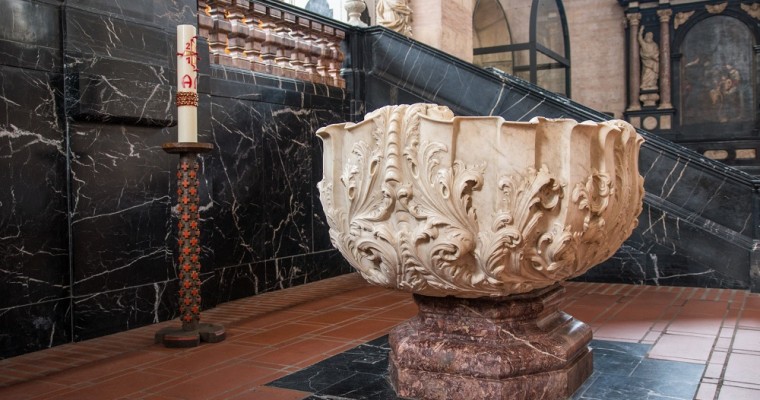
Holy Water: a constant renovation of Baptism

Holy Water: a constant renovation of Baptism

Each time we get sprinkled with holy Water, dipping our fingers in a holy water font and cross ourselves, we remember our Baptism. Since we were children, they taught us that each time we enter a Church, it is important that we dip our fingers…

10 crucifixes for your home: check them out on the Holyart catalog

10 crucifixes for your home: check them out on the Holyart catalog

Keeping a crucifix in your home. A choice for many, a duty and a need for a Christian. Symbol of Jesus’ sacrifice, it keeps Evil in all of its shapes away and reminds us about the love of God in every moment. The crucifix (also…

What are votive lights for?

What are votive lights for?

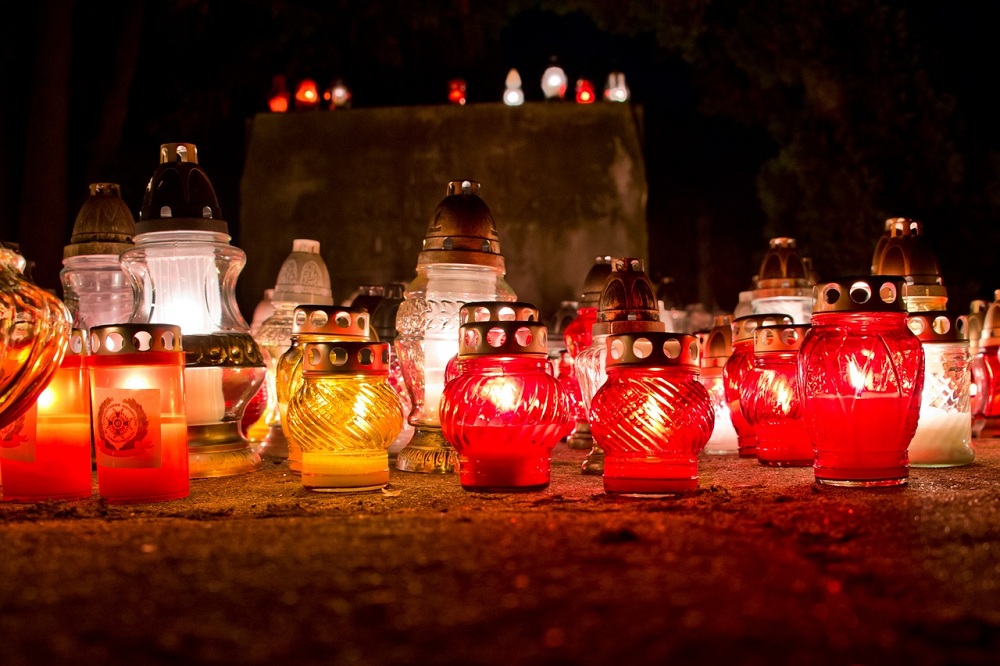
Votive candles on gravestones brighten the too dark nights of cemeteries. They are like throbbing sentinels, small fragments of light drawing the path towards the light for our beloved deceased. Here is why they are so important.

The cult of the dead has always been an important element in all civilizations. According to traditions and beliefs, giving homage to the deceased was a way to help them in their passage from life to the Elsewhere, but also a guarantee for those staying that they should not fear their revenge.

Within the Christian religion, visiting someone dear’s grave bringing flowers and praying, or talking to them, is somehow of comfort and consolation. In this ritual, perpetrated since the beginning of time, it is also a habit to light up votive candles and lights on the tombs. A very ancient tradition, already practiced by the Romans, the Etruscans before them, and even earlier, by Egyptians and Greeks. All of those people used candles for funerary rituals. It is not hard to understand why. In any culture, light has always been a beneficial symbol, tied to the victory of good over evil, life over death. The light of the fire used to protect the first men looking for shelter in the caverns; it was the only glimmer of hope against the dark of night and all of its hidden dangers. What context is then more appropriate to remind us of how fragile, how exposed to that darkness on all sides we are, if not the passing of someone we love? It is very likely that those same men who looked for shelter around a fire, also used to light flames to protect the dead corpses from night predators. A gesture of protection against darkness and demons, which got through to us in the shape of votive candles to protect our beloved deceased.

Why lighting up a candle in church
Why lighting up a candle in church?

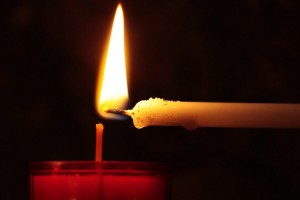
We can light up a votive candle to keep darkness away, but also to give a guidance to those who just passed away, as some sort of reference point. Just like a beacon in the darkest of nights, a candle lit by someone who loved the deceased will be able to brighten his path towards their new celestial home. Protection and guidance are then the main roles of votive candles in our cemeteries.

However, there is more to that. Keeping a light on the grave of someone that left us is the same as constantly praying for them, joining and helping them in their path towards heaven. Within the light of a burning candle, which feeds on its same wax, we acknowledge the human life slowly blowing out, becoming weaker and weaker, and destined to extinguish. More, some beliefs say that only when all candles lit for the deceased are out, he or she has reached the afterlife.

How can we make sure our beloved deceased will never be left in darkness?

Votive candles
Electric candles: when a cult loses its sacredness

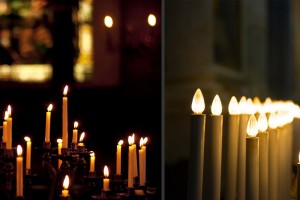
Electric lights come to our rescue. A bit less suggestive compared to actual candles maybe, but they have many undeniable pros, especially in terms of duration and efficiency, but also because they do not require excessive maintenance. Plus, since no combustion is involved, they are less polluting and wax does not drip around risking possible damages to the gravestone. There are many types: battery votive lights, led votive lights, electric candles, and they all have a much longer duration than any actual candle, so that they can guarantee the necessary and continuous lighting to those who need it. More and more often, votive lights on gravestones are the lighting in cemeteries. We must not think though that electric or battery lights for cemeteries are less worthy than the classic candles. The intention is the same, and with it, the meaning we wish to give to their lighting. In stores, we can find votive lights of any size, and electric, led and miscellaneous ones. In our online store as well, you can find a wide variety of traditional and battery lights, of many shapes and colors, simple or decorated with sacred images.

Rain-shelter votive candle
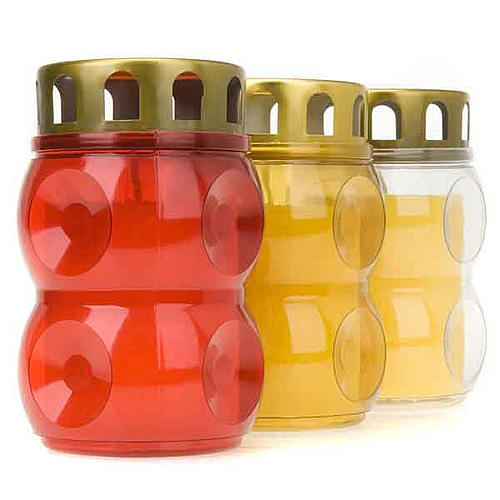
Wax votive candle with original coloured lamp. This candle lasts 38 hours. Available in three colours: Transparent; Amber; Red. Choose the desired colour.
Buy on Holyart
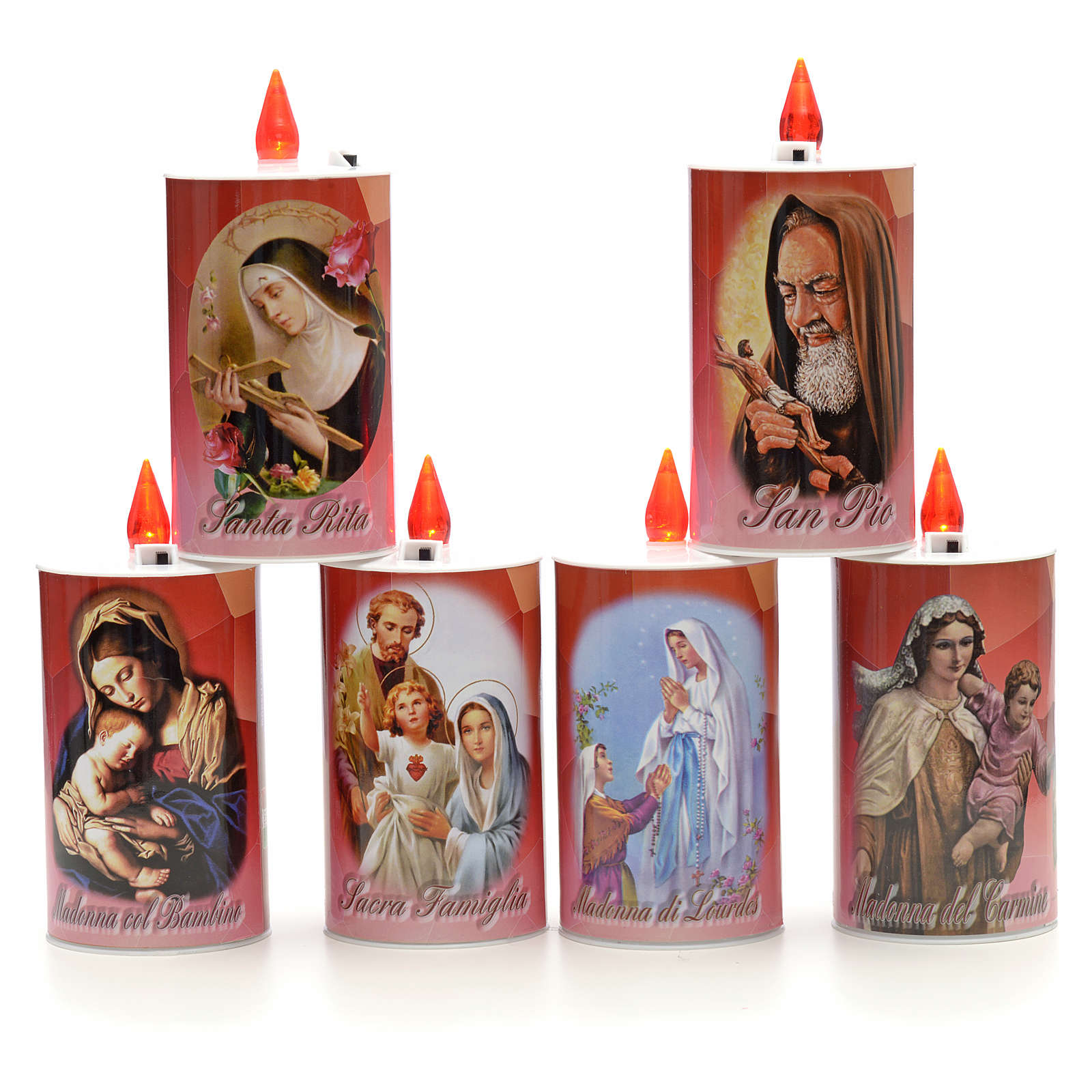
LED votive candle, red cardboard with image, lasting 70 days
LED ecological votive candle in red plastic-coated cardboard (disposable). This candle is guaranteed to last 70 days. These electric candles are available with different images on the back.
Buy on Holyart
Votive candle
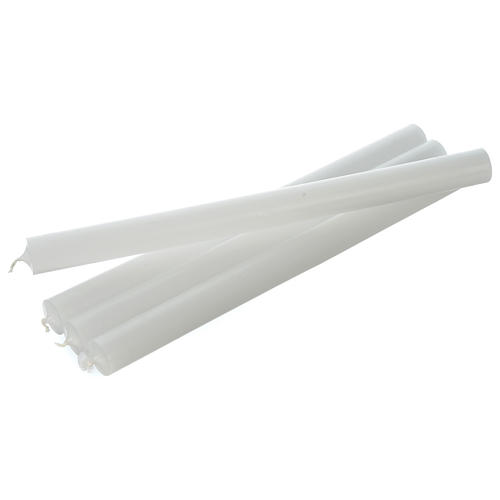
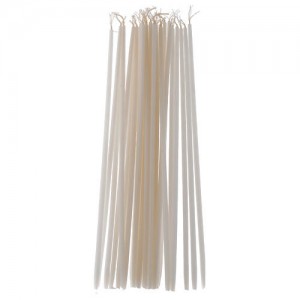
White Taper Votive Candles 350x26 mm (55 pieces), round shaped. The package of 55 votive candles are made out of white wax. Ideal for liturgical or domestic use. Flame duration: 23 hours.
Buy on Holyart
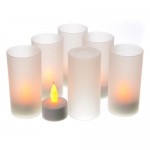
Tea light votive candles, rechargeable LED light, 6 pcs
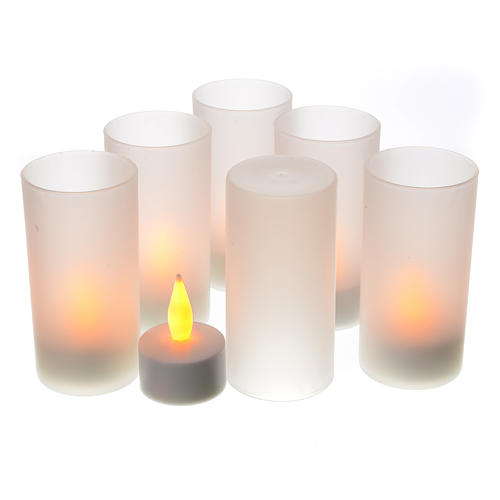
Tea light votive candles, rechargeable, flickering LED light, yellow colour, 6 pieces. LED votive candles in PVC cups, rechargeable with a charging dock powered with electricity. These lights are suitable for indoor use, the last for 8 hours and they need charging for 6 hours. Each candle has an ON/OFF switch.
Buy on Holyart
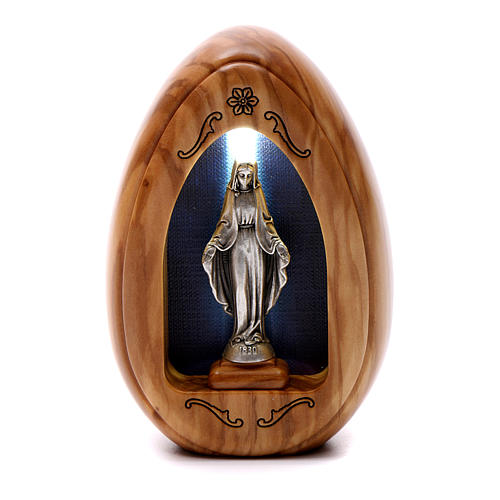
Our Lady of Miracles olive wood candle with led
Our Lady of Miracles olive wood candle with led 10X7 cm Oval candle in light olive wood, with Our Lady of Miracles statue made of silver metal inside. The led candle works with BATTERIES and has black ornamental details carved on the wood under the statue. The candle's light can be switched on through the lever on the back.
Buy on Holyart

Habits and traditions

We already mentioned how the habit of lighting votive lights and candles to accompany the passing of a beloved one has taken peculiar aspects throughout time and according to the various countries. In Germany, they think that only when the lit votive candle is completely out, the deceased has finally reached his last home. For the same reason, the body was left inside the home until that happened, to make sure it was safe until it found its peace. It was also common to take the candle off the hands of the deceased and have the youngest member of the family put it out. Votive candles were not only used to light the path of the deceased, but also to make sure rats would not come up and eat his or her eyes!

In Spain, votive candles must be kept lit in the burial place for a whole year, in order to allow the deceased the time to complete his or her journey. Taking care of it is a duty of the relatives. In Aragon, when someone dies, the relatives collect a hand-embroidered napkin and as many candles as the number of deceased in the last three generations of the family, and place them all in a wicker basket.

In France, the candles blessed during Candlemas are used as votive candles. They must be never put out with fingers, or that might burn the wings of the soul of the deceased.

In Romania, candles are made of bees wax and are called toiag, ‘cane’, meaning the cane that will help the deceased in his journey as support and weapon. When someone dies, the body is measured up with a hemp or cotton thread covered in pure wax. The waxed rope that comes as a result is placed on the grave; for forty consecutive mornings, a woman goes there and burns a little piece of it. At the end of the forty days, all that’s left is burned. It is believed that, by doing so, the deceased turns into light.

Sacred party favors: the ultimate guide

Sacred party favors: the ultimate guide

Christening, First Communion, Confirmation, Marriage. Unique and unrepeatable occasions that mark humankind history, but also spiritual events that belong to every Christian. Let’s find out why it is better to choose a sacred party favor for those ceremonies Party favors are an essential element during…

Amen Collection: when faith meets fashion

Amen Collection: when faith meets fashion

It is not easy to combine faith and fashion. The two concepts could look out of place if put one next to the other. What has faith, the largest expression of spirituality and inner dialog between man and God, to do with something so superficial,…

Metal or olive wood? Check out Holyart chalices, pyxes and patens.

Metal or olive wood? Check out Holyart chalices, pyxes and patens.

Chalices, pyxes and patens. In short: sacred objects.

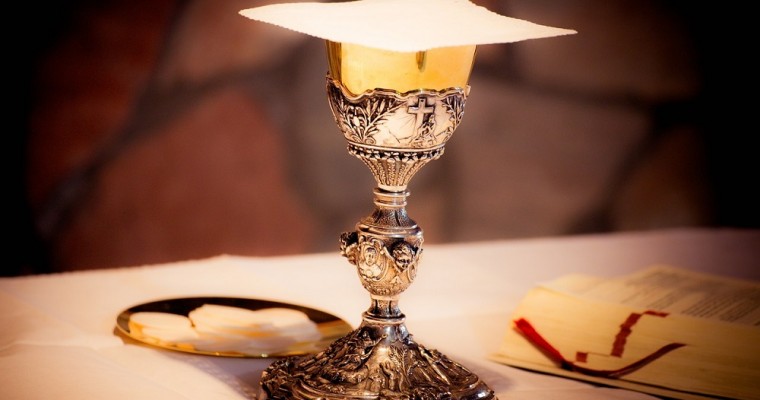
They have always been fundamental elements of Liturgy, and have evolved throughout centuries but never essentially changed their primary concept: storing Christ’s body and blood in a worthy way.

There are specific rules that define the use of sacred objects. Most of all, there are rules that define the material they must be made of. It seems trivial at first sight. After all, we have no idea what material the cup Jesus offered his own blood during the last supper was made of. It was probably a simple wooden or terracotta mug, but since the very first ceremonies carried out by Christian ministers at the beginning of liturgy, and even during the terrible persecutions that forced Christians to hide for centuries, it was established that the vessels that were meant to contain liturgical elements should be made of precious materials.

The reason behind this choice had needed no explanations: given the importance of their content, its inestimable and sacred value, it was obvious that the container needed to be good enough. Any Christian would consider putting Our Lord’s body and blood in an unworthy cup as debasing. Since when the cult was secret and consumed in basements and catacombs to escape from persecutions, it is a proven fact that they used precious vessels, much above the possibilities of those faithful gathering around them. Only the best was worthy of Jesus.

However, there was a bit of confusion on what materials should be right or not for the purpose for a long time. This matter was at the center of debates and controversies, to which the Congregation for the Divine Cult and the Discipline of Sacraments tried to put an end through the instruction “Redemptionis sacramentum”. What is that? It is an official document, which defines what necessarily needs to be done and what needs to be avoided concerning the Most Holy Eucharist. In chapter V, “Certain Other Matters concerning the Eucharist”, besides specifying the right place for the celebration of a Holy Mass (par. 108-109), various circumstances concerning the holy Mass (par. 110-116) and liturgical vestures (par. 121-128), the instructions lingers on sacred vessels (par. 117-120). About them, it is written that they must be blessed by the Priest according to the rituals described in liturgical books before they are used, and that the Priest, after distributing the Communion, must go back to the altar and perform the purification of paten or pyx above the chalice, which will be later dried with the purificator. Such operation can happen even after the assembly of the faithful has left the Church.

At paragraph 117, the ‘Redemptionis sacramentum’ lingers on the materials sacred objects should be made of. Here are the exact words:

[117.] Sacred vessels for containing the Body and Blood of the Lord must be made in strict conformity with the norms of tradition and of the liturgical books. The Bishops’ Conferences have the faculty to decide whether it is appropriate, once their decisions have been given the recognition by the Apostolic See, for sacred vessels to be made of other solid materials as well. It is strictly required, however, that such materials be truly noble in the common estimation within a given region, so that honor will be given to the Lord by their use, and all risk of diminishing the doctrine of the Real Presence of Christ in the Eucharistic species in the eyes of the faithful will be avoided. Reprobated, therefore, is any practice of using for the celebration of Mass common vessels, or others lacking in quality, or devoid of all artistic merit or which are mere containers, as also other vessels made from glass, earthenware, clay, or other materials that break easily. This norm is to be applied even as regards metals and other materials that easily rust or deteriorate.

Such specific indications forbid the use of sacred vessels in glass or ceramic, materials that can look beautiful and well handcrafted, but are also too fragile to contain something so precious. The use of ‘noble’ materials, that is, precious metals, is instead encouraged.

The Roman Missal General Instruction further specifies in chapter III that the sacred vessels must be made, if possible, of noble metal or, if the metal is less noble than gold or is subject to rust, they must be gilded at least on the inside (par. 328)

According to the judgement of the Episcopal Conference, in some cases also sacred vessels made of other solid and noble materials such as ebony or other hard woods can be used, provided that they do not break or deteriorate easily (par. 329); if they are meant to contain Christ’s blood, they must me made of a nonabsorbent material (par. 330).

Holyart catalog offers a wide variety of sacred objects, suitable for any ceremony and occasion, in different price ranges. In our online store, you will find metal chalices, pyxes and patens of different shapes and sizes for liturgical celebrations. Some are in silver-plated or gilded metal, more elegant and precious, decorated with the filigree technique. There is also a wide choice of steel chalices, pyxes and patens, silver, and even bronze and brass.

You can find traditional models from Molina as well as modern and contemporary ones from Forma Fluens. You can also find accessories for Holyart metal chalices, pyxes and patens, such as the chalice holder or pyx holder chest, a rotatable Plexiglas lid for pyxes and a red chalice holder bag.

About chalices, as we mentioned, you can find them of any kind, classical and modern. For example, the Molina Chalice in gilded brass with silver-plated medals depicting Jesus, Saint Joseph and Mary.

The Spanish firm Molina, which boosts a ten-year experience in manufacturing high quality liturgical objects, is the producer. It is entirely handcrafted, with professional machinery, then refined by the highly specialized hands of their staff. It is a model with baroque lines, recalling a classical concept of Eucharistic chalice. On a completely different level is the Ventus chalice for masses, made of gilded metal with a hand-wrought and textured central body. Lines are soft and elegant; the design, studied by a team of architects and designers, is post-conciliar contemporary, perfect to reinterpret church sacred objects in a modern key. About modern Eucharistic chalices, Holyart proposes the ‘Forma Fluens’ Drop chalice. Forma Fluens is a line of liturgical products with a contemporary post-conciliar design, thought for an innovative dimension of church sacred objects. The design is original, and has bas-relief drops around the edge of the chalice.

Even the pyx, the liturgical object meant to store consecrated hosts after the Eucharist celebration, has many different design options in Holyart catalog: from the classical and traditional lines of the golden pyx with striped knot, made of gilded smooth brass with silver-plated knot, to the Ciborium design metal pyx, result of strict studies on shapes and proportions, with a double finishing: a shiny finishing on the cup and a satinized finishing on the base. It also has a solid silver knob and a titanium disc.
Alternatively, more, the sumptuous Molina St. Remy pyx with silver 925 cup, handmade, recalling the style of the XII century chalice stored in the Cathedral of Reims (France). The external cup and base are hand-chiseled and show pictures of arches. Thirty-two natural mounted stones (amethyst, lapis lazuli, aventurine and garnet) ornate the pyx, which is decorated with cloisonné-fired enamel. The St. Remy pyx exquisitely combines beauty, quality and dignity in its design. Each part is handmade according to the purest techniques passed on by medieval jewelers and combined with the most modern gilding systems, in order to guarantee that each piece pay tribute to the original work and become a work of art that will raise its value with time.

The paten

the paten
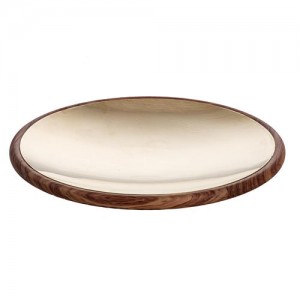
Paten in metal and rose wood, Essentia model

The paten is the plate or bowl used to cover the chalice and to store the host, before and after its consecration. Holyart offers many models; many of them are available with coordinated chalice and pyx. Let’s see for example the silver-plated and rosewood paten, Essentia model, simple and essential, but very elegant. Rosewood is worked in a particular way, since it is very hard to find pieces that are big enough to allow the creation of a paten with only one piece. They are cut into wedges and then worked together. The particular working of this paten makes every piece unique. Behind this decor as well, there is the study and work of architects and designers, constantly looking for a noble simplicity and sumptuousness at the same time. On a whole different level, we have the Materia paten from ‘Forma Fluens’ line, in two-tone metal, with solid but soft lines; or else, the Molina Gothic offertory paten in solid silver 925, with its elegant bas-relief depicting the four Evangelists on the knot, Christ and his twelve apostles on the cup, and Passion flower motif engraved on its base. This last paten is often sold with its matching chalice, made on special request by the Vatican as a tribute to His Holiness John Paul II for the commemoration of the fiftieth anniversary of his priesthood.

Chalices, pyxes and patens in olive wood

Holyart offers also a wide choice of sacred objects in olive wood from the Holy Land, very beautiful and simple. Olive wood has special properties that make every piece special. In fact, the wood veining are always different, as its color, which can range from ‘blond’ to ‘reddish’. The shape itself of sacred vessels in olive wood can undergo small variations according to the characteristics if the wood that is being worked. That makes each piece, even if it is made in many copies, unique.

Holyart catalog includes the very basic chalice in olive wood from the Holy Land, handmade by artisans in Bethlehem, but it is not suitable for liturgical use as it lacks an internal gilding. Alternatively, the more refined Chalice in aged olive wood from Assisi with IHS writing, entirely handmade by artisans from Umbria; the wonderful veining of aged olive wood and the quality of metals used for the cup gilding make it a real masterpiece.

About patens, here is the paten in olive wood from Jerusalem, handmade by artisans in Bethlehem (Holy Land), very simple and nice, available also with the inside in gilded brass.

About pyxes, Holyart offers for example the beautiful short pyx in olive from Bethlehem, made by Palestinian artisans from Jerusalem with local wood. The veining of the pyx can differ from one piece to another since each piece is unique, and they even change according to the features of the wood that is being worked.


Religious wrist cufflinks: the ultimate guide

Religious wrist cufflinks: the ultimate guide

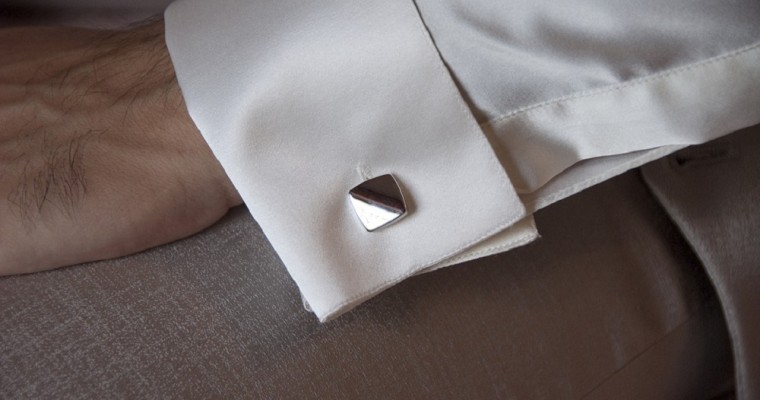
Wrist cufflinks are elegant and refined accessories, which are only apparently old-fashioned. Both men and women can wear them, and they can turn into small unique and precious jewels, able to emphasize the personality of those wearing them. Let’s find out how they are made,…

Clergy clothing: the simple elegance of the clergyman

Clergy clothing: the simple elegance of the clergyman

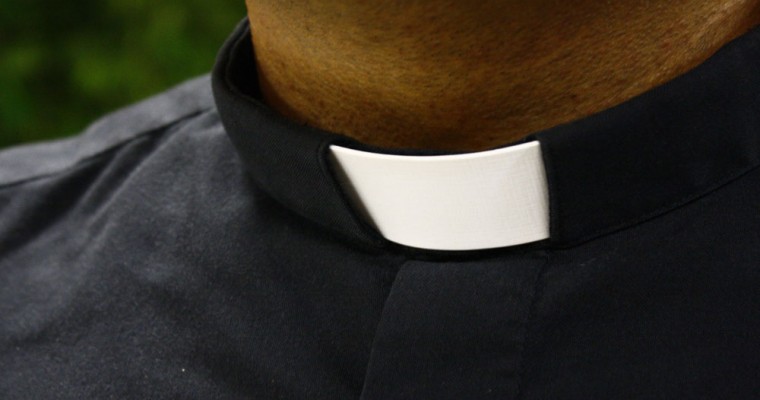
Simple and sober: this is what we expect a priest to look like. Practical clothes that let people can immediately identify them for what they are and the role they have. What defines clergy clothing today? What is the most appropriate clothing for a modern…

Footwear for clergy: how to walk comfortably on the path of faith

Footwear for clergy: how to walk comfortably on the path of faith

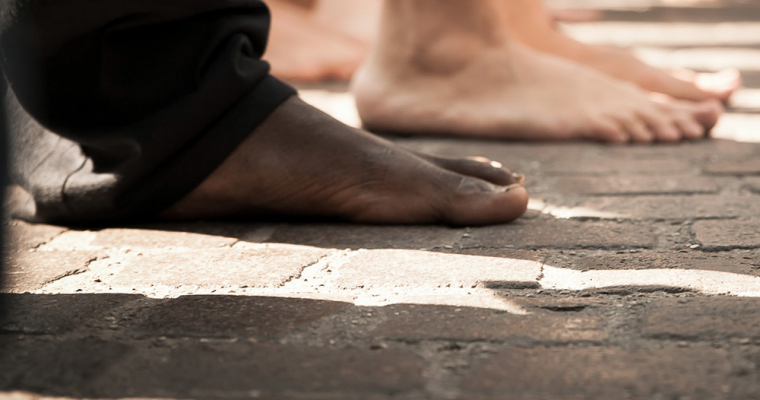
We can easily recognize priests and friars by the clothes they wear: the priest shirt and the friar tunic. Clergy clothing has its own rules and meaning, but footwear is also important. Let’s find out something more about that.

An article dedicated to clergy footwear can seem uncommon, but it’s not. We are not going to talk about fashion, but about a lifestyle embraced by those men who chose a life consecrated to Faith and, with it, to simplicity and frugality. Nevertheless, these men need to walk in order to spread Christ’s message throughout the world, to help those faithful that look up to them as point of reference. Therefore, we should not underestimate the importance of their footwear, which is in the end just as important as their clothes are.

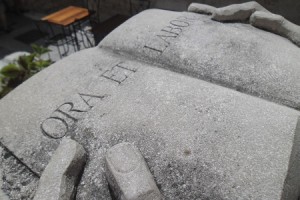
ora et labora en
Priest, friar and monk: three words that are often convoluted

We already mentioned how the concepts of simplicity and poverty were important for those embracing a religious life. In particular, we lingered on the differences between priest, friar and monk, three often convoluted words. About monks, we said they were men tired of all the violence and evil of their times, who chose to look for comfort in faith embracing an ascetic and lonely lifestyle, dedicating their lives only to prayer and contemplation. About friars, they dedicated their lives to imitate Jesus’ life, living in poverty, chastity and obedience.

Poverty in particular was the first duty imposed to those who wanted to become friars, and the consequent sacrifice of any property. Friars used to live like brothers, only relying on donations and offertory, in an environment of brotherhood and communion among them and with the people who helped them. Just think of Franciscan or Capuchin monks, and their choice to live a simple and poor life, consecrated to contemplation, prayer and preaching the Word of God.

The poor and humble lifestyle of monks and friars reflected into a modest clothing, with simple robes and only sandals to protect their feet; and so it is still today for modern friars.

The order they belong to (Franciscan, Benedictine, etc.) determines the differences in clothing. In general, religious clothing include an ankle-length tunic, its color depending on the institute of belonging: black, white, brown, but also blue, grey and light blue. Benedictine, Dominican and Augustinian friars tie their tunic at the height of their waist with a leather belt, while Jesuits and Carthusian monks wear a fabric belt.

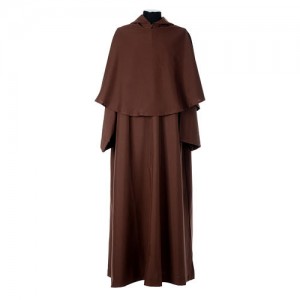
clothing of Franciscan friars
Discover our category of liturgical clothing and altar cloths

The clothing of Franciscan friars is very particular. They wear the typical brown robes tied to their waist with a cincture, a rope tied in three knots representing Poverty, Chastity and Obedience, the three rules of the Order. They wear open sandals to their feet. The choice of a brown tunic comes from the fact that, at the beginning, poor clothes were not colored and kept the color of raw wool they were made of. Brown then, or grey. They were also the colors of soil, worn by farmers and by those who worked hard. We must keep in mind that Franciscan friars spent a lot of time travelling to spread comfort and relief to those in need. Brown or grey clothes were harder to stain even if they were forced to sleep rough. Francis chose the simplest robe possible for him and his brothers, which reminded a cross for its shape. He chose a rough, ungraceful fabric to mortify flesh, so that no one could ever envy it. He gave up a belt in favor of a rope, in order to be as close as possible to Jesus and his disciples.

Even Franciscan friars, like Padre Pio, tie their tunic at waist height with a rope, and are characterized by the long and uncultivated beard and the typical light brown tunic with a big hood. Sometimes they wear a scapular over their tunic (for example as Carmelites, Carthusians and Benedictines do): it is composed of a hood, typical of monastic and mendicant orders, and a cloak. However, today many religious men prefer wearing more simple clothes for everyday use. If we think about clothes or shirts for priests, the first image we have is a clergyman, or if anything, a cassock.

Let’s get to sandals.

sandals
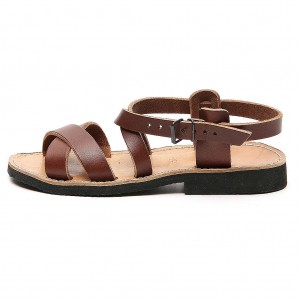
Franciscan Sandals in leather, model Sinaia

Sandals are probably the first footwear ever invented by men. Since the Stone Age, men used to protect their feet with leaves and vegetal fibers, and such rudimentary protections were the ancestors of the first sandals. About four thousand years before Christ’s birth, Egyptians made sandals with braided papyrus leaves. In Greece, they were made of leather, with a sole and some stripes to tie them to the foot, and so was in Rome as well. During medieval age, people began preferring closed shoes, because showing the bare foot was considered a bad form. Mendicant orders chose sandals, simple and humble footwear par excellence, as fundamental component of their poor clothing. They were very rough sandals, with simple leather or even wooden soles, tied to their feet with leather strips. Saint Francis preferred to go barefoot, but not all of his brothers could show his same endurance while walking on arduous paths. It was very hard to give up protecting their feet from the cold and the asperity of the ground. Those who wanted to join the Order, but could not walk barefoot, were allowed to wear simple sandals. Since then, sandals remained the footwear par excellence of friars, the only one tolerated as an alternative to bare feet; they are a symbol of mortification and will to join Our Lord’s existential choices as much as possible, and to consecrate their lives to humbleness, poverty and sacrifice.

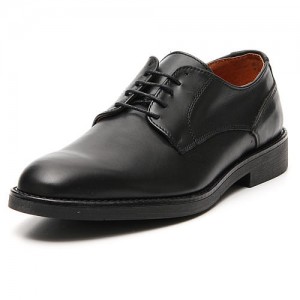
About clergy footwear, Holyart catalog offers a wide variety of shoes and sandals. In particular, Holyart shoes are made of real leather, made in Italy by a firm specialized in clothing and footwear for priests and clergy. The shoe is crafted with attention and precision, paying the utmost care to treatment and working of leather, keeping all of its properties intact.

Shoes in opaque real black leather

Franciscan and Benedictine sandals by Holyart are handmade by the Monks of the Atelier de l’Etoile, in the monastery of Bethlehem (France). They are of great value and high quality, made of real leather. Leather is handcrafted and shaped; then it is sewn to the sole with a 100% warranty of being an artisanal product.

The halo: origins and meaning

The halo: origins and meaning

Symbol of light and grace given directly by God, the Saints halo expresses their bliss status and the divine majesty they are appointed with. The saints halo, the nimbus, the vesica piscis (or almond). The irradiating light has been present in art illustrations since very…

5 sacred objects that cannot miss in our homes

5 sacred objects that cannot miss in our homes

Crucifixes, sacred pictures, icons, statues. Objects we keep in our homes to remind us we live in the grace of Baptism and in the love of God at any time. A crucifix, a religious picture, an icon of the Holy Family, a statue of the…

7 types of religious bracelets to wear with style

7 types of religious bracelets to wear with style

Religious bracelets tell us a different way to live our Faith. Fancy jewels, precious metals, but most of all symbols that we can always carry with us.

Jewels. Symbols of vanity, born to ornate, embellish, with no other purpose. It’s not always like that.
Rosary rings and religious bracelets tell us a very different story.

We’ll talk here about religious bracelets. But how? It is often hard to connect the idea of faith with a jewel. Probably that’s because when we think of a jewel, the first thing that pops into our mind is an object of vanity, an ornament made to embellish and decorate our body, with no use for the spirit. It is surely true that the Church, especially in the past, used to show off precious treasures, decors of undeniable magnificence, ornaments of gold, silver and precious stones. This is not the place to debate about historical and social reasons behind this ostentation. What we would like to talk about here is how a jewel, whether a necklace, a ring or a bracelet, can have the double role of ornament and devotional object, stimulating and helping during prayers. They are not just jewels, of course, but they are object that are created with the specific goal to inspire the faithful and join them in their moments of daily meditation and prayer, and to give them the feeling they can see and touch something useful to encourage their concentration and faith. The most blatant example is the Rosary crown. Whether it is a necklace, a bracelet or a prayer ring, this is an instrument of devotion that helps the faithful recite the prayers that compose the Rosary with its grains or the bumps in a ring.

There are many types of religious bracelets. Holyart has seven in its catalog, and offers bracelets that are suitable for different occasions and uses, from the devotional object to the gift idea for a very special occasion.

  • Rosary spring bracelets
  • AMEN bracelets
  • Decade bracelets
  • Silver bracelets
  • Multi-image wooden bracelets
  • Multi-image metal bracelets
  • Various bracelets

Let’s get into details

Rosary spring bracelets

Spring rosary bracelets

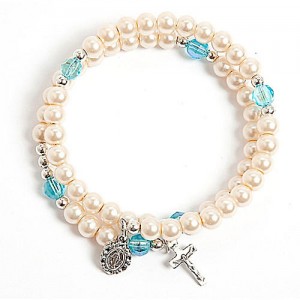
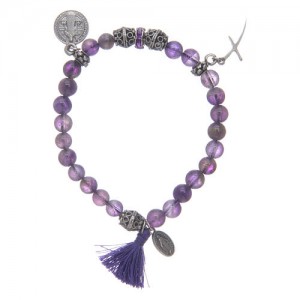
The spring bracelet is a cheap rosary bracelet. It is simple, made of elastic threads along which small glass, or plastic, beads are inserted. There are also more expensive versions, where precious stones or materials replace glass beads. The spring bracelet can be worn on any occasion. It is surely appropriate for young girls, but it looks good on anyone. Holyart offers a wide variety or spring rosary bracelets made with cut glass beads and finished with aurora borealis, a type of finishing made of transparent resin and luminescent pigments that catch sunlight during the day and reflect it later, creating a visual effect that resembles the aurora borealis indeed. In the catalog, you can find spring rosary bracelets of various colors, all adorned with a small pendant cross and a medal depicting the Miraculous Virgin, Our Lady of Medjugorje or other sacred images, depending on the chosen model. Many of the spring rosary bracelets by Holyart are unique pieces, all handmade; some are classic and vintage, such as the model made of fake pearl beads, a small pendant cross and a medal of the Miraculous Virgin. Some others are very modern and fancy, such as the one made of small anthracite gray cubes and dark gray beads, with a medal of Our Lady of Medjugorje.

AMEN bracelets

AMEN bracelets
AMEN bracelets

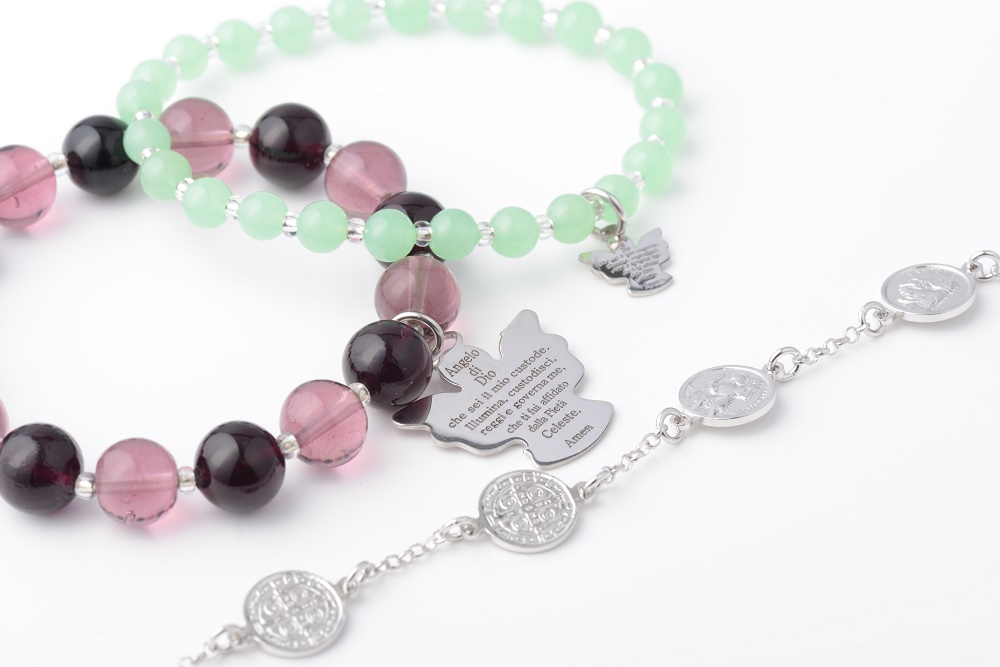
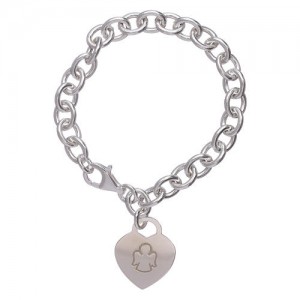
AMEN jewels tell us about faith through simple and elegant lines. They are a refined collection of rosaries, rings and bracelets with embossed words of faith, such as our beloved prayers Our Father, Hail Mary or Angel of God. All jewels are made in Italy with selected precious metals and nontoxic materials. These jewels can be worn every day, and are suitable for any occasion: a way to carry a tangible sign of our devotion with elegance. In particular, the collection of AMEN religious bracelets offers a wide variety of shapes and materials. For example, golden, silver or bronze bracelets, with engraved famous prayers or suggestive passages from the Bible, such as the wonderful OUR FATHER bracelet, made of pink bronze with the Latin words of the Our Father embossed. Or the Slave AMEN Bracelet, in silver 925 with pink finishing and an embossed passage from the Song of Songs. The bracelet shows the sentence: “Put me as a sign on your heart, as a sign on your arm; Love is strong as Death“. There are also lighter and simpler models, such as the pretty bracelets of beads and medals shaped as little angels or as Madonna. You can find original AMEN religious bracelets, such as the Shamballa AMEN bracelet of Saint Rita with Purple finishing, made of cord and steel medals, or the beautiful Our Father AMEN bracelets, available in many colors, all made of vegetal tanning leather with Italian Our Father words engraved on. It has a magnetic closure in hypoallergenic Steel 316L, is nickel free, cadmium and lead free, with the possibility to have electrolytic nickel free rhodium/golden plates . Fun and informal, the AMEN bracelets in rubber come in various colors, with magnetic closure in hypoallergenic steel 316L.

Decade bracelets

Decade bracelets
Single decade rosary bracelets

Even the Holyart decade Bracelets offer a wide variety of shapes, materials and colors. Like the rosary bracelets, they can help recite prayers with their grains, their small knots in the cord, and all those elements that recall each of the passages. We remind you that the whole Rosary is made of 20 decades, or ‘Mysteries’, divided into four different parts, each of them composed of 5 decades. In order to recite a whole Rosary, you need to recite all 20 Mysteries in a row or divided throughout the day, that is, all 20 decades. Each decade is made of 1 Our Father, 10 Hail Mary and 1 Glory.

The decade Bracelets are most of all beautiful to look at and to wear, they are colorful and modern, and are therefore appropriate for children and young people, simple and suitable for any occasion. For example, the adjustable Bracelet made of painted cord, with olive wood beads and metal roses, and a medal of Our Lady of Medjugorje is so fresh and pretty that you can wear it every day. Even the 3-rounds Rosary bracelet with 6 mm olive wood grains and elements in turquoise stone, enriched by a modern-looking metal cross is particularly suited for young people who wish to wear their faith but being trendy at the same time.

Silver bracelets

Silver bracelets
Silver bracelets

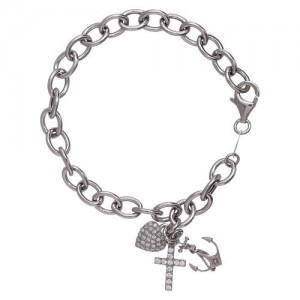
In the Holyart catalog we can also find many bracelets with silver inserts and elements. Precious jewels enriched with hard stones, brilliants or Swarovski crystals. Many of the Holyart silver religious bracelets are handmade by Italian goldsmith masters, they are particular and elegant, to wear or to give. In this line we can find many religious bracelets for men, such as the one in real black leather with SILVER 925 decorations made with the technique of lost wax precision casting with artisanal hand finishing. Or else, the Bracelet for men in rhodiated Silver 925 with 3 mm spheres, with details and trifoliate cross embellished with white rhinestones, up to a maximum circumference of 21 cm, and it is closed by a snap-hook and adjustable closure . Wood is another material that is suitable for decorations with silver inserts, as in the MATER rosary bracelet, made of wood and silver 925 decades and cross; this is suitable for men, maybe as a gift on a special occasion.


Multi-image wooden bracelets

Multi-image wooden bracelets
Multi-image wood bracelets

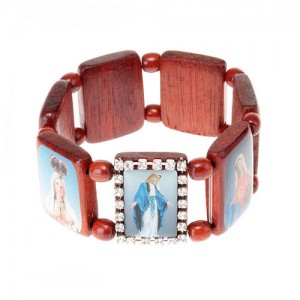
The multi-image wooden bracelets are different. What are they? They are elastic bracelets made of elastic threads with applications of various images. They are bracelets with religious symbols applied as decorations. Bracelets with wooden images are very colorful and picturesque, such as the elastic multi-image St. Anthony bracelet, made of wooden grains with applications of various images, a small low relief depicting St. Anthony with Baby Jesus, 5 different St. Anthony medals, 14 color images of the saint, a Franciscan tau. The elastic multi-image bracelet includes 20 different color images of Mary on golden medals alternating with wood grains.


Multi-image metal bracelets

Multi-image metal bracelets

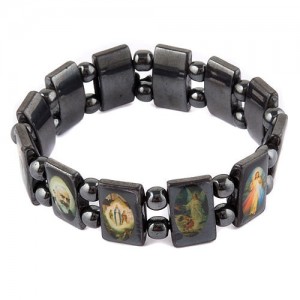
Same concept, different materials. Multi-image metal bracelets have the same pattern of wooden bracelets, but the base of the bracelet is made of metal or crystal beads. The most used metal is hematite, as we can see in this elastic bracelet with a double thread of grains in real shiny and glossy hematite on a plaque, where a big image of Mary, four small ones, and rhinestones are mounted. Other materials are perfect for this kind of working as well, as we can see in this bracelet with silver metal mesh and two color images in the center, one of the Virgin Mary and one of the Holy Heart of Jesus, surrounded with small rhinestones.


Various bracelets

Various bracelets
Various bracelets

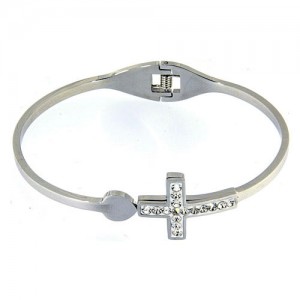
Holyart offers a wide variety of bracelets, of different types and materials, many of them are made of precious or semi-precious metals and hard stones, such as amethyst, lapis lazuli, agate and tiger eye. Other bracelets are made of leather, decorated with Swarovski crystals, or with the embossed Our Father or Hail Mary all around, steel magnetic closure shaped as a cross. The bracelets made of amethyst or lapis lazuli with 6 mm diameters grains are very elegant and refined, made of cord with non-allergic steel button. They are true rosary bracelets, made of 5 decades with relative pater, exactly like the traditional rosaries, and a satiny and rhodiated Miraculous Medal in silver 925.

The Priest Chalice: a short guide to a conscious choice

The Priest Chalice: a short guide to a conscious choice

The Priest Chalice, the vase that contains Christ’s Blood during a Mass. Symbol of communion between God and men, of the salvation incarnated in Jesus. The chalice is the sacred vase containing the wine that turns into Christ’s Blood during Eucharist. It symbolizes the chalice…

10 blessings we need to know

10 blessings we need to know

Contents1 The Papal Blessing (apostolic blessing)2 Urbi et Orbi blessing3 Eucharistic blessing4 Padre Pio blessing5 Saint Francis blessing6 The nuptial blessing7 Blessing of animals8 The blessing of Homes9 The Irish blessing10 The Easter blessing Blessings we should know, some are famous, some others are curious.…

Garden statues: how to choose your outside religious garden statue

Garden statues: how to choose your outside religious garden statue

Garden statues, an ancient but yet current tradition. Enrich your garden with garden statues depicting sacred subjects, made of resin, wood, stone and marble

Decorate your garden with outside statues. How to choose the most appropriate garden statues for your taste and inclination.
An old-fashioned trend? No, definitely not.

The taste for exterior design is extremely current, carried out by the best and most famous architects, defined by precise standards and constantly evolving. The trend of decorating gardens and outside spaces, even with statues, dates back to the birth of the garden as extension of the house itself, or, in some civilizations, of the temple. In both cases, beyond the practical use of exterior and green areas, in particular the cultivation of plants, vegetables and fruit, the garden has always been intended as a place that could convey peace and pleasure to those living it.

The first proof of an ornamental garden dates back to 3000 B.C. in the Sumer culture, but also Egyptians had already been practicing gardening activities by then, and in 1500 B.C., they used to depict marvelous gardens adorning palaces and temples of their towns in their wall paintings. Exactly from Egypt, and in particular from the famous Tolomeo’s gardens in Alexandria, the Romans imported their taste for decoration of gardens and porches of their villas. Roman gardens embellished patrician homes and were places of peace and tranquility, connected to the inside of the house by porches decorated with friezes and statues. Besides Egyptian gardening techniques, Roman gardens took inspiration mostly from Persians, and most of all from Greek gardens; they took the sacred and symbolical dimension from them. In fact, Greek gardens were considered as an appendix of the temple, a place where they enjoyed spending time. Not so much a leisure place then, but a miniature sacred wood where ministers grew plants and bushes that were so dear to the deity. Greek gardens were built according to a specific geometry, had fences dedicated to sports activities, and were guarded by the shadow of the trees. They even hosted tubs to collect rainwater and fruit trees, palms and grapevines. Even in Roman gardens fruit trees were preferred, or big trees such as plane trees, cypresses, oaks, holm oaks and green and evergreen bushes and plants, such as laurel, box, myrtle, acanthus, periwinkle and maidenhair. Another feature of Roman gardens was that they were embellished with garden fountains and statues depicting sacred subjects, but also chosen for essentially ornamental reasons. It was very popular to place statues of the Lares agrestes in the garden, the gods connected to farm life, but also statues depicting fauns, nymphs or Priapus, god protector of vegetable gardens. If we can recall Lares statues to the current trend of garden gnomes to some extent, it is interesting to consider that we owe the origin of the nativity scene exactly to them. In fact, during the winter solstice, Roman children were invited to place the Lares statues inside a hedge. The Italian word ‘presepio’ (nativity scene) is said to come right from ‘prae-saepere’, meaning surround with a hedge. In the centuries that followed the fall of the Roman Empire and the barbaric invasions, most of the Roman villas were torn down and the materials retrieved were used again for construction building. For what concerns garden statues and precious marbles, they will end up decorating the gardens and palaces of noble families and the highest exponents of the Roman clergy

Ancient garden Rome

During medieval age, Roman gardens were devastated and erased by barbaric invasions. They were replaced by hortus conclusus, that is, fenced garden, often appearing next to monasteries and convents. Here monks grew herbs, vegetables and fruit trees, aimed to sustenance. The fall of the Roman Empire and the loss of a big part of the cultural and architectural traditions led to start over, thanks also to a taste for decorating gardens. Soon the rediscovery of the garden moved from a religious to a lay context. Slowly even gardening techniques became popular, and even the care for fruit trees, especially citrus fruits; they came from Arabs, who in turn had taken that from Babylonians and Egyptians. To some extent, it is in this very context that the term ‘garden’ was born, from Indo-Germanic gart or hart that means ring, surround. Arab gardens were not adorned with statues, but they were rich in flowers, herbs, fountains, water games and animals, conveying a sense of harmony meant to please all senses and give a taste of Paradise.

During the Renaissance, a new concept of garden grew in Italy, the so-called Italian garden, or formal garden. It recalled the geometry subdivision of spaces of the Greek gardens, but added amazing architecture and technique. In the Italian garden, architectural elements such as fountains and statues merged with hedges and tree-lined paths, plant sculptures, water pools; they were arranged in an apparently harmonic and natural order, but that order was actually based on very strict rules and was the result of deep studies.

Even the French garden comes largely from the Italian garden, with an additional taste for symmetry and its pretension to bend nature according to formal perfection. Even in this case, a large space was dedicated to ornamental statues. The English garden, or informal garden, is completely different. Developed during the 18th century, it refuses geometric elements, while it joined natural and artificial elements, which combined, give life to wild landscapes. In the English gardens elements such as caves, streams, bushes, pagodas, pergolas, small temples and ruins are preferred instead of classic statues. A curious and charming aspect of English gardens is an unexpected evolution of the Roman Lares agrestes, the so-called ‘ornamental hermits’; they were men paid to live inside caves and caverns inside the noble owner’s garden, living indeed as hermits, and represented a curiosity to show and look at with guests.

More recently, and still today, new design waves were born next to the revival of historical gardens, addressed especially to gardens and green areas. Some elements are still present, and among them, garden statues are surely the ones with the most ancient and charming history. Even if today classic statues depicting athletes, deities, nymphs and fauns still keep their appeal, also statues depicting saints, or in general sacred statues, are very popular as well. Once again, the garden becomes a place dear to divinities, a cozy and pleasant place where it is easier to talk to our inner side, pray or meditate.

Sleeping garden angel

Features of garden statues

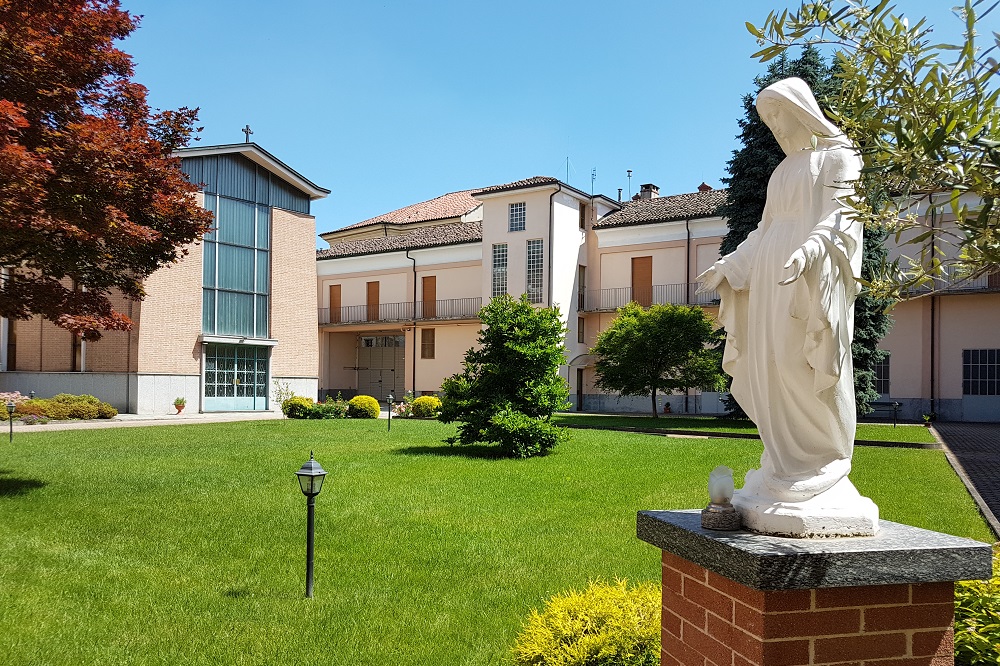
Let’s see how we can choose our outside religious statues. There are of any kind and size, suitable for any solution and style: from the outside Mary statue to garden angels statues, or even affordable garden amphora, and they can be made of stone or resin. There are statues about 10 cm tall that can decorate a green corner or a small votive cave, and very big statues up to 2 meters tall depicting the Helper Virgin or the Immaculate Virgin, or even Jesus Redemptor or the Christ resurrected. The statues depicting Our Lady of Fatima, Our Lady of Lourdes, or even Our Lady of Medjugorje are very appreciated and popular. An outside ambient is also suitable for saints’ subjects, such as Padre Pio or Saint Francis, Saint Joseph or Pope John Paul II, but there is a wide variety of images to choose from, whether big or small. Setting up a corner in our garden that can host a garden statue depicting a scared subject we particularly love can be a very comforting and enriching experience.

The materials of outside religious statues

Obviously, when we choose garden sculptures we need to take into account that they will be constantly exposed to bad weather, to sunlight, to pollution, and to all of those agents that are not inside a house. On the long run, these factors can ruin statues that are not made with appropriate materials. To create outside sculptures, materials such as marble and stone were once used, and these materials are used still today, but also concrete, marble powder and wood. Materials that are more modern are common nowadays, such as fiberglass, which is particularly light and suitable for some contexts.

outside religious statues
Outside religious statues

Holyart offers a very wide catalog of outside religious statues and sells garden statues online. In particular, the fiberglass statues are all hand-painted with oil paints, finely worked and cared in each detail. Both the molding and the finishing is carried out in Italy in a firm that boasts a long experience in the realization of sacred furniture. Since they are light, garden statues made of resin can be transported easily and can be placed outside, even if it is not recommended to keep them outside for a long time as they might lose brightness, unless they are protected with a special transparent paint. Resin garden statues are affordable, beautiful and suitable for any context.

Holyart also offers a wide variety of wooden statues representing Jesus, Mary and many Saints. Holyart wooden statues are very detailed, are available in any size and are made following different styles. Holyart wooden statues are made of olive wood coming from the Holy Land, Italian olive trees and other precious types of wood.

Moreover, Holyart catalog offers stone statues, handmade by the Atelier d’Art of Bethléem (France). They are statues made of Pyrenees stone, sometimes have resin inserts, and are an example of the French high quality monastic craft.

Particularly suited for outside areas and gardens are Holyart Carrara marble statues. They are perfect both for home gardens and cemeteries, since they are made of synthetic marble (or reconstituted marble), and rigorously handmade. They can be left natural, white or hand-painted. All Holyart marble powder statues are made in Italy with a 100% warranty of a Made in Italy product. Carrara marble powder is particularly indicated for funerary articles: ashes urns, applications and plaques for cemetery and flower vases.

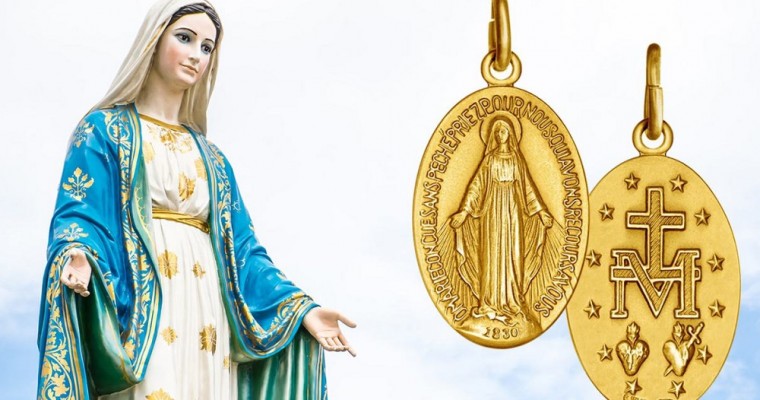
The story of the Miraculous Medal: from apparitions to the novena

The story of the Miraculous Medal: from apparitions to the novena

Contents1 The apparitions and the story of the Miraculous Medal2 The meanings of the Miraculous Medal: miraculous, shiny and painful3 The Novena to the Miraculous Medal The Miraculous Medal is a symbol of devotion and love recognized by the Catholic Church. It is a support…

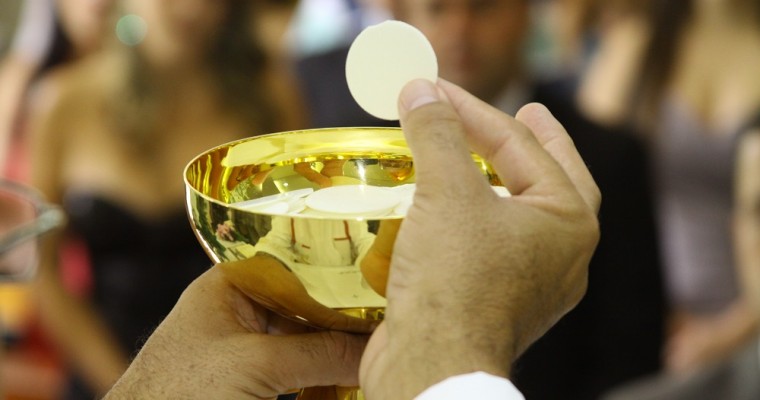
10 questions and answers about hosts and communion

10 questions and answers about hosts and communion

Can you eat the host if it falls on the floor? Should you stand or kneel down? Gluten-free hosts are effective according to the Church? 10 questions and 10 answers about Eucharist.   We will never get tired of repeating the fundamental and essential importance…

Why lighting up a candle in church?

Why lighting up a candle in church?

Lighting up a candle in church is a tangible sign of faith. From the baptism candles to votive candles, light as a symbol of love towards God.

We already talked about the importance that light has in the Christian religion sphere; furthermore, lit candles in a church are an important expression of light as manifestation of God’s love. Paschal candles, baptism candles, the candle held in the spouses’ hands during a wedding, the candles burning around a deceased’s coffin are just a few examples of the use of liturgical candles during religious celebrations.

Light as manifestation of God then, as His first manifestation since that is the first thing He created in his endless benevolence and wisdom, and with it, He made all the Creation visible. Light as symbol of Christ, who said about himself: “I am the true light”, and that for us all embodies the Light of God that brightens the world, that defies death and forces darkness to withdraw. During Baptism, the sacrament that sanctions the entrance of the new Christian into his religious life, the father or Godfather light up the Baptism candle, using the flame of the paschal candle burning on the Baptism font or altar for the occasion. That way, the child will became a son of the light, destined with his life, his actions, his faith, to feed that fire of love lit to greet his rebirth. The Paschal candle on the other side, recalls Resurrection, the new life beginning with the loss of sins, thanks to the sacrifice Jesus made for us all.

Light manifestation of God

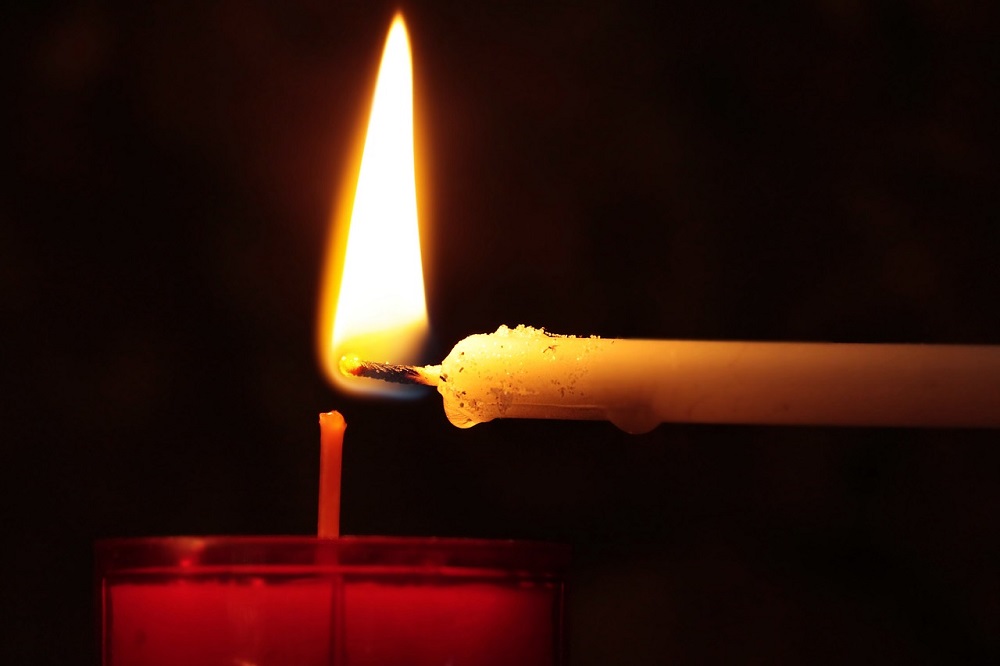
But there is also a more intimate dimension, tied to the practice of lighting up a candle in church, something that concerns every devotee and his silent dialog with God. A lit candle becomes the symbol of divine fire burning inside all of us, the expression of a flaming passion that warms us and makes us part of that Light that Jesus symbolizes, but that all Christians are part of. So, every time we buy votive candles, every time we stop to light up a candle for the Virgin Mary while going to church or to a Chapel of a Saint we feel close to, we perform an act of love towards God, Jesus and his Holy Mother. Such love, made of the vibrating fire of that small flame, but most of all made of the devotion permeating us and of the prayer we whisper while doing that, acquires an immense symbolic value. Of course, it’s not only lighting up the candle, or grabbing one of the best spots in the church sconce, maybe putting someone else’s candle out to get a privileged position! If we do that thinking about something else, with our mind wandering on what we have to do outside the church, our commitments, our thoughts, our worries, we might as well not do that. It is not one more lit flame that will make God satisfied or pleased. He created light, he surely won’t need our candle!

Non-dripping candles
White Tape Candles Non-drippings – 100 pack

All lies in the spirit we have while doing this act of devotion and faith, the meaning we give to it from the moment we buy the candle to the moment we light it up, until the moment we put it on its support. Exactly for that reason, the use of electric candles in church takes nothing away from the solemnity and sacredness of our sacrifice. Aesthetically speaking, electric candles can look a bit less evocative, but have many pros in terms of safety and cleanliness, and God appreciates them just as much as traditional candles. The same can be said for liquid wax candles, rechargeable and to some extent even safer. For those reasons, there is no need to pay too much to buy huge or extremely decorated candles. A candle as big as the Baptism candle will not grant us a bigger grace, and it will even be hard to place.

But there is more. Lighting up a candle in church, or holding one during a procession or a community ritual, has a deep unifying purpose. In such occasions, our love becomes unanimous, like a hymn sung by many joyful voices altogether. It is not just us, nor our swaying flame, but we become part of a union made of love and warmth, many fragments of light warming up in the passion of our faith, in the endlessly benevolent and shiny look of God.

More, the candle symbolizes the light of knowledge, which can guide us through the darkness. A knowledge that lies only in the word of God, the guide and light in the path of those who believe and trust Him. Ignorance and incapability to welcome this awareness doom souls to darkness and death, in which they can only wander without hope.

The candle is therefore a symbol, a mean to express our love and our devotion. It is not the purpose. It joins the life of each devotee even outside the liturgical celebration, shows the intention of prayer to Jesus, Virgin Mary, the Saints, and we can say that lighting up a candle extends the prayer, and amplifies it! It can also be a request for help, a silent plea we try to draw the attention of Someone on higher grounds with, who can help us with an encouragement or a blessing. In just one word, lighting up a candle is a tangible sign of faith, especially if it comes with an offer, which, even small, shows a personal sacrifice that only the receiver can appreciate.

There are also holidays tied to candles. If we think about Judaism, candles are lit on Friday night to celebrate the beginning of the Shabbat, or the Holiday of Hanukkah, the Holiday of Lights, when every night for eight consecutive days a candle is lit to commemorate the consecration of a new altar in the Temple of Jerusalem. In Catholic religion, we can consider Candlemas as the “holiday of candles”. It falls forty days after Christmas and recalls the presentation of Baby Jesus to the temple. It is an occasion for celebrations during which, among other things, many candles are blessed, and are later lit up to celebrate Jesus as bringer of Light, but also to celebrate the end of winter, because according to ancient farming traditions, from that moment on spring will take over.

Where can you buy votive candles for church?
You can easily find them in religious articles shops, in small shops close to churches or in baptisteries. In the last few years, the online sale of candles has become popular, and there are many e-commerce websites with a wide variety of candles of any kind: simple candles for church, Paschal candles, and even Advent candles, that have to be lit up when approaching Christmas.