In the collective imagination, the Holy Grail represents an enigma shrouded in legend—a mystical and sacred object of power that has fascinated humanity for centuries. But what lies behind this chalice? And where might it be found today?
Mentioning the Holy Grail immediately evokes legends and mysterious tales, linked on one hand to the Knights of the Round Table and on the other to esotericism and a whole genre of modern fiction and cinema that has, to varying degrees, co-opted this and other symbols of Christianity. This is because the Grail is, first and foremost, an object that connects us to Jesus, specifically to the Last Supper. It is said to be the cup from which Jesus drank, the cup He offered to His disciples, inviting them to drink His blood during the institution of the Eucharist. In this same chalice, Joseph of Arimathea—the man who collected Christ’s body after it was taken down from the Cross—is said to have preserved a few drops of blood that trickled from the wound inflicted on Jesus’s side by the Spear of Longinus. We use terms like ‘would be’ or ‘is said to be’ because everything regarding the Grail is the result of a legendhanded down through the centuries, which has grown over time to create one of history’s most fascinating enigmas.
The Grail’s journey through time is an intricate web of myth, religion, and literature that has captivated generations of scholars, writers, and mystery enthusiasts. Countless writers, poets, and artists have contributed to the evolution of this tradition, starting with medieval European legends, particularly the Arthurian Cycle. In the stories of King Arthur and his Knights of the Round Table, the Grail is recognised as the sacred cup used by Jesus at the Last Supper and subsequently brought to Britain. Specifically, in the collection of stories known as the Grail Cycle, written primarily between the 12th and 13th centuries by poets such as Chrétien de Troyes, Robert de Boron, and others, the focus is on the quest for the Grail—a symbol of sanctity and chivalry, guarded by a mysterious keeper often called the Fisher King.
There is no single version of the Grail legend. Over time, numerous theories have been proposed regarding its meaning, ranging from its interpretation as a Christian symbol of salvation to its association with ancient pagan myths and rituals. Some scholars have hypothesised that the Grail may have been inspired by ancient Celtic myths or sacred objects from other religious traditions. Others believe the Grail has historical roots and might have been based on ancient chalices or Christian relics, such as the Sacro Catino (Sacred Basin) of Genoa or the Holy Chalice of Valencia. Another tradition associates the Grail with the Knights Templar, who were said to have been its guardians for centuries.
Regardless of its origin, the Grail has always influenced Western culture, inspiring literary, artistic, and cinematic works to this day. Its enigmatic nature and symbolic meaning continue to stimulate the fantasy and imagination of millions of people worldwide.
The Legend of the Holy Grail
In ancient Celtic sagas and the mythological traditions of various cultures, there are tales featuring themes similar to those associated with the Grail. These stories often involve a hero embarking on an adventurous journey into another world—a magical realm or a dimension parallel to our own—where he faces trials and encounters mysterious figures. Frequently, during these journeys, he is sustained by a magical cup or dishthat provides inexhaustible food or possesses healing powers, symbolising spiritual nature or divine abundance. According to some scholars, the Grail may have originated in this context as the ultimate object of a search for life’s deepest meaning, wisdom, and connection with the divine. Thus, it is not just a physical object, but also—and above all—a symbol laden with spiritual and metaphysical significance. Its quest therefore becomes an inner journey in search of knowledge, transformation, and personal fulfilment, as was typical of Celtic traditions that often expressed a profound link with nature, spirituality, and ancestral wisdom.
The word “gral” or “graal” may derive from the Latin “gradalis”, which simply means “vessel”. However, after the spread of Arthurian romances—in which the cup was first associated with the one used during the Last Supper of Jesus Christ—the term’s meaning was enriched with new nuances. Notably, “san greal” (“Holy Grail”) and “sang real” (“royal blood”). These French terms generated new interpretations and meanings, increasingly linking the Grail to sanctity, spirituality, and the concept of the blood of Christ.
Even before the French romances, references appeared regarding the hypothetical chalice used by Jesus at the Last Supper in Italian texts, such as the Legenda Aurea (Golden Legend) by Jacopo da Varagine, who in 1260 recounted how the Genoese had found the mythical cup during the First Crusade. It was a Genoese leader, Guglielmo Embriaco (nicknamed Testadimaglio or ‘Mallet-head’), who fought alongside Godfrey of Bouillon to liberate Jerusalem, who recovered the Sacro Catino—a vessel carved from a brilliant, translucent green stone, still preserved today in the Treasury Museum of San Lorenzo Cathedral in Genoa.
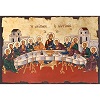
Screen-printed icon reproducing the last supper of Jesus and his apostles. The screen-printed is applied on a special wooden plate.
In the romance Perceval, le Conte du Graal, written by Chrétien de Troyes in the 12th century, a precious cup appears, guarded in the castle of the Fisher King alongside other sacred relics. At this stage, it is still a cup of abundance, like those found in ancient Celtic myths, and there is no mention of the cup from the Last Supper. The Fisher King (or Wounded King) has been punished for past sins with a terrible leg infirmity that no one can cure. As a consequence of this wound, his land has turned into a deserted and sterile place: the Waste Land (terre guaste). According to certain traditions, his legs were wounded by the Spear of Destiny—that is, the Spear of Longinus. Legend has it that only a knight can save the Fisher King, but no one succeeds. Even Parsifal, the hero of the romance, attempts in vain to break the enchantment, failing to realise that the only way to save the Fisher King is to ask him questions regarding the relics he keeps in his castle.
Subsequently, Robert de Boron wrote a romance entitled Joseph of Arimathea, in which both the Fisher King and the mysterious cup, the Grail, reappear. Here, for the first time, it is associated with the blood of Christ. In this version, the Fisher King is named Bron, a name that echoes Bran, the mythical giant king of Britain in Celtic mythology. He is described as the brother-in-law of Joseph of Arimathea, the first guardian of the chalice in which Christ offered His blood during the Last Supper. Thus, the legend of a lineage of guardians of the chalice takes shape—a lineage that would have passed it down through the centuries, protecting it.
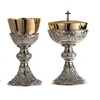
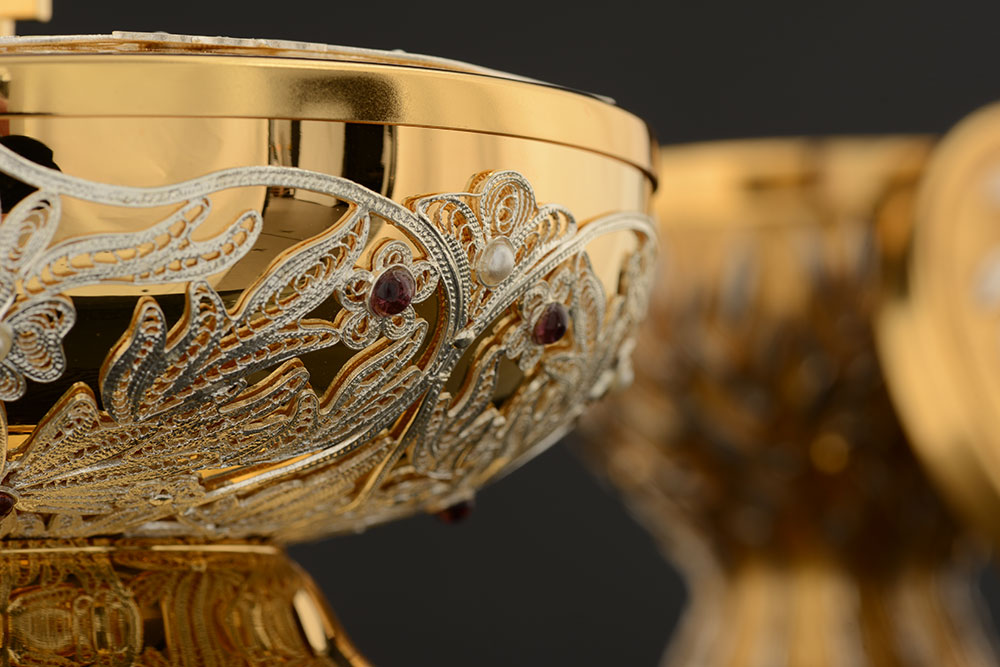
Richly worked and decorated, on the cup we can see the traditional scene of the Last Supper
Other medieval authors, such as Wolfram von Eschenbach, contributed to the gradual Christianisation of the Grail symbol, but it is only with the romances of the Arthurian Cycle that we find it in a prominent role as the object of many knights’ quests. Some of them found it after a long journey—such as Parsifal or Galahad, who were innocent and pure—while others, like Lancelot, failed and were in some way cursed. The Fisher King also returns in the Arthurian Cycle, and the quest for the Holy Grail is often associated with his name. The legend of the Holy Grail has continued to be a theme of narrative and study over the centuries. In time, it assumed increasingly precise connotations, becoming a miraculous relic capable of healing wounds and diseases and granting immortality to those who drank from it.
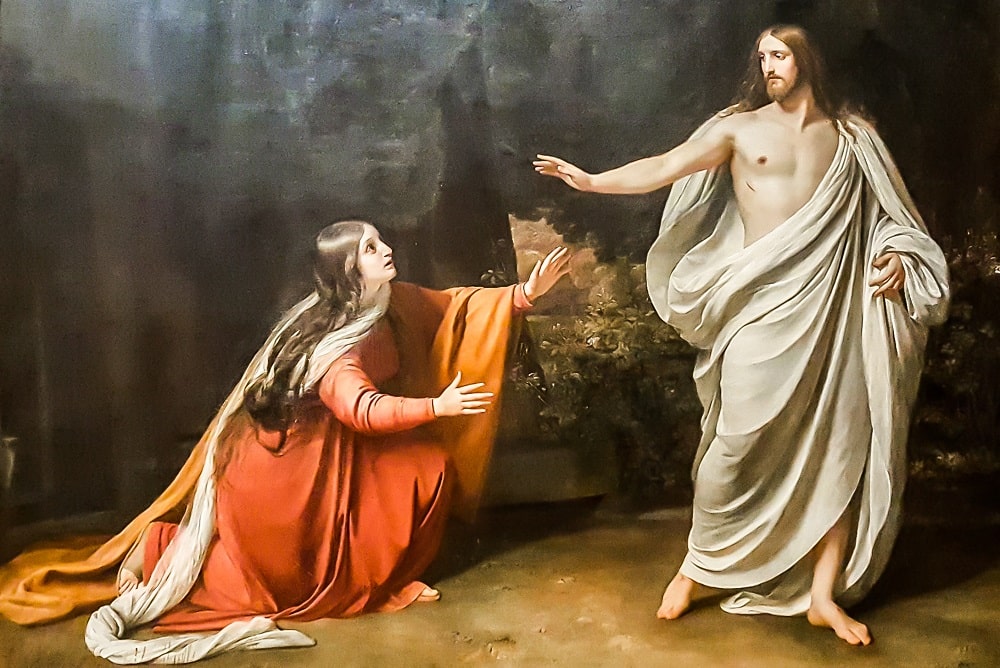
Modern fiction has dusted off the Grail myth, especially following the publication of the non-fiction book The Holy Blood and the Holy Grail, written by Michael Baigent, Richard Leigh, and Henry Lincoln, and published in 1982. According to this study, the Grail is actually the bloodline of Jesus and Mary Magdalene, His wife, who arrived in Normandy after His death. The sacred blood of Christ would have flowed through the first Frankish kings, and the Holy Grail would not be a cup, but its content: the royal blood (sang réal) of the French kings.
In Search of the Holy Grail
The question of where the Holy Grail is located is the subject of speculation, myths, and legends rooted in history, literature, and popular culture. However, there is no definitive answer or tangible proof of its current location.
In the romance by Wolfram von Eschenbach, the Grail was kept in the secret castle of Munsalvaesche, also known as Montsalvat, the home of Titurel, the first Grail King. This mysterious place is described as the “mountain of salvation”—a sacred refuge where the Grail was venerated and protected.
The identification of Montsalvat with the Monastery of Montserrat in Catalonia has been suggested by some scholars, as Montserrat, with its mystical atmosphere and isolated position on a mountain, seems to mirror the imagery of the Grail castle described by Wolfram von Eschenbach.
In reality, ever since the Middle Ages, various theories—some more fanciful than others—have flourished regarding where the Grail might have been kept. Arculf, a 7th-century Anglo-Saxon pilgrim, claimed to have seen and even touched a silver chalice kept in a reliquary near Jerusalem. Another account, cited in a 13th-century romance, places the Grail (or a copy of it) in Constantinople. Stolen during the Fourth Crusade, it was allegedly taken to France, only to disappear during the French Revolution.
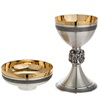
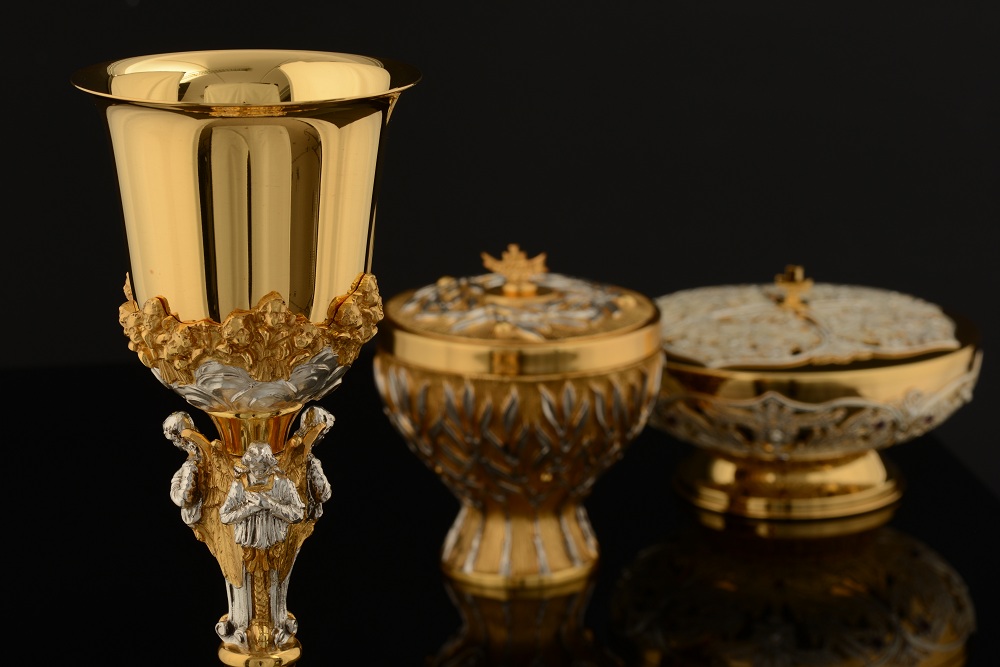
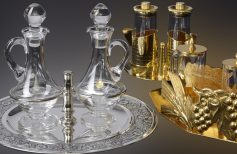
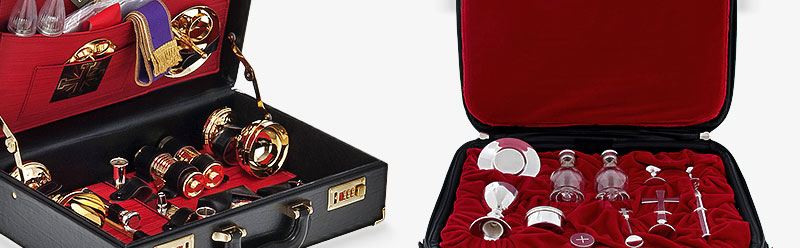
Chalice and paten in silver plated brass. Both the items are silver and smooth, embellished with hand reeded strips.
In Genoese Treasury Museum of the San Lorenzo Cathedral, as previously mentioned, the Sacro Catino is kept, having been brought there after the First Crusade. Meanwhile, in the cathedral of Valencia, there is the Santo Cáliz, a mysterious relic that King Martin I of Aragon received as a gift from the monastery of San Juan de la Peña.
The Link with the Holy Shroud
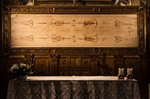
Some modern scholars, including the historian Daniel Scavone, have hypothesised a link between the Grail myth and the . According to this theory, the Shroud—the cloth donated by Joseph of Arimathea that wrapped the lifeless body of Jesus—is the true Grail, as it is permeated with His blood. News regarding this relic would have become confused over the centuries, gathering inaccurate details and giving rise to the legend of the cup. According to Scavone, Joseph of Arimathea never actually went to Britain, as tradition claims, but to Edessa in Upper Mesopotamia, where the royal palace was called Britio. This would have been the place where the Shroud was kept between the 6th and 10th centuries. From the term Britio, it was erroneously deduced that Joseph had gone to Britain. This fascinating theory also requires further study and research to be definitively confirmed or debunked.
Read more:
The Holy Shroud: What We Know So Far
It is said to be the cloth that wrapped the body of Christ after His burial. Between faith and science, the Holy Shroud divides and fascinates…
Despite their diversity, many religions show elements in common. Let us discover which religions believe in angels Angels are perhaps...
What’s the Future of Religion?
What’s the Future of Religion?
A Beginner’s Guide to Christianity
A Beginner’s Guide to Christianity
Mind-Blowing Statistics About Christianity You Need to Know
Mind-Blowing Statistics About Christianity You Need to Know
8436
Enter the Holyart world: $20 discount voucher valid on over 60,000 items
Come and discover Holyart, the largest e-commerce of religious articles in Europe and immediately receive a $20 voucher to use with your first purchase.
Check your mailbox: you will receive your discount within 5 minutes






 16 October 2026