Author: Redazione

The cult of Our Lady of Sorrows

The cult of Our Lady of Sorrows

Contents1 The origins of worship2 The Seven Pains Suffered by Mary3 Mary, all the suffering of a mother4 The depictions of Our Lady of Sorrows Our Lady of Sorrows is a name attributed to Mary, mother of Jesus. This is how secular devotion to Mater…
The Nativity of Mary, when and why is it celebrated?

The Nativity of Mary, when and why is it celebrated?

Contents1 8 September Feast of Our Lady2 History of Mary’s Birth3 Devotion to Mary the Child 8 September is the birthday of Mary, the mother par excellence, the woman who changed the history of the Church and humanity. Let’s find out more about her birth…

Religious jewellery: the new Holyart product line

Religious jewellery: the new Holyart product line

Religious jewellery? Yes, but only high quality, made with artisan methods by Italian companies of proven excellence. Because beauty, professionalism and faith can go together.

We at Holyart have told you in the past about the religious jewels that we offer in our online store. These are collections of exclusive jewellery made mostly by hand, or with artisan methods, by Italian master goldsmiths, beautiful to wear and unique to give as a gift. Our catalogue offers a rich range of splendid creations in gold, silver and precious stones, enriched with refined decorations and splendid sculptings because beauty, elegance and faith can go hand in hand.

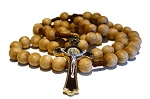
In addition to religious jewellery, the Holyart shop offers everything you need to make DIY rosaries in a few simple steps, using the endless range of grains, crosses, crucifixes and chains that you can choose from, or entrusting yourself with the practical complete kits, which already contain everything you need to assemble your customised rosary.

In this article, in particular, we want to talk about religious jewellery in metal decorated with enamel.

If you are looking for a crucifix for a truly original DIY rosary, to give your sacred jewel a touch of colour, you can take a look at our online store. You will find a wide range of beautiful metal and enamel crucifixes, as well as grains, crosses and chains to create a truly unique rosary with your hands.

If you want to give a gift to someone to whom you hold a medal with a saint everyone appreciates very much, but at the same time, you want to make an important gift, choosing a product made in detail, the religious jewels that we will talk about in this article are definitely for you.

The products of this type sold by Holyart are made by a company that has been operating on the market since 1977. An entire family has decided to dedicate their passion and efforts to creating truly unique sacred jewels. And they keep doing it, from father to son.

religious jewels fashion devotion

Read more:

Religious jewels: fashion or devotion?
There is a lot of talk around the trend that has become popular during the last few years, that is wearing religious jewels without knowing…

A meticulous, artisanal production, made almost entirely by hand, was cared for in every aspect of the workmanship. Every step is carefully controlled by highly qualified staff.
The particularity and attention to detail these religious jewels are made with fully justifies our choice, and you too cannot help but appreciate the excellence of these unique products.

We mentioned that this is a family business, which started to produce Art Deco and Liberty jewellery but soon converted to sacred and museum jewellery, beginning to make crosses, crucifixes, religious medals, jewellery crosses and other precious elements in metal decorated with enamels.
Not only that, but they also produce gadgets and reproductions of precious objects kept in museums or taken from the great masters of the past, famous paintings, crucifixes and so on.
Furthermore, the company produces buttons and fashion accessories for the greatest Italian brands.

The production of enamelled religious jewellery has become their speciality over time, an all-Italian and ‘family’ excellence, which is carried on with pride and with the determination to maintain the high standards of the past to guarantee valuable products every day.

The priority of this company is to create something beautiful and do it in the best possible way, with all the care and attention that only a job well done requires. Their jewels are very detailed and precise, the result of an authentic passion and an awareness of excellence carried out with pride by all the members of the family.

They do not use many machines, their production is based entirely on experience, manual skills and passion.

For enamelled religious jewellery, the company is inspired by the great masters of the past, especially the Renaissance, to reproduce already existing subjects. In forty years of activity, the company has created hundreds and hundreds of subjects and does not stop always proposing new ones. One of the most appreciated and sought-after subjects is the Crucifix of San Damiano, perhaps because it is very detailed and easily recognisable.

Crucifix of San Damiano

Read more:

Crucifix of San Damiano
The Crucifix of San Damiano is the one in front of which St. Francis was intent on praying when he received from the Lord the call to work…

Exclusively for Holyart they have made crosses and crucifixes of great value, and are developing other items, in particular, elements to assemble the DIY rosaries, perhaps to make an exclusive and completely personalised gift. The choice of colours, the thought and the attention that it takes to choose the elements and assemble them, taking into account the tastes of those who will receive it, make this type of gift really unique and special.

The company strongly believes in Made in Italy, of which it is a proud ambassador. All the processing phases take place in Italy, within the company itself. They do not want to import anything, materials, or above all ideas, preferring to take advantage of the immense heritage that our country offers us. Italy has always been famous for this, for its artists, craftsmen and geniuses capable of creating exceptional things.
In comparison with the global market, they choose to remain faithful to their roots, to focus everything on craftsmanship.
The attention to detail and meticulous care of every aspect of the work differentiates them from large mass processing. Only by doing well what you know how to do can you remain competitive in a market constantly invaded with products from all over the world.

But let’s discover together the various stages of the processing of these unique and exclusive jewels, made of metal and enamel only for Holyart.

Prototypes and moulds

The first phase of the work is design, and it is also the most artisanal. Andry’s creatives design prototypes, from which they obtain moulds that will be used to melt the metal and give it the necessary shape. To do this, they have to be very careful with all the details, because the prototypes have to be absolutely perfect. All the work is carried out by hand, with manual tools, from the hole to the file, no machinery can help the operators in this delicate phase. A research work that requires study, attention plus artistic and aesthetic sensitivity in absolute contrast with the great modern commercial production. Starting from an image, a technical drawing is created that allows you to have a first base or starting point through photoengraving.

Once it has been photo-etched, the prototype is cut and finished by hand and is used to make rubber moulds, using a cast. The rubber moulds are baked and then used to melt the metal.

The moulds only last for one day of work and then are rebuilt.

Casting, moulding and grinding

The metal is melted and distributed in the moulds via a centrifuge. The metal that is used is zamak, a zinc alloy, combined with small percentages of aluminium and tin, very resistant, malleable and versatile. The zamak “ingot” is molten, then taken with a special ladle and poured into a sort of funnel/tank.

From there the metal passes through the grooves of a centrifuge and fills the moulds, which have the shape of two rubber circles. A specialist brushes the rubber circles with a special powder that has the function of making the metal stick better when the centrifuge is activated as if it were talcum powder.

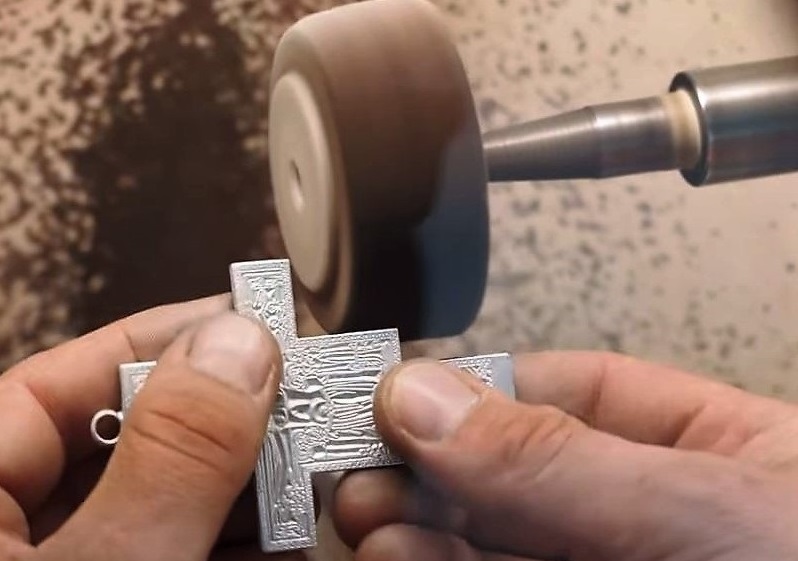
Once the product has come out of the mould, it is passed into a grinder that has the function of polishing any imperfections. The abrasive spring perfectly finishes the product’s edges.

grinding

This is a process that is scrupulously done, every product that comes out of the mould passes to this quality control. For this purpose, we also use cleaning machines and abrasive brushes that eliminate fusion attacks and smears.

Galvanic treatment

After the raw metal has been molten and poured into the mould, it is subjected to galvanic treatment, which embellishes the metal base. Galvanic technology involves a series of operations with aqueous solutions at room temperature or slightly higher, mixed with salts of metals, bases, acids and additives. The galvanic treatment produces electrochemical depositions on the metal, i.e. the formation of a layer that increases its corrosion resistance, wear and the effects of atmospheric agents. It is also an aesthetic treatment that makes the metal more beautiful and resistant, able to last over time. After the galvanic treatment, the piece of metal resembles a piece of gold or silver.

All galvanic treatments carried out by Andry are anti-allergic because they are performed without nickel

Decoration and colouring with the enamel

The decoration is done by hand, and it is the most important moment. Each step is carried out with care and attention, to highlight every single detail of the jewel. Especially in minute jewellery, such as a crucifix, it is attention to detail that makes the difference.

Decoration

They include control and attention to each step that allows you to finally get a well-crafted and well-made product. The decorators are all very passionate about work, and over the years they have learned to be very attentive and precise.

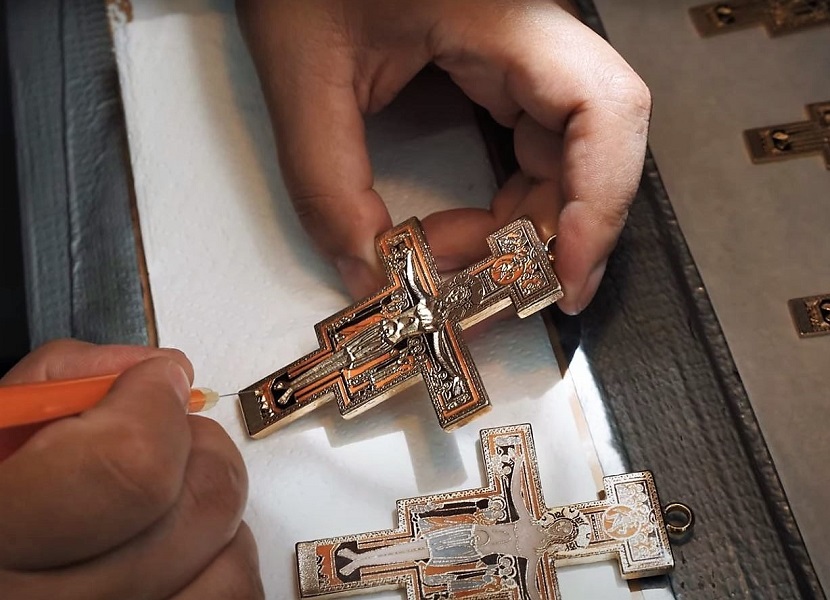
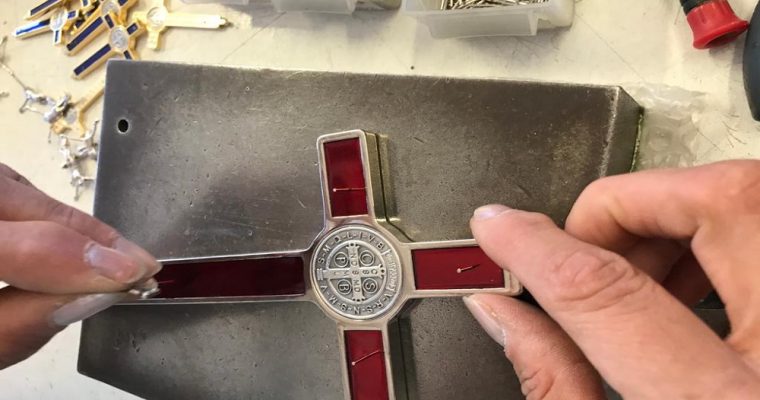
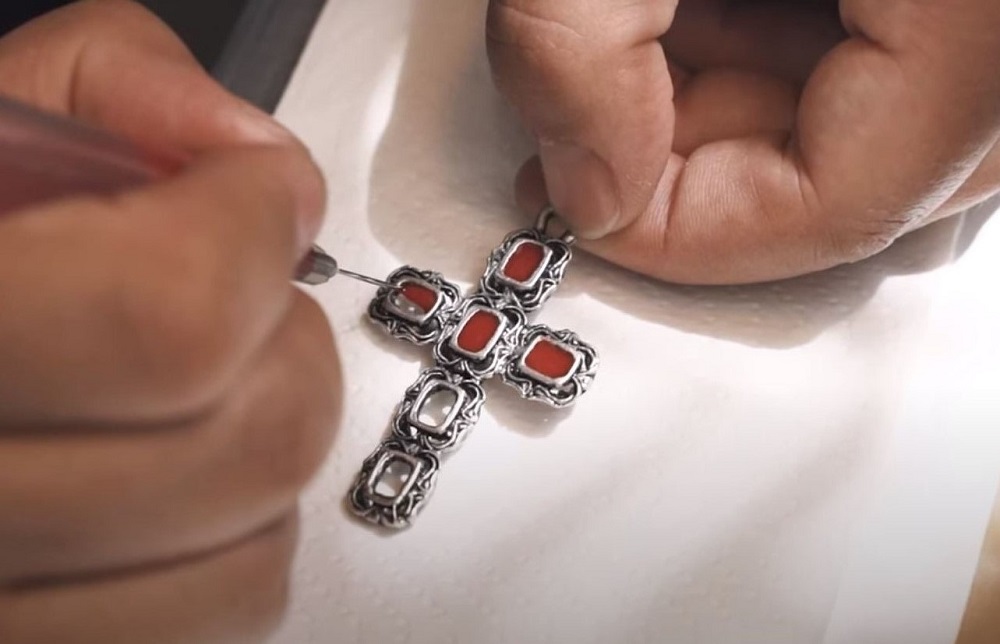
Decoration and colouring are done using needles and syringes used to fill the products with coloured enamels. The needles are used to chisel and decorate the metal. Syringes for glazing.
The enamels that are used are epoxy enamels, which thanks to their chemical composition create a thin but resistant film on the surface of the object, which protects the colours from wear and atmospheric agents. To facilitate and speed up the application of enamel, making the operation not only faster but also more accurate, the enamel dispensers are mounted on complex pneumatic systems that allow the deposition of enamel quickly and precisely on the piece to be decorated. Attach the syringe to the syringe bayonet attachment. The operator can exert absolute control over the enamel output by pressing on a pedal and interrupting its escape by releasing it.

After being glazed, the product is baked. This is a very important step that requires time and care because the operation must be repeated for each colour. In practice, the product must be placed in the oven every time a different colour enamel is applied. The oven phase is then repeated several times depending on the number of colours you use. The product remains in the oven every time for 3/4 hours at 60°. The enamel they use is mixed with a percentage of hardener to make it more solid and resistant.

When the product has been completely glazed and leaves the oven for the last time, it is sprinkled with a layer of transparent polishing enamel that makes the surface uniform and shiny, giving it an extra point of light. Even to the touch, the enamel makes the surface more uniform and does not make it perceive, as the fingers pass, the difference between the layers of colour. In addition, the transparent enamel makes the details stand out, even more, making it a little like a magnifying glass, and protecting the piece. Even after the application of the final transparent enamel, the jewel must be passed back into the oven.

Some jewellery is then decorated with Swarovski‎ rhinestones.

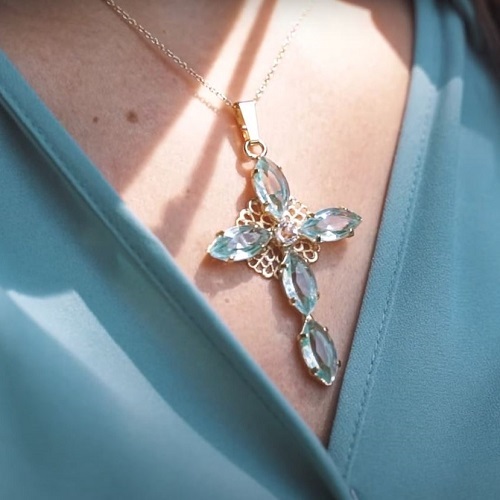
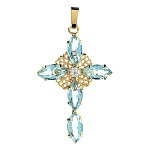
Aquamarine crystal cross
Elegant cross pendant with beautiful aquamarine crystals, hand applied onto golden brass. 100% made in Italy.
Buy on Holyart
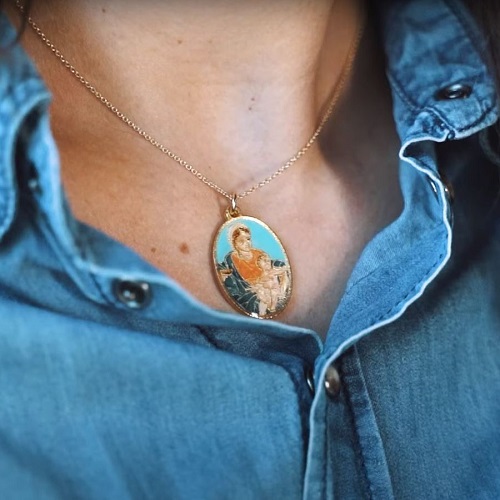
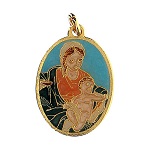
medal with Virgin Mary and Jesus
Religious medal with turquoise background, depicting Mary with Child, hand decorated with enamel paint on a zamak background. 100% made in Italy, glazed by hand with a syringe, which allows you to decorate it with precision; subsequently the enamel is covered with a layer of resin which gives it shine and resistance.
Buy on Holyart
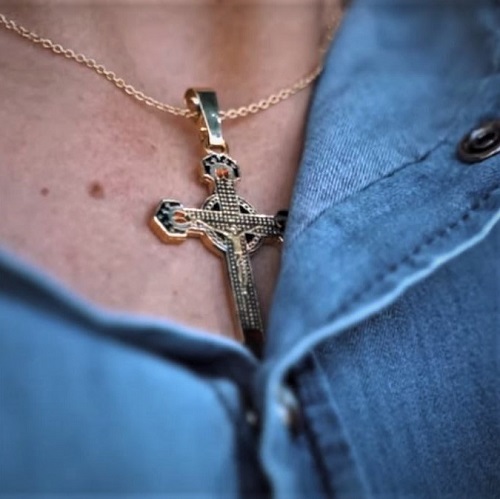
Enamelled crucifix
Crucifix pendant in golden metal, hand enameled. 100% made in Italy, hand glazed with a syringe, which allows you to decorate it with precision; subsequently the enamel paint is covered with a layer of resin which gives it shine and durability.
Buy on Holyart

Other products

In addition to enamelled jewellery, our supplier also manufactures crosses with crystal bezels and stones. The brass bezels are welded and the stones set, all strictly by hand, and then passed to the galvanic treatment. It is a job that requires patience, attention and a lot of passion.

As for the buttons, they are appreciated and known by insiders, demanding fashion experts and always looking for excellence, even in the smallest details.

Saint Monica: patron saint of mothers and example for women

Saint Monica: patron saint of mothers and example for women

Saint Monica of Tagaste was a woman endowed with extraordinary strength of mind and unwavering faith. Let’s find out why she’s become a symbol for all mothers. Saint Monica is the patron saint of married women, mothers and widows. In an era when the woman…

The Assumption of Mary and the most characteristic celebrations

The Assumption of Mary and the most characteristic celebrations

15 August is not just an occasion for partying and outings. We remember the Assumption of Mary into heaven. Let’s discover the most evocative celebrations that this anniversary is celebrated with. In an article of some time ago we had already spoken extensively about the…

Saint Dominic of Guzman and the delivery of the rosary

Saint Dominic of Guzman and the delivery of the rosary

Saint Dominic of Guzman, the saint in love with Christ, lived his life dividing himself between preaching and prayer. A proud opponent of heresy, he received the Rosary from the Virgin Mary as a weapon of prayer and preaching.

As tender as a mother and as strong as a diamond. Thus Jean-Baptiste Henri Lacordaire, restorer of the Dominican order in France after the Revolution, one of the greatest exponents of nineteenth-century liberal Catholicism, defined St. Dominic of Guzman as the founding father of the Dominican friars.

And this saint really must have been a singular man, endowed with great charm, brilliant and ardent with love and a spiritual vigour worthy of an apostle. He was always extended with the most tender love to his brothers, those Dominicans whom he wanted to found, to gather around him others who, like him, loved Christ and wanted above all else to live in his contemplation.
At the same time, however, he was a proud champion of the Word among heretics, whom he always tried to convert with debate and persuasion, at a time when resorting to violence and torture was a common custom.

But what moved Saint Dominic of Guzman was love and passion. Father Lacordaire will always say of the first Dominicans who were passionate souls, that “They loved God, they really loved him. They loved their neighbour more than themselves.” Armed with this love, with this enthusiasm, the white friars, with the colour of the garment of Saint Dominic, swarmed all over Europe, to preach the Truth.

Another fundamental trait of the Dominicans, and their founder, first of all, was the extraordinary devotion to Our Lady. The Virgin Mary in person appeared to St. Dominic, pointing to the Holy Rosary as the most effective weapon against the heresies of the Cathars and Albigensians. Still no violence, no prevarication, but the prayer most dear to the Mother of the Saviour, as an instrument of faith and conversion.

We know better this extraordinary saint and his unique and special connection with the Holy Rosary.

The history of the saint

San Domenico de Guzman was born in 1170 in Caleruega, in the mountains of Old Castile, Spain. Not much is known of his youth, except that he was educated in liberal arts and theology. From a very young age he showed great piety, so much so that, troubled by the misery to which wars and famines had condemned many people, he sold all his goods, even books and scrolls, to help the poor. He is said to be a very handsome young man, with long and elegant hands and a strong musical voice, and to inspire sympathy and serenity. This was the first stretch that conquered those who came into contact with him.

After his studies, he was ordained a priest and entered the regular canons of Osma Cathedral.

Soon he was noticed by his superiors and in 1203 the bishop of Osma, Diego de Acebes wanted him with him for a diplomatic mission of the utmost importance and delicacy in Denmark. Thus, among the Nordic Christians and the Cathar heretics of northern France, the young man discovered his vocation as a missionary. Together with his bishop and friend Diego, he went to Rome to ask the Pope for a license to dedicate himself to the evangelisation of the pagans of North Eastern Europe.
The Pontiff sensed the potential of this diligent and enthusiastic apostle of the Word of Christ and decided to use his preaching skills in the Languedoc, threatened by Cathar heresy.

Saint Dominic demonstrated a new approach to heresy. He tried to understand the reasons of the heretics and their thought and embraced in some ways their rigorous and austere lifestyle, which so much fed their popularity among the poorest classes, especially compared to the glories and excesses of some high Catholic prelates.

His apostolate was also distinguished by his method of preaching, based on public debates and personal conversations, passionate speeches and works of persuasion, to which he always added prayer and penance. Becoming an official preacher of the diocese of Toulouse, he began to cherish the possibility of gathering around him a group of young people equally enthusiastic and passionate, to carry on the preaching in a stable and organised way. Saint Dominic first gathered the women who had abandoned Catharism, forming a community of Dominicans dedicated to the contemplative life, but also “holy preaching”, as their prayers would soon be used to support and give strength to their fellow preachers.
Men also joined him, despite the austere and rigorous lifestyle that made it difficult to follow his ideals, and that was how the Order of Preachers originated. The Order, approved by Pope Innocent III in 1216, would be called the “Order of Friars Preachers”. The Order was based on: preaching, study, poverty, common life and missionary expeditions.

The Friars’ Preachers soon began to travel through Europe, preaching, but also participating in cultural and theological life, especially in large university cities, such as Paris and Bologna,

St. Dominic de Guzman died in Bologna on 6 August 1221, surrounded by the love of his brothers. He was canonised in 1234.

The delivery of the Rosary by the Virgin Mary

We have already mentioned the Marian devotion of Saint Dominic of Guzman and the apparition of the Virgin in which he would have been the protagonist. At that time the Saint lived in Toulouse, and he worked hard to find a way to fight the heresy of the Albigensians without having to resort to violence. Alano della Rupe, another Dominican who became famous for his particular devotion to the Rosary, tells us that during the preaching the Saint was kidnapped by pirates who took him on their ship. The same ship was overwhelmed by a storm, and it was then that the Virgin manifested herself to Domenico, pointing to the Holy Rosary as the only salvation from the shipwreck and death of all of them. The Saint told the pirates that warning, they accepted, and immediately the fury of the sea subsided. The pirates were the first members of the Brotherhood of the Rosary, the abode of the Virgin Mary on earth.

The moral of this story is clear. By Our Lady’s will, the Rosary was no longer just an instrument of personal salvation, but a weapon of community prayer. “If they receive this last Refuge of Mercy of my Rosary, they will not be swallowed up by the waters and by hell!” Thus Our Lady would have said to Saint Dominic, always according to Alano, and it is clear that this warning does not only concern the pirates, and does not refer only to the episode of the shipwreck. For the young Saint engaged in fighting the heresy Catara, it was evident from the outset that the way of the Rosary had been shown to him by the Virgin to fight the enemies of the Church and heretics with the strongest and most effective weapon possible.

It was following the mystical experience of Saint Dominic that the Rosary acquired the form that we still know and practice today, with the role of the central Virgin Mary and the circular movement that expresses the spiritual path of the faithful, its progressive movement towards God. With Saint Dominic and his Order of Friars Preachers, the Rosary becomes an instrument of personal and community meditation and prayer, but also a means of preaching.

The origins of the Dominican order

The Order of Friars Preachers was born from the men gathered around St. Dominic by Guzman during his apostolate in Languedoc.

In 1216 the papacy signed the official and definitive approval to the foundation of the Order. After a difficult start, due to the hostility of the local clergy and mistrust of the newborn Order, Dominicans were welcomed and appreciated everywhere. Although they lived on alms, many received substantial donations from supporters and sympathizers.
In 1218 a papal bull decreed that all the prelates would assist the Dominican preachers.
In 1220 and 1221 in Bologna, the first two General Chapters were held during which the Magna Charta of the order was drawn up.
According to the latter, the Dominican friars had to base their path of life and faith on: preaching, study – which had to be practised day and night -, poverty, life in common, travel and missionary expeditions.

Even today Dominicans live their daily search for truth and intimacy with Jesus. The  Rosary remains one of the greatest instruments of faith and meditative research, as well as love for the Virgin Mary.

The Dominican Movement of the Rosary, or Confraternity of the Holy Rosary, followed for centuries to welcome anyone who wants to know better and learn to practice this form of devotion. The Movement organises occasions for common prayer and encounter, pilgrimages to shrines and conferences aimed at reflecting on the mysteries of the Holy Rosary.

The Dominican’s Rosary Movement

Read more:

The Dominican’s Rosary Movement
The Dominican’s Rosary Movement shows both the desire for community devotion

Bible stories for young and old

Bible stories for young and old

Contents1 Jacob2 Joseph and his brothers3 Samson and Delilah4 Queen Esther5 Bile Stories for children The stories of the Bible are so many, and so compelling that over the centuries they have inspired countless artists and writers, up to modern directors who have made films…

World Day of Friendship

World Day of Friendship

July 30 is the World Day of Friendship, a celebration born to celebrate one of the most wonderful aspects of coexistence between men. On the occasion of the World Day of Friendship we wanted to verify what is the exact definition of this form of…

The story of Saint Anne Mother of Mary

The story of Saint Anne Mother of Mary

On July 26, St. Anne and St. Joachim, the parents of the Virgin Mary, are celebrated. Let’s find out why.

Although the Day of the Grandparents was established as a civil anniversary in Italy on October, 2 each year, in conjunction with the day of the Angels, also on July 26, grandparents are remembered and celebrated. This is because on this day we remember Saint Anne, the mother of Mary, who, in addition to being the protector of mothers and women in childbirth, together with her husband Saint Joachim is also the patron saint of grandparents. It is not difficult to imagine the reason for this patronage: in fact, Saint Anne and Saint Joachim are none other than the grandparents of Jesus.

On a  previous article  We focused on the fact that the Feast of Grandparents celebrated on October 2 is an official recognition by the Italian state to the value of grandparents in society, a role considered no less important than that of parents, for the growth and happiness of children.

your Guardian Angel

Read more:

Who your Guardian Angel is and what they do: 10 things you should know
According to Christian tradition, every one of us has a guardian angel, who accompanies us from the moment …

But also the fact that this feast falls on the same day on which the Angels are celebrated is certainly not accidental. In fact, in many respects grandparents are similar to guardian agels in the flesh, always ready to sacrifice themselves for the good of those they love, always prostrate to protect their children, grandchildren, with their forces and their thoughts.

So it does not seem wrong to dedicate another party to grandparents, so that those who are still lucky enough to have them can remember them and maybe go to visit them, bring them a gift, or just the pleasure of a little company. Especially children should be encouraged to spend as much time with grandparents as possible, not only because they are good and caring, but also because of the immense wealth of experience and knowledge that they can convey to them with their stories. We would not be who we are without those who came before us, and grandparents are the very symbol of a distant and yet extraordinarily close historical heritage. They are our link with the past, they are the very roots of our present, and their example and love can instill in us hope for the future, for when we will be grandparents in our turn.

Let’s get to know better Saint Anne and Joachim, parents of Our Lady and grandparents of Jesus.

History of Sant’Anna

Anna and Joachim do not appear in the Bible. What we know of them, as well as of Zechariah and Ismeria, this last sister of Anna, parents of Elizabeth, comes to us from the later hagiographic tradition and from the apocryphal gospels.

Legend has it that both were members of the Jewish priestly class, although there are several versions that attribute to Anna illustrious kinship with other figures in religious history, such as Joseph of Arimathea, the man who took care of the recovery and burial of the body of Christ, who would be his uncle.

What is certain is that although both were noble and virtuous, Anna and Joachim could not bear children, just like Zechariah and Ismeria.

The shame for this lack led Joachim to retire to the desert, among the shepherds, but just then an angel appeared to him and his wife Anna, announcing to them the next birth of a son. Following the angel’s instructions, the two met at the Golden Gate of Jerusalem, and here, thanks to a single kiss, their creature would be conceived.

When, as the angel had promised, a little girl was born, who would forever change the history of the world, Anna and Joachim called her Mary, which in Hebrew means ‘loved by the Lordl’.

This is how the Virgin Mary, the future mother of Jesus Christ, was born. He was born without sin, preserved immune from it from conception, according to the dogma of the Immaculate Conception.

Like all mothers, it was Anna who taught little Maria to do housework, to clean the house, to weave and sew. For this reason she is invoked as the protector of tailors, weavers and sellers of linen. But it is above all her being pregnant in old age to have deserved over the centuries the role of patroness of the impossible parts and protector of pregnant women, but also widows and mothers of the family.

Moreover, because she carried the Virgin Mary in her womb, like a casket containing a precious jewel, she is the patron saint of goldsmiths, cabinetmakers, carpenters and miners.

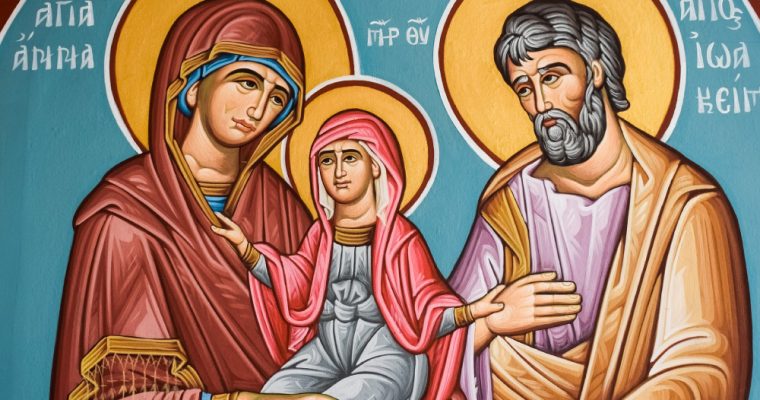
It is therefore almost always in relation to her daughter Mary that Saint Anne is remembered. In the early Middle Ages they were often represented together, Mary sitting with the Child Jesus in her arms and her mother Anna behind, symbolizing the hierarchy of the divine family. But there is also a sacred iconography linked only to Anne and Joachim and their lives.

The meaning of the name Anna

The name Anna derives from the Hebrew Channah, or Hannahe, which means ögrace’, ‘gracious’, ‘full of grace’.  Although the name of Mary’s mother is not mentioned in the Bible, other women who bore this name are mentioned in the Holy Texts, as the mother of the prophet Samuel and as the elderly prophetess who recognized as the Messiah Jesus child when He was presented to the Temple of Jerusalem.

mother Picasso

Read more:

From Eve to Mary: the figure of the Mother in the Bible
The mother, pillar of every family, beating heart and source of life for those who gravitate around her…
Gifts for the grandparents

We wrote that on July 26, on the occasion of the celebrations in honor of Saint Anne and Saint Joachim, grandparents also celebrate. It can be a great opportunity to give them a gift, although there should be no need for a special occasion to remind these special people how much we love them.

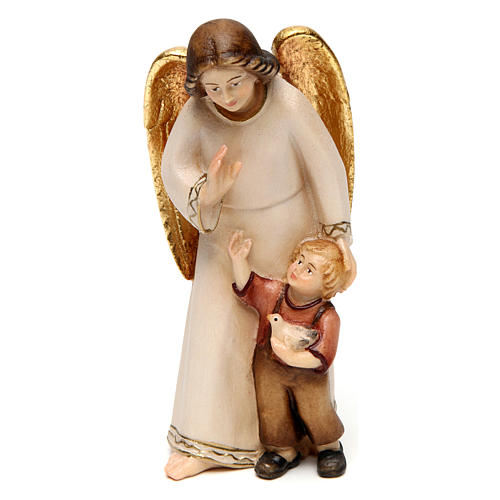
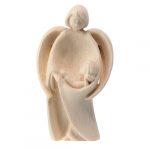
To remember the deep bond between grandparents and the figure of the guardian angel it might be a good idea to give a statue of the Guardian angel with child made of wood, painted and hand carved by the artisans of Val Gardena. The style is modern, and the craftsmanship and customizable finishes make this sculpture truly unique and precious. It is available in various sizes.

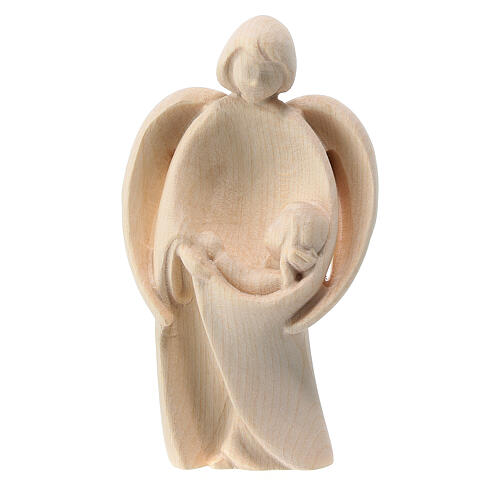
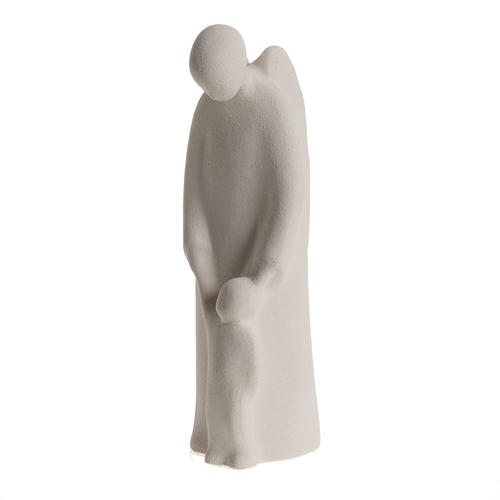
Also in modern style, the Guardian angel custon in refractory clay is a stylized statue that expresses an intense spirituality. It is handmade with white refractory clay at the Centro Ceramiche Ave di Loppiano (Florence). The clay is first worked by hand molding, then baked to over 1000 C. The finishing and processing are completely by hand, to give it essential lines and expressive at the same time. It is an important gift, a high quality product, 100% Made in Italy.

guardian angel with little boy modern style in val gardena wood
This angel statue is hand sculpted on wood with traditional methods by the artisans of the Val Gardena. Available in 4 different sizes: - 10 cm, - 12 cm, - 14 cm, - 28 cm. You can choose the measurement you prefer in the menu under the picture. It is possible to order this guardian angel in a different finish. If you need further information about this article do not hesitate to contact us: we will be happy to help you.
Buy Now
guardian angel with young girl painted maple wood val gardena
Natural maple statue, made in Val Gardena, Italy by a company specialized in woodworking. They are recognized for their high-quality works of wooden art.The guardian angel protects the child with its tunic. The lines are harmonic and soft.Prestige and quality angel statue.The statue is available in various heights: from 5 cm to 24 cm.
Buy Now
guardian angel figurine stylized
Hand-crafted 100% by the Italian company "Ceramiche Centro Ave" in Loppiano, near Florence.
Buy Now
Saint Benedict: the saint who inspired Italian craftsmanship

Saint Benedict: the saint who inspired Italian craftsmanship

Contents1 The cross-medal of Saint Benedict2 Material and workmanship3 The lines Saint Benedict of Norcia, Patron Saint of Europe, throughout his life he fought against the devil he cast out in the name of the Cross. This is how the Saint Benedict medal inspired an…

Saint Maria Goretti

Saint Maria Goretti

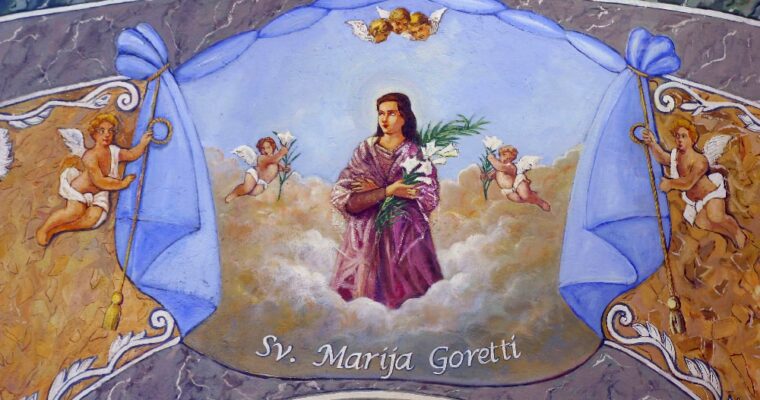
Contents1 History of Saint Maria Goretti2 Casa Santa Maria Goretti, pilgrimage destination3 The sanctuary of Maria Goretti in Nettuno On July 6, Saint Maria Goretti, the holy child who died to preserve her innocence, is remembered. Here is how her cult was born. Devotion to…

Saint Peter and Paul, why are they celebrated together?

Saint Peter and Paul, why are they celebrated together?

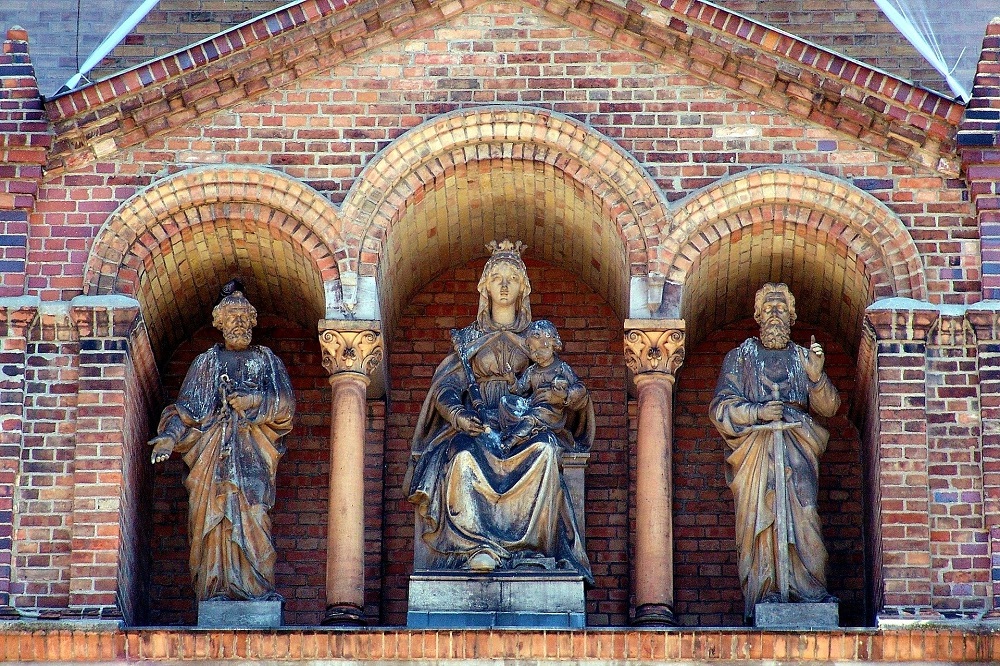
On June 29, Saint Peter and Paul are celebrated. Two apostles, two very different men, both fundamental to the history of the Church. Let’s get to know better these two examples of faith and their feast.

It is difficult to think of two men more different from each other in history and vocation than Saint Peter and Paul were. Yet, not only are they both remembered as two bulwarks of faith, and symbols of the Catholic Church itself, but they even share the same feast, June 29.On that date, in 67 A.D. Saint Peter and Saint Paul were martyred in Rome during the persecutions ordered by the emperor Nero against the Christians. This according to the Roman Martyrology, the Sinassari of the Eastern Churches (collections of lives of saints) and the Decretum Gelasianum, a document of the fifth century that contains several lists of religious material, from written texts to be recognized or rejected, to the list of synods.

Although it is almost certain that both Peter and Paul suffered martyrdom by the will of Nero, the first crucified upside down, the second beheaded between 64 A.D. and 67 A.D., the fact that the two killings took place on the same day of the same year is highly unlikely.

It is more plausible that the choice to commemorate the death of both Saints Peter and Paul on 29 June derives from the desire to convert a pagan feast into a Christian celebration, as has happened over the centuries for many other religious holidays. In fact, June 29 coincided with the feast of Romulus and Remus, founders of Rome. Christians have probably wished to pay homage to the two founders of the Church on that same day, as if to celebrate the birth of a new Christian Rome.

We know better Saint Peter and Paul and their common destiny.

The Story of Saint Peter, the men’s fisherman

Simon, who changed his name to Peter when he decided to follow Jesus together with his brother Andrew, was the first of the disciples to recognize Jesus as the Messiah and Son of the living God.

13 And when Jesus came to Caesarea Philippi, he asked his disciples, «Who do men say that I, the Son of Man, should be?».  14 And they said, «Some, John the Baptist, others Elijah, others Jeremiah, or one of the prophets».  15 He said to them, «And you, who do you say that I am?».  16 And Simon Peter answered and said, «You are the Christ, the Son of the living God». (Matthew 16,13-16)

Likewise, and on the same occasion, Jesus himself designated Peter as His successor, the foundation of His Church and the leader of God’s flock:

17 And Jesus answered and said to him, You are blessed, O Simon, son of Jonah, because neither flesh nor blood have revealed this to you, but my Father who is in heaven.  18 And I also say unto you, that thou art Peter, and upon this rock I will build my church, and the gates of hell shall not overcome it.  19 And I will give you the keys to the kingdom of heaven; all that you have bound on earth will be bound in the heavens, and all that you loose on earth will be loosed in the heavens». (Matthew 16,17-19)

This is exactly what happened after Jesus’ death. Peter, who had three times denied his Master after his arrest, became the point of reference for the other apostles, and for all the disciples. He will be the one to initiate the preaching of the Good News, after the descent of the Holy Spirit on all of them at Pentecost. He will be the one to assume in his own hands all the duties of the Vicar of Christ on Earth.

Speaking of how Peter denied Jesus we cannot fail to dwell on his weakness, on the flaws that make him a human being among human beings. It is incredible to think that this man whom Jesus called of little faith, when he did not believe he could walk on water to reach it (Matthew 14:22-36), will become the very foundation of the Christian Faith and the stable and cohesive rock on which the Church will be founded!

Yet, this was Peter before he was what Jesus asked him to become. A man, a fisherman who threw his nets into the sea of Galilee, and who awaited the coming of the Messiah preached by the prophets, and declared imminent by John Baptist. To him Jesus asked to be able to get on his boat to preach, and, blessed by a miraculous catch, Simon decided to leave everything, even his own name, and to follow Jesus proclaiming himself a fisherman of men.

24 June Saint John the Baptist

Read more:

24 June Saint John the Baptist
On 24 June we celebrate the birth of Saint John the Baptist, one of the most venerated Saints in the world, the last prophet of the Old…

Peter also witnessed the Transfiguration of Jesus, together with James and John.

Ardent and impulsive, Peter expected a Messiah who would be a spiritual guide, but also a warrior, a conquering King who would break the yoke of Rome. The personality and charisma of Jesus, however, conquered him completely. Even at the moment of the latter’s arrest the ancient ardor of Peter re-emerged, prompting him to hold his sword against the guards who came to take Jesus away and to strike one with the sword. This will not prevent him from denying him three times, an act he will bitterly regret.

The transfiguration of Jesus Christ

Read more:

The transfiguration of Jesus Christ
On 6 August the Transfiguration of Jesus is celebrated, forty days before the Exaltation of the Holy Cross, the commemoration of the Crucifixion…

To Peter who came on Easter morning to the tomb of Christ found empty by the women, Jesus appeared before the others, and from this moment on the Acts of the Apostles and the sacred texts bring us continual confirmation of the role fully embraced by the Apostle.
On Pentecost day, while the Holy Spirit descended in tongues of fire gave the disciples the ability to speak in all the languages of the world, Peter will enrich the crowd, troubled and frightened by declaring Jesus Lord and Messiah, resurrected from the kingdom of the dead and ascended to heaven, to perform that miracle. His speech will prompt many of those present to convert and ask for Baptism, and thousands will come in the following days for the same reason.

On the same day, Peter’s preaching of the Good News began, leading him to be arrested several times by the Jews and the Romans. In particular we remember the arrest by King Herod Agrippa, to whom the apostle would have fled thanks to the intervention of an angel.

His travels will take him to Rome, where he will meet his destiny by the will of Nero.

Legend has it that while he was trying to escape from Rome to escape arrest, Jesus appeared to him. The apostle asked him: “Quo vadis? (Where are you going?)” and the Lord answered him that he was going to Rome to die again. Then Peter went back on his way, let himself be arrested, and accepted martyrdom. The choice to die crucified upside down was Peter himself, who did not consider himself worthy to die as his beloved Master. He was buried on the Vatican Hill, and around his tomb, in time, the Basilica of San Pietro was erected, which still houses his tomb.

History of Saint Paul, apostle of the Gentiles

Paul was called Saul of Tarsus before he converted.  He never knew Jesus, but is remembered as His first missionary, the supreme preacher of His Word to Hebrews, Greeks and Romans, the so-called ‘gentiles’, in fact, understood as pagans, not Christians. It was thanks to him and to Saint Peter that the Gospel message spread throughout the Mediterranean kiss of that time. His exceptional writings make him the first theologian in the history of Christianity.

The differences between Judaism and Christianity

Read more:

The differences between Judaism and Christianity
What are the differences between Judaism and Christianity? Is the God of the Jews the same as the Christians? Let’s try to discover together…
He was a Hellenized Jew, an aristocrat, a Roman citizen. A fierce supporter of Jewish traditions, he dedicated the first part of his life to persecuting Christians, whom he saw as a dangerous sect to eradicate by any means.

It was while he was carrying out his duty as an exterminator of Christians that he knew his destiny. In the Acts of the Apostles (Acts 9:1-9) we read how, on his way to Damascus to pursue a group of Christians who had fled from Jerusalem, Saul was struck by a dazzling light that made him blind. In the glow he heard a voice that said: “Saul, Saul, why do you persecute me?”  (Acts 9:4). After that miraculous event, the man wandered for three days, arriving in Damascus, where he was welcomed and cared for by Ananias, head of the Christians of the city.

Thus took place his conversion and the beginning of his mission as a tireless missionary of Jesus.

Precisely from his conversion, Saint Paul will draw inspiration to begin his preaching. A hard mission, considering that everywhere we remembered his hatred of Christians. But Paul did not lose heart. Baptized by Ananias, and after living for some time in Damascus with the Christian community, he undertook several journeys. The tradition indicates three main missionary journeys: the first in the regions of present-day Turkey, on the island of Cyprus, in the city of Antioch and in Syria; the second in Greece; the third again in Asia. There was a fourth journey, which Paul undertook as a prisoner, to Rome. Here, the Acts of the Apostles interrupt the story of his life. He died beheaded during the persecutions organized by Nero. His remains still lie in the Basilica of San Paolo Fuori le Mura.

The testimony of his evangelical work remains, as well as in the chronicles and reports of the time, especially in his Works. We refer to the Letters he wrote to the Christian communities touched upon during his apostolic journeys or founded by himself. They have become part of the New Testament. In them Saint Paul makes himself the spokesman of God and of his promise of salvation. That salvation that had enlightened him first, snatching him from his old life and making him the most fervent of the apostles, though he never met Jesus in life.
“I have transmitted to you first of all what I myself have received: Christ died for our sins, according to the Scriptures, he was buried, resurrected on the third day according to the Scriptures, appeared to Cephas (Saint Peter), then to the twelve.”   (First Corinthians 15:3 – 5).

Why are Peter and Paul celebrated together?

Leaving aside the tradition that wants them in Rome at the same time, and killed on the same day, we can recognize the traits that unite Saint Peter and Paul, these two men so different, and ensure that they are celebrated together, in their common will to spread the Gospel message and the legacy left by the human and mortal experience of Jesus.

If Peter was the “stone” on which the Church was built, as well as leading the flock of God, Paul was the most fervent preacher of the Word in the whole Mediterranean world, the first missionary in history.

There is also no doubt about the link between Saint Peter and Paul and Rome, where both died, but above all to the Christian rebirth of which both tended. In 2012 Pope Emeritus Benedict XVI declared them both “principal patrons of the Church of Rome”. Even today Rome remembers them with a great feast, during which an impressive fireworks display takes place, while Saint Peter is decorated with a magnificent infiorata, and the Pope gives a band of white wool (the palio), to the bishops of the city, before kissing the foot of the statue of Saint Peter that for the anniversary is covered with a red cloak.

Although different, although distant in history and experience, and despite having clashed with each other precisely because of these differences, Saint Peter and Paul are like complementary brothers, bound by the Gospel of which they were messengers and depositories. In the Discourses of Saint Augustine we read: “One day is dedicated to the feast of the two apostles. But they too were one. Although they were martyred on different days, however, they were one in Christ.”

Sant’Agostino d’Ippona philosopher, bishop and theologian

Read more:

Sant’Agostino d’Ippona: philosopher, bishop and theologian
Very few men of faith can be compared to Sant’Agostino d’Ippona. He was not only a great theologian and bishop, philosopher and doctor…

So two individuals that history is kept separate, that nature and nature have kept apart, have gathered together in Christ and for Christ.

The depiction of the embrace of Saints Peter and Paul

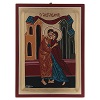
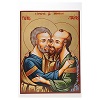
The Icon of Saint Peter and Paul represents them in the act of hugging. Perhaps it was with a hug that they greeted each other before being taken away by their executioners, according to tradition. But this embrace means much more than a simple greeting between two men who are the pillars of Christianity. It is a symbolic gesture that goes beyond the message of love promoted by Jesus, and rightly put into practice by his two closest disciples: “This is my commandment: that you love one another as I have loved you.” (John 15:9-17)

This ideal embrace symbolizes the union between two worlds, the pagan one, represented by the Gentiles to whom Saint Paul addressed, and the Jews, whom Peter continued to consider the chosen people. For Saint Peter it was not possible to embrace Christianity without first embracing Jewish culture and tradition, and the pagans could at most become second-class Christians, while for Paul only the message of Christ counted, went beyond the roots themselves, offering the possibility of a full and complete rebirth in His name.

Paul, however, always recognized the primacy of Peter, his authority as the head of the Church willed and elected by Jesus himself. Peter, for his part, despite the initial disagreements, recognized the value of Paul’s doctrine, and also in this complementary value from authority and doctrine we can read a further meaning in the embrace of the two apostles.

24 June Saint John the Baptist

24 June Saint John the Baptist

Contents1 The Precursor: Why John the Baptist Is Called That2 The baptism of Jesus3 The Madonna del Cardellino: explanation of the work4 Our Lady, Jesus and John the Baptist5 What the name John means On 24 June we celebrate the birth of Saint John the…

Corpus Christi, meaning and celebrations

Corpus Christi, meaning and celebrations

Contents1 But when was this party instituted?2 The meaning of Corpus Christi3 How Corpus Christi is celebrated in the various areas of Italy4 The mysteries of Campobasso5 The Corpus Domini of Orvieto6 The flowers of Spello The Solemnity of Corpus Christi is one of the…

Saint Anthony of Padua, the Saint of miracles

Saint Anthony of Padua, the Saint of miracles

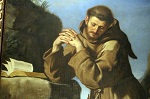
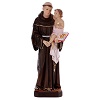
Saint Anthony of Padua was already one of his contemporaries master of Christian wisdom and an author of immortal works. Charged with the teaching of theology by Saint Francis of Assisi himself, he is one of the saints most loved and venerated by Catholics.

If we read the story of Saint Anthony of Padua we immediately realise some similarities between him and Saint Francis of Assisi, the saint who will have such an important role in his religious and life experience for Anthony himself.

Born in Lisbon in 1195, he was the firstborn in a noble family. His father Martino Alfonso de’ Buglioni was a knight of the king who boasted descent even from Goffredo di Buglione, the legendary commander of the First Crusade. Anthony was baptised with the name of Fernando, and it is interesting to note that, once he took his vows and changed his name, he chose one that retains the same etymological meaning as his baptismal name. In fact, Fernando means “bold, courageous in peace”, while Anthony means “courageous, invaluable who fights for peace”.

Not that Fernando was a man of war, on the contrary. He was probably initiated into the craft of arms, like all the young people of his social class, and as they could enjoy the fun in vogue at the time. But from a young age he showed a different attitude, more inclined to contemplation and prayer, so much so that, just fifteen years old, he wanted to become part of the regular canons of the Holy Cross, those belonging to the Augustinian order who lived in the Abbey of San Vincenzo in Lisbon.

Fernando did not remain an Augustinian for long. He lived for eight years in the monastery, devoting himself above all to study in the great library and undertaking theological studies. Above all, he did not want to get involved in the internal disagreements of the order, caused by the controversial conduct of the prior. We must bear in mind that the Europe in which Fernando lived was plagued by many problems of political and religious origin. Deep social and cultural changes, the birth of the Communes, the development of commerce, and the birth of the bourgeoisie were transforming the structure of the world. The Church herself experienced profound changes and was shocked by a profound renewal that will lead to the construction of Gothic cathedrals, the prolongation of the Crusades, heresies, an ever-increasing political and secular interference by the Popes, on the one hand, and the birth of new clergy figures linked to a more contemplative and apostolic dimension, from the Augustinians, Dominicans and Franciscans.

In 1219, Fernando had the opportunity to learn the story of five Franciscans, three priests and two lay brothers, sent by Francis of Assisi as missionaries to Morocco, to convert Muslims to Christianity. They also passed through Coimbra, where Ferdinand was staying and had a great ascendancy over him. In particular, when their decapitated bodies were returned to Coimbra, the young priest decided to leave the Augustinian order and enter the Franciscan one, in September 1220. It was then that he changed his baptismal name from Fernando to Anthony, the name of the monk to whom Olivais di Coimbra was dedicated, home of the Portuguese Franciscans. The Franciscans of the Romitorium also joined him, asking to be able to leave as a missionary in Africa.

The bad health, further strained by a tropical fever, forced Anthony to a premature return. But as he sailed to Spain, his ship, caught in a storm, sank on the coasts of eastern Sicily. Here Anthony and Filippino of Castile, the confrere who was travelling with him, learned that Francis had summoned all his brothers on the occasion of Pentecost for a General Chapter that would be held in the valley around the Porziuncola. Anthony and Filippino set out on foot to climb Italy and take part in this exceptional event, which gathered more than three thousand friars and which will be remembered as the Mat Chapter, due to the mat huts built as accommodation for the occasion.

Anthony stayed for the duration of the Chapter, which lasted from 30 May to 8 June 1221. His participation was not very active. He did not take part in the discussions regarding the state of the Order, the new Rule, or the expeditions of missionaries. He stood aside, observing, meditating, but in the end, he was equally noticed by Friar Graziano, supervisor of the Franciscan friars in Romagna. He, struck by his humility and spirituality, took Anthony with him to the hermitage of Montepaolo, near Forlì. Here, Anthony would live for a year together with six other friars, in prayer and penance.

The following year the bishop of Forlì was looking for a new preacher. Anthony spoke before him and all the other priests gathered and enchanted them with his eloquence, wisdom and spirituality. Thus he began to preach through the villages and cities of Romagna. In a time plagued by civil wars, feuds between families and clans, and heresy, Anthony was a bearer of peace, a supporter of balance and gentleness. The only ones against whom he was outraged were those nobles who should have watched over the safety and well-being of ordinary people and instead ignored them thinking only of their interests. To this particular human category, he gave the name of mute dogs and apostrophised them harshly in his Sermons.

Anthony also stood proudly against heretics, strong in his vast theological knowledge and doctrine, the only weapons that could not be opposed against the heretical movements that raged everywhere in the Europe of the time. Inspired by his struggle against heresies, Anthony pointed out the essential need to found the first Franciscan theological studentship in 1223 in Bologna.

Despite his shyness and natural tendency to remain on the sidelines, Anthony still managed to play an important part in the changes that would profoundly change the Franciscan movement in those years. His firm claim to the importance of the study of doctrine was certainly one of the greatest influences. But this did not stop Anthony from preaching, on the contrary, he was ordered to enlarge his area to include Emilia, the Marca Trevigiana, Lombardy and Liguria. It seems that it was while he was in Rimini, dominated by a strong presence of Cathars, who, unheard by the people, decided to turn to the fish of the sea, who rushed around him to listen to his words. In the face of this episode, it is impossible not to think about Saint Francis and his special relationship with animals, and his preaching to birds.

In Bologna, home to one of the most important theological universities of the time, Francis himself entrusted him with the task of studying and spreading theology. Strengthened by this new experience, Anthony later went to France to counteract the heresy of the Cathars and Albigensians. Here, he was awarded the name of the hammer of heretics.

Shortly after Francis’ death, Anthony returned to Italy and participated in the new General Chapter, organised to elect his successor as head of the order. Giovanni Parenti was chosen, who appreciated and esteemed Anthony and who wanted him as provincial minister for northern Italy. With this important position, Anthony visited many cities in northern Italy and eventually decided to elect Padua as his residence. Here he dedicated himself to the drafting of the Sermons, one of the most important theological works of Catholicism, which earned him the title of Doctor of the Church.

He also continued with his work as a preacher, summoning crowds of faithful who came to Padua to meet him and hear him speak.

As a Minister, Anthony continued to lead a humble life, made up of fasting and deprivation, modesty, humility and a deep sense of justice and mercy.

In this regard, he wrote in the Sermons: “The life of the prelate must shine with intimate purity, it must be peaceful with the subjects, which the superior has to reconcile with God and with each other; modest, that is, of irreproachable customs; full of goodness towards the needy. Indeed, the goods he possesses, except what is necessary, belong to the poor, and if he does not give them generously he is a robber, and as a robber, he will be judged. He must govern without duplicity, that is, without partiality, and charge himself with the penance that would be up to others… May the prelates assert their words with the humility of Christ, commanding with kindness and affability, with foresight and understanding. For not in the great wind, not in the noise of the earthquake, not in the fire is the Lord, but in the whisper of a gentle breeze is the Lord.”

Anthony stayed in Padua for the duration of his mandate, also cultivating friendships and valuable relationships with religious people from other orders. When in 1230 his office came to an end he decided to settle here, where he died at the age of thirty-six in the hospice next to the monastery of the Poor Clares in the district of Arcella. It was 13 June 1231, and his canonisation took place the following year, 30 May 1232, by the will of Pope Gregory IX, who had known and greatly appreciated him.

The miracles of Saint Anthony

We have already mentioned the miracle of the fish, when Anthony preached to the fish of the sea, in Rimini, they rushed to listen to him. A miracle that immediately reminds us of Saint Francis of Assisi and in particular the preaching to birds.

The Canticle of the Creatures of St. Francis

Read more:

The Canticle of the Creatures of St. Francis
St. Francis of Assisi is one of the most loved and venerated saints by the Catholic Church. Close to the poor, brother of the least, he made…

But it was only one of the miracles performed by Saint Anthony, not by chance known as the Saint of Miracles, or the Thaumaturgist, the one who performs miracles.

Let’s take a look at just a few.

There was the miracle of the mule, when Anthony, put to grips by a heretic who denied the presence of Jesus in the Eucharist, was challenged to prove the contrary. To do so, the heretic closed a mule for three days of fasting, and then released it in front of a pile of fodder on one side and Anthony with the consecrated host in his hand on the other. Although hungry, the mule ignored the food and knelt before the sacrament of the body of Christ.

In Ferrara, instead, the miracle of the newborn who spoke took place. Urged by the Saint, a newborn child, suspected of being the result of a betrayal, recognised his legitimate father speaking despite having a few days.

The miracle of the bread of the poor had Tommasino as its protagonist, a child of a few months drowned in the water while he was in the house alone. The desperate mother invoked the help of the Holy One promising in return that she would give the poor as much bread as her child’s weight. Thus was born the tradition of pondus pueri: parents invoked the grace of Saint Anthony to protect their children by promising in return the bread for the poor equivalent to their weight. Tommasino came back to life.

The sermons of Saint Anthony

The  Sermons (Sermones in medieval Latin, the language in which they are written) are the sum of the doctrinal and theological experience of Saint Anthony. With them the Saint examines all Scripture examining and deepening reading after reading the liturgy of Sunday Mass and feast days.

In fact, we can divide the Sermons into:

  • Sunday
  • Holidays
  • Marian

We can also consider them an instrument of formation for Christians in general and preachers in particular, because they provide a series of rules of life and good customs, as well as advice on how to teach the doctrine of the Gospel, enhance the sacraments, first of all, the Eucharist, live penance.

Anthony, a refined and elegant writer, dispensed with all his culture this work is rich in citations not only from the Sacred Scriptures but also from classical scholars of natural sciences, such as Aristotle and Solinus.

The six sermons dedicated to the Virgin Mary express a vision of Our Lady imbued with light, joy and life. For Anthony, Maria was a real, vibrant presence, a figure to be honoured every day with a cult full of love and trust.

Love and trust, but also faith and piety, because Anthony is convinced that Mary from heaven watches over all of us, and is willing to lend an ear and heart to anyone who calls for her help.

Marian Sermons can be divided into three groups:

  • Mary and God
  • Mary and us
  • Mary as seen in herself

Anthony dwells on the Annunciation of Mary, on her Assumption into heaven, repeating already known events with an expressive freshness and an unattainable spiritual depth.

Prayer to Saint Anthony of Padua

There are many written prayers to address Saint Anthony. After all, devotion to the Saint began even before his early canonisation. Many have turned to him over the centuries, seeking help and counsel, comfort, as to an older brother who could intercede with God the Father.

We think of the famous Tredicina in Saint Anthony, one of the most famous devotions that are recited for thirteen days in preparation for its feast on 13 June. This devotional form arises from the belief that Saint Anthony grants each day to his thirteen devotees thanks, in addition, more generally, to his intercession with Jesus.

We also remember the prayer Si quaeris (If you look for) composed by Fra Giuliano da Spira two years after the death of the Saint and often sung in the Basilica of Saint Anthony in Padua, but not only:

If you seek miracles,

behold, death, and error, and calamities, and the devil, are fled;

behold, the sick are made whole.

The sea calms down, the chains break;

the young and the old ask for and find health and the lost.

The dangers move away, and the necessities disappear:

this is attested by those who have experienced the protection of the Saint of Padua.

Glory to the Father, the Son and the Holy Spirit.

As it was in the beginning, is now, and ever shall be, a world without end. Amen.

Amen.

From Eve to Mary: the figure of the Mother in the Bible

From Eve to Mary: the figure of the Mother in the Bible

Contents1 Motherhood in the Sacred Texts2 Eve: mother of all living3 Bathsheba: wife and mother of kings4 Iochebed: the brave mother of Moses5 Elizabeth: mother in adulthood6 Mary: the chosen mother The mother, pillar of every family, beating heart and source of life for those…

How to make a sacrifice to the Madonna

How to make a sacrifice to the Madonna

Contents1 What’s a religious sacrifice?2 How to make a sacrifice to the Madonna3 Children’s sacrifice4 San Francis’ sacrifices A sacrifice to Our Lady, a small sign of devotion to show great love. But how to make one enjoyable? Let us start from the assumption that,…

How to pray for grace in the Marian Month

How to pray for grace in the Marian Month

May, the month of love has always been dedicated to the Virgin Mary. Let’s find out how to pray for grace in this special month.

May has always been a month closely linked to the symbolism of rebirth and the cycle of life.

This year more than ever it seems important to us to remember how to pray for grace this May which will be different from any other we have experienced. Yet, despite the fears and concerns, despite the pain for those who are no longer there, and the constant anxiety for those who are sick or could get sick, we cannot stop the advance of this lush and hot spring. The sun continues to shine, despite everything, and the nature of awakening bursts, once again. Life continues, in its perpetual renewal, and once again May brings us hope, the desire to move forward.

This dimension of renewal of May has its origins in cults long before Christianity. As we mentioned in a previous article, dedicated to how to celebrate Our Lady in the Marian month, how pagan cults dedicated to ancient Greek and Roman deities that symbolised the return to life, fertility, have become over the centuries forms of popular devotion to Our Lady.

May is the month of Our Lady how to celebrate the Marian month

Read more:

May is the month of Our Lady: how to celebrate it
May is the month consecrated to the Virgin Mary. Special prayers, devotions and Mother’s Day, which is on the second Sunday of May…

So it was for the rites addressed to Persephone, Proserpine for the Romans, kidnapped by Hades, lord of the Underworld, and forced to live with him during the winter season, and then return to the Earth, bringing with him spring. Or Maia, mother of Hermes, one of the Pleiades, goddess of fertility and the awakening of nature in spring, from whose name derives precisely ‘May’.

May is the month of rebirth, of renewal, therefore, but also the month of love. In ancient times they hung at the door of the beloved girl garlands of roses, to declare their love. Over time this romantic custom has shifted towards a higher and spiritual form of love, and wreaths of roses have gone to adorn the statues of Our Lady, in the month of May. Precisely from this custom also derives the practice of the Rosary.

Speaking of the Rosary, and since in this article we want to dwell in particular on how to pray for grace in the Marian month, the thought can only run to devotion to Our Lady who unties the knots. It is a particular form of devotion with which we turn to Mary in particularly difficult moments, to solve a problem or find comfort in a particularly burdensome situation. The knots are those blocks of various nature that prevent us from living serenely and welcoming God into our existence.

They can be forms of physical or mental discomfort, serious addictions to drugs, alcohol, medicines, but also living with sick or disabled people, or even problematic and in need of special care. The Madonna loosening the knots is depicted just as she tries to untie the knots of a rope with her fingers, and this symbolic image is charged with a deep spiritual meaning when we turn to her for help. As in many other representations of the Virgin, what we find in her is an ideal and perfect point of reference, to find comfort and help. Mary, Mother of all mothers, guides us and accompanies us on the most tortuous and difficult paths, she is at our side to face the most arduous trials.

Prayer to Our Lady to obtain grace

We started talking about the Rosary because there is a particular Novena dedicated to the Madonna that loosens the knots. It must be recited for nine consecutive days as a prelude or tail of the Holy Rosary, with the soul prepared for prayer, addressing Mary with the “Supplication to Mary who Loosens the Knots”. Alternatively, the petition can be recited at the end of the Rosary.

This particular Novena and, in general, the devotion to Our Lady who loosens the knots, is much appreciated by Pope Francis. Ever since the first Novena to Mary loosening the knots was written by the Argentine priest Juan Ramón Celeiro in 1998, the then Cardinal Bergoglio has supported it and recommended its diffusion.

Pope Francis, however, also proposed a prayer to Our Lady that unties the knots to be recited in the Marian month to obtain grace.

Virgin Mary, a mother who has never abandoned a son who cries out for help,
A mother whose hands work tirelessly for her beloved children,
because they are driven by divine love and the infinite mercy that comes from your heart,
turn your compassionate gaze to me,
look at the pile of ‘knots’ that suffocate my life.

You know my despair and my pain.
You know how much these knots paralyse me, and I put them all in your hands.
No one, not even the devil, can take me away from your merciful help.
In your hands, there is not a knot that is not loose.
Virgin Mother, with your grace and your power of intercession before your Son Jesus,
my Saviour, receive this‘ knot ‘today.

For the glory of God, I ask you to loosen it and untie it forever.
I hope for you.
You are the only comforter the Father has given me.
You are the strength of my weak forces, the wealth of my miseries,
deliverance from all that prevents me from being with Christ.

Accept my request.
Preserve me, guide me, protect me.
Lord God my refuge.
Mary, who loosens the knots, pray for me.

This year, faced with the difficult situation we are all debating, Pope Francis also wrote a letter addressed to all the faithful, precisely because of the Marian month. His invitation is to pray together, to recite the Rosary at home, with his family, to fight the pandemic. Because it is right to remain closed in their homes, it is important to keep hearts open to hope that everything can return to normal soon. For this reason, it is nice to recover the tradition of the Rosary in May, recited at home, with loved ones, as it happened in the past, rediscovering that family dimension that we have been forced to re-evaluate in recent weeks also in faith and prayer.

In addition to the Novena to the Madonna that unties the knots or the prayer of Pope Francis, what else can we do? How can we pray for grace in the Marian month and, in general, in this difficult moment?

Sacrifices have always been an instrument of intimate and powerful popular devotion. These are small sacrifices, a commitment, a promise, the deprivation of something we like, offered to Jesus or Our Lady as when a flower is given.

Another form of popular devotion that has always been widespread, especially in difficult situations, is ex-voto. It is then an object donated to God, to Mary, to a Saint, or to someone else that received a blessing. Tangible signs of God’s love, as well as manifestations of joy, relief and hope, the ex-vow, originates from the gifts that were made to the gods in ancient religions to thank them and show gratitude for a gesture of benevolence. Christianity has made this tradition its own and over time the ex-voto, as well as a manifestation of popular art, have in many cases become works of art and collectables, on the same level as sacred furnishings and sacred representations.

Although any object can become an ex-voto, it is usually an object that has had an active part in the attainment of grace or something that represents it. There are therefore crutches, work tools, clothing, wedding bouquets, but also works of art or objects intended for worship, such as a cross, a chalice and a lamp. Ex-voto that depicts anatomical parts, often made in the form of jewellery, are defined as objects.