Author: Redazione

Pope Paul VI, his memory celebrated on May 29

Pope Paul VI, his memory celebrated on May 29

Contents1 Life before becoming a Pontiff2 Pope from 1963 to 19783 When St. Paul VI is celebrated4 The Papal Encyclicals Pope Paul VI was a reserved and courteous man, with a refined intellect and great spiritual depth. He led the Catholic Church in a period…
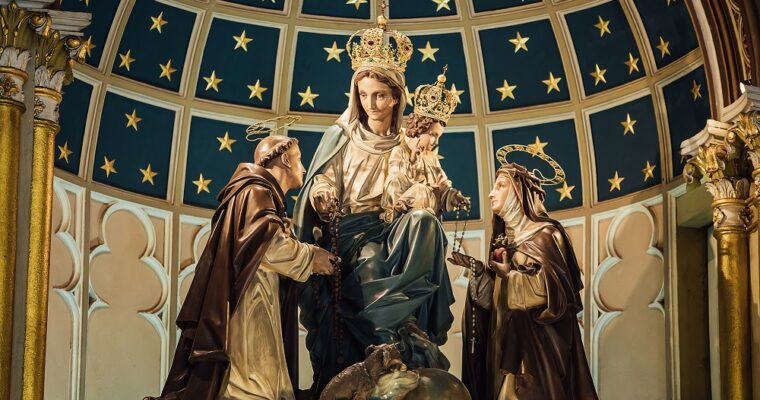
How to recite the supplication to Our Lady of Pompeii

How to recite the supplication to Our Lady of Pompeii

Contents1 What is the supplication to Our Lady of Pompeii?2 Prayer to Our Lady of Pompeii: the text3 Padre Pio and the Rose at Our Lady of Pompeii4 The Sanctuary of Our Lady of Pompeii The Virgin of the Rosary is celebrated on 8 May.…

Padre Pio’s devotion to Our Lady of Pompeii and the gift of the rose

Padre Pio’s devotion to Our Lady of Pompeii and the gift of the rose

May 5 is the feast day of the Saint of Pietrelcina. Discover the evocative birth of devotion to Padre Pio and Our Lady of Pompeii

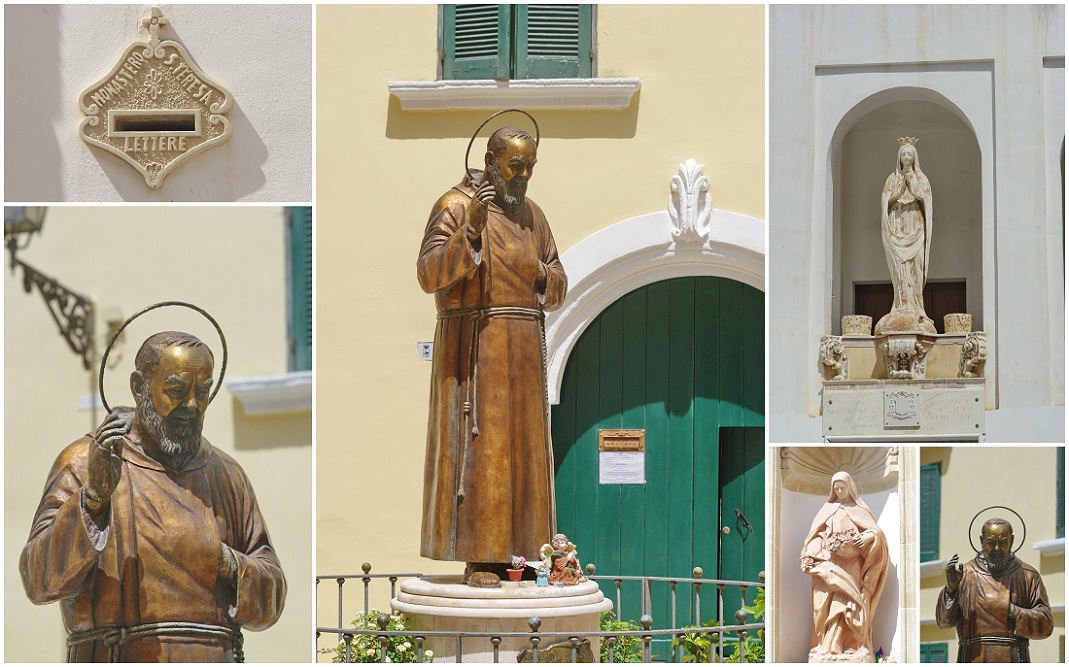
That Saint Pio of Pietrelcina is one of the most beloved and venerated saints in our country, and not only, is well known. His fame as a miracle worker, in addition to the example of his own life marked by prayer, sacrifice and total dedication to others, have earned him a popular devotion begun when he was still alive. Every year thousands of people visit the Sanctuary of Padre Pio in San Giovanni Rotondo, one of the most famous pilgrimage sites in the world. In this article, we want to dwell on Padre Pio and Our Lady of Pompeii, an aspect that on the one hand emphasizes the deep love that the Saint brought throughout his life to the Blessed Virgin, on the other tells a fascinating miraculous event related to his figure.

The Shrine of Padre Pio

Read more:

The Shrine of Padre Pio in San Giovanni Rotondo
What drives thousands of people to visit the Shrine of Padre Pio in San Giovanni Rotondo every year?

Padre Pio and the Sanctuary of the Blessed Virgin Mary of the Holy Rosary of Pompeii

Let us remember that throughout his life Padre Pio was an Apostle of the Rosary. He loved immensely this devotional practice, which he recited several times a day, and always carried a Holy Rosary, wrapped around his hand or arm. Even at his death he held the rosary in his hand. As we well know, the Rosary is the most widespread devotional and contemplative prayer recited by Christians all over the world, especially for the possibility attributed to it of receiving indulgences, thanks to the intercession of Our Lady.

During his life, Padre Pio went on pilgrimage to the Shrine of the Blessed Virgin Mary of the Holy Rosary in Pompeii, one of the most important and visited Marian shrines in Italy, at least three times, the first barely fourteen years old, together with his teacher then and some fellow students.

He then returned in 1911, when he was a young priest in the convent of Venafro, and again in 1916, during a licentiate.

The correlation between the Madonna and the rose

It was September 20, 1968, and Padre Pio lived his last days in the world. Fifty years had passed since he received the Stigmata and a devotee offered him a basket of red roses to celebrate the anniversary. The Saint moved, took one and handed it to him, asking him to bring it as an offering to Our Lady of Pompeii. The devotee was very happy to satisfy him and worried that the rose would be placed right in front of the picture of Our Lady. Three days later Padre Pio had died, and a nun, removing the flowers in front of the effigy of the Madonna, noticed that, while all the flowers had withered, the rose of Padre Pio was still fresh, indeed, had even returned to close in a fragrant bud. Informed of the miraculous event, the bishop prelate of the Shrine of Pompeii wanted it to be placed in a precious reliquary in which it is still kept today.

In our store, you will find many articles, in particular pictures, rosaries, and statues, which recall this story of devotion and celebrate the link between Padre Pio and Madonna di Pompei

painting press our lady pompeii
Our Lady of Pompei printed picture 27x19 in
Buy Now
rosary p pio and jesus misericordial wood
Rosary with Padre Pio and Merciful Jesus in wood
Buy Now
blessed vergine rosary pompeii
Shrine of the Virgin of the Rosary of Pompei replica
Buy Now
St. Pius resin
Padre Pio in resin, Landi 30cm
Buy Now

The Scent of rose of Padre Pio

Padre Pio’s apparitions and spiritual visits have always been characterized by particular scents and smells. Already in life his person and his clothes emanated different scents, as many people who have known him testify. These scents spread like a scent in their passage, remaining in the environments in which they had stayed. After his death, perfume became his way of conveying messages to his devotees. In particular, the scent of rose would be the one chosen by Padre Pio to manifest his presence to those who invoke his help. However, not everyone can feel this perfume. Many of those who say they have heard him also claim to have benefited by the Saint a grace for themselves or for someone who was dear to them.

The Madonna del Roseto represented by various artists

The Madonna del Roseto represented by various artists

Contents1 The roses: symbol of Mary2 The Madonna del Roseto: the most famous works3 Other representations of Madonna del Roseto The theme of the rose symbol of Mary is recurrent in art. Here are the most famous works depicting the Madonna del Roseto and the…

The tomb of Saint Peter and his incredible discovery

The tomb of Saint Peter and his incredible discovery

The tomb of St. Peter in Rome has always been considered one of the sacred places par excellence of Christianity. Simon, called Peter, was the head of the twelve apostles by the will of Jesus himself, designated by him as the head and founder of…

The story of St George who killed a dragon

The story of St George who killed a dragon

The legend of Saint George and the dragon has become over time a parable of the struggle between good and evil. But who really was Saint George, the holy warrior?

Saint George and the dragon. It looks like the title of a fairy tale. In fact, tradition tells us the story of a Christian martyr, brave soldier, and brave warrior, who came to become one of the bodyguards of the emperor Diocletian. His ancient cult developed in the fourth century and spread throughout Christianity. The Islamists gave him the title of Prophet. What does the dragon have to do with it?

History of San Giorgio

To understand the evolution of the figure of Saint George we must consider that he lived in a very remote era. According to the Passio sancti Georgii, an ancient codex dating back to the thirteenth century decorated with suggestive miniatures, George was born around 280 A.D. in Cappadocia, in present-day Turkey, to a Persian father and a Cappadocian mother. His parents educated him in the Christian religion, but George also grew up learning the art of war, so much so that, once he grew up and moved to Palestine, he enlisted in the army of Emperor Diocletian. He was able to prove himself to the point of becoming one of the Emperor’s bodyguards, but when the Emperor began a fierce persecution of Christians, George was also a victim.

Martyrdom of Saint George

At first, Diocletian, who was fond of the young man and appreciated his warrior skills, tried to convince him to embrace paganism, to sacrifice offerings to the gods, and tempted him with gifts and promises of power. Saint George refused to renounce his faith before the emperor himself, and for this, he was imprisoned, beaten and tortured in every way. While he was a prisoner, God foretold him that he would suffer six years of torment and that he would die three times, three times resurrected. So it happened: George was cut in two with a wheel full of nails and swords, but resurrected, leading to the conversion of the magister militum (commander of the soldiers) Anatolius and all his garrison. Later, with the sole power of his breath, he demolished all the statues of a pagan temple, and thus obtained the conversion of Empress Alexandra. While around him the persecutions against the Christians became increasingly cruel and extensive, George was again condemned to death by the emperor Diocletian. This time he suffered martyrdom by beheading, not before guaranteeing protection to those who had honoured his relics.

The dragon

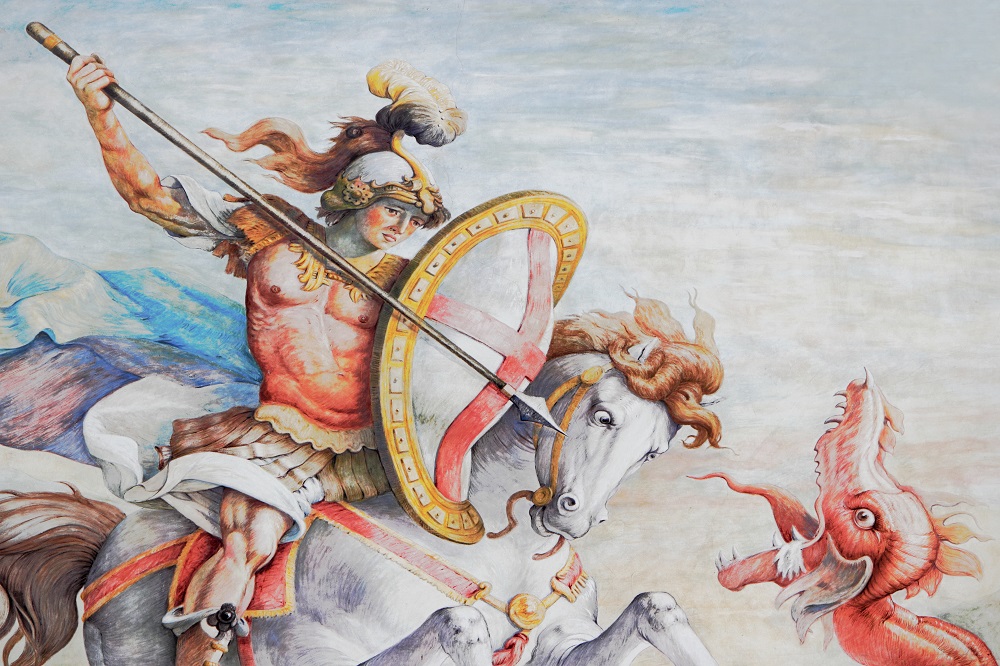
The legend of Saint George and the dragon is told in the Legenda Aurea, the collection of hagiographic biographies composed by Jacopo da Varazze, bishop of Genoa, in medieval times. According to legend, in the city of Salem, Libya, there was a pond inhabited by a huge hungry dragon. The inhabitants of the region tried to appease him by offering him sheep and goats, but at a certain point the cattle were no longer enough and the dragon claimed human beings as an offering. The people of the place began to make a macabre draw among their children, choosing in this way who should be sacrificed to the insatiable hunger of the dragon. When Princess Silene, the daughter of the local king, was also drawn, Saint George appeared at the gates of the city. He proclaimed that God had sent him to defeat the monster, provided that all the inhabitants of Salem accepted faith in Christ. The king and all his subjects agreed to be baptized, and so Saint George confronted the dragon, reduced him to meekness, and had the princess lead him to the city, bound with a simple belt. At the sight of the miracle, all converted and the dragon was killed.

St George and the dragon
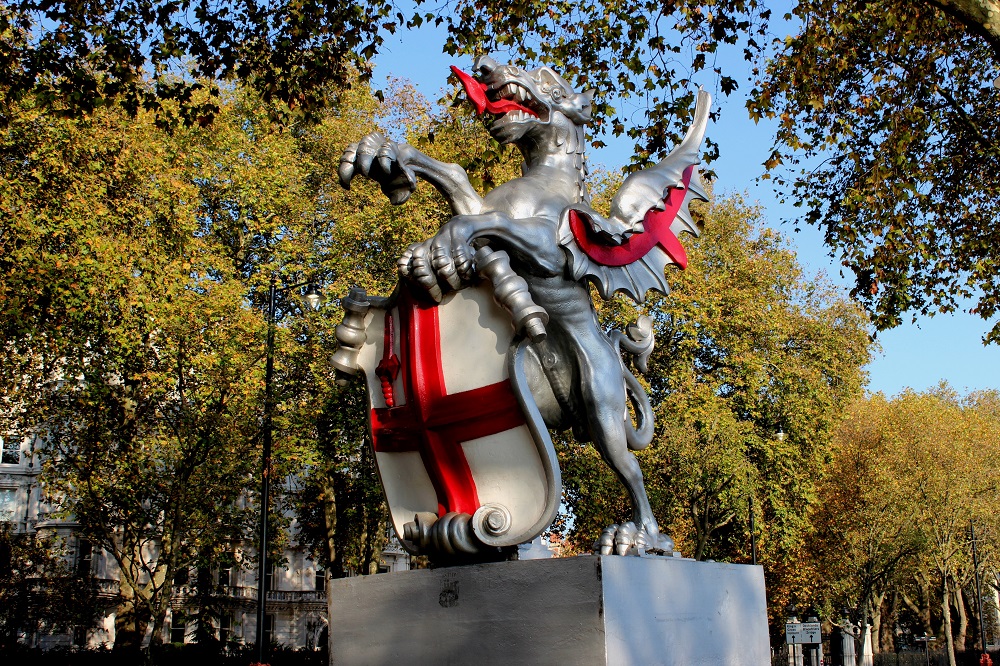
Dragon statue with shield in entrance to the city of London

Spread especially in medieval times, this story inspired many artists, from Paolo Uccello to Donatello in Kandinsky, who represented in their works Saint George and the dragon, but it was also the inspiration for the birth of numerous orders of chivalry that took the name of the Saint. Richard the Lionheart’s devotion to Saint George made him the patron saint of England.

The legend of Saint George and the dragon represents the struggle of good against evil, and the values of Christianity against chaos and barbarism. In this sense, it was taken as an emblem of the ideals of the nascent cavalry.

The Cross of Saint George is a red cross on a white field. Used by the Genoese since the end of the sixth century, it became the official banner of the Republic of Genoa, but it was also used by the Crusader knights for its strong symbolic value and then imprinted on the flags of many nations.

St. George’s Day

St. George is venerated in many Italian municipalities. In Reggio Calabria, his cult dates back to the early 11th century, where he is venerated as the saviour of Calabria against the Saracens. Saint George is also the patron saint of archers, knights, soldiers, boy scouts, explorers and guides. It has been invoked since ancient times like many other saints against skin diseases, but also plague and venereal diseases.

The Last Supper by Leonardo da Vinci

The Last Supper by Leonardo da Vinci

Contents1 Where is the Last Supper?2 Last Supper Leonardo analysis3 The apostles at the Last Supper4 The washing of the feet The Last Supper by Leonardo da Vinci, in Santa Maria delle Grazie, is one of the most famous works in the world, full of…

Easter Monday or Angel Monday? Let’s find out why they are called so

Easter Monday or Angel Monday? Let’s find out why they are called so

Contents1 Easter Monday, Angel Monday, Little Easter2 The Catholic Feasts of Obligation3 How is celebrated Easter Monday Why is the Monday after Easter called Easter Monday? How is Angel Monday celebrated? You will find out in this article. Perhaps not everyone knows that Easter lasts…

The animal symbols of Christian Easter

The animal symbols of Christian Easter

Doves, rabbits, lambs: as animals and other elements of the natural world become symbols of Easter

Men have always reflected themselves in the world around them. How can it be otherwise? Since Creation, humanity has been closely connected to the natural world in which it lives, immersed in a world made up of immense and infinitesimal lives, all irreparably interconnected. The fact that in the modern world this aspect of the existence of the individual and mankind as a whole is increasingly ignored and forgotten does not make it any less real. Indeed, it is to be feared that this inexorable departure of man from nature, of which he too is a part, this ever deeper and irreconcilable abyss, will bring ever more frightening results. It was not so in the past. Although there has always been a relationship between men and the natural world based, in large part, on the will of the former to dominate and control the latter, exploiting the resources for their livelihood and learning to defend themselves from its pitfalls, there was indeed a form of mutual respect. In this scenario, the spirituality of men also found itself in natural manifestations, and animals became a way to understand and make accessible all religious concepts and events that would otherwise remain inaccessible to most. It is starting from this assumption that we can understand how and why plants and animals have become, over the centuries, symbols of Easter, but also of Christmas and, more generally, have been associated with particular Saints, with Our Lady, with Jesus himself.

So we see a quick roundup of Easter animals, creatures often close to men, such as the lamb, hen and farmyard animals, but also wildlife, such as the cardinal, and even the lion.

The lamb in Easter

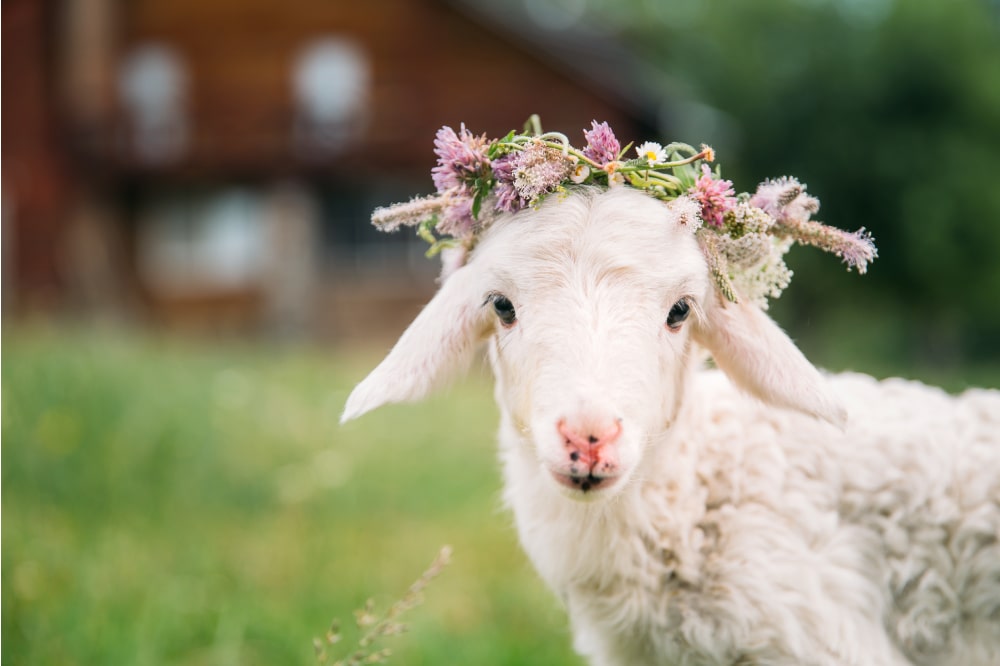
Perhaps the most classic of the symbols of Christian Easter is if we think of the animal world. And also one of the most unfortunate animals, considering the end that many lambs make every year on this anniversary. It must be said that, although it has always been considered the sacrificial victim par excellence, long before it became a symbol of Jesus who died to cleanse humanity from sin, the slaughter of lambs that takes place today on the occasion of Easter has very little to do with religion and spirituality. The meaning of the lamb at Easter goes far beyond eating it at lunch!

The symbolism of the Easter Lamb

Read more:

The symbolism of the Easter Lamb
Easter is getting closer, carrying its solemn suggestions and symbols full of spirituality. The Easter Cross, candles, lamb.

Already in the Jewish sphere this white and fluffy animal, a symbol of purity and whiteness, innocence and meekness, was often used for sacrifices. This is because in the past it was normal to offer the gods what was most beautiful and pure, as a gift. The Jewish Passover, which evoked the escape of the Jews from slavery in Egypt, saw the lamb among its protagonists: in fact, it was with the blood of this very sweet creature that Moses had instructed his companions to dirty the doorposts, to save their firstborn from the terrible passage of the Angel of Death.

How is Easter calculated

Read more:

How is Easter calculated?
Each year changes date but remains the most important holiday: in this article, you will find out how Easter is calculated

After the advent of Jesus, this gracious and tender animal became the symbol of Easter par excellence, a sort of incarnation, to the point that for many centuries after His death it was in this form that He was represented, like a lamb with its body pierced by a cross. Subsequently, this iconography was abandoned, because it lent itself too much to any pagan interpretations, and remained in some devotional forms, such as the Agnus Dei, an object of blessed devotion with a special rite made of white wax, imprinted with the effigy of the paschal lamb curled on the book of Revelation and with a banner with the cross between the legs to symbolise Christ. The recurring formula in these representations is: “Ecce agnus Dei, qui tollit peccata mundi (behold the Lamb of God who takes away sins from the world” (John 1:29)., the words spoken by John the Baptist at the sight of Jesus.

The Lamb at Easter, as a symbol of Jesus who takes upon himself all the sins of the world and dies on the cross, is tormented by those same men whom he came to save. But after death the Resurrection and glory in Heaven, and the promise of salvation for those who choose to follow him who is innocent and pure and good.

Easter Bunnies

As for tenderness and sweetness, even bunnies and hares hold up plenty. Associated in the ancient religions to divinities linked to fertility and fertility, but also to love, as Aphrodite, and to the moon. An ancient Japanese fable tells that the hare, betrayed by its fox and monkey friends and fed to a foreigner, was transformed by the latter into a shining star and immortalised. Even the Celts often resorted to this animal in their symbolism. The alpine hare changes the colour of its fur from white to grey when spring comes, and St. Ambrose has associated this change with the Resurrection. Rabbits and hares are innocent and defenceless animals, and many saints have made them protectors against hunters, making them the emblems of cruel persecution. As Easter symbols, they are often associated with eggs, partly for their fertility, which recalls the triumph of life and the Resurrection, but there are ancient legends that, over time, have left traces that justify the link between rabbits and Easter eggs, such as that of the goddess of spring and the Germanic fertility Eostre who turned a bird into a rabbit, then again into a bird, and he out of gratitude gave her an egg.

Lion (Lion of Judah)

Even the lion, an animal much further from the daily life of men, has clothed over time a strong Easter symbolism. In the Jewish tradition, Judas, the fourth son of Jacob, founded a tribe whose emblem was The Lion of Judah, which is also called Jesus in the Revelation: “Then one of the elders said to me, ‘Do not weep, for the Lion of the tribe of Judah, the Branch of David, has won to open the book and the seven seals'” (Revelation 5:5).

An expression of courage and strength, of the victory of good over evil, the lion becomes in Christ also a symbol of the Resurrection. Remember that the lion cubs for the first three days seem dead and from the third day they begin to move.

European Goldfinch

Over the centuries, many artists have tried to face the complexity of the Paschal Mystery by enriching their paintings with natural elements that symbolize its different aspects. The Madonna del Cardellino painted by Raffaello Sanzio in 1506 is an example. Easter is told through natural images that are only apparently simple but imbued with profound and ineffable symbolism. St John and the Child Jesus play with a cardinal under the loving gaze of the Virgin Mary. Precisely the bird is the fulcrum of the work, as it represents the Passion of Christ. According to legend, a robin tried to remove a thorn from the crown of the head of Jesus on the cross, and in doing so stained his chest red. Another tradition is that there were three birds: a robin, a finch and a goldfinch. The latter, moreover, takes its name from the thistles, vegetables covered with thorns that recall the same crown.

Dove

The Easter dove is also an essential symbol of this holiday, especially when combined with olive branches. Although this graceful white bird was associated with other deities even in pre-Christian times and used in the Old Testament to indicate beauty and meekness, the meaning of the Christian dove is strongly linked to God’s will to communicate His benevolence to men. A dove freed from the Ark brought to Noah the olive branch that informed him of the end of the universal Flood and a new beginning for humanity. When Noah returned, he welcomed the bird with love and gratitude. A dove symbol of peace, therefore, not only between God and man, but also between man and man, and the incarnation of the Holy Spirit in many passages of the Sacred Scriptures.

The dove in Christian iconography

Read more:

The dove in Christian iconography
Even before the birth of Jesus, the dove was considered an animal with a strong symbolic value.

The olive branches are connected to Jesus’ entrance to Jerusalem, amid his triumph and a step away from the Passion. They are also held in the beak by the dove of peace, immortalised by Picasso as a symbol of the Movement for Peace.

Easter Chick

Finally, the symbolism of the egg and the chick that comes from it is perhaps one of the oldest, present in countless cultures and religions since the dawn of time, the protagonist of cosmogonies and myths. For Christians, the egg is a symbol of Christ who rises from the dead and comes out of the tomb by rolling the stone away. The egg, an inert and inanimate object, truly preserves a new life, just as new is the life that Jesus promises to all those who trust and trust in him. The custom of giving eggs on the occasion of Easter is widespread in antiquity. The first Christians decorated them with crosses or other symbols and painted them red to recall the blood of Christ.

The mystery of the Veil of Veronica, the cloth with the imprint of the face of Jesus

The mystery of the Veil of Veronica, the cloth with the imprint of the face of Jesus

Contents1 The Veil of Veronica: to whom did it belong?2 The healing of the bleeding woman3 Saint Veronica4 The Holy Face of Manoppello The Veil of Veronica is one of the most mysterious and fascinating relics in the history of Christianity. Where does the legend…
The story of Jesus: the most important events of His life

The story of Jesus: the most important events of His life

Contents1 Annunciation of the Lord2 Jesus’s birth3 Epiphany (The Magi)4 The escape to Egypt and the slaughter of the innocent5 When Jesus was found in the temple6 Baptism and Temptations of Jesus7 The public life of Jesus8 The miracles of Jesus9 Entry of Jesus into…
Women in the Bible: Jesus and the relationship with his disciples

Women in the Bible: Jesus and the relationship with his disciples

What was the role of women in the history of Salvation? Let us discover the relationship of Jesus with the disciples of the Gospel

A more incisive female presence in the Church. This was the wish of Pope Francis already in 2020, in his prayer intentions for the Angelus of 11 October. The Pontiff’s intention was to integrate women more closely in any decision-making context and in the institutions of responsibility in the Church, claiming their equality with men as baptized, albeit secular. The Pope had already spoken in 2018 about the need to respect women, as Jesus respected them, who: «[Jesus] “dignifies” the woman and puts her at the same level of man, because she takes that first word of the Creator: both are “image and likeness of God”, both; not first the man and then, a little lower, the woman; no, both […] The man alone without the woman next to him – both as mother, as sister, as bride, as work partner, as friend – is not the image of God».

These words of the Pope help us to introduce a broader and more delicate topic, namely the relationship of Jesus with women, the way in which he related to the female world in general and the role of women in the Bible. We speak of his disciples, of those women who followed Jesus in His movements, who listened to the preaching and who took care of Him and the apostles. More generally, although the Old and New Testaments are masculine, it is true that there are many figures of courageous women in the Bible, of complex and fundamental women for the fulfilment of the divine plan, as and more than men. There are many figures of women who have influenced the history of the church and the world, including women in the Bible, saints, mystics and women illuminated by grace.

Returning to the women who followed and loved Jesus, Anna Katharina Emmerick in her visions on the Passion of Christ, in addition to countless details not reported in the Gospels, cited the presence of at least seventeen women close to Him, the existence of which is confirmed by other sources. Remaining with the episodes related to women in the Gospels, we all know well the figures of the pious women at the foot of the cross, who witnessed the death of Jesus on the Cross, described in different ways in the various canonical Gospels, but the presence of which is not questioned by any of the Evangelists. For Matthew and Mark, it was two women named Mary (Mary of Magdala, Mary mother of James and Joseph, or perhaps Mary of Cleophas), and another woman with an uncertain identity. Luke speaks of women in a generic way, while John is much more precise, and speaks of the Virgin Mary, mother of Jesus, of Mary of Cléofa, her aunt and Mary Magdalene, the “penitent” of Magdala.

Mary Magdalene herself was later called “an apostle among the apostles” because she was the first to announce the Resurrection to the other apostles of Jesus, and the “evangelist”, as the bearer of the Good News. And if Luke about the three pious women does not go into too much detail, in other situations is perhaps the most feminist among the evangelists, given the role of primary importance that reserves to Elizabeth, mother of John the Baptist and relative of Mary, Mary herself and her mother Saint Anne at the beginning of her Gospel story.

In view of Women’s Day we want to pause for a moment on a short gallery of the disciples of Jesus. It was above all He who always showed himself close to the women in the Bible, who wanted them at his side and treated them as equals, even deciding to show himself to them first, after the Resurrection.

Maria Maddalena

Who was Mary Magdalene? Mary Magdalene was one of the many people healed by Jesus, who had freed her from seven demons who persecuted her. She was also called Mary of Magdala. In some Gospels, Apocrypha states that Mary Magdalene was indeed the wife of Jesus, but there is no reliable evidence of this. There is no doubt, however, the very strong bond that united them, such as to make Magdalene an important figure as the Apostles. There is also a Gospel of Mary Magdalene, in which she appears as the beloved disciple of the Lord, the depositary of the great divine plan and of a higher teaching that God would have entrusted to her alone.

Certainly the role of this woman alongside Jesus goes beyond the affection and caring devotion of Martha of Bethany (Tamar) or the enthusiasm and desire to learn of her sister Mary (Miryam). Mary Magdalene was the first to whom the Risen Christ appeared on Easter morning, and addressed her by name. Just as the Virgin Mary was chosen by God to bear His Son, Mary Magdalene was chosen by Jesus as the first depositary of the mystery of His Resurrection.

Martha and Mary sisters of Lazarus

Among Jesus’ friends stood Lazarus, who was resurrected from the dead, and his sisters, Mary and Martha. Luke in his Gospel characterizes the latter very much, offering us two portraits of women very different from each other, even if united by their devotion and love for Jesus. Martha takes care of Christ, looks after him as a brother, as a family, with care and dedication. Mary follows him, sits at His feet, venerates Him, listening to what comes out of His lips. Contemplation on the one hand, gestures and practical actions on the other, but on the basis of love for Jesus. The desire to please and care for him with food, warmth, tranquillity, and the love of a family. The example of Martha, Mary and Lazarus of Bethany, the silent and faithful friend and the loving and devout disciples of the Gospel, is a call to mercy and charity nourished by love.

For centuries it was believed that the sinner in the Gospel, the prostitute who would wash Jesus’ feet with her tears and dried with her hair in the house of Simon the Pharisee (Lk 7:36-50) could be Mary Magdalene or Mary of Bethany. Only recent studies have confirmed that it was a third woman who had nothing to do with the other two, except for the fact that Mary, sister of Martha and Lazarus, anointed Jesus’ feet with expensive oil and dried them with her hair (John 12:1-8). In any case, Jesus has always shown the utmost respect and kindness even to women considered ‘lost’, impure and forced to do degrading work.

Samaritan at the well

The episode of the Samaritan woman is told in the Gospel according to John (Jn 4,4-26). Jesus was travelling from Judea to Galilee, and as he passed through Samaria he stopped to rest by a well. Soon after, a local woman arrived. There was no good blood between the Jews and the Samaritans, but Jesus kindly turned to her and asked her if he could give her some water from the well. Astonished by so much kindness the woman asked her reason, and Jesus answered her: «If you knew the gift of God and who is he who tells you: “Give me to drink!” you would have asked him yourself and he would have given you living water» […] «Whoever drinks of this water will thirst again; but whoever drinks of the water that I will give him, will never thirst again, indeed, the water that I will give him will become in him a spring of water that gushes for eternal life».

The episode of the Samaritan woman at the well highlights Jesus’ desire to offer salvation not only to the pure Jews and to upright and destitute men and women, but to anyone who could welcome and appreciate her with a heart full of faith. Water itself is a symbol of salvation and the New Covenant.

The bleeding woman

Among the many healings attributed to Jesus in the synoptic Gospels, there is also that of the bleeding woman, a woman who for years suffered from haemorrhage. Taking advantage of the crowd that was crowding Jesus who was going to the house of Jairus, head of the synagogue, he approached him and stealthily touched him behind. Immediately recovered. Jesus turned and asked who had touched him, and when she, fearful, was revealed to him he did not mistreat Jesus but confirmed to her that her faith had saved her.

Also in this story emerges how Jesus was close to those who were considered not pure, also for reasons independent of his will, and exalts the healing power of faith.

Holy sinners: here are the most famous conversions

Holy sinners: here are the most famous conversions

Contents1 Saint Paul of Tarsus2 Saint Camillus de Lellis3 Saint Matthew4 Saint Disma5 Saint Augustine6 Saint Pelagia7 Saint Mary of Egypt Holy sinners. A contradiction in terms? Not always. Here are the saints who converted after a life of sin Is one born or becomes…

5 good reasons to buy religious items online

5 good reasons to buy religious items online

Contents1 1. Choose the best product2 2. All the choices you want3 3. No stress or anxiety4 4. Helpful and unobtrusive customer service5 5. Receive the goods at home6 Other reasons to choose Holyart Still not sure whether to buy a crucifix or what you…

Angels and Saints: how the life of some saints was influenced by angels

Angels and Saints: how the life of some saints was influenced by angels

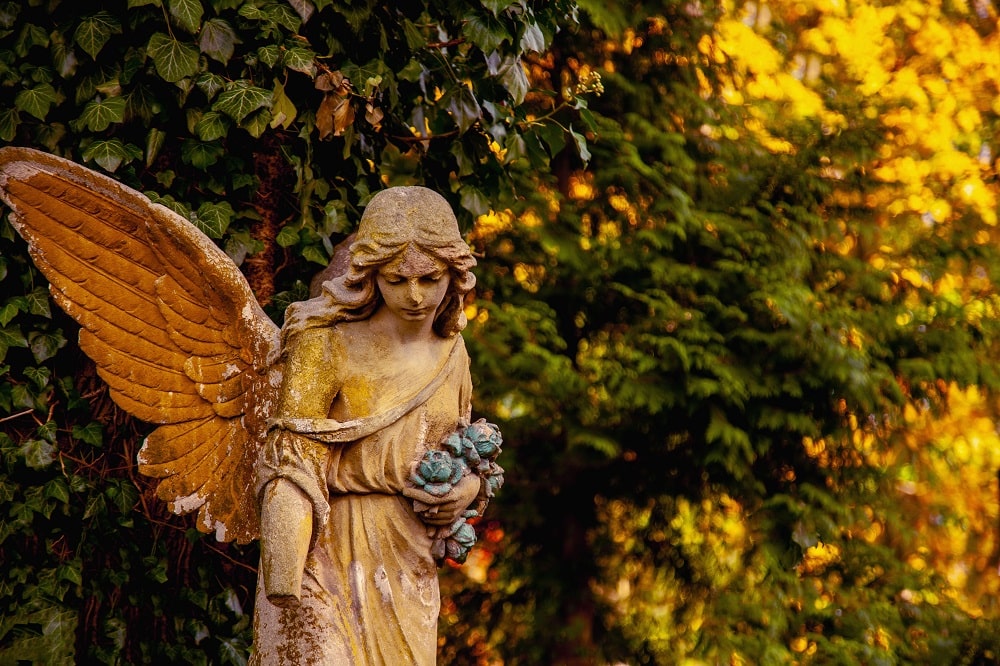
What are angels and how do they intervene in human life? The lives of the saints help us to enter into the mystery of the heavenly spirits.

In both the Old and New Testaments we find interventions and apparitions of angels, which manifest the will of God and mediate between the human and the divine reality. The nature of the angels and their role in the History of Salvation has been the subject of study by several Fathers of the Church.

The Catechism of the Catholic Church says that angels “are spiritual creatures who unceasingly glorify God and serve his saving plans for other creatures […] Angels surround Christ, their Lord. They serve him above all in the fulfilment of his mission of salvation for all men. The Church venerates the angels who help her on her earthly pilgrimage and who protect every human being” (CCC 350-352).

The hierarchy of angels

The hierarchy of the celestial hosts has waned in the De coelesti hierarchia of the Pseudo-Dionysius the Areopagite. This scheme divides the angels into three hierarchies, each of which contains three orders or choirs. These are the three hierarchies in descending order of power:

  • First Hierarchy: Seraphim, Cherubim, Thrones
  • Second Hierarchy: Domination, Virtue, Power
  • Third hierarchy: Principalities, Archangels, Angels

Many Holy Fathers, such as St Gregory the Great, St John Damascene and St Thomas Aquinas, followed the theory of Pseudo-Dionysius.

Saints and angels

The cult of angels has great strength and spread. Saint Francis de Sales said: “Good angels desire our good and do not disdain to assist us. Our good angels give us the strength and courage to practice virtue. Extend your hand to your good angel to lead you to heaven”.

It is interesting to see how the relationship between saints and angels is often a special and mysterious relationship. Many saints, thanks to their Faith, have seen angels manifest themselves and intervene in their lives, in different and particular ways.

St. Francis of Assisi

Saint Francis of Assisi received the stigmata from an angel: a Seraph with six flaming wings. It is also said that in the church of the Porziuncola the angels were a habitual presence for Saint Francis and that, during his illness, the angels comforted him with their singing.

saint francis

Read more:

The Canticle of the Creatures of St. Francis
St. Francis of Assisi is one of the most loved and venerated saints by the Catholic Church.

Saint Theresa of Avila

The reformer saint of Carmel is known, among other things, for the episode of her ecstasy. Recounting it, she describes how an angel pierced her heart with a golden dart with a burning tip, leaving her mysteriously immersed in an infinite love for God.

saint teresa

Read more:

Saint Teresa of Avila: Spanish nun and mystic
Saint Teresa of Avila was a Spanish nun and mystic. One of the few women declared a Doctor of the Church, she reformed the Carmelite order

Saint Aloysius Gonzaga

Saint Aloysius Gonzaga was particularly attached to devotion to angels. Among his intentions were some practices in their honour, such as the recitation of the Angele Dei in the morning, in the evening and during the day. He also composed a short treatise on what the Holy Scriptures say about celestial spirits.

Saint Philip Neri

The saint of joy had a special relationship with his guardian angel. Once he was raised high to prevent a carriage from overwhelming him in an alley in Rome. In another episode, the angel appeared to him in the form of a needy who asked for alms: the saint was ready to give him all the little he had, but the angel replied that he only wanted to see what he was capable of, then disappeared.

Saint Dominic Savio

Even the young saint, a friend of Don Bosco, had a close relationship, with full confidence, with his own guardian angel. When he dived to save his little sister who had fallen into a pond, even though he could not swim, he managed to do so because his angel supported him. When he walked alone in the streets, he said he was not afraid because with him, even if invisible to the eyes, there was his guardian angel.

Saint Angela of Foligno

Saint Angela of Foligno had a vision of angels and speaks of the joy that comes from them as something extraordinary. He wrote: “I felt such joy at the presence of the Angels and their speeches filled me with so much happiness that I would never have believed that the holiest Angels were so kind and able to give such delights to souls”.

Skincare routine: natural products for face care

Skincare routine: natural products for face care

Contents1 Anti-wrinkle cream2 Natural anti-ageing cream3 Rejuvenating face cream4 Cleansing milk5 Argan oil Taking care of your facial skin every day is the surest way to keep it young and fresh. Let’s find out the ideal skincare routine together. We live in a society where…

Feast of Sant’Agatha in Catania between faith, tradition and folklore

Feast of Sant’Agatha in Catania between faith, tradition and folklore

Contents1 The history of Sant’Agata2 Saint Agatha, patron saint3 The procession of Saint Agatha4 The candelore of Saint Agatha The feast of Saint Agatha in Catania, with processions, typical costumes and famous candles, is a great event for many devotees. What is it? The feast…

5 valid reasons to inquire and read the Holyart Blog!

5 valid reasons to inquire and read the Holyart Blog!

Catholic blogs provide information, stories and curiosities about the Christian world. This is what drives us at Holyart to give you new and engaging content every day.

Write an article to promote our blog? Why not?

Perhaps we tend to take it for granted that Catholic blogs always and only act through a mission of evangelization and the will to address exclusively those who, already fervent believers, can look for topics close to their life and spirituality in them.

This is not entirely wrong, because truly those who like us disseminate a certain type of content do so in the full awareness that the reading will be mainly Christian and Catholic men and women, who have studied catechism, know very well the church, the Sacraments, the Gospel, dogmas, the stories of the saints.

But we at Holyart are not a simple blog linked to a Catholic newspaper, or to a diocese. We are a company, made up of people, and each of us is committed to doing our best job, for our success and your satisfaction.

We are the largest and leading e-commerce in Europe for religious articles, and our service is extended to many countries, each with dedicated customer service. This is why our site is translated into 8 foreign languages. In this scenario, it is clear that even those who write articles and keep the blog updated with always new and useful content offer a service that we believe is indispensable.

So here are 5 good reasons to read our blog. For our part, we can only renew our commitment to continue to do our best, to involve our readers more and more and convince new ones to follow us. If you already do so, we thank you for your trust and choice. We will do our best not to disappoint you.

1. Values ​​and Mission Holyart

The first reason to read our blog is linked precisely to why the Holyart blog exists. The mission of the Holyart blog is to provide those who follow us with accurate and exact information regarding all aspects and themes of the Christian world. This is why we have chosen to divide our blog into thematic areas, easily accessible, where all the articles we insert are collected and archived in order to be found by you at any time.

Liturgy, Saints and Blesseds, Religion, but also Christmas and Special Occasions, as well as a large space dedicated to monasteries and brotherhoods. We have tried to create a container as comprehensive as possible, which covers all the fields of interest of our readers, which can provide useful information about the products that our catalogue offers, but above all which involves the reader, with anecdotes and curiosities, even unusual ones and surprising.

The approach we have chosen is making even difficult issues accessible to anyone.

We have no academic interest, what we do is collect as many documents as possible, make sure of their veracity, and then filter them in order to make them understandable, usable and – we hope – pleasant to read for everyone. Knowledge of the Church, the stories of the Saints and the blessed, and even the Dogmas of religion are precious subjects, which should be within the reach of anyone who has the desire to approach them. At the same time, we are always aware that the issues we deal with cannot be trivialized in any way.

The task of Catholic blogs is even more difficult for this very reason: you need to be really good at creating easy-to-read texts that anyone can read on their computer or smartphone at any time of the day, while not detracting from the greatness of theological and spiritual concepts. treaties, ritual and devotional.

Holyart blog and marketing department
Holyart Customer Service
Holyart Logistics
Holyart Logistics
Over 50,000 items in stock

2. Stories of Saints

The stories of the Saints have always fascinated the Christian faithful. Perhaps because it has always been easier for ordinary people to approach religion and its great mysteries through figures of men and women like them, who knew how to live in God’s grace and conduct themselves in such a way as to deserve holiness.

Models of life and faith, objects of devotion and comfort in times of difficulty, the saints and blessed are the protagonists of fascinating stories, in which  historical interest is combined with spiritual and devotional interest.

This is how we at Holyart have chosen to introduce them to you, accompanying you to discover their extraordinary lives and trying to make you feel a little closer, a little more similar. Thus the saints and blessed become friendly and understandable presences, current in their immortality, reference models to be inspired by and from which to draw the strength to face the difficulties of daily life, such as the 10 Christian Women who changed the Church and the world, or the Holy Martyrs who sacrificed their lives in the name of God.

3. Handcrafted nativity scenes

Christmas is the holiday most felt by Christians, although Easter is more important from a liturgical point of view. But the spirit of Christmas, the expectation that accompanies Advent, really involves everyone, young and old, with suggestions that come from the past, from family memories and popular traditions that over time have been mixed with religion in an indissoluble way.

It will also be that sense of warmth and intimacy that surrounds the houses, illuminated by the light of candles that warm the environment, but also the hearts, with all their deep symbolism.

Candles, therefore, but also Christmas trees, with their splendid and varied decorations, and lights, festoons, decorations for the home and for the outdoors, greeting cards, gifts, all the Christmas items you find in our catalogue are also told in our blog, to advise you and help you prepare in the best way the most beautiful party of the year.

Of course, a large space in our blog is dedicated to the Nativity scene, in all its forms, but in particular, to the handcrafted Nativity Scenes, the DIY Nativity Scenes that so engage and excite those who follow.

To help you create your unique and special nativity scene, we not only publish insights into the most beautiful nativity scenes in Italy, or the nativity scene in the world, but also practical tutorials on how to build a DIY nativity scene, or how to create your own nativity scene with a waterfall in a few simple steps or how to build a Neapolitan nativity scene.

The Neapolitan Nativity scene in particular is the protagonist of many articles, where all the deepest and most fascinating aspects of its tradition are examined, from the symbolism of the characters to the trades to the sets.

4. Liturgical Times and Calendars

Understanding what the liturgical times of the Catholic Church are and how they are divided is fundamental for a Christian. But it is not always easy, and often even Catholic blogs fail to define it fully and clearly for everyone. For this reason, in a recent article on our blog, we wanted to summarize the division of the liturgical year into liturgical times, precisely to help those who still have doubts to understand in a concise and synthetic way how the liturgical times of the church are organized.

Not only that, we try to keep you up to date on the holidays (the ones that change and not) and on the celebrations that accompany the salient moments not only of the liturgical year but also the feasts linked to individual saints, identifying for you the most evocative celebrations with which they are remembered. the various recurrences, such as the Assumption of Mary, just to give an example or the feast of Corpus Domini. But let us not overlook other recurrences that are not strictly religious, but equally important for us and worthy of being remembered by Christians, such as Grandparents’ Day or World Friendship Day.

Again, we want to inform you about sacred furnishings and vestments, explaining why certain objects or materials are used in celebrations and what certain customs derive from. For this reason, we also dedicate in-depth articles to chalices, pyxes, and patens, to help priests choose the chalice that suits their needs, or which materials are better to prefer for mass services or for baptism services.

Vestments and liturgical garments are featured in other articles, to help readers understand the different meanings of liturgical garments or the colours of the Catholic liturgy and their meaning.

5. Made in Italy craftsmanship

Another of the missions that we have set ourselves to carry out with our online catalog and with our blog is the promotion and dissemination of products and working realities linked to the tradition of made in Italy and quality. These are small businesses, often family-run, some with an ancient and illustrious history, made of love for detail and respect for their work. Like our suppliers of sacred plaster statues, who carry out their work in an artisanal way with great professionalism and attention to detail, or like those who create for us exclusive religious metal jewels decorated with enamel according to craftsmanship methods, made almost entirely in hand and cared for in every aspect.

Made in Italy craftsmanship

And then there are the products of Italian monasteries, food excellence, but not only. Of course, we have dedicated many insights to liqueurs and jams made in monasteries, with genuine ingredients and traditional methods handed down by monks over the centuries, as well as to herbal health products, such as propolis and all its benefits, cosmetic creams of a thousand virtues, and so on. But our goal is to talk not only about products but also about the history behind them, a history made up of men and small and large events, made above all of dedication to work and faith.

So, for example, speaking of the excellent monastic beers, appreciated all over the world, we also wanted to dwell on the holy brewers and their miracles, revealing to our readers legends and curiosities about the saints who inspired the master brewers over the centuries, or telling you about the atelier d’art de Bethleem we wanted to talk about craft techniques and the life of the nuns who work there.

As always, men and women first of all.