Saint Lawrence the Deacon dedicated his life to serving the poorest and those most in need. On the night of the shooting stars, the Church commemorates his martyrdom and his mercy.
On 10 August, the Catholic Church celebrates Saint Lawrence, Deacon and Martyr, Patron Saint of Permanent Deacons. During his lifetime, he served as Archdeacon of Rome under the future Pope Sixtus II, meaning that he was responsible for the charitable activities of the Diocese of Rome and its early Church. As a deacon, he was entrusted with leading and coordinating efforts to assist those living in poverty and hardship, such as orphans and widows. His dedication and generosity in serving others have become a model for all those engaged in charitable work and solidarity.
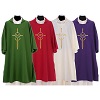
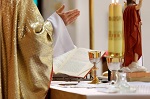
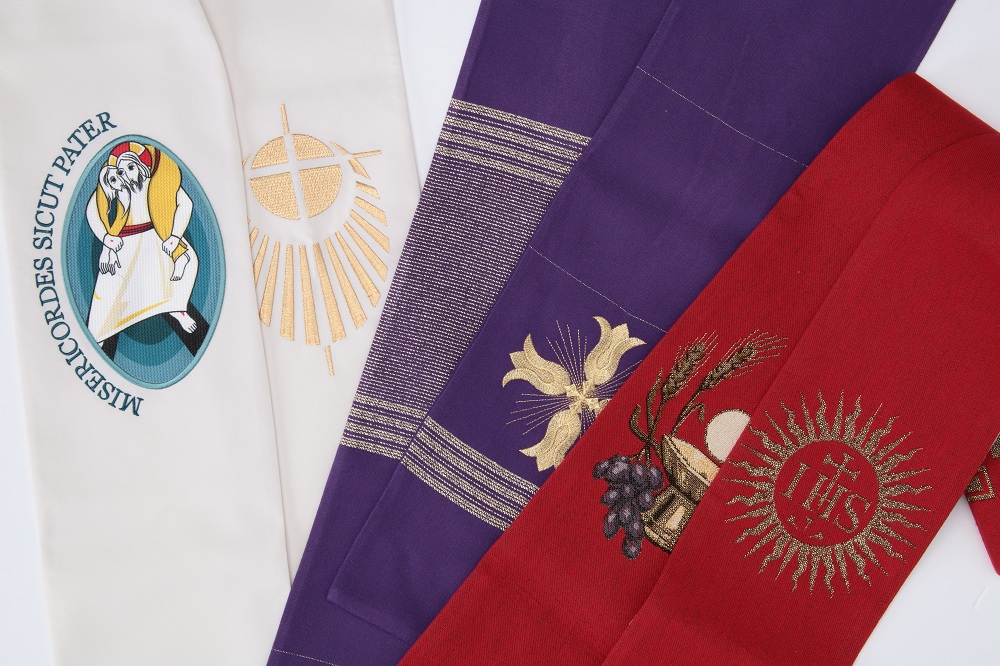
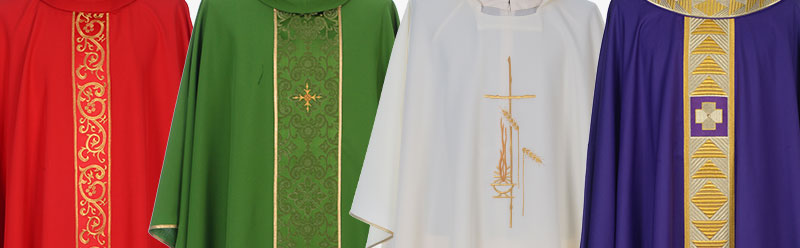
You can find the dalmatics with the official logo of the Jubilee 2025 in the four liturgical colors.
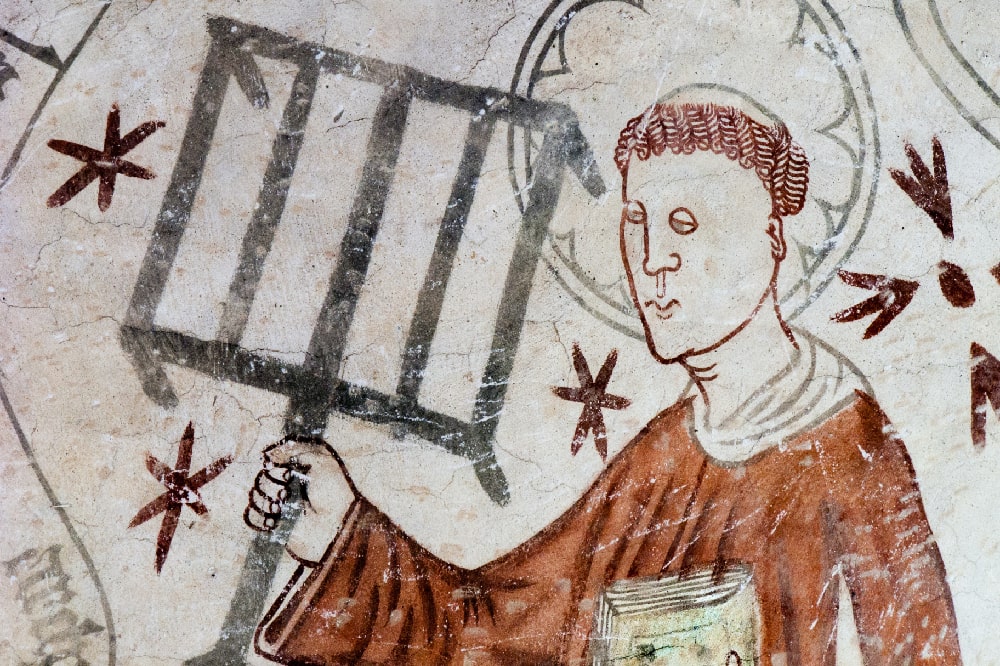
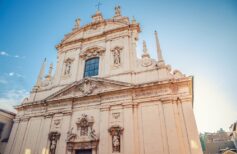
In Church tradition, Saint Lawrence is often depicted holding a gridiron, the symbol of his martyrdom. His cult is ancient and spread rapidly after his death. Many churches and communities celebrate the feast of Saint Lawrence on 10 August with processions, solemn Masses and other activities in his honour. Patron saint of several cities, including Grosseto and Tivoli, he is also one of the three patron saints of Perugia and co-patron of Rome. Genoa Cathedral is dedicated to Saint Lawrence the Deacon. He is regarded as the patron saint of librarians, cooks, booksellers, pastry chefs, vermicelli makers, firefighters, roast cooks and glassworkers.
In the town of Amaseno, an ampoule containing his blood is preserved. It is displayed to the faithful during the feast on 10 August and, on that occasion, liquefies in the same way as the blood of Saint Januarius in Naples, before coagulating once again.
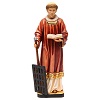
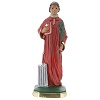
This statue in maple wood is hand made by the Valgardena artisans
Saint Lawrence the Deacon
Little is known about the history of Saint Lawrence the Martyr. Born in the 3rd century in Huesca, Spain, he showed remarkable learning and virtue from an early age. He completed his humanistic and theological studies in Zaragoza, where he met the future Pope Sixtus II, then Archdeacon of the Roman Church, who became both his friend and mentor. Together they travelled to Rome, where Lawrence joined the clergy of the early Church. At the age of seventeen he was ordained acolyte by Pope Fabian, and six years later, when Sixtus became bishop, he received the sacred orders of subdeacon and then deacon at just twenty-seven years of age, enjoying the privilege of becoming one of the seven deacons of Rome. His position as archdeacon placed him in charge of assisting the Pope in caring for the poor and the needy.
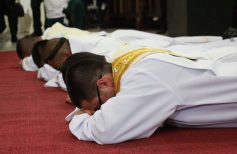
The Second Vatican Council defined the laws and structure of the modern Diaconate, the first level of ordained ministry in the Church. Today, a deacon is a man who chooses to live midway between the lay state and the priesthood. He is not a priest, yet figures comparable to this role have been documented since the time of the Apostles, often serving bishops, just as Saint Lawrence did.
Deacons can be divided into two categories: transitional deacons and permanent deacons. Transitional deacons are those ordained as deacons in preparation for their future ordination as priests. Their diaconal ordination is therefore temporary and prepares them for their future ministry as priests. Permanent deacons, of whom Saint Lawrence is the patron, are those who choose to be ordained only to the Order of Deacons, without seeking priestly ordination. These deacons may come from both unmarried baptised men and married men, dedicating their lives to serving the Christian community without the prospect of becoming priests.
During the reign of the Emperor Valerian, in AD 258, an edict was issued ordering the confiscation of the Church’s property and the execution of all bishops, priests and deacons. Saint Lawrence the Deacon was arrested and, according to tradition, Sixtus was imprisoned as well. As the latter was being brutally dragged away by soldiers, Lawrence ran towards him with tears streaming down his face and said: “Where are you going, Father, without your son? Where are you going, holy priest, without your deacon?” Sixtus replied: “I do not leave or abandon you, my son, but greater trials await you… In three days you will follow me… Take the riches and treasures of the Church and distribute them to whomever you think fit.” Lawrence immediately set to work, seeking out the poor and the clergy in every corner of Rome, distributing all the wealth he had gathered among them. Then, after bidding farewell to the Christians for the last time, he presented himself before Valerian, who had summoned him, and in response to the demand that he hand over the Church’s possessions, promised to show them within three days. He walked through the streets of the city gathering a great number of poor people and led them before the Emperor, saying: “Here are the treasures of the Church!” With this bold act, he sealed his own death sentence.
According to tradition, Saint Lawrence suffered martyrdom upon a burning gridiron. Legend also tells that he maintained extraordinary courage and infectious humour until the very end, saying to his executioners: “I’m well done on this side. Turn me over onto the other!”
Saint Lawrence’s martyrdom is believed to have taken place on 10 August and is first mentioned in the *Depositio martyrum*, a document dating to AD 354, and later in the *Passio Polychromi*, a text from between the 5th and 7th centuries. From the very beginning, the events surrounding his arrest and death became intertwined with legendary elements, which did not prevent many distinguished scholars and men of faith from recounting his story on the basis of earlier testimonies. One such figure was Saint Ambrose, one of the four great Doctors of the Church, in his *De officiis ministrorum*.
After his death, the body of Saint Lawrence was laid to rest in a tomb along the Via Tiburtina. Emperor Constantine I later had a basilica built on the site, which, having been restored after the damage sustained during the Second World War, continues to be an important place of pilgrimage for the faithful. The site of Saint Lawrence’s martyrdom, meanwhile, became home to the Church of San Lorenzo in Panisperna, whose name derives from the tradition of the friars and Poor Clares distributing bread and ham to the poor on 10 August.
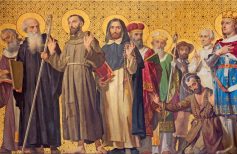
The martyrdom of Saint Lawrence has also become one of the most iconic and frequently depicted episodes in Christian art. Many great masters portrayed the moment of his arrest and martyrdom, including Bernardo Strozzi, Pietro da Cortona and Titian.
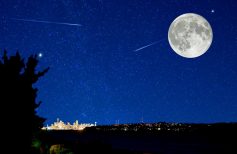
There are several traditions linking Saint Lawrence the Deacon with shooting stars. This connection between the saint and the falling stars was immortalised in Giovanni Pascoli’s poem *X agosto*, in which the falling stars are interpreted as heavenly tears. From a scientific perspective, we know that in the days around 10 August the Earth passes through the Perseid meteor shower. This creates a genuine shower of shooting stars visible in the summer sky. Recalling the death of his father, murdered on the night of 10 August 1867, Giovanni Pascoli saw in the stars that seemed to burn and fall through the still air the heavenly tears of a great sorrow blazing across the vast sky.
*Saint Lawrence, I know why so many*
*stars through the tranquil air*
*burn and fall, because such boundless grief*
*blazes across the hollow sky.*
The shooting stars visible in the sky on the night of Saint Lawrence are therefore said to be heavenly tears or, alternatively, sparks that escaped from the pyre of the young saint at the moment of his martyrdom.
The catechism is much more than simply preparing to receive the Sacraments of the Catholic Church; it represents a journey...
What’s the Future of Religion?
What’s the Future of Religion?
A Beginner’s Guide to Christianity
A Beginner’s Guide to Christianity
Mind-Blowing Statistics About Christianity You Need to Know
Mind-Blowing Statistics About Christianity You Need to Know
8505
Enter the Holyart world: $20 discount voucher valid on over 60,000 items
Come and discover Holyart, the largest e-commerce of religious articles in Europe and immediately receive a $20 voucher to use with your first purchase.
Check your mailbox: you will receive your discount within 5 minutes



 21 October 2026