Homepage | Religion | Storm on the Sea of Galilee: a biblical episode told through art
Storm on the Sea of Galilee: a biblical episode told through art
12 October 2026
Reading Time: 6minutes
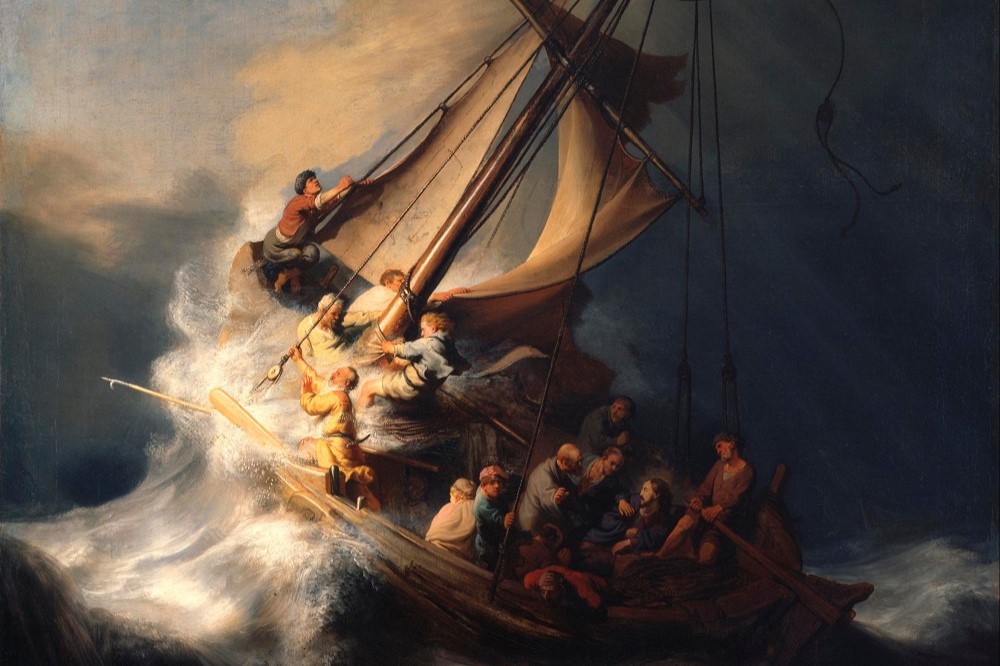
Rembrandt’s painting Storm on the Sea of Galilee tells a story of faith and hope. Especially when we feel lost in the storms of life, God’s love and faith save us, if we are ready to trust blindly
Art has always been a powerful means of telling and immortalising sacred stories. We think of the countless paintings and frescoes preserved in churches throughout the world, an artistic heritage which, especially in our country, reaches immeasurable value, the statues that adorn squares and places of worship, but also the architecture of the great cathedrals, and the sacred music composed by immortal musicians. From the origins of Christianity, the faithful have felt the need to visibly depict the object of their devotion. For the early Christians, forced to conceal their faith, this often meant engraving symbols and messages understandable only to other members, allowing them to communicate without risking persecution. Over time, as Christianity became the official religion and spread throughout the known world, the creation of sacred images underwent enormous expansion. This is because art speaks to the soul, and becomes the language of the soul, in a deep and intimate dialogue that changes from person to person, according to character and spirituality.
Among all these works of art that have been and are an expression of the human yearning towards God, Rembrandt’sStorm on the Sea of Galilee stands as an example of how art can become a vehicle for a message of hope and consolation, even when it depicts dramatic episodes. This is such a case. That of Christ in the Storm on the Sea of Galilee is a biblical episode of great emotional impact, masterfully immortalised by the Dutch painter Rembrandt. This event, narrated in the Gospel of Mark, sees Jesus calm a furious storm, demonstrating His divine power and reassuring the frightened disciples.
Christ in the Storm on the Sea of Galilee (or simply Storm on the Sea of Galilee) is described in the Gospel of Mark(4:35-41). Jesus and His disciples were in a boat when a violent storm descended upon them. While the disciples were terrified, Jesus was sleeping peacefully. When they woke Him, He rebuked the wind and the sea, which immediately became calm, and asked the disciples whether they still did not have faith in Him. This miracle demonstrated His authority over nature and strengthened the disciples’ faith.
Rembrandt Harmenszoon van Rijn, one of the greatest Dutch painters of the seventeenth century, was able to capture and represent the emotional power of this biblical event. His painting Christ in the Storm on the Sea of Galilee is one of the most iconic works dealing with this subject. Unfortunately, this extraordinary canvas was stolen in 1990 from the Isabella Stewart Gardner Museum in Boston and has never been recovered. Rembrandt was no stranger to sacred art and subsequently created other precious canvases, fortunately preserved to this day, such as The Return of the Prodigal Son, painted in 1668 and now housed in the Hermitage Museum in Saint Petersburg. If the heart of this second painting is that of the three parables of mercy, namely the concept of God’s love and forgiveness, universal and absolute, which embraces everyone without distinction, in the case of Storm on the Sea of Galilee we speak in a different way of God’s love, which does not abandon us even when we find ourselves lost in the storms of life.
Pope Francis also commented on the episode from the Bible that inspired the painting, quoting the Apostles who, terrified and at the mercy of the fury of the elements, cry out to Jesus: “Teacher, don’t you care that we are perishing?”(Mk 4:38) The meaning of the Gospel story and of the painting inspired by it can be summed up in this supplication. How often does anyone find themselves overwhelmed by trials that are too terrible, by anxieties that hold us back and prevent us from seeing a tomorrow? A troubled love, problems at home, a family member who is suffering, or once again a serious illness that appears to leave no way out. On such occasions it is human to doubt, to turn to God asking Him why He does not intervene to save us, why He does nothing for us.
Unfortunately, love for Jesus and Faith cannot protect anyone from suffering and from the tragic experiences of life. Indeed, precisely when we feel most helpless, we have the sensation that He is not there, that He is sleeping, just as in the episode narrated by Mark.
But it is in these moments that true faith emerges. It is too easy to believe in Jesus when everything is going well and we are happy. Much more difficult and courageous is to entrust ourselves completely to Him in adversity, to surrender ourselves to His love and maintain the conviction that He will save us in the end, even when it seems that He is not doing so. God is also in the storm and does not abandon us.
In the Gospel account, after calming the wind and the sea, Jesus asks the disciples: “Do you still have no faith?” This is what we should ask ourselves every day: “Do we truly have faith?” That faith which makes us feel God always at our side, in light and darkness, in moments of serenity and in storms, in the awareness that what we can do is limited, compared with what He can do, and that the only possibility given to us is to entrust ourselves completely to Him, Creator and Saviour.
The sea recurs in the Bible as a place of danger and adversity. The Sea of Galilee, in particular, was often subject to sudden storms, and therefore even more treacherous. In Rembrandt’s painting, we see a dynamic and dramatic representation of the scene. The central theme is Jesus’ ability to bring calm and order amidst chaos, and symbolises the power of faith to overcome adversity. Christ is depicted at the centre, serene and composed, while the disciples struggle with the fury of the storm. The contrast between Jesus’ calm and the surrounding chaos highlights the central theme of the miracle: faith in Christ can overcome any storm. The contrast between the dark sky and the sea illuminated by light is emblematic, as are the faces of the apostles, each of them different, each lost in their own fear, in their own doubt, which takes different forms. One tries to steer the boat at the mercy of the waves, one despairs, one becomes angry, just as every person reacts differently in the face of pain.
And yet it is precisely there that the answer lies, Salvation, in the sleeping Christ who only apparently ignores the despair of His friends. He is there, He has always been there, for those who blindly believe in Him, for those who have Faith, and His salvation is real; sooner or later it comes, for those who know how to wait, even when the world seems to be falling to pieces all around them. And so the apostles who crowd around Him become men in prayer, reaching towards the only glimmer of hope, and we too draw close to one another, and our gaze turns towards God, our hearts ignoring the roar of the wind, the crashing of the sea, in search of the peace and tranquillity that will come.
Let us explore together the profound meaning and importance of the Sacrament of Reconciliation in the Christian faith. The crucial...
What’s the Future of Religion?
What’s the Future of Religion?
A Beginner’s Guide to Christianity
A Beginner’s Guide to Christianity
Mind-Blowing Statistics About Christianity You Need to Know
Mind-Blowing Statistics About Christianity You Need to Know
8738
Enter the Holyart world: $20 discount voucher valid on over 60,000 items
Come and discover Holyart, the largest e-commerce of religious articles in Europe and immediately receive a $20 voucher to use with your first purchase.
Check your mailbox: you will receive your discount within 5 minutes





 12 October 2026