Homepage | Religion | The Faradda di li Candareri: one of the most famous processions in Sardinia
The Faradda di li Candareri: one of the most famous processions in Sardinia
17 August 2026
Reading Time: 7minutes
The Faradda di li Candareri, the Descent of the Candlesticks in Sassari, combines religious devotion, history and popular tradition. Here is how it takes place every year on 14 August
Like many patron saint festivals in Southern Italy, the Faradda di li candareri, or Descent of the Candlesticks of Sassari, is an event that has unfolded over centuries between tradition, religion and spectacle. After all, the city that hosts it, Sassari itself, has deep historical roots and a rich religious and cultural tradition. The Descent of the Candlesticks is one of the most evocative and eagerly awaited events of the year. It takes place on 14 August in honour of the Assumption of the Virgin Mary. This centuries-old celebration combines faith, devotion and spectacle in a unique blend of colours, music and religious fervour.
Here you can find a selection of products for the Assumption of Mary.
The Descent of the Candlesticks has ancient origins and has its roots in a distant past. It probably dates back to the Middle Ages and draws inspiration from the custom of offering candles to Our Lady of Mid-August, which the guilds of arts and crafts of Pisa honoured every year. Also known as the “Faradda di li Candareri” in the Sardinian dialect, the first traces of this celebration date back at least to the 17th century, when the gremi, the guilds of workers and artisans of Sassari, decided to honour a vow made to Our Lady of the Assumption for having saved the city from the plague of 1652. They did so by building majestic wooden structures, covered in wax and decorated with sculptures depicting saints and biblical episodes. Each structure was different from the others, usually taking the form of a large tabernacle, and was carried by the faithful to the cathedral, accompanied by solemn music and chants.
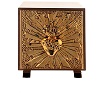
Altar tabernacle made in Italy with thick wood with gold plated shell and inner lining of 24-karat gold plated brass with silver solder…
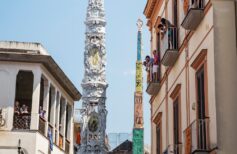
This tradition became deeply rooted in the hearts of the people of Sassari and was carried on even during the Kingdom of Sardinia, despite repeated attempts by the Spanish rulers to abolish it. Over time, the gremi, aware of the considerable expenses required for the construction of the structures and, above all, for the wax covering them, decided to transform the real candles into wooden candlesticks, identical for everyone. This transition took place between the 17th and 18th centuries, and since then the Candlesticks have taken on the form we know today: grand wooden structures, up to eighteen metres high, adorned with elaborate decorations, ribbons and garlands. Each wooden structure is a true artistic masterpiece, created with extraordinary details; each sculpture tells a story and expresses the faith of the community. The sacred representations depicting significant moments from the lives of saints make them portable works of art and best express the history and traditions of the ancient guilds. Even today, each Gremio dedicates itself to creating its own candlestick with pride and devotion.
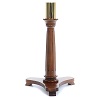
This article is entirely made of walnut wood by Italian craftsmen.
The Descent of the Candlesticks of Sassari is much more than a simple religious celebration: it is an experience that involves the hearts and minds of all those who take part. This extraordinary event continues to embody the identity of Sassari, preserving its historical roots and conveying a message of unity and belonging for future generations. In 2005, aware of the importance and cultural value of the Sassari Candlesticks festival and of other similar events in various Italian cities, the Network of the Great Italian Shoulder-Borne Machines was established. This network includes some of the country’s most significant and traditional celebrations, including the Feast of the Lilies of Nola. This initiative was born from the desire to preserve, protect and promote these precious traditions, recognising their historical, artistic and religious value. The Network of the Great Italian Shoulder-Borne Machines is committed to safeguarding the cultural heritage of our country, passing it on to future generations and maintaining a living connection between the past and the present.
On the occasion of the festival, the citizens are involved from the early hours of the morning, when the ritual of the Dressing begins. This moment of preparation is a special occasion for members of the Gremio, who wear traditional clothing and gather in a spirit of unity and brotherhood. The atmosphere is filled with emotion and anticipation for the great event that is about to take place. The Candlestick is taken from the guild’s patron chapel: the Church of San Pietro in Silki for the Massai, Sant’Agostino for the Viandanti, Sant’Antonio Abate for the Butchers, the Cathedral of San Nicola for the Blacksmiths and Shoemakers, San Giuseppe for the Labourers. The other seven Candlesticks are kept in seven other chapels in the Church of Santa Maria. From the chapel, the Candlestick is taken to the residence or headquarters of the Obriere di Candeliere, the appointed “guardian”, where it is decorated with paper garlands, flowers and characteristic elements that differ for each Gremio. At the top of the Candlestick, the cappelletto is fixed, bearing the names of all the Obrieri embroidered in damask and, in the centre, the emblem of the current Obriere di Candeliere.
The “Faradda”
The herald announces the imminent Descent, which in the Sassari dialect is called Faradda, setting in motion a series of events that will involve the entire community. The Gremio dei Massai, one of the main protagonists of the event, meets with the mayor at Palazzo Ducale, where the starting point of the celebration is established. From here, together, they proceed towards Palazzo di Città, where the Gremio’s flag is displayed as a sign of devotion and belonging.
In the afternoon, in an atmosphere of fervour and anticipation, the thirteen Candlesticks are carried on shoulders from the cathedral square to the evocative Piazza Castello. Here, after a brief stop to give thanks to the Virgin in the nearby Church of the Rosary, the dancing procession begins, opened by the marching band, which advances through the city streets announcing the arrival of the Candlesticks. The majestic wooden works follow in order of admission, performing numerous evolutions with a fascinating and engaging dance: Labourers, Autoferrotranvieri, Butchers, Blacksmiths, Stonecutters, Viandanti, Farmers, Carpenters, Market Gardeners, Shoemakers, Tailors, Bricklayers and Massai.
The Candlesticks sway among the crowd to the sound of drums, while the one belonging to the Viandanti is accompanied by the pipe, spinning and making the *betti* turn, the long ribbons that descend from the top.
The procession crosses Corso Vittorio Emanuele until reaching the Teatro Civico, where, in the presence of the Mayor and the Council, the ceremony of the *Intregu* takes place. The new Obriere Maggiore of the Gremio dei Massai is appointed, and the traditional toast “A zent’anni” (“One hundred years!”) is held, wishing a long and prosperous life to the Gremio and to the entire community of Sassari.
The Faradda continues until late into the night and reaches its climax when the Candlesticks enter the Church of Santa Maria di Betlem.Here they receive the final blessing, in an act of profound faith and devotion. According to the ancient rules dating back to 1531, after the entrance of the Massai and the authorities into the church, the Candlesticks enter the church in reverse order compared with the previous procession. When the Viandanti’s candle prepares to enter, the members of the guild order the breaking of the cross with the Obriere’s flag located at the top of the capital, as a sign of good fortune. The solemn final ceremony then takes place with the participation of the Guardian Father of the convent and the Metropolitan Archbishop of Sassari. These important moments represent the conclusion of the celebration and the moment when the vow connected to the festival is considered fulfilled until the following year.
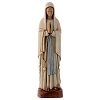
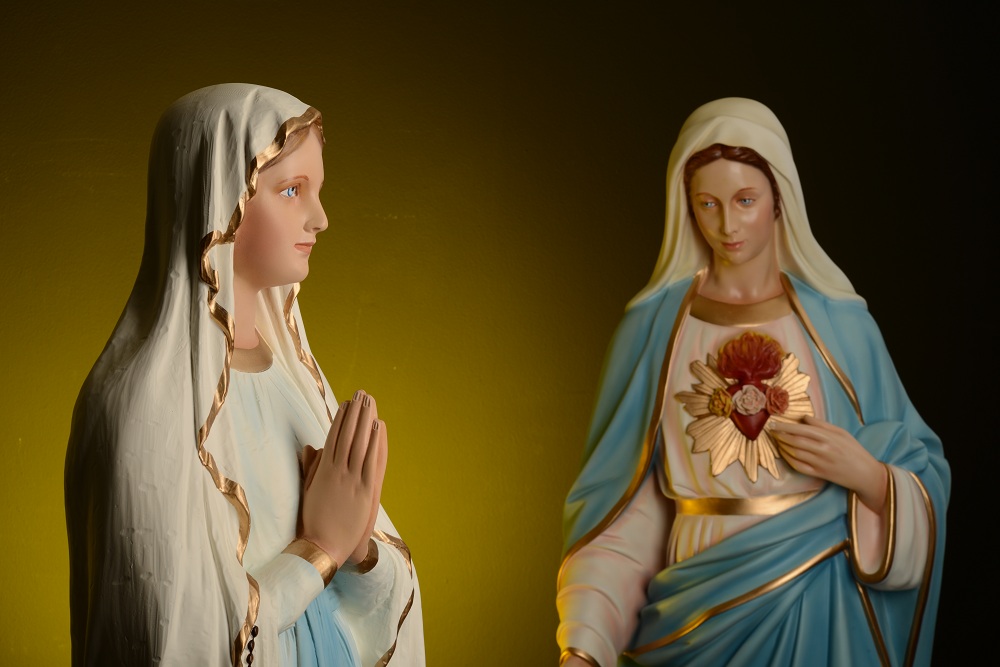
A splendid reproduction of the Virgin of Lourdes, a faithful reproduction of Saint Bernadette’s testimony; an intense and delicate respresentation of the Virgin.
The Descent of the Candlesticks and the Assumption of Mary
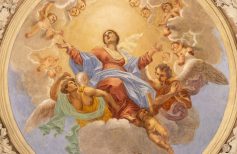
The date of the Descent of the Candlesticks, 14 August, is closely linked to the celebration of the Assumption of the Blessed Virgin Mary, one of the most important moments in the Catholic liturgical calendar. This religious event commemorates the ascent into heaven of the Virgin Mary’s soul and body after her death, at the end of her earthly life. Like many other festivals dedicated to this event, the Descent of the Candlesticks of Sassari is also a testimony of faith and devotion towards the Mother of Jesus and represents a moment of communion and reflection for the entire Catholic community of Sassari.
On 15 August, the actual date of the celebration of the Assumption of Mary, a solemn Mass presided over by the Archbishop is held at the Church of Santa Maria, attended by all the Gremi in official attire. In the evening, a procession departing from the Cathedral of San Nicola carries the Sleeping Virgin through the streets of the city. The Candlesticks are then placed around the Virgin’s catafalque and are returned to their respective patron chapels on 22 August, when the octave of the festival is celebrated.
On 5 October, the liturgical memorial of Saint Faustina Kowalska, mystic and devotee of the Divine Mercy devotion, is celebrated...
What’s the Future of Religion?
What’s the Future of Religion?
A Beginner’s Guide to Christianity
A Beginner’s Guide to Christianity
Mind-Blowing Statistics About Christianity You Need to Know
Mind-Blowing Statistics About Christianity You Need to Know
8551
Enter the Holyart world: $20 discount voucher valid on over 60,000 items
Come and discover Holyart, the largest e-commerce of religious articles in Europe and immediately receive a $20 voucher to use with your first purchase.
Check your mailbox: you will receive your discount within 5 minutes

 30 September 2026