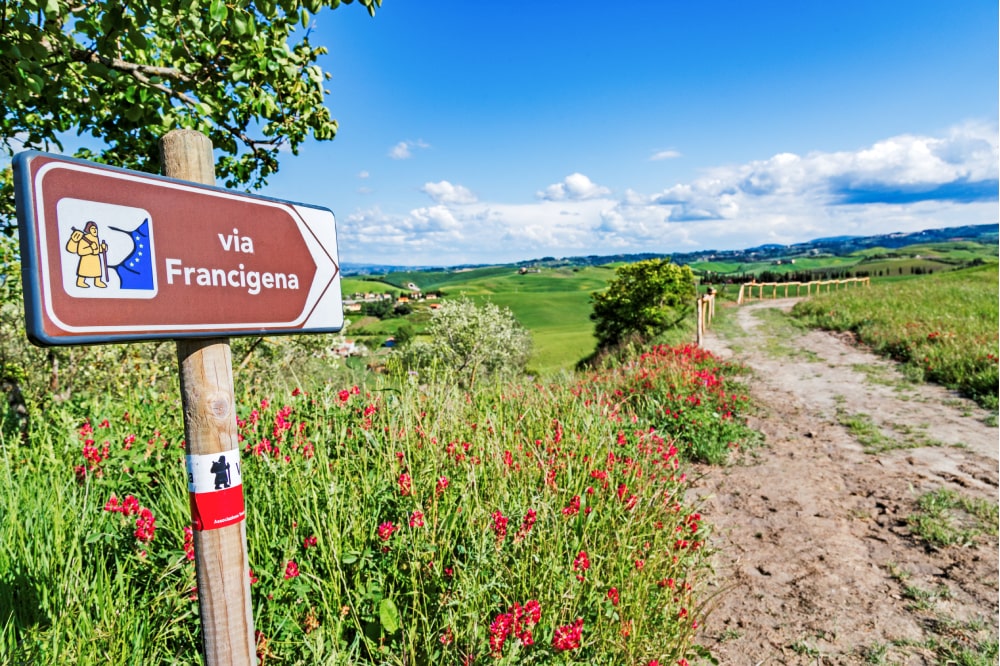
Most of us have probably heard of the Via Francigena, one of the most renowned pilgrimage routes in the world. A journey of self-challenge and inner reflection, it tests body and mind along its nearly 2,000 km route, from Canterbury in England to Santa Maria di Leuca in Puglia, passing through France and Switzerland. It is a journey of faith, as it crosses Rome, where the earthly remains of the apostles Peter and Paul have lain for centuries.
In fact, it is not quite correct to speak of a single Via Francigena, also known as the Francisca or Romea. The Via Francigena is not just one road, but a network of routes that brought pilgrims from Canterbury to Rome and then on to Puglia, from where they could embark for the Holy Land.
This long route winds through unspoiled nature, ancient and picturesque villages, cities rich in art, and breathtaking landscapes. It was declared a European Cultural Route in 1994, on par with the Camino de Santiago de Compostela.
As mentioned, it is an ancient road, or rather a set of roads, that since the Middle Ages linked Canterbury to Puglia, the embarkation point for pilgrims and Crusaders travelling to the Holy Land. The landscapes along the route are strikingly varied: from the Gothic splendour of Canterbury Cathedral to the timeless allure of Rome, from the towering mountains of France and Austria to the cobalt-blue seas of Puglia.
Beyond the natural and architectural wonders, the Via Francigena has absorbed, over centuries, the cultures and traditions of those who travelled it. It is a true custodian of Western civilisation and spirituality.
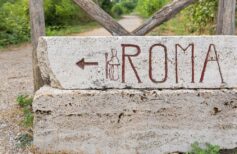
In the past, this road network was called the Vie Francigene, as they were built by the Franks to more easily oversee the lands they had conquered and subdued. Later, in the Middle Ages, these routes came to be known as Vie Romee, because they led pilgrims to Rome—one of the three great Christian pilgrimage destinations, alongside Jerusalem and Santiago de Compostela.
How long is the Via Francigena? The full route stretches for 1,700 km from Canterbury to Santa Maria di Leuca, with a total elevation gain of 1,347 metres. It can be completed on foot in about a month and a half, averaging 20 km per day, or in around two weeks by hybrid bicycle, averaging 60 km per day.
What are the most beautiful stages of the Via Francigena? It’s hard to say, given its diversity. Much depends on the interests and preferences of the traveller.
Even the very first stage, from Canterbury to Dover via the North Downs Way, offers views of the beautiful English countryside.
Crossing the English Channel, the route enters France, travelling through stunning regions like Nord-Pas-de-Calais, Champagne-Ardenne, Picardy, and Franche-Comté.
From Reims—where French kings were crowned for a thousand years—to Verzy, you can admire the natural wonders of the Montagne de Reims Regional Park and explore the world-renowned Champagne-producing areas, ideal for wine and food lovers. From Mouthier-Haute-Pierre to Pontarlier in the Burgundy-Franche-Comté region, the route leads through lush forests and dramatic karst gorges, up to the Jura mountains dividing France and Switzerland.
In Switzerland, the Via Francigena passes through the cantons of Vaud and Valais. From Lausanne to Aigle, the landscape shifts once again, with charming towns, medieval castles, the shores of Lake Geneva, and the UNESCO-listed Lavaux vineyard terraces. Between the Great St Bernard Pass and Étroubles, the route climbs to 2,473 metres above sea level, amid snow-capped peaks and alpine flowers. Here lies the highest point of the Via Francigena, before descending into the Aosta Valley, with its stunning mountain vistas, wildlife, and unmissable culinary delights.
We’ll explore in a later section where the Via Francigena runs through Italy.
Sigeric’s Itinerary
It was Sigeric of Canterbury, Archbishop of Canterbury in the late 10th century, who first documented the stages of the journey along the Via Francigena. His itinerary, meticulously recorded in a travel journal, traced a route from Canterbury to Rome, about 1,020 km in total, completed in fourteen days.
Even today, some pilgrims follow this historic path, aware of its difficulty and the need for good physical preparation. Sigeric’s itinerary remains the most faithful to tradition. Here are the key stops:
Canterbury Cathedral
Hauts-de-France (Northern France)
Nord-Pas-de-Calais (Northern France)
Région Champagne-Ardenne
Franche-Comté
Canton of Vaud (Switzerland)
Canton of Valais (Switzerland)
Aosta Valley
Piedmont
Lombardy
Emilia-Romagna
Tuscany
Lazio
Vatican City
Via Francigena: the stops in Italy
In Italy, the Via Francigena winds through seven regions: Aosta Valley, Piedmont, Lombardy, Emilia-Romagna, Liguria, Tuscany, and Lazio. It passes through 140 municipalities and comprises 45 of the 79 total stages of the journey.
It is a long, once-perilous road that crosses the Italian peninsula from north to south. From the Great St Bernard Pass, through Pavia—the ancient Lombard capital—and then on through Ivrea and Vercelli, Piacenza, Fidenza, Fornovo and Berceto in the Tuscan-Emilian Apennines, crossing the Cisa Pass and descending to Pontremoli and Luni (from where pilgrims once embarked for Santiago).
The path then continues through the Lucchese hills, along the Arno River from Altopascio to San Miniato, from Colle Val d’Elsa to Monteriggioni, then on to Siena, Lake Bolsena, Montefiascone, and Viterbo, before finally following the Via Aurelia to Rome—the heart and soul of Christendom.
It was once trodden by bandits and brigands, merchants, and men searching for God—or simply for themselves.
Religious Magnets with the images of famous Saints, Guardian Angels, Our Lady and Pope John Paul II.
Pilgrim Passport
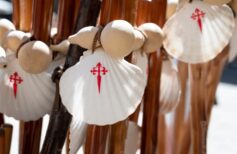
Just as those walking the Camino de Santiago carry a special document issued by the Pilgrim’s Office and stamped at each stage—entitling them to discounts and services—the Via Francigena also has its own credential.
This “pilgrim passport” is similarly stamped along the way at tourist offices, churches, accommodation providers, and eateries. It grants pilgrims access to special offers and treatment.
And just as those who reach Santiago receive the Compostela certificate, those who walk the last 100 km (or cycle the last 200 km) of the Via Francigena are awarded the Testimonium, the official certificate of pilgrimage completion.
The chrism mass celebrates the mystery of the church, its unity and communion while waiting for Easter. It is also...
What’s the Future of Religion?
What’s the Future of Religion?
A Beginner’s Guide to Christianity
A Beginner’s Guide to Christianity
Mind-Blowing Statistics About Christianity You Need to Know
Mind-Blowing Statistics About Christianity You Need to Know
6484
Enter the Holyart world: $20 discount voucher valid on over 60,000 items
Come and discover Holyart, the largest e-commerce of religious articles in Europe and immediately receive a $20 voucher to use with your first purchase.
Check your mailbox: you will receive your discount within 5 minutes







 4 March 2026