Homepage | Religion | The Sanctuary of San Gennaro at the Solfatara of Pozzuoli
The Sanctuary of San Gennaro at the Solfatara of Pozzuoli
9 September 2026
Reading Time: 4minutes
The Sanctuary of San Gennaro in Pozzuoli, a place of worship and pilgrimage for all devotees for centuries
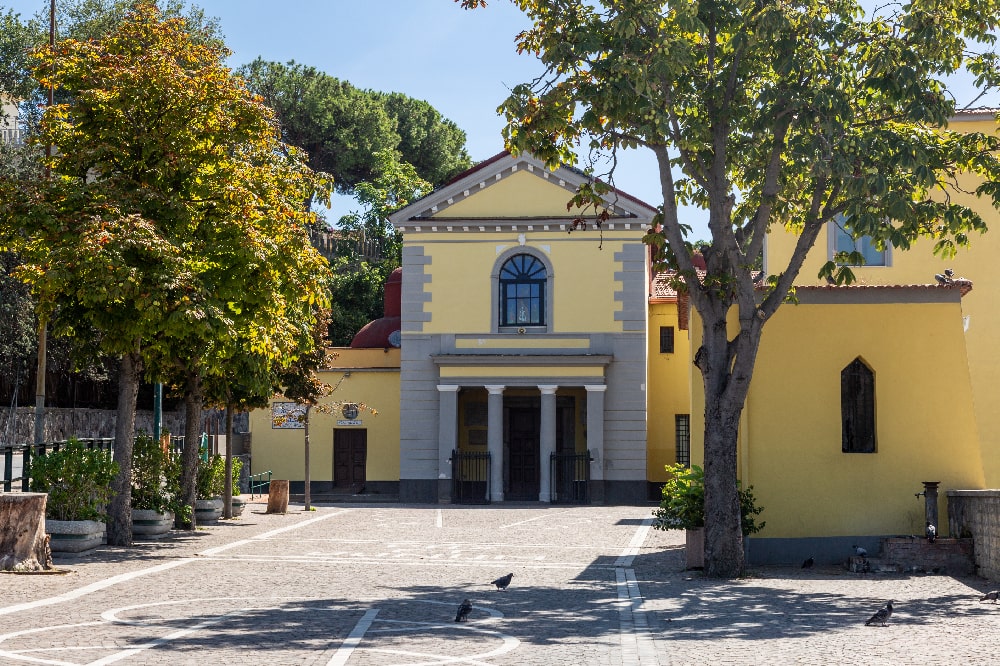
The miracle of San Gennaro is repeated three times a year in the Cathedral of Naples, before a crowd of jubilant faithful who have gathered to witness the liquefaction of San Gennaro’s blood. But in Campania there is another place dedicated to the veneration of this much-loved Saint: the Sanctuary of San Gennaro in Pozzuoli, near the Solfatara, which was the site of his martyrdom.
When he was Bishop of Benevento, San Gennaro learned of the arrest of his friend Sossius, a deacon from Misenum, a locality in the Gulf of Pozzuoli. To show his support for the latter, and also to help the Christians of Pozzuoli, San Gennaro went to visit the local Christian community together with the lector Desiderius and the deacon Festus. But Dragonzio, governor of Campania, who had already ordered the arrest of Sossius, also had the three visiting religious men arrested. It was near the Solfatara, then known as Forum Vulcani, that in 305 San Gennaro and his friends were beheaded. The Solfatara was considered by the ancients to be the entrance to the Underworld. In reality, it is the mouth of one of the forty volcanoes that make up the Phlegraean Fields, the vast area of intense volcanic activity that includes the municipalities of Naples, Pozzuoli, Quarto, Giugliano in Campania, Bacoli and Monte di Procida. The Solfatara, in particular, is three kilometres from the centre of the city of Pozzuoli. Here, at the place where San Gennaro suffered martyrdom, a basilica dedicated to him was erected, destroyed during the eruption of the Solfatara in 1198, and rebuilt several times, up to the version of 1584, when the convent of the Capuchin Friars Minor was built alongside it. Of the original Basilica, only the former altar remains, namely the stone on which San Gennaro is said to have been beheaded, now kept in a dedicated chapel.
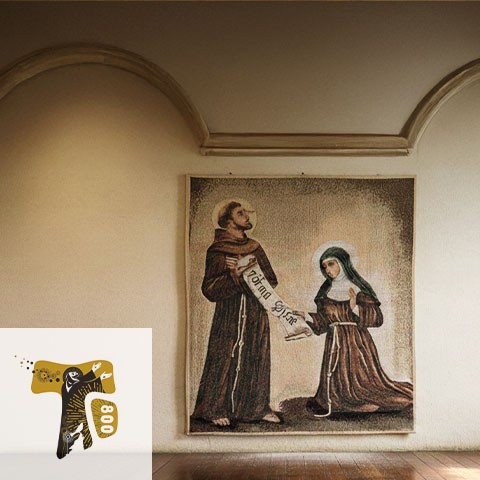
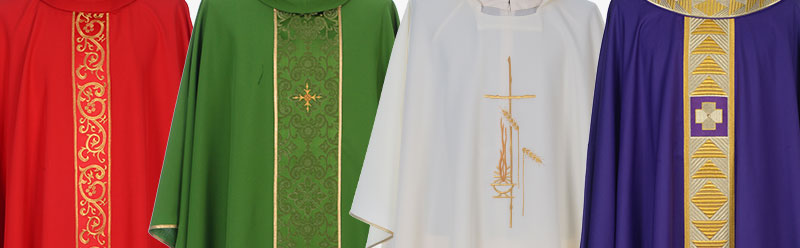
This tapestry is produced in Tuscany (Italy) with a modern Jacquard loom; the images are in high definition and use refined yarns such as lurex and are fully lined.
A place of worship and pilgrimage for devotees of the Saint, Neapolitan and otherwise, the building was further enlarged in the 1700s, but suffered damage due to a major fire and frequent earthquakes, changing over time and becoming enriched with marble, statues and paintings. From February 1945, the sanctuary was elevated to the status of a parish and dedicated to San Gennaro, bishop and martyr, and to Saints Festus and Desiderius, martyrs.
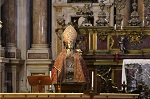
The bust of San Gennaro
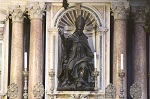
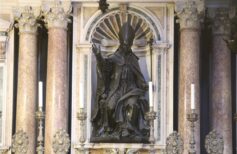
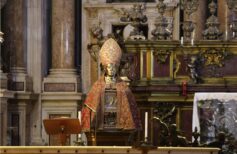
In the right-hand chapel of the single nave of the church of the Sanctuary of San Gennaro in Pozzuoli, the stone on which San Gennaro was beheaded and a bust of the Saint dating back to the 12th century AD are kept. Legend has it that, during the plague epidemic of 1656, which was claiming victims among the inhabitants of Pozzuoli, the bust was carried in procession from the Sanctuary to the Flavian Amphitheatre. As the procession proceeded, a yellowish mark is said to have appeared on the Saint’s neck, becoming increasingly larger and more evident. Once the bust reached the amphitheatre, the mark had become an enormous buboe, a typical symptom of the plague. Before the astonished eyes of those present, the buboe burst, releasing a strong smell of burning, and only the mark remained on the bust, still visible today to those who visit the Sanctuary of San Gennaro in Pozzuoli. The plague left Pozzuoli.
Subsequently, the bust of San Gennaro fell victim to an act of vandalism by Saracen pirates, who severed his nose with a blow of a scimitar. All attempts to restore the statue proved futile, as all the new noses fell off, until some fishermen found the original nose in the sea, which, when brought near the bust, flew into place and miraculously repositioned itself on the Saint’s face.
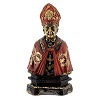
the patron saint of Naples, Italy. The predominant colors are the red of the cloak and the gold of the face, chest…
The stone with the blood of San Gennaro
In the same chapel that houses the bust of San Gennaro there is also the stone used as the block for his martyrdom. Here, in the days preceding the anniversary of the beheading, the blood shed by San Gennaro regains a vivid ruby-red colour, standing out clearly against the black of the stone. The stone was actually almost certainly the jamb of a pagan altar dating back several centuries before the death of San Gennaro. Recent analyses have cast doubt on the authenticity of the miracle of the Blood of San Gennaro, claiming that the alleged bloodstains are made of wax and red paint, but, as is also the case with the vials of the Saint’s blood kept in the Cathedral of Naples, no official denial has ever been issued.
For Neapolitans, San Gennaro is and remains the protector who has preserved them over the centuries from volcanic eruptions, earthquakes, epidemics and famine. The affection they feel for this Saint is not deterred by laboratory tests and scientific dissertations, because love and faith are not in any way required to submit to the rules of rationality.
The catechism is much more than simply preparing to receive the Sacraments of the Catholic Church; it represents a journey...
What’s the Future of Religion?
What’s the Future of Religion?
A Beginner’s Guide to Christianity
A Beginner’s Guide to Christianity
Mind-Blowing Statistics About Christianity You Need to Know
Mind-Blowing Statistics About Christianity You Need to Know
8642
Enter the Holyart world: $20 discount voucher valid on over 60,000 items
Come and discover Holyart, the largest e-commerce of religious articles in Europe and immediately receive a $20 voucher to use with your first purchase.
Check your mailbox: you will receive your discount within 5 minutes





 21 October 2026