Homepage | Religion | The Oldest Confraternities: History and Curiosities
The Oldest Confraternities: History and Curiosities
22 October 2025
Reading Time: 7minutes
For centuries, confraternities have formed a connective tissue within Italian society, balancing devotional spirit, religion, and secular life. Here are the most important ones.
Confraternities within the Catholic Church are public associations of the faithful dedicated primarily to liturgical service, the promotion of public worship, and the carrying out of charitable works,penance, and catechesis. Another key purpose is encouraging greater lay participation in liturgy and communal prayer. Their principal and distinctive aim is therefore liturgical service, including substituting altar servers during Eucharistic celebrations and leading the Liturgy of the Hours.
Confraternities may also practise acts of penancesuch as fasting, prayer, and mortification to grow spiritually. They also play a significant role in spreading catechesis, fostering religious and spiritual formation through the teaching of Catholic doctrine. These associations are governed by canons 298 and onwards of the Code of Canon Law.
Read more:
Giving alms: is it charity?
Almsgiving to the poor is a manifestation of mercy strictly connected to the duties of a good Christian. In some ways …
Historically, there were groups similar to confraternities: the Disciplineor Flagellants, named after the discipline, a whip used for corporal penance. This act of self-flagellation was seen as a way to atone for sin and seek divine mercy.
During the Carolingian era, from the 8th century onwards, confraternities began to thrive in France and across Europe. These were mixed associations, including both laypeople and those in consecrated life. The disciplinati were often not monks or friars, but laypeople who retained their family and professional lives. However, they followed a rule and aimed to live a Christian life of perfection, akin to monastic and conventual orders. Well before many religious orders, they engaged in works of charity and mercy, founding hospitals, hospices, hostels, cemeteries, and oratories, while supporting public worship and popular devotion through assistance to the sick, hospitality to travellers, prayers for the dead, alms for orphans and widows, and religious aid for prisoners and the condemned. Many members chose to live together, much like religious orders.
All products from Monasteries: the Abbey of Finalpia, the Trappist Nuns of Vitorchiano, and many others. …
In the Middle Ages, these forms of lay participation in religious and social life gained clearer identity. By the 13th century, confraternities had spread throughout Europe, forming a vital social fabric that combined religious motivation with a need for social standing and security. We can distinguish at least four types of confraternities:
Devotional confraternities: united by shared piety, such as devotion to the Eucharist or the Rosary;
Penitential confraternities: such as the Compagnia dei Disciplinati or the Flagellants;
Trade confraternities: linked to a profession and dedicated to a patron saint;
Charitable confraternities: offering services like hospital management or burial of the dead.
Religiously, confraternities were a lay attempt to find space between the ecclesiastical hierarchy, the monastic world, and the general faithful. Their influence grew, making them power centres independent of episcopal authority. Religious orders also took interest, and some confraternities were founded by friars, such as the Carmelite Confraternities, the Confraternities of the Girdle (Augustinians), and the Rosary Confraternities (Dominicans).
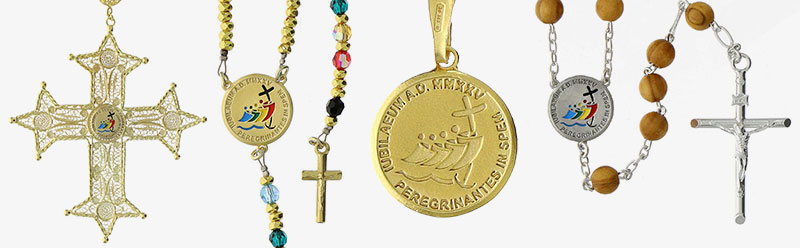
Metal medallions for confraternities handcrafted by Italian artisans …
Around the mid-13th century in central Italy, the Flagellant movement emerged. Many members of religious orders and confraternities joined. They organised processions in which penitents whipped themselves to bleeding, in an effort to atone for societal sins and usher in a new spiritual age. Confraternities also organised processions in honour of saints, the Virgin Mary, and Christ, some quite brutal in their re-enactments of the Passion. Over time, these evolved into medieval sacred dramas or religious plays, often performed by confraternity members.
Above all, confraternities promoted devotion to the Most Holy Eucharist, organising Eucharistic processions with canopies, torches, thuribles, and leading the prayers.
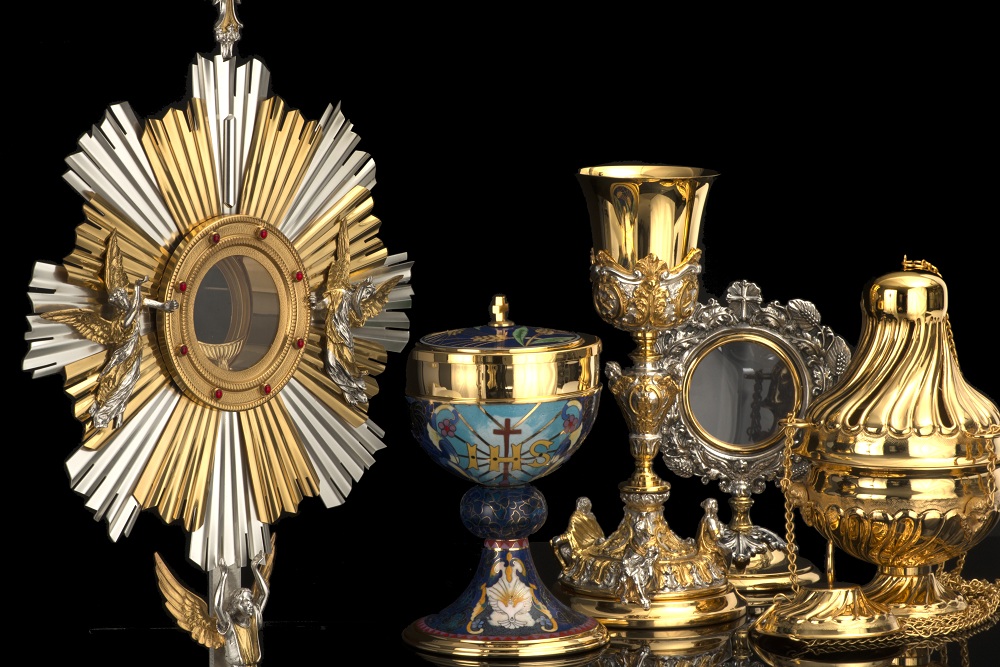
Here you will find all the items designed to accompany religious processions…
During the Counter-Reformation, confraternities took on even greater liturgical significance. The Council of Trent reformed penitential culture, emphasising spiritual interiority and reducing self-flagellation. Many confraternities, especially in Liguria, adopted precise new statutes and took on new tasks, filling gaps in popular devotion. Some adopted specific liturgical garmentsand received special privileges confirming their religious and social importance. While members originally wore simple clothes and white hoods, by the 16th century, especially as flagellation declined, their garments became more elaborate—silks, fine fabrics, and gold or silver embroidery.
The most widespread confraternities in the 16th century were those devoted to Marian devotion,particularly after Pope Pius V attributed the victory of the Holy League at Lepanto to the Virgin’s intercession. As Marian veneration grew, so did the number of Marian confraternities.
Following Napoleonic suppression, when confraternities’ goods were confiscated, only those with a strictly religious character survived and eventually resumed their activities. Though not initially recognised by Italian lawas religious entities, confraternities experienced fluctuating regulations until 28 June 1934, when they were grantedlegal personality, acknowledging their lawful existence.
The ecclesiastical norms governing confraternities are contained in theCode of Canon Law, Title V: Associations of the Faithful (CIC 298–329). These define the organisational and operational rules for lay associations, including confraternities. Confraternities possess legal personality separate from their members. In Italy, the Italian Episcopal Conference established the Confederation of the Confraternities of the Dioceses of Italy on 14 April 2000. This organisation brings together most Italian confraternities, promoting collaboration and mutual support.
Each confraternity must be dedicated to a saintor mystery of faith, which provides spiritual focus and guides its mission. It must also declare a specific purpose—prayer, worship, charity, or promoting a specific devotion. The confraternity may have a physical seat such as a church, oratory, or altar within a church, where it conducts activities and ceremonies.
Confraternities are officially established via adecree from a competent ecclesiastical authority—the Pope, Bishops’ Conference, diocesan bishop, or religious superior. Internal matters are governed by an approved statute, outlining organisation, member responsibilities, and rules of participation. Members wear distinctive liturgical attire during ceremonies and processions, with regionally specific styles and colours denoting their affiliation.
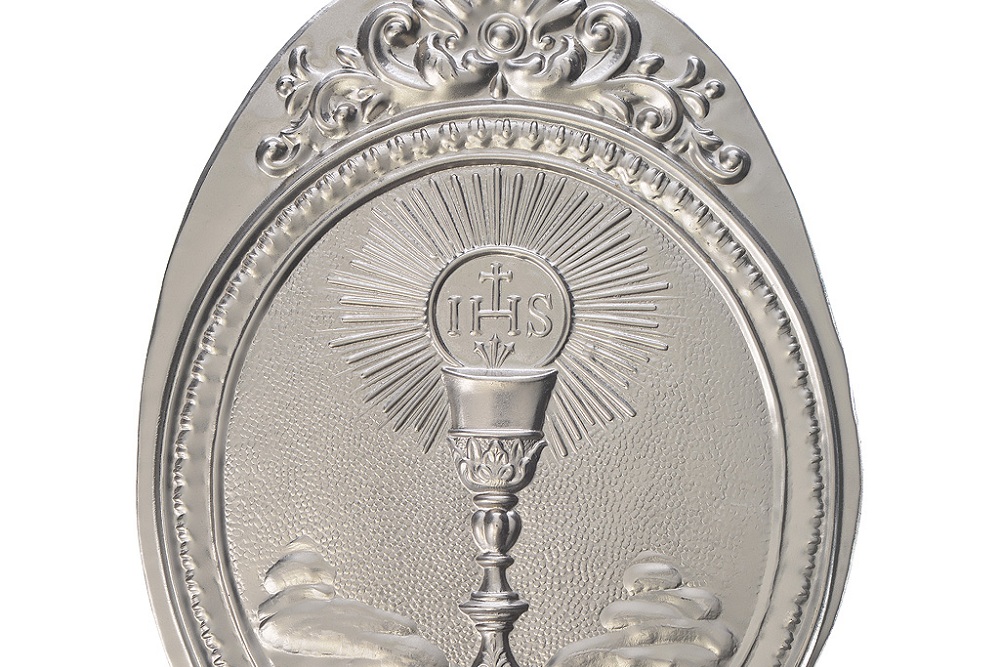
This medal for confraternities is made in golden or silver metal. This product is entirely handmade in Italy. …
Each confraternity is managed by an internal council or governing body, comprising:
the Prior (head and spiritual leader);
one or two Vicars;
various officers such as a Secretary, Treasurer, Providers, Fiscal, etc.;
Councillors or consultants.
A Spiritual Assistant, usually a priest or religious, is also appointed by the competent ecclesiastical authority.
To join a confraternity, candidates usually undergo a year-long novitiate, during which they participate in activities and are assessed by the council. After this period, new members attend a solemn Mass, swear an oath before God and fellow members, receive a blessing, and are presented with the consecrated habit, to be worn during processions and liturgies.
Difference Between a Confraternity and an Archconfraternity
After 1530, especially in Rome, archconfraternities emerged—groupings of multiple affiliated confraternities. A confraternity could join an archconfraternity by submitting its statutes and a bishop’s letter confirming its canonical legitimacy. Pope Clement VIII made this procedure obligatory in the late 16th century to ensure order and regularity.
The 16th century marked a golden age for Italian confraternities, especially archconfraternities, also known as “mother confraternities”, which had the right to aggregate local groups, extending to them all indulgences and privileges granted to the mother confraternity.
Confraternity of the Gonfalone
The Confraternity of the Gonfalone in Rome has ancient origins. Originally called “Raccomandati di Madonna S. Maria”, it was recognised by Pope Clement IV in 1267 and based in the Basilica of Santa Maria Maggiore. In 1351, it became the “Raccomandati del Gonfalone”. In the late 15th century, it merged with another confraternity in the basilica, forming the Confraternity of the Gonfalone.
Pope Gregory XIII elevated it to Archconfraternity status in 1579. Two years later, he entrusted it with the mission ofredeeming Christians captured by Barbary pirates—its primary activity during the 17th and 18th centuries. Suppressed under Napoleon, the Gonfalone resumed activities in 1823 but gradually declined. In December 2010, it was reactivated by decree of the Cardinal Vicar, with updated statutes and twelve founding members in memory of the original foundation.
Archconfraternity of the Blessed Sacrament
This Catholic confraternity is dedicated to venerating and preserving Eucharistic worship. Its exact foundation date is unclear—some sources suggest 1539. During the Counter-Reformation, the Church sought to reaffirm belief in the real presence of Christ in the Eucharist. Many confraternities changed names from “Corpus Christi” to “Blessed Sacrament” to better express this doctrine. The Confraternity of Corpus Christi in Vico del Gargano likely did so as well.
This pendant for confraternities is made in golden or silver metal. This religious medallion is entirely handmade in Italy….
Confraternity of the Holy Crucifix
Founded in Alessandria in the 13th century, the Venerable Confraternity of the Holy Crucifix at San Giovannino belongs to the penitential movements mentioned earlier. An Archconfraternity of the Holy Crucifixwas also established in 1591 in the Cathedral of Agrigento. Officially named Holy Crucifix of Charity, it emphasised compassionate works, especially towards prisoners and the poor. With recognition from the bishopric, it was elevated to archconfraternity and affiliated with the Archconfraternity of the Holy Crucifix of San Marcello in Rome.
This medal for confraternities is made in golden or silver metal. This product is entirely handmade in Italy…
Confraternity of Mercy
Generally,Misericordie are confraternities or archconfraternities of Catholic origin, dedicated to helping those in need. One of the oldest is the Misericordia of Florence, traced back to 1244. Many Misericordie also cared for pilgrimsand those condemned to death.
Today, over 700 Confraternities of Mercy operate across Italy. Since 1899, they have been united in the National Confederation of the Misericordie of Italy, involved in volunteer work including ambulance services, elderly care, social centres, and civil protection.
Jubilee of Youth 2025: A Week Dedicated to the Pilgrims of Hope Who Will Change the World As summer takes...
What’s the Future of Religion?
What’s the Future of Religion?
A Beginner’s Guide to Christianity
A Beginner’s Guide to Christianity
Mind-Blowing Statistics About Christianity You Need to Know
Mind-Blowing Statistics About Christianity You Need to Know
7299
Enter the Holyart world: $20 discount voucher valid on over 60,000 items
Come and discover Holyart, the largest e-commerce of religious articles in Europe and immediately receive a $20 voucher to use with your first purchase.
Check your mailbox: you will receive your discount within 5 minutes














 25 August 2025