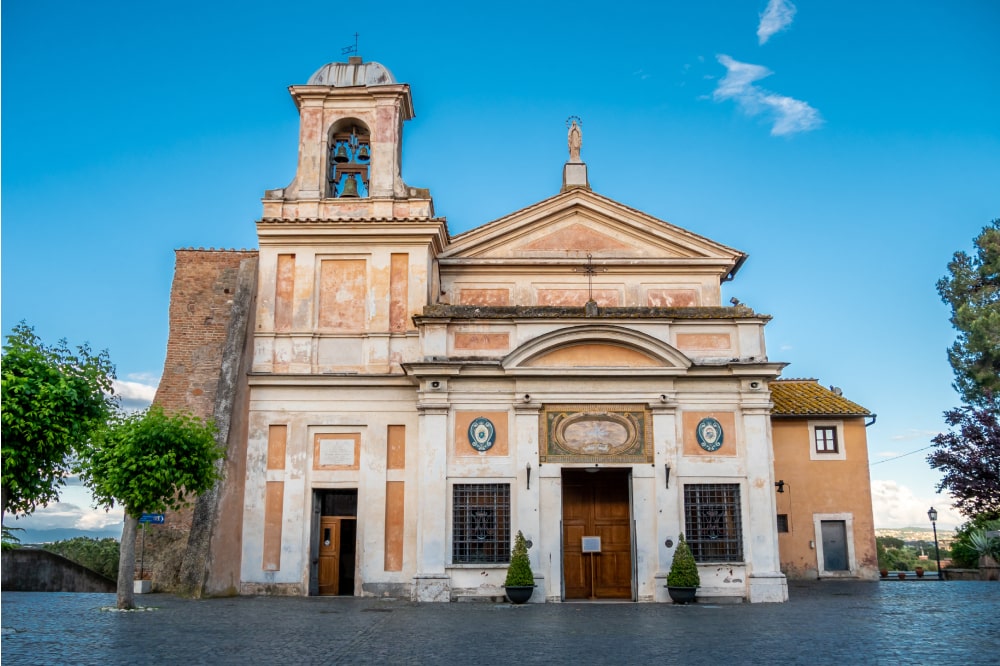
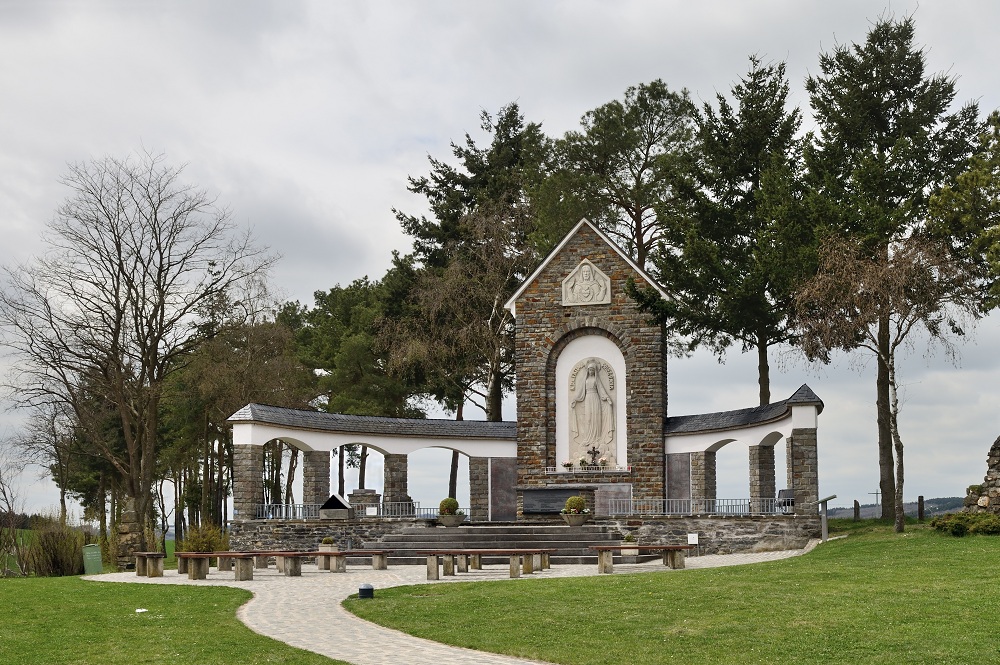
In Castel di Leva, the twenty-third zone of the Agro Romano, 12 km south of the heart of the Eternal City, stands the Sanctuary of Our Lady of Divine Love, a site of pilgrimage beloved by Romans for centuries. Consisting of two churches—one dating back to 1745 and the other a modern structure built in 1999—it attracts a significant number of pilgrims each year, especially in the summer months. During this time, on Saturday nights, it is possible to take part in a nocturnal pilgrimage from Rome to the Marian sanctuary on foot.
Since November 2020, by the will of Pope Francis, the Sanctuary has been under the jurisdiction of the diaconia of Saint Mary of Divine Love in Castel di Leva.
But where does the devotion to Our Lady of Divine Love originate, and why does this Sanctuary receive so many visits?
The Sanctuary of Divine Love in Rome
The Sanctuary of Our Lady of Divine Love is an emblematic place of faith and devotion for the people of Rome. It is intriguing to consider that, despite Rome being the city with the most churches in the world—over 900—many Romans forgo the more famous places of worship in favour of a pilgrimage to this small sanctuary in Castel di Leva, in the countryside south of the Grande Raccordo Anulare.
Understanding the reason for this influx of visitors—already exceeding two million annually in the 1970s—is not easy. It is even more puzzling when one considers that after the construction of the first small church in 1745, no religious order wanted to take responsibility for maintaining it. The location was isolated, in an unhealthy region plagued by bandits. For the first hundred years of its existence, the Sanctuary of Our Lady of Divine Love was entrusted to a hermit caretaker, with priests visiting only during Pentecost to welcome pilgrims.
The New Sanctuary was built after World War II in fulfilment of a vow made by the citizens of Rome to the Virgin, who had saved the city. After the war, the Oblates of Divine Love and the Congregation of the Daughters of Our Lady of Divine Love took on the responsibility of managing the sanctuary, as well as the numerous activities and services that developed around it. Don Umberto Terenzi, the rector of the Sanctuary, advocated for the fulfilment of the vow and the construction of the New Sanctuary. Finally, in January 1996, Cardinal Vicar CamilloRuini laid the first stone. Today, the New Sanctuary, designed by Franciscan friar and priest Father Costantino Ruggeri, can accommodate over 1,500 pilgrims.
Adjacent to the Sanctuary of Divine Love, on a nearby hill, stands the Sanctuary of the Gypsies and Blessed Zeffirino. Zeffirino Giménez Malla was a Catholic Romani man who was executed during the Spanish Civil War in 1936 for trying to save a priest. He was beatified in 1997. This site has become a pilgrimage destination for Catholic Romani people, blending symbols of faith with those representing their nomadic way of life—a people who have always lived by divine providence.
Nocturnal pilgrimages to the Sanctuary of Divine Love are a cherished tradition, one that the faithful had to forgo during the pandemic but have now resumed. Every Saturday, from the first after Easterto the last in October, pilgrims depart at midnight from Piazza di Porta Capena (near the Circus Maximus) and walk through the night to the New Sanctuary of Our Lady of Divine Love, where they attend Holy Mass at 5:00 a.m.
Alternatively, private pilgrimages to the Sanctuary of Divine Love can be arranged by contacting the Sanctuary’s office. The facility offers prayer and meeting rooms, services for pilgrims, and everything needed for a fulfilling spiritual experience.
On 19 March, the feast of Saint Joseph, a special nocturnal pilgrimage was organised to pray for the end of the war in Ukraine. This pilgrimage, promoted by the Diocese of Rome, was also broadcast live on television and streamed on social media. A similar act of devotion took place in 1944 when Pope Pius XII urged the people of Rome to entrust themselves to Our Lady of Divine Love to protect the city from bombings and devastation.
The Image of Our Lady of Divine Love and Her Miracles
Devotion to the Virgin Mary, of which the Sanctuary is the heart, originates from an ancient depiction of the Madonna enthroned with the Child Jesus in her arms. This image was once placed on one of the towers surrounding the old Castle of the Lions.
According to legend, in 1740, a pilgrim travelling to Rome became lost in this inhospitable and virtually uninhabited area. Seeking refuge among the ruins of the old castle, he was suddenly attacked by a pack of ferocious stray dogs. In that moment of desperation, he looked up and saw the painted image of the Madonna with the Child and the Holy Spirit above her. He invoked the Virgin’s help, and immediately, the dogs stopped and retreated, as if called away by some unseen force.
From that moment, the site of the miracle began to attract numerous devotees, necessitating the construction of a church to accommodate the faithful. The image of the Madonna with the Holy Spirit dove was moved to the church’s main altar in 1745. On this occasion, Pope Benedict XIV granted plenary indulgence to all pilgrims for one week.
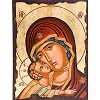
Screen-printed icon reproducing the Holy Virgin who has her son, Jesus, in her hands and looks at him with a tender, sweet look.
Over the years, more miracles were reported, further strengthening the Virgin’s benevolence towards this small sanctuary. As mentioned earlier, in 1944, the people of Rome, encouraged by the Pope, turned to Our Lady of Divine Love, whose image had been temporarily moved to the Church of Saint Ignatius of Loyola in Campo Marzio to protect it from bombings. They made a solemn vow for the city’s safety. That very evening, the Germans abandoned Rome, and the Allied forces entered the city without further destruction.
Like many sanctuaries, the Sanctuary of Divine Love has received countless ex-votos—offerings of gratitude from the faithful for graces received through the Madonna’s intercession. These are preserved in a dedicated hall, but due to their sheer number, they have also been placed outside in courtyards and along pathways. Alongside the usual plaques, votive tablets, holy cards, letters, and photos, one can also find children’s garments, football jerseys from athletes, and even bicycles belonging to legendary cyclists Felice Gimondi and Francesco Moser.
Read more:
The dove in Christian iconography
Even before the birth of Jesus, the dove was considered an animal with a strong symbolic value. For the Greeks was a symbol of love and…
How is Easter celebrated around the world? Many customs, traditions, and curiosities from each country for a single, great Christian...
What’s the Future of Religion?
What’s the Future of Religion?
A Beginner’s Guide to Christianity
A Beginner’s Guide to Christianity
Mind-Blowing Statistics About Christianity You Need to Know
Mind-Blowing Statistics About Christianity You Need to Know
6207
Enter the Holyart world: $20 discount voucher valid on over 60,000 items
Come and discover Holyart, the largest e-commerce of religious articles in Europe and immediately receive a $20 voucher to use with your first purchase.
Check your mailbox: you will receive your discount within 5 minutes









 16 June 2025