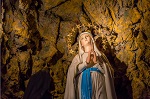
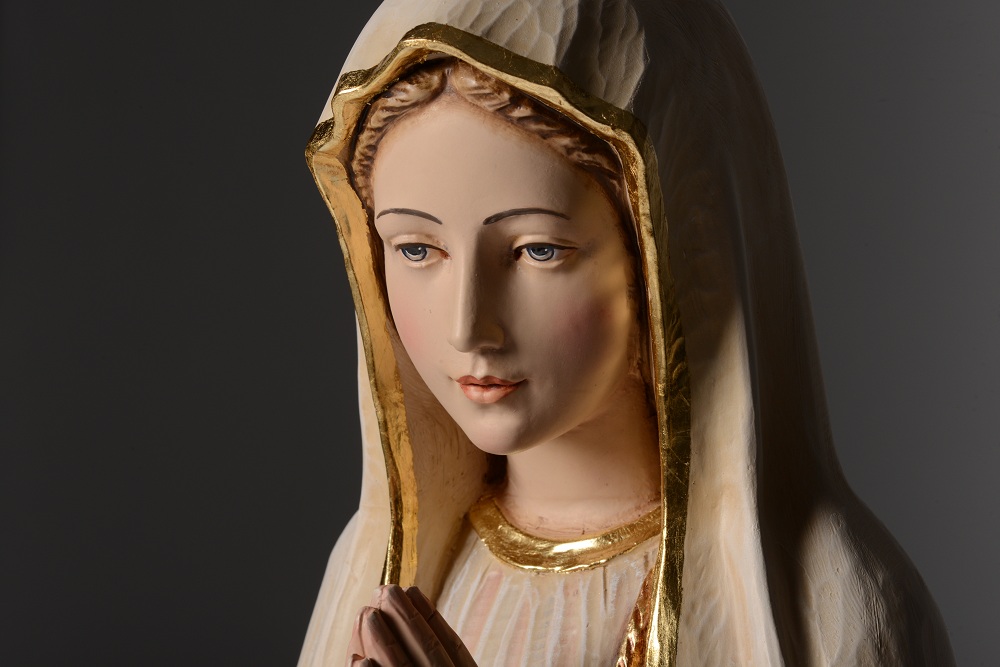
Mary of Nazareth doesn’t just hold the primacy of being the Mother of Jesus. In the very moment when this humble girl chosen by God was visited by the Angel and consented to bear in her womb and on her shoulders the terrible and marvellous burden that she was asked to accept, she became the Mother of God and mother of every man. In the Child depicted in countless paintings and statues that dot the history of art and humanity, each person recognizes and rediscovers the need for affection and protection, the infinite comfort of a mother’s embrace that asks for nothing and gives everything, without reasons, without questions, without guarantees, only for love. But it’s not just about identifying Mary as the Mother of all mothers. There are many Marian feasts dedicated to Mary, in her various forms, with all the Marian titles attributed to her. In particular, on January 1st, we celebrate Mary, the Most Holy Mother of God, but since 2018 there has also been a special feast to commemorate Saint Mary, Mother of the Church. This is precisely the feast of Mary, Mother of the Church, instituted by Pope Francis in 2018, which falls on the Monday after Pentecost.
How the feast of the Blessed Virgin Mary, Mother of the Church, came about
Already in November 1964, during the Second Vatican Council, Pope Paul VI defined the Virgin Mary with this title: Mother of the Church, Mater Ecclesiae. That is, Mother of the entire Christian people, “both of the faithful as well as the Pastors, who call her most loving Mother” (Mater Ecclesiae 1965, 1, p. 5).
In 1975, a votive Mass was included in the Roman Missal to honour the Blessed Virgin Mary, Mother of the Church, while at the behest of Pope John Paul II in 1980, the Marian title Blessed Virgin Mary, Mother of the Church, was added to the Litany of Loreto, the supplications addressed to God and the Virgin Mary, recited during the Rosary and originating from the Holy House of Loreto.
In 1997, the Catechism of the Catholic Church also includes a paragraph entitled “Mary – Mother of Christ, Mother of the Church.”
Finally, in March 2018, Pope Francis decreed the obligation to celebrate the liturgical memorial of Mary, Mother of the Church, on the Monday after Pentecost.
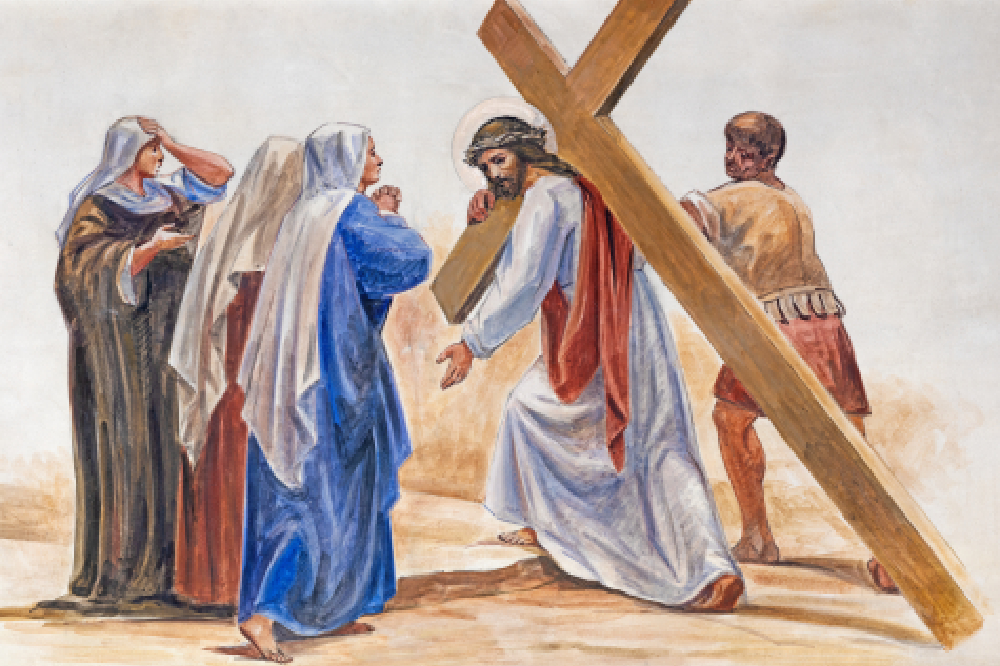
But the history of the consecration of this feast is long, and it has its origins in ancient times, particularly on a terrible day when, at the foot of a cross, a tormented mother wept for the fate of her innocent Son condemned to die for the sins of men, and that Son, even in the extreme moment of agony, put the well-being of his mother and all men before his own, entrusting her with a new son to care for and be cared for by. We are obviously talking about the Gospel of John, when Jesus asks the Virgin Mary to consider his beloved disciple as a son, and John himself to take care of Mary as if she were his mother: “Woman, behold, your son!” And then: “Behold, your mother!” (Jn 19:25).
The revolutionary significance of the Gospel episode reported by John is immense and has inspired great theologians and Church Fathers such as St. Augustine and St. Leo the Great to reflect and write about the dual role of Mary as Mother of the Church and Mother of God, which finds its greatest celebration at the foot of the cross on Calvary. St. Augustine defines Mary as the mother of the members of Christ, while Leo the Great had already affirmed the importance of Mary as Mother of the Church by recognizing in the birth of Jesus the birth of the Church itself, and consequently in Mary, who gives birth to the Head of that Body of which Christians are the members, the Mother of the Church. Thus reads the eighth chapter of Lumen Gentium (Light of the Nations), the second of the four constitutions of the Second Vatican Ecumenical Council.
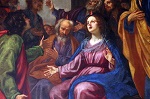
By accepting John as her son, Mary also accepts all the Apostles, chosen by Jesus as bearers of His Word, and with them presides over the birth of the Church on the day of Pentecost. We recall that forty days after Jesus’ Ascension into Heaven, Mary and the Apostles gathered in Jerusalem to celebrate Shavuot, a kind of harvest festival in Jewish tradition (Acts of the Apostles 2:1-11). While praying together, they were surprised by a deafening noise, and the Holy Spirit, in the form of tongues of fire, descended from heaven to rest on the head of everyone present. Suddenly, all the Apostles discovered that they could speak in all the languages of the world, and this is the moment when their ecumenical mission begins and, effectively, the creation of the Church. The Holy Spirit makes the Church alive; it is the last of Christ’s gifts to His Mother and His most faithful friends, who, empowered by this divine force, transform into the members of His mystical body. And to watch over and protect, to preside over this fundamental moment when a group of frightened men, troubled by the recent loss of their Master, become aware of their mission, is precisely Mary, Mother of the Church, touched by the same spirit as much as, if not more than, the others, since she carried within herself the Son of God from whom everything originated.
On the day of Pentecost, the first nucleus of the Catholic Church was born, and since 2018 the Feast of the Blessed Virgin Mary, Mother of the Church, has become part of the Roman Calendar with the obligation of celebration on the Monday after Pentecost. This is what Pope Francis decreed, as published in the decree of the Congregation for Divine Worship and the Discipline of the Sacraments on February 11, the feast of Our Lady of Lourdes.
Prayer to Mary, Mother of the Church
At the end of the encyclical Lumen Fideion June 29, 2013, Pope Francis had already included a special Prayer to Mary, Mother of the Church and Mother of our faith. It captures well the spirit underlying the feast of Mary, Mother of the Church, the desire to recognize in her the Mother of every man, in our singularity as Christians, and in our being members of something greater and precious.
Help us, O Mother, in our faith! Open our ears to the Word, so that we may recognize the voice of God and His call. Awaken in us the desire to follow in His footsteps, leaving our land and embracing His promise. Help us to be touched by His love, so that we may touch Him with faith. Assist us in fully entrusting ourselves to Him, in believing in His love, especially in times of tribulation and the cross, when our faith is called to mature. Plant in our faith the joy of the Risen One. Remind us that those who believe are never alone. Teach us to see with the eyes of Jesus, so that He may be a light on our path. And may this light of faith grow in us always, until the day without sunset, which is Christ Himself, your Son, our Lord!
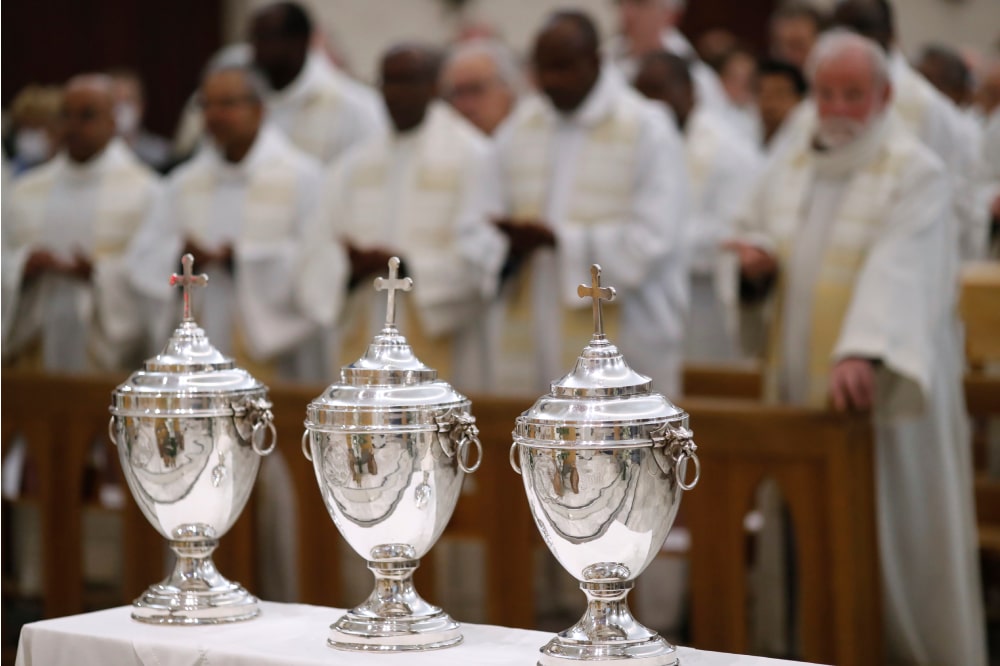
The chrism mass celebrates the mystery of the church, its unity and communion while waiting for Easter. It is also...
What’s the Future of Religion?
What’s the Future of Religion?
A Beginner’s Guide to Christianity
A Beginner’s Guide to Christianity
Mind-Blowing Statistics About Christianity You Need to Know
Mind-Blowing Statistics About Christianity You Need to Know
6340
Enter the Holyart world: $20 discount voucher valid on over 60,000 items
Come and discover Holyart, the largest e-commerce of religious articles in Europe and immediately receive a $20 voucher to use with your first purchase.
Check your mailbox: you will receive your discount within 5 minutes





 4 March 2026