Homepage | Religion | Marian symbols: what they are and their meaning
Marian symbols: what they are and their meaning
20 October 2025
Reading Time: 9minutes
The rose, the moon, but also the Gate of Heaven and the Ivory Tower: Marian symbols that help us understand how devotion to Mary has grown throughout history.
Speaking about Marian symbols in May is almost a must. May is the quintessential Marian month. Always dedicated to rebirth and the cycle of life, it was already in ancient civilisations assigned to the celebration of pagan rites connected to renewal, fertility, and love. Just think of Persephone, Proserpina to the Romans, who returns from the Underworld where she spent the winter with her husband Hades, who kidnapped her, and with her return brings spring back to Earth.
All these rites evolved over the centuries, transforming and adapting to new beliefs, to the new religion. For this reason, it is easy to find references in certain devotional forms dedicated to the Madonna and in Marian symbols that seem to recall ancient cults. Even among Marian titles, that is the names by which Mary is venerated, we find names derived from attributes referring to the Virgin in the Holy Scriptures, but also, and especially, arising from popular veneration or from characteristics attributed to her by ordinary people. After all, Mary, Mother of God and Mother of all men, is already a symbol in herself — a symbol of the Mother indeed, but also of the merciful mediator, the feminine ideal to which all women should aspire, the feminine integration of every man through her maternal function. Thus, Marian symbols are not only signs but live, change, and grow as human awareness addressing them grows.
Christianity, after all, is rich in symbols, and many Catholic symbols are borrowed from other religions, reinterpreted by the new faith. Think of the Cross, which has become the quintessential symbol of Christians, but only from the fourth century is the veneration of this symbol documented. Early Christians venerated the monogram of Christ XP or the stylised fish.
Returning to Marian religious symbols, they appear in devotion but also in the history of sacred art. The iconography of the Madonna developed over centuries, drawing both from sacred texts and popular tales, in a continuous interplay of exchanges, references, and connections between words and objects.
Screen-printed icon depicting the Odighitria Virgin: “she who shows the way to salvation”. Choose the desired size…
Let us look at some of the most recurring Marian symbols, but also the most curious ones.
The Mirror of Justice (Speculum iustitiae)
In the Litany of Loreto Mary is invoked as Speculum iustitiæ, “Mirror of Justice”. The meaning of this symbol is simple: the Madonna expresses the perfect incarnation of the divine image, so much so that she reflects in herself, as in a mirror, harmony, truth, and beauty that belong only to God. Indeed, the Immaculate Virgin is also called Speculum sine macula(“mirror without stain”) and Speculum pulchritudinis (“mirror always clear and bright”). Just as Saint Joseph, her spouse, is called a “just” man (Mt 1:19) for his holiness and determination to observe the Law of God, so the virtue of “justice” in the Virgin is another definition of her holiness, of her will to conform to the Divine Will. Clear, pure, humble, she became a reflecting surface of God’s light, a docile instrument to refract it in all its shining colours.
In addition to the traditional depictions of Saint Joseph, you can also find the Sleeping Saint Joseph….
Let us remember that the Litany of Loreto, or the Litany of the Blessed Virgin Mary, are prayers to God and above all to the Madonna, made in the form of a litany, linked to devotion in the Holy House of Loreto from the sixteenth century onwards.
The moon has always been one of the recurring symbols in many ancient civilisations and religions. The Catholic religion has also adopted it, linking it to the figure of Mary the Virgin, but even earlier it was one of the Bible’s symbols and represented the Jewish people, God’s people, who illuminated the world by reflecting the Creator’s light. Also in the Bible, particularly in the Apocalypse of John, the Church appears as a woman clothed with the sun, with the moon under her feet and a crown of twelve stars. In reality, the woman is Mary herself, clothed with the glory of God, “full of grace,” destined to reflect His light with her purity, just as the moon reflects the sun’s light. In countless depictions of Mary, we see her with the moon at her feet, sometimes waning, to symbolise her purity, sometimes waxing, with the hump upwards, emblematic of Christ’s triumph over sin and death. In this case, the moon as a symbol of the Madonna represents death and mortality.
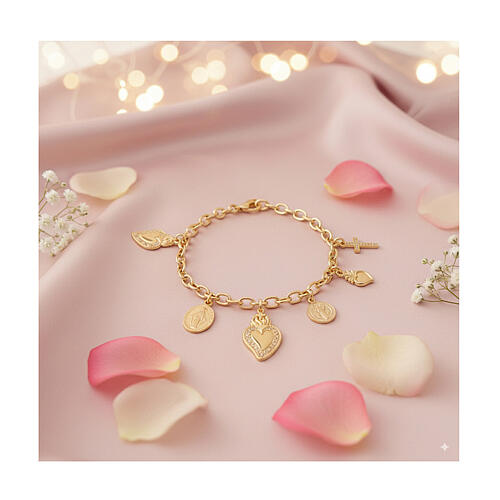
A selection of products dedicated to the Virgin Mary…
The Rose
Another Marian symbol, as well as a symbol of May, the month dedicated to Mary, is the rose. Crowns of these wonderful flowers placed on statues of the Virgin have over time become the Rosary, one of the most widespread and solemn devotional prayers.
The petals of the roses are also associated with the Holy Spirit, as in Rome, where on Pentecost they are dropped from the central oculus of the Pantheon to recall the tongues of fire that touched the Madonna and the Apostles.
Rosary Crowns: here you’ll find a wide selection of rosaries — we have more than 700!…
Considered at all times the queen of flowers, a symbol of Aphrodite and, in general, of perfection, the rose appears in many works of art depicting Mary the Virgin. Mary herself, again in the Litany of Loreto, is called Rosa mystica or Rosa sine spine, she who was born free of Original Sin. Roses associated with Mary also change meaning according to their colour: the yellow roses at the feet of the Virgin of Lourdes, as described by Bernadette Soubirous, recall the light of God, the colour of holiness; at Fatima the white roses symbolise purity; the red roses recall the blood of Christ.
The Ivory Tower, or Turris Eburnea, is also a symbol of purity and nobility, first in Jewish culture and then in Christian religion. Mentioned in the Song of Solomon (“Your neck is like an ivory tower”) it becomes an appellation of Mary in the Litany of Loreto. The Madonna is the Turris Eburnea of popular devotion, because through her pass the graces of which Christ is the source and head of the body represented by the Church, and Mary—the ivory tower—is the neck connecting the head to the limbs.
The ivory tower also indicates Mary’s solitude, her inviolate and inviolable chastity, precious and immaculate.
The Ark of the Covenant
Besides being a mirror of God’s light and a link between Christ—the head of the mystical body—and the Church—the body’s members—Mary is also the incarnation of the Ark of the Covenant, which according to Jewish tradition contained the tablets of the Law, allowed Moses to speak with God, and represented God’s very presence. Mary, who welcomed Jesus in her womb, became the new Ark of the Covenant, the living receptacle of the Word, of God’s will, of the new and eternal covenant that Christ represents.
The pregnant Madonna statue wears a white dress with a gold trimmed blue mantle. She holds a red book in her hand…
The Gate of Heaven
Another Marian symbol comparing Mary to a passage identifies her as the Gate of Heaven. This is how the ancient Fathers of the Church described her, as well as the sanctuary of divinity, rest and peace of the Holy Trinity, throne of God, city of God, altar of God, temple of God, world of God, and paradise of God, emphasising her role of intercession between men and God the Father, due to her humility, selflessness, and obedience, which placed her at the opposite pole to Eve. Indeed, Eve’s sin had closed the gate of Heaven, and a new gentle woman was needed to open it to allow Grace to flow back into the world.
In the Letter to the Church in Philadelphia in the Apocalypse we read:
“7 To the angel of the church in Philadelphia write: these things says the Holy One, the True One, who holds the key of David, who opens and no one will shut, who shuts and no one opens: 8 ‘I know your works. Behold, I have set before you an open door, which no one can shut, because you have a little strength, and have kept my word, and have not denied my name.’” (Revelation 3:7-13) The Immaculate Heart of Mary represents this door, always open to those who wish to believe, to those who, like her, know how to humbly present themselves before God confessing all their weakness.
Sculpture in maple wood of Valgardena, hand painted and decorated with a painted thread …
The Seat of Wisdom
Another of the most famous Marian titles is the Blessed Virgin Mary, Seat of Wisdom. As Mother of Christ, she welcomed all the Wisdom of God within herself, becoming its cradle and treasure, and once again a means, because through the Virgin we can grasp the sweetness of the Word, enjoy the Wisdom of God, which is Christ. Mary is also called the Wise and Teacher of Truth, who knows how to interpret the message of Jesus her son and make it accessible to men. Saint Ambrose also called her Mary, the model of life, perfect disciple of Christ.
The Burning Bush
Among the mostfamous Marian icons is that of the Mother of God called the Burning Bush. The connection with Moses is inevitable, who in the third chapter of Exodus heard the voice of God on Mount Horeb through a bush burning with fire but not consumed. “I am who I am,” said the voice, then ordered Moses to save the Hebrews from slavery. In the miracle of the burning bush it has been read as a foreshadowing of Jesus’ birth. Just as the bush burns without being consumed, so the Madonna became mother while remaining chaste and virgin, and as fire is a symbol of God, so Jesus, born from her womb, is God Himself.
In the late medieval period, Gideon’s fleece became a symbol of Mary’s virginal conception. According to biblical tradition, an angel appeared to Gideon, entrusting him with the task of freeing the Hebrew people from the raids of nomadic peoples. Since the young man was reluctant, God sent him two signs: He burnt a kid and caused dew to soak a fleece spread out in the threshing floor, while all around the ground remained dry (Judges 6:36-40).
The Virgin, fertilised by divine dew, was called to bear a grave and fundamental mission for Salvation and chose to embrace it in absolute freedom, entrusting herself with trust and purity to God’s will.
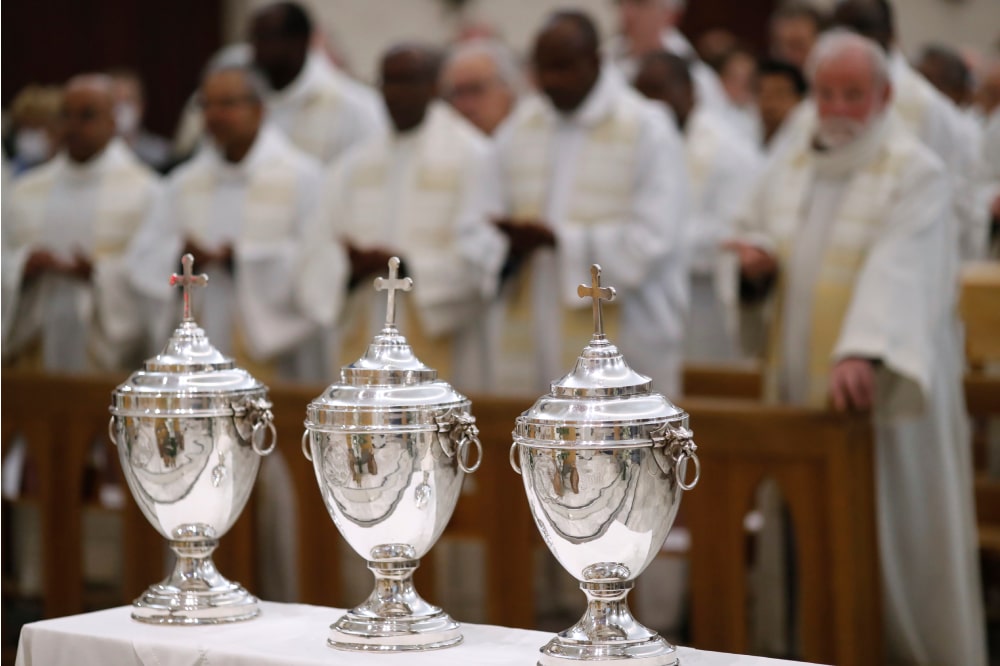
The chrism mass celebrates the mystery of the church, its unity and communion while waiting for Easter. It is also...
What’s the Future of Religion?
What’s the Future of Religion?
A Beginner’s Guide to Christianity
A Beginner’s Guide to Christianity
Mind-Blowing Statistics About Christianity You Need to Know
Mind-Blowing Statistics About Christianity You Need to Know
7268
Enter the Holyart world: $20 discount voucher valid on over 60,000 items
Come and discover Holyart, the largest e-commerce of religious articles in Europe and immediately receive a $20 voucher to use with your first purchase.
Check your mailbox: you will receive your discount within 5 minutes










 4 March 2026