Homepage | Religion | Ice Saints: The Phenomenon That Brings Winter into Spring
Ice Saints: The Phenomenon That Brings Winter into Spring
7 May 2025
Reading Time: 5minutes
Who are the Ice Saints, who in the heart of spring return us, for a few days, to the depths of winter? Halfway between peasant tradition and devotion, here’s what happens on the days dedicated to them.
Who are the Ice Saints? The peculiar name may at first conjure images of sacred sculptures depicting saints, or perhaps evoke fairy-tale-like atmospheres reminiscent of the northern lands, the Snow Queen, and so on. The truth, however, is much more down-to-earth, linked to a climatic phenomenon which, although considered an anomaly—or, as meteorologists say, a singularity—has been studied for centuries, and continues to influence human life, especially that of farmers.
But what is it all about? And why “Ice Saints”?
Quite simply, it has long been observed that around the sixth week after the Spring Equinox (which falls on 21 March), winter, which had seemed a distant memory, makes a brief return for a few days, bringing a sudden drop in temperatures and, in some cases, frost that can endanger seedlings and freshly sprouted crops. This is one of the reasons why, particularly in certain parts of Central and Northern Europe where the phenomenon is more common and intense, farmers prefer to wait until the Ice Saints’ days are over before beginning to sow.
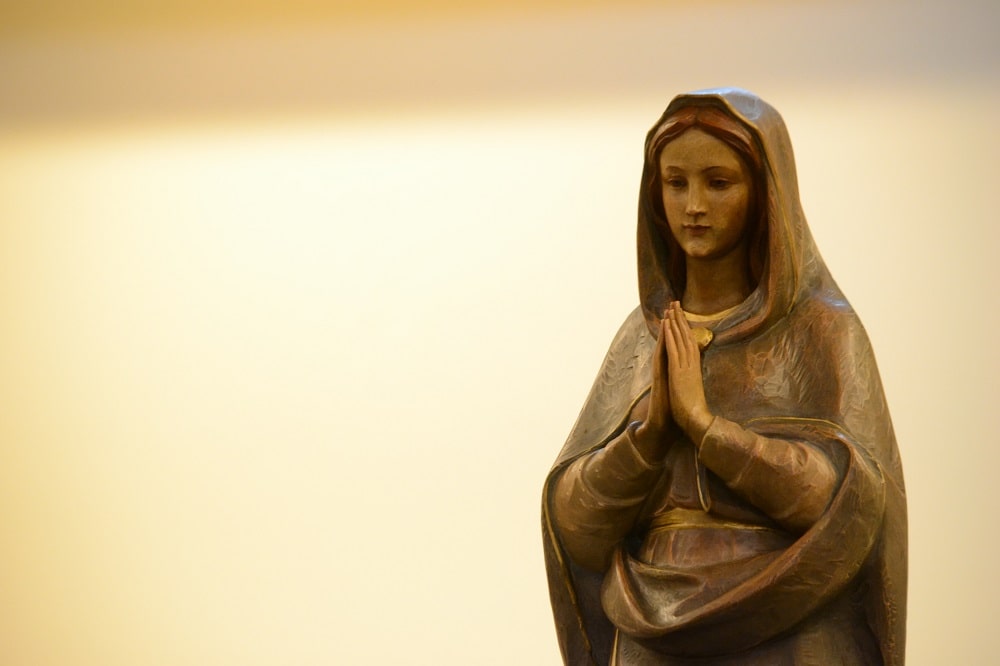
Religious statues. Here you can find various Catholic statues and figurines of various sizes and materials.
According to the Gregorian calendar, the period in question runs from 11 to 15 May. These five days have, over the centuries, been dedicated to an equal number of saints. The tradition linked to them, blending peasant folklore, popular wisdom, and religious devotion, remains widespread—especially, as mentioned, in Northern Europe, particularly in Germany, Sweden, Poland, Austria, Switzerland, but also France, England, and Hungary.
Even in Italy, there are legends associated with the Ice Saints that have over time given rise to customs and proverbs among the farming communities—many of which are still in use today.
Let’s look at the names of the Ice Saints: Saint Pancras, Saint Servatius, Saint Mamertus, Saint Boniface of Tarsus, and Saint Sophia of Rome—though her liturgical feast actually falls on 17 September. The Germans call her die kalte Sophie, “Cold Sophia.”
Let’s get to know them better—and keep an eye on the May weather forecast!
Saint Mamertus
The first of the Ice Saints commemorated, whose feast day is 11 May, is Saint Mamertus of Vienne, a French archbishop who lived in the 5th century. Renowned for his literary and theological education, he became Bishop of Vienne, clashed with the Archbishop of Arles, and around 470 AD introduced the Rogation Days in France. These were processions accompanied by prayers and acts of penance, intended to invoke Divine Grace to support sowing, combat drought, and ward off natural disasters. His remains still rest in Vienne, in the ancient Church of Saint Peter of Vienne, and many churches, chapels, and hospitals—even in Italy—are dedicated to him.
Saint Pancras
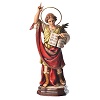
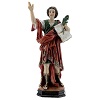
Saint Pancras, commemorated on 12 May, died very young—just fourteen—during one of the Christian persecutions initiated by Emperor Diocletian. Born in Phrygia, a province of Asia Minor, to Roman parents, he was orphaned early and raised by his uncle Dionysius, who brought him to Rome and introduced him to the Christian community. After receiving Baptism, young Pancras embraced the new faith with passion and enthusiasm, and inevitably fell victim to the persecution ordered by the Emperor. Brought before Diocletian himself—who was struck by the boy’s beauty and fervour—Pancras was coaxed and threatened to renounce his faith. Yet he remained so resolute and unyielding that the Emperor was forced to sentence him to death. He was beheaded at sunset on the Via Aurelia. A Roman matron, Ottavilla, gathered his body and head, prepared them for burial, and laid them in a tomb over which a Basilica was later built. His devotion also spread widely in Germany, where he became co-patron of the Teutonic Knights.
Today, most of his relics lie in the Basilica of Saint Pancras, built on the site of his martyrdom, though parts of his body are also preserved in churches in Italy and France.
This saint statue depicts Saint Pancratius in Roman clothes, with one hand towards the sky and the other holding a palm and a book.
Saint Servatius
On 13 May, another Ice Saint is celebrated: Servatius of Tongeren, Bishop of Tongeren in Belgium, originally from Armenia. Living in the 4th century AD, he was a strong supporter of Saint Athanasius of Alexandria during the First Council of Nicaea (325 AD), the first ecumenical council of the Christian Church. He was also the first to evangelise Belgium. His remains are preserved in Maastricht, Netherlands, in the Basilica that bears his name.
Saint Boniface of Tarsus
On 14 May, the final day of the Ice Saints, Boniface of Tarsus is remembered—a Christian martyr and another victim of the persecutions carried out by Diocletian and Galerius. Steward to a noblewoman named Aglaida, he travelled to Tarsus on her behalf to retrieve some precious relics of saints. Though Aglaida was still pagan, she had grown curious about Christianity and hoped the relics would help her better understand the faith. Upon arriving in Tarsus amidst the Christian persecutions, Boniface declared himself a Christian and was martyred. When his embalmed body was returned to Rome and delivered to his mistress, she too converted to Christianity and spent the rest of her life in prayer. Boniface’s remains were laid to rest in what is now the Basilica of Saints Boniface and Alexis, built by Aglaida on the Aventine Hill.
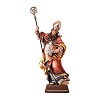
Statue in maple wood, hand painted by the artisans of Val Gardena.
Saint Sophia of Rome
Though associated with the Ice Saints, Saint Sophia’s feast is actually celebrated in September (though in the Middle Ages, it fell on 15 May). Saint Sophia—or Sonia—lived in Rome during the 2nd century AD. A noblewoman married to the distinguished senator Philander, she converted to Christianity and gave her daughters the names of the three theological virtues:Pistis (Faith), Elpis (Hope), and Agape (Charity). She also converted her husband and, after his death, devoted herself to acts of mercy and evangelisation.
Reported as a Christian, she was brought before Emperor Hadrian, who had her flogged and branded on the forehead. He then had her daughters tortured and beheaded, one by one, in front of her. Sophia buried them and died from grief at their tomb. It was the year 122 AD. The tomb of Sophia and her daughters is still visible in the Catacombs of Saint Pancras on the Via Aurelia.
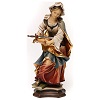
The memory of Saint Sophia and her daughters was included in various Martyrologies, and they are all commemorated together on 17 September. In iconography, they are usually depicted as four women dressed in mourning.
The chrism mass celebrates the mystery of the church, its unity and communion while waiting for Easter. It is also...
What’s the Future of Religion?
What’s the Future of Religion?
A Beginner’s Guide to Christianity
A Beginner’s Guide to Christianity
Mind-Blowing Statistics About Christianity You Need to Know
Mind-Blowing Statistics About Christianity You Need to Know
6262
Enter the Holyart world: $20 discount voucher valid on over 60,000 items
Come and discover Holyart, the largest e-commerce of religious articles in Europe and immediately receive a $20 voucher to use with your first purchase.
Check your mailbox: you will receive your discount within 5 minutes






 4 March 2026