Homepage | Religion | Basilica of San Zeno: the bronze tiles of its famous portal
Basilica of San Zeno: the bronze tiles of its famous portal
13 May 2026
Reading Time: 4minutes
The Basilica of San Zeno in Verona is one of the masterpieces of Lombard Romanesque. Its portal, composed of 73 bronze tiles, tells a story of faith and sacred art.
The Basilica of San Zeno is located in the homonymous district of Verona, which, until 1300, lay outside the city walls, where a large Roman necropolis once stood. Here he was buried in 371 AD, Zeno, or Zenone, the eighth bishop of Verona, venerated as a saint by the Catholic Church and the Orthodox Church. The entire neighbourhood developed around the church dedicated to him, which, over the centuries, was rebuilt and remodelled several times until it reached the current building, which stands on the site of at least five different places of worship. The Basilica, as we know it, with the necessary alterations and restorations due to earthquakes, fires, barbarian invasions and other calamities, dates back to the end of the 11th century and the beginning of the 12th, and retains its medieval structure and Romanesque style. Architectural elements from previous buildings are also still visible, such as the 10th-century crypt and sections of walls. The large portal lined with bronze tiles of different sizes and styles is one of a kind.
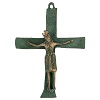
The design of the cross of San Zeno comes from one of the tiles of the famous portal of the Basilica of San Zeno in Verona, Italy.
The Basilica
In general, the church of San Zenone represents one of the most harmonious and shining examples of Lombard-Padan Romanesque. In contrast, the portal panels, which depict stories from the New Testament and the hagiography of San Zeno, are more recent and belong to Lombard Gothic. This artistic and architectural current took place in the second half of the thirteenth century in Lombardy, particularly in Milan.
From an architectural point of view, Lombard Romanesque is particularly indebted to European tradition, which included imposing cathedrals, usually developed in three naves defined by mighty pillars and structured on three levels: the main one, the presbytery that houses the altar and is raised, and the crypt, buried and intended to house tombs and relics. The greatness and sense of solidity of these buildings were fundamental because they expressed their role not only architecturally but also symbolically. This is also the case for the Basilica of San Zeno, which has three large apses: a larger one corresponding to the central nave and a smaller one on the left, both visible from the outside. The one on the right is not visible externally because the buildings to the right incorporate it.
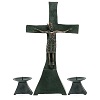
Saint Zeno cross altar set with base and 2 candle holders.Altar cross set consisting of two bronze San Zeno candle holders
The large central rose window, known as the “Wheel of Fortune”, is another typical element of European Romanesque. Created by Brioloto de Balneo, a local sculptor and architect, it owes its name to the six statues that decorate it and depict the phases of human life. In ancient times, a bas-relief depicting the Last Judgment was displayed on the tympanum above the rose window.
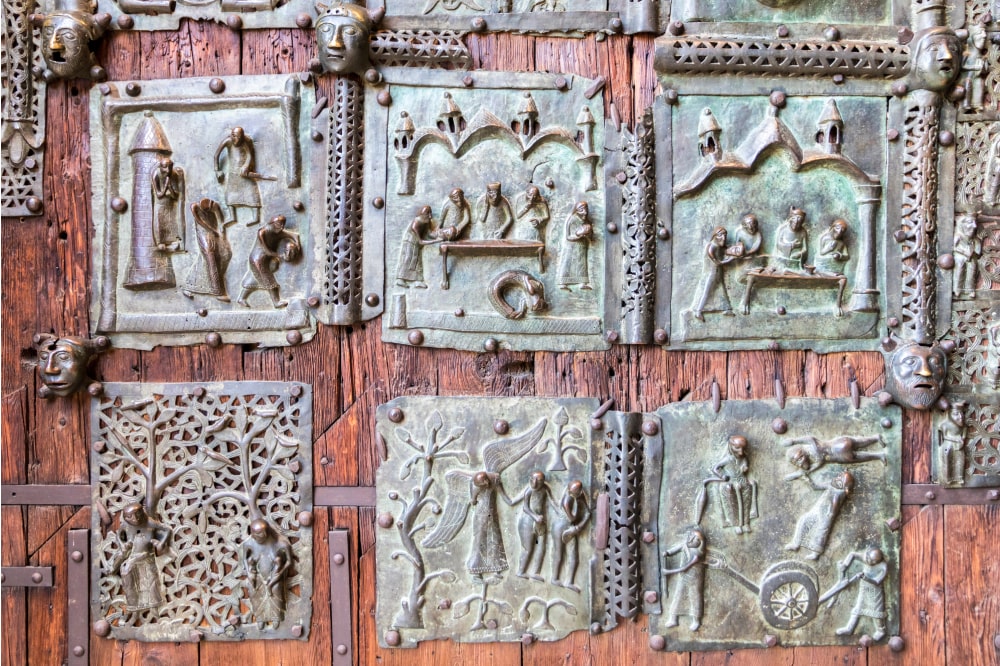
The façade of the Basilica of San Zeno in Verona recalls the division of the interior into three parts. The two outer sections corresponding to the minor naves are in tuff; the rest of the façade and the outer walls are in stone, decorated with numerous friezes and bas-reliefs. The entrance is characterised by a small cusp-shaped portico that protects the portal and is decorated with high-relief figures of both sacred and profane character. The large portal is famous. It consists of wooden doors to which 73 bronze tiles, of various sizes and without apparent symmetry, have been fixed over the centuries with iron nails.
The current bell tower stands on the remains of the previous one and dates back to the early 11th century. It is located on a high rectangular plinth formed from stone blocks.
The altarpiece of San Zeno
Among the many works of art in the Basilica of San Zeno is the Altarpiece of San Zeno, a tempera-on-panel painting by Andrea Mantegna, executed between 1456 and 1459. The panel is located on the main altar and consists of three panels. It depicts the Madonna and Child surrounded by angels, musicians, and singers (central panel) and eight saints (four on each side panel) engaged in a sacred conversation. The saints are: Saint Peter, with venerable air and keys; Saint Paul, with his sword in his hand; Saint John the Evangelist, depicted as a young man; Saint Zeno, dressed as a bishop; Saint Benedict, painted as a monk; Saint Lawrence, with the signs of martyrdom; Saint Gregory the Great, dressed as a pope; Saint John the Baptist, dressed as a hermit. The work is a masterpiece of the Italian Renaissance.
The panels of the portal of the Basilica of San Zeno on Holyart
The San Zeno tiles were made, as we have mentioned, at different times and by various masters of Italian landscape art. Some of the tiles date back to an earlier 11th-century portal and are heavily influenced by German art of the time. They are called “tiles of the First Master“. When the Basilica was built in 1138 with the structure we still know today, the door was enlarged, and the need for new tiles was born. The Second Master’s tiles (although they are likely the result of teamwork) occupy the right door and are inspired by stories from the Old Testament. According to some scholars, there was then a Third Master, who worked on the tiles of the right wing between the end of the twelfth and the beginning of the thirteenth century, inserting scenes from the life of Saint Zeno. Over time, the tiles have been moved, replaced, and coloured according to prevailing tastes and the various interventions on the facade of the Basilica.
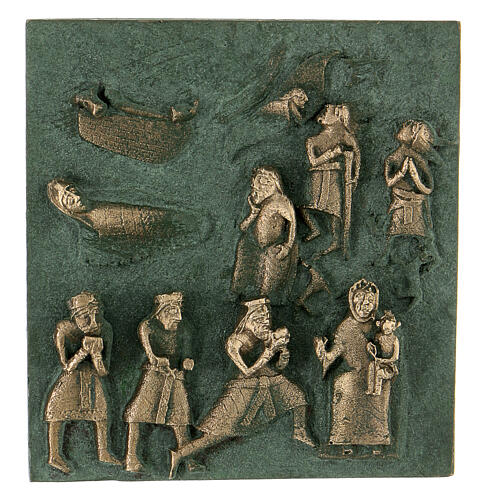
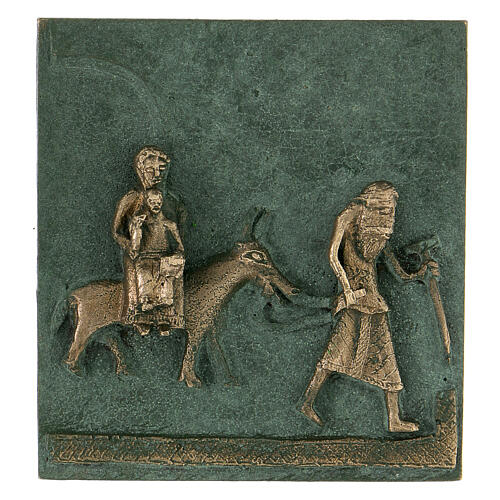
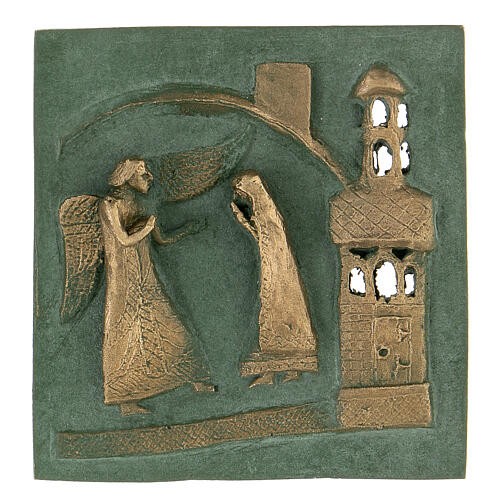
A prestigious foundry in Verona, starting from the San Zeno tiles, has created three models exclusively for our store. Find these original tiles only in our online store. The tiles are made of bronze, equipped with a hook to hang them, each measures 7×7 cm, and their colour varies from golden to dark petroleum green. They depict, respectively: the Birth of Jesus with the Shepherds and the Magi; the Flight into Egypt; the Annunciation of Gabriel to the Virgin Mary.
Tile St Zeno Verona Nativity Shepherds Magi bronze hook Buy on Holyart
Tile Saint Zeno Verona Flight into Egypt bronze hook Buy on Holyart
Tile panel Annunciation St Zeno Verona bronze hook Buy on Holyart
For five hundred years, the Swiss Guards have protected the Pope's security and watched over the Vatican. Here is who...
What’s the Future of Religion?
What’s the Future of Religion?
A Beginner’s Guide to Christianity
A Beginner’s Guide to Christianity
Mind-Blowing Statistics About Christianity You Need to Know
Mind-Blowing Statistics About Christianity You Need to Know
8159
Enter the Holyart world: $20 discount voucher valid on over 60,000 items
Come and discover Holyart, the largest e-commerce of religious articles in Europe and immediately receive a $20 voucher to use with your first purchase.
Check your mailbox: you will receive your discount within 5 minutes







 7 October 2026