The Holy Helpers are invoked in situations of illness and serious danger. Between medieval beliefs and faith, here is who they are and how their cult developed.
Invoking God, the Virgin Mary, Angels, or Saints to obtain help and comfort in times of danger, serious illness, or even merely distressing situations is a practice intrinsic to the history of humanity. Within the universe of Christian devotion, there exist Patron Saints, who watch over particular categories of people, cities, and towns, and Healing Saints, invoked to address specific ailments. These Saints have been turned to by the faithful since time immemorial to obtain graces and protection in times of hardship, seeking support not only spiritually but also physically.
There are also the Holy Helpers, a group of fourteen saints invoked by Christians in circumstances of particular need, often linked to the search for healing from specific illnesses and serious danger. The origin of this devotion is believed to trace back to Germany in the 13th century, but the spread of the cult of the Holy Helpers accelerated considerably during the devastating black plague epidemics of the 14th century and expanded throughout Europe. A common feast was dedicated to them on 8 August, but with the reform of the saints’ calendar in 1969, the cult of the Fourteen Holy Helpers was suppressed by Pope Paul VI. Nevertheless, the legacy of this veneration and the history of miracles attributed to the Fourteen Holy Helpers continue to arouse interest and curiosity, representing a significant chapter in the rich history of popular Catholic devotion.
The devotion dedicated to the group of Holy Helpers spread and gained growing importance, especially following the extraordinary apparitions witnessed by the young shepherd Hermann Leicht of Langheim, a Bavarian town on the banks of the River Main, now known as Lichtenfels. On 17 September 1445, the Child Jesus appeared to Hermann surrounded by countless lit candles. On 29 July 1446, at the same place, the apparition occurred again, but this time the Child Jesus was accompanied by fourteen children. Hermann asked who they were, and they identified themselves as the fourteen saviours, requesting that a chapel be erected in their honour.
Baby Jesus figurines in different shapes, sizes and colors and materials.
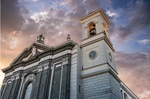
News of these apparitions spread rapidly, gaining further momentum due to the miraculous recovery of a seriously ill young woman who had been brought to the site of the visions. The local population and the increasingly numerous pilgrims strongly urged the construction of a chapel in honour of the Holy Helpers. The demands were so pressing that even the abbot of the Cistercian monastery of Langheim gave way, allowing the chapel to be built. Despite collapses and destruction during the Peasants’ War of 1524–1526, the church was constructed in 1543, but the growing devotion to the Holy Helpers required a more imposing sanctuary. Between 1743 and 1772, the architect and engineer Johann Balthasar Neumann designed a true sanctuary, a tangible symbol of the community’s deep devotion: the Sanctuary of Vierzehnheiligen.
With the suppression of the Cistercian monastery of Langheim in 1803 due to Napoleonic laws, the sanctuary passed under the guidance of the Franciscan Order starting in 1839. Each year, approximately half a million visitors travel to this sacred site, testifying to the importance and persistence of devotion to the Holy Helpers.
Who Are the Holy Helpers?
The list of the Holy Helpers includes figures such as Saint Acacius (or Agathius), invoked against migraines, Saint Barbara, protector against lightning, fever, and sudden death, Saint Blaise, against throat disorders, and Saint Catherine of Alexandria, recognised for her intercession in tongue-related illnesses. Other members of this group include Saint Cyriacus of Rome, invoked against temptations and diabolical obsessions, and Saint Christopher, considered a protector against plague and hurricanes.
The saint statue is finely worked and is hand painted.
The specific role of each saint in combating illnesses and adversities is a distinctive element of devotion to the Holy Helpers. For example, Saint Denis is invoked against headaches, Saint Giles against panic and madness, and Saint Erasmus against abdominal pains. Furthermore, the Christian faithful directed their supplications to Saint Eustace, protector from the dangers of fire, and to Saint George, whose patronage extended to skin infections.
Some of the Holy Helpers addressed specific issues linked to everyday life, such as Saint Margaret of Antioch, invoked against childbirth complications, and Saint Pantaleon, regarded as protector against wasting diseases. Another important member of this group was Saint Vitus, invoked against chorea, hydrophobia, lethargy, and epilepsy.
It is noteworthy that in some contexts there are substitutions within the list, with figures such as Saint Dorothy, Saint Magnus of Oderzo, Saint Sebastian, Saint Pancras, and others included in certain circumstances. This flexibility in the composition of the Holy Helpers reflects the richness and diversity of popular devotion, which adapts to local needs and traditions.
Saint Agathius, recognised as protector of military troops, is venerated by the faithful who turn to him in various circumstances. His intercession is particularly invoked against migraines and toothaches. Furthermore, believers turn to Saint Agathius for consolation during long agonies and to invoke his protection against drought. Acacius was a centurion in the Roman army, originally from Cappadocia. He was martyred around 304 AD, after being accused by the tribune Firmus and the Proconsul Babianus of being Christian. After harsh tortures, he was beheaded in Byzantium during the reign of Diocletian and Maximian. Emperor Constantine the Great built a church-sanctuary in his honour at Caria in Constantinople. In the Latin rite, he is commemorated on 8 May. In Squillace and Guardavalle, of which he is patron, his feast is celebrated on 7 May.
Saint Barbara
4 December is dedicated to the liturgical memory of Saint Barbara, venerated as protector of firefighters, sailors, and miners. Born in Turkey, Saint Barbara was martyred in the 3rd century AD by her father, Dioscurus, who collaborated with Emperor Maximian Hercules.
During the feast of Saint Barbara, celebrated on the date of her martyrdom, devotees participate in processions and prayers. In many communities, it is traditional to light fireworks to honour the saint, who is also the patron of pyrotechnicians. A significant example of these celebrations can be found in Paternò, in the province of Catania, of which Saint Barbara is the patron. Saint Barbara is invoked against dangers related to fire, such as lightning.
Saint Blaise of Sebaste, bishop and martyr who lived in Armenia between the 3rd and 4th centuries, is venerated for the miracles attributed to him and enjoys particular devotion as healer and physician. His veneration is anchored in his reputation as a saint to invoke for throat ailments, to the extent that he is recognised as the patron of otorhinolaryngologists, specialists in ear, nose, and throat diseases.
Saint Catherine of Alexandria is venerated as a saint by both the Catholic and Orthodox Churches. Her recognition is accompanied by the identifying symbol of a broken wheel. The Roman Martyrology commemorates her memory on 25 November, describing her as a virgin and martyr of acute intellect, wisdom, and extraordinary courage. Having been beheaded, she is, among other things, protector of nurses, infants, mothers, and sufferers of migraines. Her sanctity is further highlighted by legends surrounding her tomb, from which milk and oil were said to flow, liquids believed capable of healing any illness. These stories fuel popular devotion, creating a profound link between Saint Catherine and the physical and spiritual well-being of the faithful.
Wooden statue entirely made in Val Gardena, Italy, and hand painted by craftsmen.
Saint Cyriacus of Rome
Saint Cyriacus of Rome, deacon of the Church of Rome and martyr, shared his fate with companions Largo, Memmia, Crescentian, Juliana, and Smaragdus. Their martyrdom culminated with beheading on 16 March 306 along the Via Salaria. The Catholic Church commemorates their memory on 8 August, the day their bodies were transferred from the site of martyrdom along the Via Salaria to the seventh mile of the Via Ostiense by Pope Marcellus.
Saint Cyriacus is venerated as a Holy Helper, especially invoked against temptations and diabolical obsessions, particularly at crucial moments such as death. His sanctity is associated with a particular event during his imprisonment for faith: he exorcised Artemia, daughter of Diocletian, possessed by the devil, and subsequently baptised her.
Saint Christopher
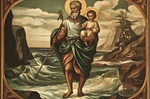
Saint Christopher, martyred in Lycia in 250 during Emperor Decius’ persecution, is remembered for the legend that he carried a child on his shoulders, who later revealed himself as Jesus. The Roman Martyrology commemorates his cult on 25 July. The Western Catholic Church dedicates 25 July to Saint Christopher, recognising him as protector of pilgrims, drivers (soldiers in charge of vehicles), travellers, athletes, fruit sellers, and gardeners. His intercession is invoked against various dangers, including those of the sea, lightning, hurricanes, demons, famine, accidents of all kinds, sudden death, toothache, and plague. Saint Christopher represents guidance and protection for those undertaking journeys or facing danger.
Saint Denis, a French saint venerated as martyr and patron of Paris, is a figure enveloped in mystery and popular devotion. He is believed to have been martyred between 250 and 270, and a basilica, later the Abbey of Saint Denis, was erected at his burial site. He is considered a powerful intercessor against headaches. A popular story recounts that a Roman soldier struck him with a sword, beheading him. Incredibly, after his death, Saint Denis stood up, took his head, and continued walking for a while, preaching a sermon on repentance.
Saint Giles
1 September is the feast of Saint Giles. Originally from Athens, Saint Giles spent most of his hermit life in France, where he is known as Saint Gilles. He settled in Provence, living in a cave accompanied by a doe that nourished him with her milk. His life took a significant turn when, in an attempt to save the animal from a hunt, he was seriously wounded by an arrow, leaving him infirm. The incident was caused by a Visigothic king who, impressed by Giles’ loyalty, as an act of penance donated the land on which the hermit’s monastery would be established.
Saint Giles’ fame grew after this event, and he was called to the French court, likely by King Charlemagne. From that moment, his reputation as a miracle worker spread across Europe. He was invoked against panic and madness.
Saint Erasmus
Saint Erasmus of Formia, also known as Saint Elmo, was bishop of Antioch and martyr. During the persecutions against Christians, he sought refuge in a cave for seven years. When discovered and imprisoned for refusing to sacrifice to pagan idols, he was miraculously freed. Saint Erasmus is venerated as protector of lathe operators, probably because his intestines were extracted with a torture instrument resembling a lathe. His figure is also associated with protection from visceral diseases and aid for women in childbirth. The term “Rasmo” or “Saint Erasmus’ Pain” was used in old Italian to indicate abdominal pain, and so he is invoked against such afflictions. He was also particularly invoked against epidemics.
Saint Eustace, who lived between the 1st and 2nd centuries, was initially known as magister equitum under the name Placido during the reign of Emperors Titus and Trajan. Described as generous and attentive to the needy, his life took a crucial turn when he converted to Christianity after seeing a majestic stag with a Cross between its antlers, revealed to him as Christ, the Saviour of the world. Deeply moved, he requested baptism and took the name Eustace. His faith, however, led to a tragic sentence along with his family. Saint Eustace, together with his wife and children, was enclosed in an iron bull and placed on a burning brazier for his Christian faith. All four died within. His memory is celebrated on 20 September, and his cult is associated with intercession against the dangers of fire.
Saint George
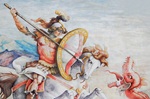
Saint George was a Roman soldier and later Christian martyr who lived in the 4th century AD. The most famous legend associated with Saint George tells of his courageous act of slaying a dragon that terrorised the region. The dragon lived in the pond of Silena, in Libya, killing anyone who crossed its path with its lethal breath. Saint George intervened, thus saving the king’s young daughter, who had been offered as a sacrifice to the dragon.
The cult of Saint George has deep roots, and he is invoked against various dangers. Traditionally, his name was invoked against venomous snakes, plague, leprosy, and syphilis. In Slavic countries, he was also invoked as protector against witches.
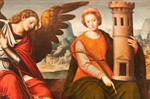
Margaret, also known as Marina, was a young Christian living in Antioch of Pisidia in the 3rd century AD. Born to a pagan priest father, Margaret was entrusted to a nurse who clandestinely practised Christianity during Diocletian’s persecution. She refused to yield to Prefect Olybrius, having consecrated her virginity to God. The humiliated prefect denounced her as a Christian. Margaret was imprisoned, and in her cell the devil appeared as a dragon and tried to swallow her. Armed with the cross, Margaret defeated the devil by tearing open its belly and emerged victorious. This episode underlies her invocation for a safe childbirth.
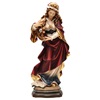
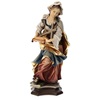
The statue sculpted in Val Gardena depicts Saint Margaret of Antioch with a pillow and on top a cross.
Saint Pantaleon
Pantaleon, born in the second half of the 3rd century in Nicomedia, modern-day Turkey, pursued the medical profession and later suffered persecution by Emperor Galerius of Constantinople for his Christian faith. In 305, he was brutally executed: his arms were nailed over his head, which was then severed by the executioner. Saint Pantaleon is venerated as patron of doctors, along with Saints Cosmas and Damian, and midwives. He is invoked against wasting diseases.
Saint Vitus
Saint Vitus, also known as Saint Vitus of Lucania, was a young Christian martyred in 303 during the great persecution ordered by Emperor Diocletian. His liturgical memory falls on 15 June. Born in Sicily to a pagan father, he spent seven years in prison due to his Christian faith. He was invoked to ward off lethargy, the bite of venomous or rabid animals, and the “dance of Saint Vitus.” According to legend, as a child, Vitus healed Diocletian’s son, his peer, who suffered from epilepsy.
The chrism mass celebrates the mystery of the church, its unity and communion while waiting for Easter. It is also...
What’s the Future of Religion?
What’s the Future of Religion?
A Beginner’s Guide to Christianity
A Beginner’s Guide to Christianity
Mind-Blowing Statistics About Christianity You Need to Know
Mind-Blowing Statistics About Christianity You Need to Know
7813
Enter the Holyart world: $20 discount voucher valid on over 60,000 items
Come and discover Holyart, the largest e-commerce of religious articles in Europe and immediately receive a $20 voucher to use with your first purchase.
Check your mailbox: you will receive your discount within 5 minutes




 4 March 2026