From high-ranking officer of the Roman army to Holy Martyr, killed by his own soldiers and comrades in the name of his faith, Saint Sebastian emerges among Christian martyrs as an example of courage, honour, and unconditional faith. His story is steeped in sacrifice and devotion, a living illustration of the ardent Christian spirit in the face of persecution, but it also demonstrates the value and sense of honour of a man who never failed in his principles and duties. Not by chance, among his patronages is that of honourable men, those who seek to live with integrity, honesty, and dignity in their actions and relationships.
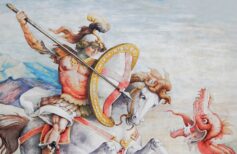
A soldier and fervent believer, Saint Sebastian belongs to the Militia Christi, that is, those Saints who were soldiers during their lifetime without showing conflict between their Christian faith and military profession. Alongside him are Saint George, a career soldier who was martyred for refusing to sacrifice to the gods, and Saint Maurice, a prominent figure among the martyrs of the Theban Legion, a soldier who refused to be employed in the persecution of other Christians. All these Saints are united by their determination to maintain consistency between their faith and military role, making their actions a coherent expression of the values they professed.
His liturgical memorial falls on 20 January, the date of his death, for the Western Church, and on 18 December for the Eastern Church.
Saint Sebastian the Martyr lived in the 3rd century AD, under the rule of Emperor Diocletian. He was originally from Narbonne in Gaul on his father’s side, and educated in Milan, the city of his mother, where he encountered and was captivated by the Christian faith. He later moved to Rome, where he quickly rose through the ranks of the imperial army, eventually becoming tribune of the first praetorian cohort, effectively the emperor’s bodyguard. Thanks to this prestigious position, when the Emperor unleashed his terrible persecution of Christians, Sebastian was able to secretly help his imprisoned companions, protecting them and, when he could do nothing more, at least ensuring they received dignified burial. Moreover, strengthened by his position, Saint Sebastian committed himself to spreading Christianityamong officials and soldiers of the imperial court.
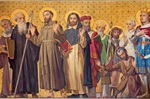
Saint Sebastian tapestry 20.8×15.7″. Jacquard woven tapestry finished by hand and entirely made in Italy.
The Martyrdom of Saint Sebastian
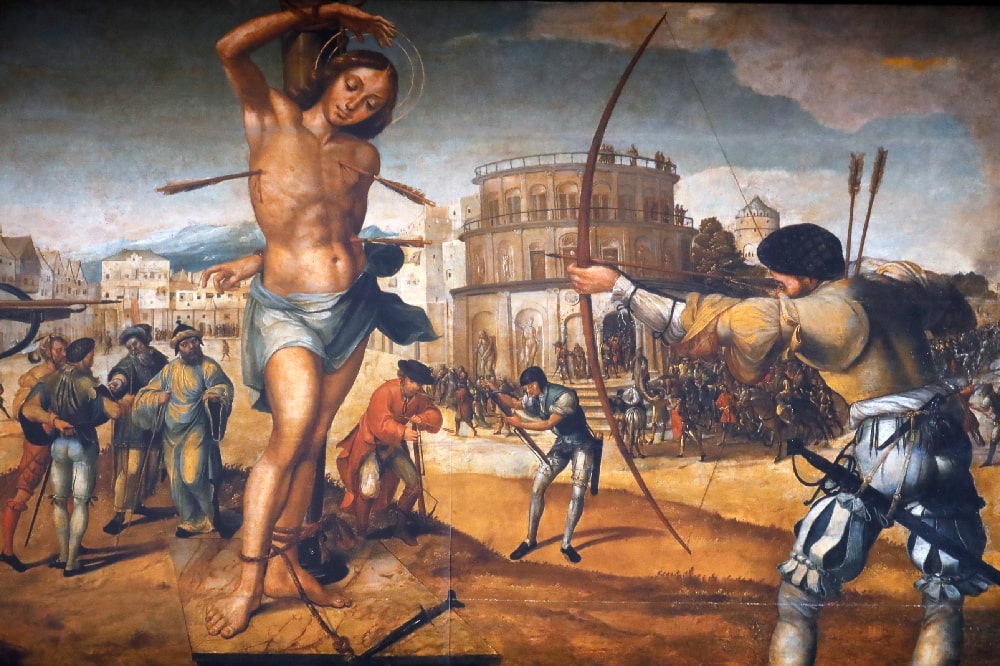
When Diocletian discovered that one of his most loyal guards was helping those he had sworn to persecute and annihilate, his anger was overwhelming. He ordered that Sebastian be tied to a tree on the Palatine Hill and pierced with so many arrows that he was completely covered. Believing him dead, the soldiers abandoned him, but a Christian matron named Irene gathered him up and, realising he was still alive, brought him to her home to tend to him.
When he had regained his strength, Sebastian presented himself at the imperial palace and publicly accused Diocletian of his persecution of Christians. The emperor, astonished to see him before him once again, this time ordered that he be flogged to death and thrown into the city’s sewers. Again, it was a woman, Lucina, who recovered the Saint’s body and ensured he received a proper Christian burial in the catacombs which would later bear his name.
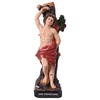
Statue of Saint Sebastian, 20 cm, made in resin and hand painted.
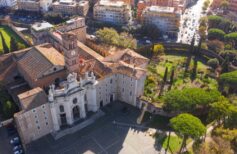
A Basilica was then erected over those catacombs, and from there an important cult developed which extended to other parts of Rome, with the construction of new churches, often on the sites mentioned in the Passion of Saint Sebastian. In the 10th century, a church dedicated to the Saint probably stood on the Palatine Hill, on the ruins of the temple of Elagabalus, where Sebastian had acted as accuser of Diocletian.
What Does Saint Sebastian Protect?
The story of Saint Sebastian continues to be a source of inspiration today for Christians around the world who face persecution. His courage in confronting brutality with dignity and his steadfast adherence to the Christian faith are a beacon of hope in times of darkness. In an age in which many Christians are persecuted because of their faith, the figure of Saint Sebastian offers comfort and strength.
Besides being a protector of honourable men, Saint Sebastian is venerated as patron by other categories of people, precisely because of his ability to embody a wide range of meanings and symbols, especially for those who work in the fields of security and defence. In fact, he is the Holy Patron of local police and soldiers.
Likewise, Sebastian is invoked as protector of the suffering, an intercessor for those facing physical or emotional pain.
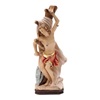
This statue in painted wood is made by a company of Val Gardena which through handmade and technologic techniques is able to give life to original artworks respecting the characteristics of the wood.
Furthermore, though no less important, he is the patron saint of archers, crossbowmen, arquebusiers, due to his terrible martyrdom, and of tapestry workers, stonecutters, blacksmiths, firefighters, and gardeners.
The variety of categories that consider him their patron underscores his influence and his ability to inspire and protect people from different walks of life. His veneration as patron of these various groups represents the wide impact that his story and devotion have had over the centuries.
In ancient times, Saint Sebastian was venerated as protector against the plague. This was due to the wounds and sores that disfigured his body. His figure was particularly dear to the Confraternities of Mercy because of his reputation as helper of the suffering, thus earning a prominent place among the Saints invoked against plague and epidemics. The connection between Sebastian and the plague can be attributed to the fact that the wounds inflicted by the arrows resemble the lesions caused by the disease itself. This visual link helped reinforce his association with protection against these terrible afflictions, fuelling his veneration and his continued invocation as defender against epidemics. Saint Charles Borromeo had the Civic Temple of Saint Sebastian erected in the Saint’s honour, near the Milan Cathedral, as an “ex voto” for having saved the city from the plague that struck it in 1576.
Although the plague has been eradicated, the Italian Confraternities of Mercy still claim Saint Sebastian as their patron today, by virtue of his role as helper of the martyred and the suffering, he who protected and assisted his companions killed for their Christian faith. Even today, the Confraternities, inspired by his example, continue to embody this same spirit of aid and assistance. Through the dedication of their volunteers, they run a vast network of social and health services, rooted in Christian values, which aim to support those who find themselves in conditions of suffering and need, keeping alive the Saint’s spirit of compassion and solidarity, offering concrete help to anyone in need, following an inspiration deeply rooted in the Christian principles of assistance and fraternal love.
The chrism mass celebrates the mystery of the church, its unity and communion while waiting for Easter. It is also...
What’s the Future of Religion?
What’s the Future of Religion?
A Beginner’s Guide to Christianity
A Beginner’s Guide to Christianity
Mind-Blowing Statistics About Christianity You Need to Know
Mind-Blowing Statistics About Christianity You Need to Know
7791
Enter the Holyart world: $20 discount voucher valid on over 60,000 items
Come and discover Holyart, the largest e-commerce of religious articles in Europe and immediately receive a $20 voucher to use with your first purchase.
Check your mailbox: you will receive your discount within 5 minutes





 4 March 2026