Homepage | Religion | The Story of Saint Vincent de Paul and His Work of Charity
The Story of Saint Vincent de Paul and His Work of Charity
22 September 2025
Reading Time: 7minutes
Saint Vincent de Paul made charity his mission, preaching the model of Christ, equality among men, and greater social justice. Today, his example is more relevant than ever
Among the great saints and inspirational figures who have marked the history of the Catholic Church, Saint Vincent de Paul stands out for his deep dedication to works of charity and service to the most needy. His life and work have left an indelible mark on the history of faith and the practice of solidarity.
Born in France under the name Vincent de Paul at the end of the 1500s, during a period characterised by deep social divisions, economic hardship, and religious conflict, Vincent developed from a very young age a profound love for the poor and needy, inspired by the Gospel and his desire to follow Christ’s example in serving others. Coming from a modest family, he was able to study thanks to the sacrifices of his parents and the help of some benefactors who recognised the merits of this intelligent young man with an early religious vocation. After receiving the tonsure at the age of 16, Vincent de Paul, with the support of an influential lawyer from his region, completed his theological studies in Toulouse. His religious dedication and passion led to his ordination as a priest on 23 September 1600. He initially embarked on his journey as a secular priest but later found his spiritual path within the Company of the Blessed Sacrament, where he continued to grow spiritually through the guidance of prominent scholars and religious figures associated with this Catholic secret society.
However, life held new challenges and adversity for Vincent de Paul. In 1605, while travelling by ship from Marseille to Narbonne, he was captured by Turkish pirates and spent two years enslaved in Tunis. His captivity severely tested his faith and endurance until his master, having converted to Christianity, decided to set him free.
Once he regained his freedom, Vincent de Paul returned to France and entered the French court as chaplain and almoner to Margaret of Valois, a role that gave him a privileged insight into the society of the time. It also allowed him to perceive the deep inequalities between rich and poor—inequalities that would become the foundation of his work of mercy. Despite his privileged position, Vincent was not tempted by material or career ambitions, choosing instead to withdraw to Clichy as a simple parish priest, dedicating himself body and soul to teaching the catechism and, more importantly, to providing direct aid to the sick and the poor.
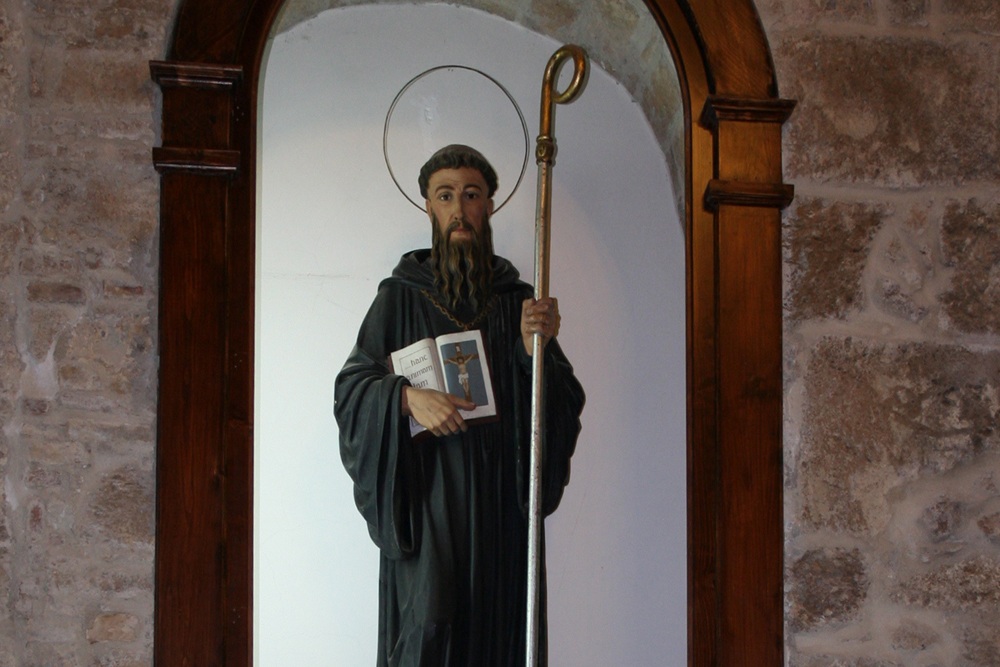
This Catholic saint statue depicts St Vincent de Paul, patron of prisoners…
This period of his life was especially inspired by his recent acquaintance with Francis de Sales—a bishop, theologian, preacher, and founder of the Order of the Visitation of Holy Mary—who had made love for God and gentleness in expressing one’s faith his most powerful tools. This encounter gave even greater direction to Vincent’s life and work, leading him towards charity and service to others and laying the foundation for the Daughters of Charity and the Confraternities of Charity—the true legacy of love and compassion for others left by Saint Vincent de Paul.
Vincent continued to pursue his goals both as a priest and by collaborating with many noble families of the time to obtain the necessary funds and support for his charitable works. As a tutor in the service of the Marquises de Gondi, he offered practical help to orphaned and destitute children. He also formed groups of educated priests to evangelise peasants in the poorest rural areas. Thus, in 1625, the first nucleus of the Congregation of the Mission (Congregatio Missionis) was born—a clerical society of apostolic life under pontifical right. Its members would later become commonly known as the Lazarists or Vincentians.
His many humanitarian initiatives—carried out with the help of his Missionaries and the Daughters of Charity—focused on the poor, the sick (they also worked in the Hospital for Foundlings in Paris), orphans, the elderly, and even victims of the Wars of Religion between Catholics and Protestants that had ravaged the country in recent decades.
King Louis XIII summoned Vincent to court as an advisor, albeit for a short time, and later requested his presence at his deathbed.
Saint Vincent de Paul died on 27 September 1660. His remains are now buried in the Chapel of Saint-Vincent-de-Paul in Paris. The Church celebrates the liturgical memory of Saint Vincent de Paul on 27 September (while the Tridentine Mass celebrates him on 19 July).
The legacy of Saint Vincent de Paul continues today through the work of the Daughters of Charity and the Confraternities of Charity, which still serve the poor and the needy around the world. His life and commitment were recognised with his canonisation in 1737 by Pope Clement XII.
Saint Vincent de Paul and the Fight Against the Divide Between Rich and Poor
Saint Vincent de Paul’s vision of charity as the central mission of the Church and of Christian life led him to forge a deep bond with the poor and the outcast. His compassion and commitment earned him the title of Apostle of Charity, and his tireless fight against the divide between rich and poor left a lasting mark on history. His life and work were entirely dedicated to serving the most needy, relieving the suffering of those marginalised by society and promoting equality among all human beings.
Saint Vincent de Paul recognised that poverty was not only a lack of financial resources but also a lack of opportunities and access to education. In this regard, he sought to ensure that the poor could acquire the skills necessary to improve their lives and find dignified ways to support themselves.
Saint statue measuring 25 cm of Saint Vincent de Paul, patron saint…
Another key aspect of Saint Vincent’s fight against the rich-poor divide was his work in raising awareness. Through his example and preaching, he aimed to inspire others—especially those with privileges and resources—to share with the less fortunate and understand their plight. He challenged the power structures and social injustices of his time, urging the wealthy to acknowledge their responsibility toward the most vulnerable.
In an age—our own—in which the divide between rich and poor remains a major challenge, the example of Saint Vincent de Paul invites us to reflect on our own commitment to reducing social disparities. His dedication and altruistic spirit call us to promote social justice, work for equality, and extend a helping hand to those most in need.
The Daughters of Charity
One of Saint Vincent de Paul’s most significant contributions to the work of charity was the foundation of the Daughters of Charity, together with Saint Louise de Marillac and Marguerite Naseau, and with the support of the Church. This female religious congregation was immediately dedicated to assisting the poor, the sick, and the marginalised.
The history of the Daughters of Charity finds its origin in the Confraternitiesof Ladies of Charity, established from 1617 onwards by Vincent de Paul himself. These confraternities aimed to provide home care for the needy and the ill. Initially spreading through rural areas of France, they eventually reached Paris, where in 1630 Vincent entrusted their leadership to Louise de Marillac (1591–1660). As the availability of women was not enough to meet the real needs of the many poor and desperate people in Paris, Vincent proposed to the first four girls who had answered his call and were educated by Louise de Marillac to live a communal life. Thus began the first company of women in secular dress devoted to service. Later, Louise and her companions took vows of poverty, obedience, and chastity, along with a fourth specific vow: to serve the poor.
Confraternity Medals entirely hand made in Italy. Confraternities are a type of popular devotion that aims to fulfill the needs to men…
The Archbishop of Paris, Jean-François de Gondi, officially approved the company, called the Company of the Servants of the Poor of Charity, and in 1668 it received pontifical recognition. Since then, the company has never ceased its charitable and merciful work, dedicating itself to the care of orphans, the sick in hospitals, the elderly in retirement homes, the disabled, as well as to education in schools and support for women and children.
The habit of the Daughters of Charity has changed over time—from secular clothing to the costume of the girls of the Île-de-France region, characterised by the “cornette,” a headdress with wide wings. After the Second Vatican Council, the habit was simplified and modified.
Today, the Daughters of Charity are present in 91 countries and form the largest female society within the Church. Their work continues to reflect the love and dedication of Vincent de Paul and Louise de Marillac in serving the most needy, carrying forward a legacy of compassion and solidarity.
The Regulae of Saint Vincent
Vincent de Paul left no written works, but his greatest legacy lies in the teaching of Charity—a charity made above all of action, of concrete deeds, fuelled by love for God and for one’s neighbour without any distinction. Prayer and action, evangelisation and the fight against inequality and social injustice, all in the name of making the world better for all people, even the least fortunate.
These are the Regulae he left to his followers: simplicity, humility, meekness, mortification, and above all, an unquenchable desire to do good, both in body and spirit, to one’s fellow human being.
How is Easter celebrated around the world? Many customs, traditions, and curiosities from each country for a single, great Christian...
What’s the Future of Religion?
What’s the Future of Religion?
A Beginner’s Guide to Christianity
A Beginner’s Guide to Christianity
Mind-Blowing Statistics About Christianity You Need to Know
Mind-Blowing Statistics About Christianity You Need to Know
7059
Enter the Holyart world: $20 discount voucher valid on over 60,000 items
Come and discover Holyart, the largest e-commerce of religious articles in Europe and immediately receive a $20 voucher to use with your first purchase.
Check your mailbox: you will receive your discount within 5 minutes
















 16 June 2025