Homepage | Religion | The Sacred Belt: One of the Most Precious Relics of the Virgin Mary in Italy
The Sacred Belt: One of the Most Precious Relics of the Virgin Mary in Italy
28 January 2026
Reading Time: 6minutes
The Sacred Belt kept in Prato is a Marian relic of great importance, the centre of a devotion that has lasted for eight hundred years.
Among the many Christian relics that have always characterised the Catholic religion, arousing popular devotion and gathering crowds of faithful and pilgrims around the places of worship that guard them, one is particularly important for the cult of the Virgin Mary. This is the Sacred Belt, also known as the Holy Girdle, a religious and civic symbol of Prato, the city where it has been preserved since the Middle Ages in the chapel that bears its name inside the Cathedral Basilica of Saint Stephen. What is it? The Sacred Belt is said to be the Virgin Mary’s girdle, given by her to the incredulous Saint Thomas at the moment of her Assumption into heaven.
From a purely practical point of view, it is a strip of goat’s wool, about 87 centimetres long and very thin, light green in colour, woven with gold thread, closed on one side with a tassel, and on the other with a fold and an emerald green ribbon. Having arrived in Prato in medieval times, the Sacred Belt was declared the property of the entire city in 1348, with a decree establishing that the relic should belong two-thirds to the Municipality and one-third to the Diocese. Three keys were forged to open the reliquary in which the Christian relic was kept under the altar of the Chapel of the Holy Girdle, and two of them were entrusted to the Municipality, one to the Diocese.
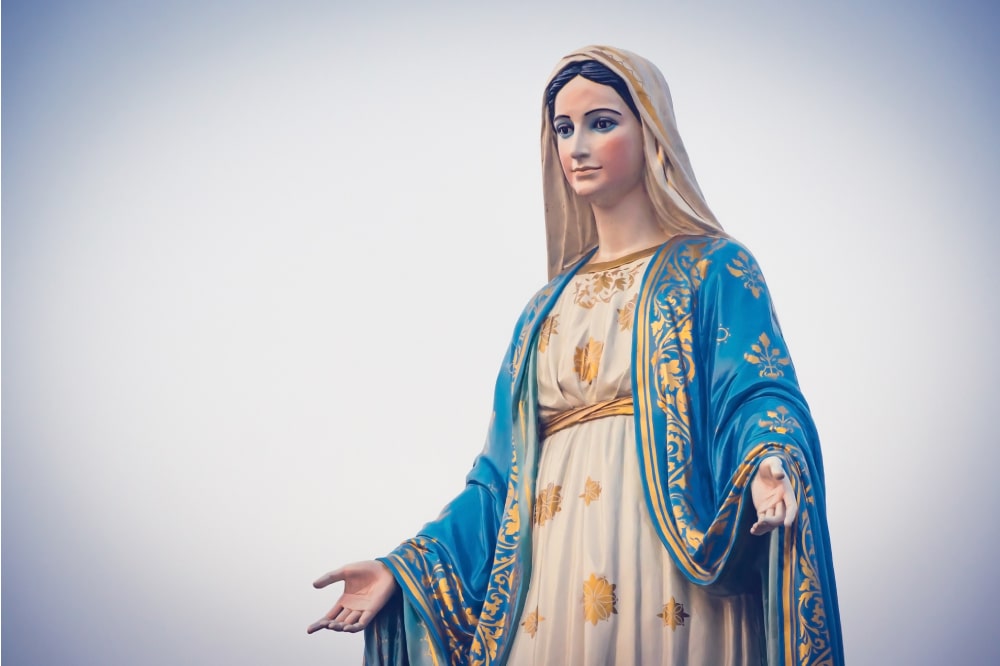
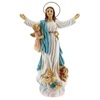
Assumption of Mary statue, depicted with a halo, open arms while on a cloud and surrounded by flowers and angels.
That of Prato is certainly not the only girdle attributed to the Virgin Mary. The existence of Virgin’s belts in various churches, from Jerusalem to Constantinople, runs through the history of Christianity, just like many other traditions linked to holy relics. But the civic as well as religious role assumed by the Sacred Belt of Prato since its arrival in the city has always made it a particularly precious treasure, as well as the focal point of great devotion. This devotion finds its highest expression on 8 September, the day on which the Nativity of Mary is celebrated, when the Sacred Belt is displayed during the Historical Pageant, or Feast of Our Lady of the Fair, an ancient celebration halfway between sacred and profane which culminates precisely in the solemn exposition of the Sacred Belt from the pulpit of Prato Cathedral.
How is it possible that such a common object, of everyday use, has over time come to assume such value as to be considered the very symbol of a city? Perhaps it is precisely its common nature, its belonging to a domestic and human dimension, that makes the Sacred Belt so special. For eight hundred years the inhabitants of Prato have sought, along the threads of that thin strip of fabric, their personal contact with the Virgin Mary, their special bond with her, a sort of bridge between earth and heaven. But not only that. The people of Prato have made the Holy Girdle the standard of their claims for civic and political autonomy against the neighbouring cities of Florence and Pistoia. As had already happened on the occasion of great battles and historical events, men chose to fight for their ideals in the name of the Virgin Mary. Let us recall above all the Battle of Lepanto, on 7 October 1571, fought by the Holy League under the sign of the Holy Rosary, to the point of establishing the beginning of the devotion to Our Lady of the Rosary.
The Sacred Belt, then, is said to have been handed over by Mary to Saint Thomas when she ascended into heaven. According to ancient traditions of the 5th–6th centuries, after announcing to the Virgin the approach of death, an angel of God gathered around her all the apostles, from every part of the world, so that they could assist her. The only one who did not arrive was Thomas. After Mary died, her body was placed in a tomb closed by a great stone in the Valley of Josaphat, and only then was Thomas brought by the power of the Angel from India to the Mount of Olives, where the Virgin appeared to him in a shining cloud as she ascended into heaven. It was then that Mary threw down the girdle to him, to bear witness to the miraculous event he was witnessing.
Saint Thomas himself is said to have given it to a priest, and from then on the religious relic passed from hand to hand until it reached Michele, a merchant of Prato who around 1141 had gone on pilgrimage to Jerusalem. There he met Maria, a young woman who was a descendant of the priest who had brought it as her dowry. Returning to his native city, Michele brought the Sacred Belt with him and kept it in a basket of rushes, and only upon his death did he hand it over to the provost of the parish church of Saint Stephen.
Soon many stories spread about the Belt and the miracles attributed to it, to the point of arousing a great popular devotion that went beyond the walls of Prato. It was then that the relic was stolen by Giovanni di ser Laudetto, called Musciattino, who in 1312 took it to deliver it to the people of Pistoia. As soon as he left the city, however, he was enveloped in impenetrable fog, to the point that, without realising it, instead of arriving in Pistoia he turned back on himself and returned to Prato, where he was captured and severely punished for his blasphemous crime. After having his right hand cut off, he was taken to the banks of the Bisenzio River tied to the tail of a donkey, burned alive, and his ashes scattered in the river.
Sacred art has handed down many beautiful representations of Our Lady of the Belt. Usually the scene depicted is that of Mary handing the girdle to Saint Thomas, leaning out from heaven and extending it with her hand, while the angels around glorify her.
Towards the end of the 14th century, the cult of Our Lady of the Belt became linked to that of Our Lady of Childbirth, because the relic had girded the womb that had carried the Saviour for nine months.
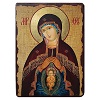
In this category you will find hand-painted icons.
The Chapel of the Holy Girdle in Prato
The Chapel of the Holy Girdle is located near the entrance to the Cathedral Basilica of Saint Stephen. After the attempted theft by Musciattino, it became necessary to guard the relic in a safer place. In 1346 the Holy Girdle was moved by order of the Municipality to an altar at the back of the church, managed by the Opera della Cintola. Once the necessary funds were collected, construction of the new chapel began, and it was built between 1386 and 1390. The task was then entrusted to Master Agnolo Gaddi to fresco the entire Chapel with scenes recounting the Story of the Virgin and the Girdle. The beautiful statue adorning the altar and depicting the Madonna and Child, however, is by Giovanni Pisano. Later, work was completed on the new façade, the external pulpit by Donatello from which the Belt is still displayed to the faithful today, as well as the internal gallery with the splendid and precious bronze railings by Maso di Bartolomeo, Donatello’s collaborator.
After the basket of rushes with which Michele brought it to Prato, the Belt was preserved in an ivory casket, then in the splendid Chapel of the Sacred Belt commissioned from Maso di Bartolomeo, then in a silver casket, until the magnificent crystal reliquary made in the 17th century. Today the Sacred Belt is kept in a silver, white gold and crystal case made by the master goldsmith Paolo Babetto and inaugurated in 2008.
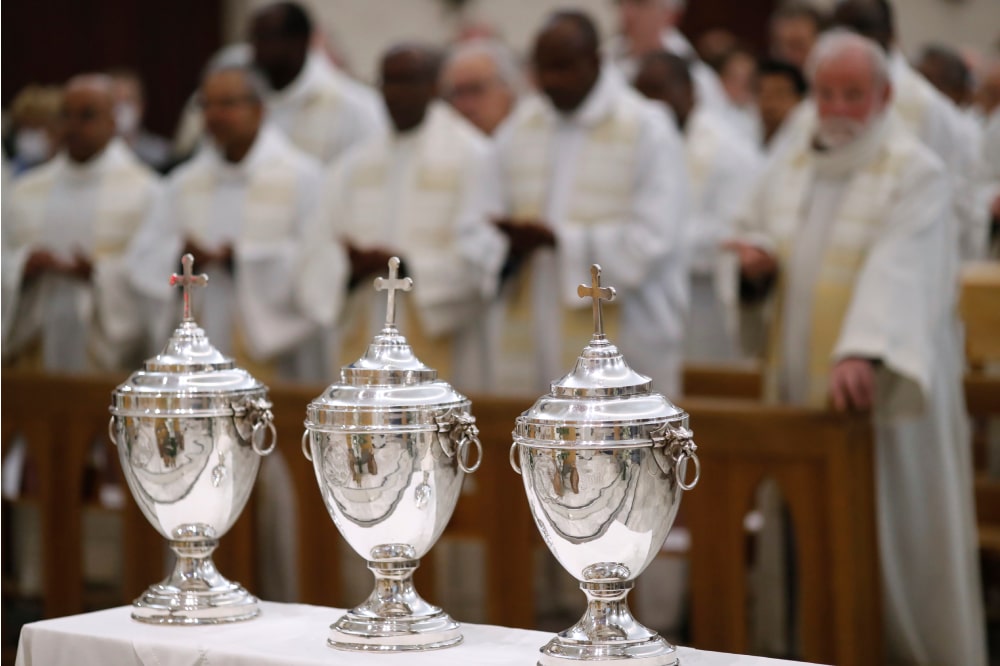
The chrism mass celebrates the mystery of the church, its unity and communion while waiting for Easter. It is also...
What’s the Future of Religion?
What’s the Future of Religion?
A Beginner’s Guide to Christianity
A Beginner’s Guide to Christianity
Mind-Blowing Statistics About Christianity You Need to Know
Mind-Blowing Statistics About Christianity You Need to Know
7844
Enter the Holyart world: $20 discount voucher valid on over 60,000 items
Come and discover Holyart, the largest e-commerce of religious articles in Europe and immediately receive a $20 voucher to use with your first purchase.
Check your mailbox: you will receive your discount within 5 minutes





 4 March 2026