It is said to be the cloth that wrapped the body of Christ after His burial. Between faith and science, the Holy Shroud divides and fascinates people of all ages with its immortal mystery
Among the symbols of Christ’s Passion, the Holy Shroud is one of the most emblematic and mysterious. Although it may seem out of place to speak of mysteries when discussing the Death of Jesus, it is undoubtedly the greatest mystery in the history of humanity. Among the relics handed down from this unparalleled event, the Shroud is certainly one of those around which the most myths and legends have arisen, along with ancient cults and modern devotions.
But what exactly is the Holy Shroud, and why is it so important for the history of Christianity?
It is said to be the burial cloth of Jesus, the linen sheet in which His body was wrapped at the moment of deposition from the Cross. On this ancient herringbone-patterned linen, measuring approximately 4.41 metres by 1.13 metres, there is indeed the faint imprint of a life-sized man, bearing marks of wounds and mutilations consistent with those inflicted on Jesus in the final tragic moments of His life, up to the Crucifixion. The image is double, front and back, joined at the height of the head.
The Gospels make reference to this cloth. Matthew, Mark, and Luke openly mention a linen cloth (sindòn), with which Joseph of Arimathea wrapped Jesus’ body before laying it in the tomb, as was customary Jewish funeral practice at the time. The deceased’s eyes would be closed, the chin tied with a cloth knotted at the crown of the head to keep the mouth closed, then the body washed, anointed with fragrant oils, and clothed in linen garments or wrapped in a linen sheet prior to burial.
This statue represents one of the best known images of the death of Jesus: the body Christ lifeless in the arms of Mary…
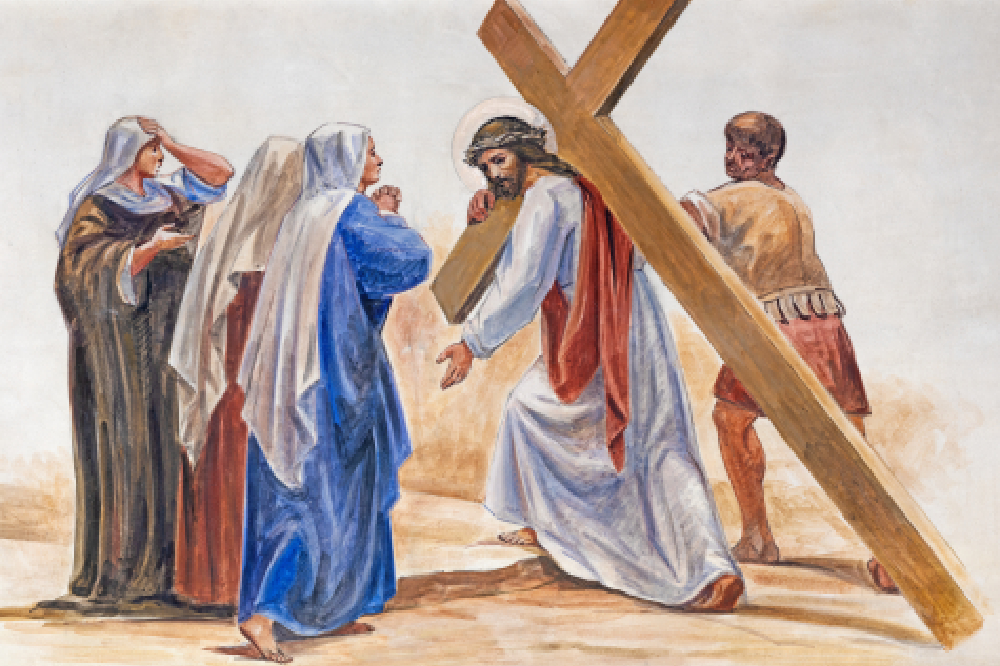
Other relics and sacred objects are linked to the Shroud or share common features with it, such as the Sudarium kept in the Cathedral of Oviedo, Spain, stained with what could be the blood of Christ. It is thought to be the cloth placed under His head at the time of deposition; the Mandylion of Edessa, a cloth bearing the face of Jesus, now lost; and the Veil of Veronica, said to have been used by the woman who wiped Christ’s face as He carried the Cross, as recounted in one of the Stations of the Cross.
Many make pilgrimages to see the Holy Shroud in Turin during the occasions when it is publicly displayed. These exhibitions are known as ostensions, from the Latin ostendere, meaning “to show.” Beyond those who visit the Shroud for reasons of faith, it has been the subject of scientific study and analysis for centuries by scholars worldwide and remains one of the most debated sacred objects ever.
The Holy Shroud is housed in the Cathedral of Turin, in Piazza San Giovanni, in the last chapel of the left nave, beneath the Royal Tribune. It is contained in a special preservation case, itself enclosed within a metal box, and so can only be seen during the aforementioned public ostensions. However, visitors may enter the chapel to pray in the pews placed in front of the case holding this precious relic.
The History of the Holy Shroud
The earliest historical record regarding the Holy Shroud dates to 1353. It is said that a knight named Geoffroi de Charny brought it from the Holy Land to the town of Lirey, where he lived and had a church built to house it. Here, the first ostensions were held for the devotion of the faithful. A descendant later sold it to the Dukes of Savoy, who took it to their capital Chambéry, placing it in a specially constructed chapel.
The story of the sacred cloth is, in a way, woven into its very fibres. Pollen from plants native to Palestine has been found among its threads, and scientific dating of the fabric has suggested it could originate from the first century AD. Until 1532, it was kept in the Sainte-Chapelle du Saint-Suaire in Chambéry, showing burn marks caused by a fire that nearly destroyed it. Notably, traces of molten silver, fallen from the reliquary that contained it, are also visible.
Duke Charles III of Savoy removed the Shroud from Chambéry and, after various relocations, the precious relic was brought to Turin in 1563, first housed in the Chapel of the Holy Shroud between the Cathedral and the Royal Palace, then moved to the Cathedral of Turin, in the chapel where it still resides today.
In 2002, a conservation restoration removed the supporting cloths applied after the Chambéry fire, as well as burnt portions of fabric, and cleaned the Shroud.
Dating the Holy Shroud
Given the Shroud’s symbolic importance, its authenticity has been questioned since the time of Geoffroi de Charny, who brought it from the Holy Land to Europe. Following numerous photographic studies, spectrometry, chemical analyses of bloodstains, and tests conducted under the supervision of witnesses and notaries, in 1988 a sample of the Shroud’s fabric underwent radiocarbon dating (carbon-14 technique) by three laboratories: Tucson, Oxford, and Zurich. This dating placed the cloth’s origin between 1260 and 1390, the period when it was brought to Europe. Those who consider the Shroud authentic reject this result, claiming it to have an older provenance, consistent with the story of Jesus as we know it.
Historical and archaeological analyses also suggest a later date for the Turin cloth, as Jewish burial linens from the first century were different in fabric, weave, and the way bodies were wrapped.
More recently, however, further measurements using a new technique called Wide-Angle X-ray Scattering (WAXS) have challenged previously accepted theories: the Holy Shroud could indeed date back to the time of Christ’s death. This would be demonstrated by the ageing of the linen’s cellulose, which according to Liberato De Caro, a physicist and Shroud researcher at the Institute of Crystallography of the National Research Council in Bari, places the Shroud’s date at around 2,000 years ago.
In truth, the mystery of the Shroud continues to captivate and divide the scientific world and humanity as a whole.
The chrism mass celebrates the mystery of the church, its unity and communion while waiting for Easter. It is also...
What’s the Future of Religion?
What’s the Future of Religion?
A Beginner’s Guide to Christianity
A Beginner’s Guide to Christianity
Mind-Blowing Statistics About Christianity You Need to Know
Mind-Blowing Statistics About Christianity You Need to Know
7204
Enter the Holyart world: $20 discount voucher valid on over 60,000 items
Come and discover Holyart, the largest e-commerce of religious articles in Europe and immediately receive a $20 voucher to use with your first purchase.
Check your mailbox: you will receive your discount within 5 minutes






 4 March 2026