Author: Redazione

The Celebrations of Good Friday: All the Most Important Moments

The Celebrations of Good Friday: All the Most Important Moments

Contents1 The Good Friday Liturgy2 Liturgy of the Word3 Adoration of the Holy Cross4 Holy Communion with the Pre-Sanctified5 Ambrosian Rite6 The Way of the Cross On Good Friday, the Passion and death of Jesus are contemplated, in anticipation of the Easter miracle. Here are…
Chrism Mass and the blessing of holy oils

Chrism Mass and the blessing of holy oils

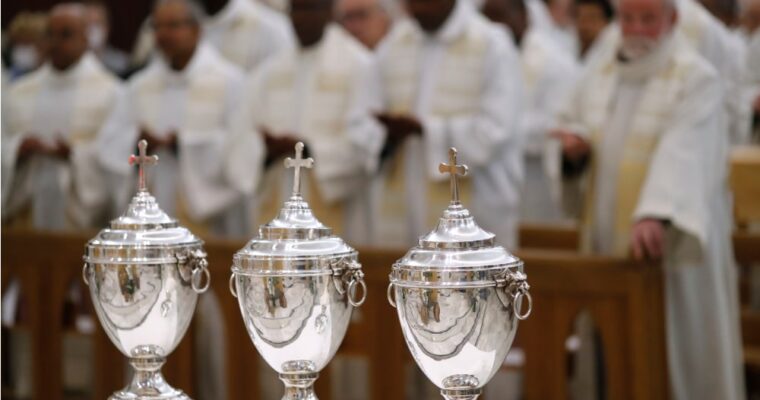
The chrism mass celebrates the mystery of the church, its unity and communion while waiting for Easter. It is also the occasion on which the sacred oils are consecrated Chrism Mass is celebrated on the morning of Holy Thursday or the afternoon of Holy Wednesday.…

Easter Around the World: Traditions and Curiosities from Other CountriesĀ 

Easter Around the World: Traditions and Curiosities from Other CountriesĀ 

How is Easter celebrated around the world? Many customs, traditions, and curiosities from each country for a single, great Christian celebration.

In Italy, Easter is undoubtedly one of the most deeply felt Christian holidays. It is celebrated with loved ones, organizing a picnic or a shared meal, exchanging Easter eggs, which may have been decorated together with children or made of chocolate, eating the traditional Easter dove cake (colomba pasquale), and so on. For believers, there is, of course, the religious and spiritual component. We must not forget that Easter commemorates the last days of Jesus’ life, His Passion, death, and Resurrection.
Over the years, the Christian component has blended with pre-existing pagan aspects. It is important to remember that Christian Easter coincides with a period in which, since ancient times, propitiatory rites were celebrated, marking the transition from winter to spring, from darkness to light, and the rebirth of life with the arrival of the warm season. The echoes of these ancient rites persist in many Easter customs and symbols, both in Italy and around the world.

The events of the Passion of Jesus

Read more:

The events of the Passion of Jesus: from the Last Supper to His Crucifixion
The Passion of Jesus is the highest and most terrible moment of…

In Italy, the religious celebration of Easter is tied to the rites of Holy Week: it begins with Palm Sunday, the day commemorating Jesus’ arrival in Jerusalem; Holy Wednesday is a day of sorrow, remembering Judas’ betrayal; Holy Thursday recalls the Last Supper, the institution of the Eucharist, and Jesus’ commandment of love (John 13:34); Holy Saturday commemorates Christ’s descent into hell. Finally, Easter Sunday celebrates the Resurrection of Jesus Christ. Religious celebrations are accompanied by secular traditions, especially Easter sweets, such as chocolate eggs and the Easter dove cake, along with countless traditional recipes that vary from region to region.

Here is an overview of Easter traditions and popular customs around the world.

Easter in England

In England, Easter and Easter Monday are celebrated. The English word for Easter, “Easter”, likely comes from the name of the ancient pagan goddess of dawn and spring, “Eostre”, who often took the form of a rabbit or hare. This is one reason why Anglo-Saxon Easter has very ancient roots, stemming from pre-Christian pagan rites that still echo today in various Easter traditions, such as giving children Easter Bunnies, chocolate rabbit-shaped treats.
Another typical Easter treat in England is Hot Cross Buns, sweet buns with cinnamon and raisins, decorated with a cross of icing on top.
Holy Thursday is known as Maundy Thursday, a name derived from the Old French “mandĆ©” and the Latin “mandatum” (meaning “command”), referring to Jesus’ commandment to His apostles at the Last Supper: “And now I give you a new commandment: love one another” (John 15:12).
On this day, it is tradition to give to the needy, not only through monetary or food donations but also by dedicating time and energy to the elderly and those in difficulty.

Easter in England is also full of fun and games, including Easter Egg Rolling, a race dating back to the 19th century, in which boiled and brightly decorated eggs are rolled down gentle slopes.
Chocolate eggs are also part of the tradition, but children must find them through a special treasure hunt called the Easter Egg Hunt.
Good Friday is a public holiday, as is Easter Monday. On Easter Sunday, families gather for a meal, enjoying traditional dishes, especially lamb, and performing the Morris Dance, an ancient folk dance believed to bring good luck. Easter Monday is often spent picnicking outdoors.

Easter Monday or Angel Monday

Read more:

Easter Monday or Angel Monday? Let’s find out why they are called so
Why is the Monday after Easter called Easter Monday?…

Easter in Spain

Easter in Spain is marked by grand processions that involve the entire population. These take place during Holy Week (Semana Santa), during which religious brotherhoods (cofradĆ­as) organize majestic events featuring processions of saint statues, crucifixes, and thrones of the Virgin Mary. Palm Sunday (Domingo de Ramos) is particularly celebrated, with the blessing of olive branches and palm fronds—or “palmons”, whole palm branches—which are later used to decorate doors and windows to ward off evil spirits.
A typical Easter delicacy in Spain is the Mona de Pascua, a rich sponge cake filled and decorated with almond glaze, chocolate eggs, and feathers.

Easter in France

In France, church bells remain silent from Good Friday to Easter Sunday as a sign of mourning for Jesus’ death. Children are told that the bells have flown to Rome, and on Easter morning, they look up at the sky to see them returning. When they get home, they find delicious chocolate eggs hidden everywhere, as part of the traditional Chasse aux œufs, or Easter egg hunt. For Easter lunch, the French typically eat lamb, pork, and eggs, often prepared as an omelette. Traditional sweets include Easter biscuits shaped like lambs.

The animal symbols of Christian Easter

Read more:

The animal symbols of Christian Easter
Doves, rabbits, lambs: as animals and other elements of the natural world become symbols of Easter…

Easter in the Netherlands

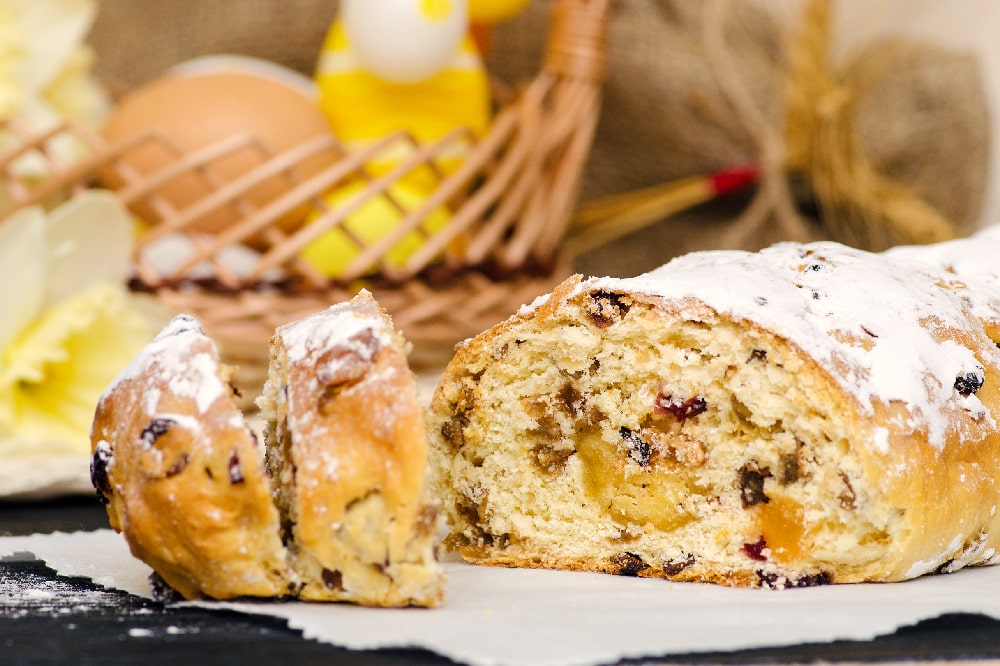
In the Netherlands, egg hunts are also common for children (and not only them) on Easter morning. Painted eggs are hung on branches, in bushes, or hidden indoors. Families then enjoy a festive meal featuring stuffed pancakes, warm bread with eggs, and the traditional Paasbrood, a sweet Easter bread similar to a panettone, enriched with dried fruit, raisins, and almond paste.

paasbrood

Easter in Greece

The Orthodox Easter always falls in April. Celebrations begin on Lazarus Saturday, the Saturday before Easter Sunday, which is usually the first Sunday after the full moon following the spring equinox. The first Monday after Carnival, marking the start of Lent, is celebrated by flying kites over fields. Lent is deeply observed, involving fasting and ancient rites, including fasting on Good Friday. On Holy Saturday night, when the Pope announces Christ’s Resurrection, everyone lights a blessed candle and takes it home. Easter Sunday is celebrated with outdoor feasts, featuring roast lamb on a spit or in soup (Maghiritsa), along with salad, feta cheese, Easter cookies, sweet Easter bread, and colored eggs. A traditional dish is kokoretsi, made from grilled lamb intestines.

How to Explain Easter to Children: Here Are Our TipsĀ 

How to Explain Easter to Children: Here Are Our TipsĀ 

Contents1 Decorating Easter Eggs2 Easter Bunnies3 Planting Wheat Sprouts for Easter Some advice on how to explain Easter to children, starting with stories suitable for them and Easter symbols they can recognise and appreciate. Explaining Easter to children is a delicate and precious moment. It…

The Story of Saint Gemma Galgani, the Saint of Lucca

The Story of Saint Gemma Galgani, the Saint of Lucca

Contents1 The Diary of Saint Gemma Galgani2 The Sanctuary Dedicated to Saint Gemma Galgani3 Prayers to Saint Gemma Galgani Saint Gemma Galgani was a mystic and seer from Lucca who died very young. Closely associated with the Passionist movement, she never entered a monastery, but…

Colouring Easter Eggs: An Ancient Tradition

Colouring Easter Eggs: An Ancient Tradition

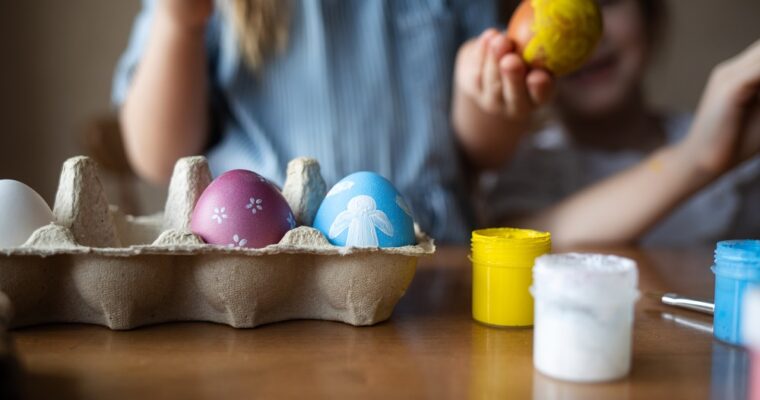
Colouring Easter eggs is a joyful way to prepare for the holiday, but it also holds deep symbolic meaning.

When did the custom of colouring Easter eggs originate? The answer to this question is simple: a very, very long time ago. According to an ancient tradition, the first person involved in a miracle concerning coloured eggs was none other than Mary Magdalene! It is also easy to understand why this tradition has persisted, weaving through the history of Christianity and often blending with folk customs, taking on different characteristics in various countries. Consider the tradition of coloured Easter eggs in Russia, which inspired the creation of true artisanal masterpieces, often crafted by miniature artists renowned for their icons. Moreover, it was the Russians who invented the precious and exclusive FabergĆ© eggs, gifts that became part of the Tsar’s treasure.

Even in medieval Europe, decorated Easter eggs were exchanged as gifts, and by the 1300s at the English court, they were covered with gold leaf, transforming them into precious jewels.

Among Italian Easter traditions, alongside religious ones, there are many rural customs still alive today. The fragile yet resilient eggshell, designed to protect life within, is used to invoke protection not only for family members but also for farm animals. When buried among the roots of plants, it is believed to bring fertility to the soil. Washing one’s face on Easter morning with water from a basin containing a red egg and a coin is said to ensure health and wealth for the entire year.

What Does the Egg Symbolise?

Long before Easter traditions, everything began with the egg, a symbol of the origin of existence, renewal, and the return of spring to warm the world after winter—a timeless cycle of life. Well before the birth of Christ, people in ancient civilisations exchanged coloured eggs as wishes for fertility and a good harvest during spring festivals. The Romans even buried red-painted eggs in their fields to enhance fertility.

After the coming of Jesus, coloured eggs became one of the symbols of Easter. The egg, representing life and rebirth, took on the profound and mysterious meaning of Christ’s Resurrection. Its vibrant yellow yolk pulses with life and light, akin to the sun, while the white shell, reminiscent of tombstones, breaks open just like the stone that sealed Christ’s tomb, releasing life and the hope of the Saviour.

Easter 10 curiosities about the symbols of the Passion of Christ

Read more:

Easter: 10 curiosities about the symbols of the Passion of Christ
The symbols of the Passion of Christ are an integral part of the Solemnity of Christian Easter…

Thus, the tradition of giving eggs continued, now imbued with an entirely new significance.

Why do we paint eggs? Let’s find out how people in Italy celebrate Easter, diving into the eggs traditions.

Why Do We Paint Eggs?

Among the Easter traditions of many countries, colouring eggs is one of the most widespread. In Italy, giving chocolate eggs is particularly popular, especially among children. The custom of chocolate eggs derives from the older tradition of giving Easter eggs, initially simple hard-boiled eggs, later painted in various colours and decorated with different designs.

Tradition dictates that eggs are coloured on Maundy Thursday and then gifted to family and friends. Red-painted eggs clearly symbolise Christ’s Passion and His blood shed in sacrifice for all humanity. This vivid, bright red can be achieved using water from boiled onions or red beetroot, red cabbage leaves, hibiscus tea, mallow infusion, or blackcurrant juice.

The events of the Passion of Jesus

Read more:

The events of the Passion of Jesus: from the Last Supper to His Crucifixion
The Passion of Jesus is the highest and most terrible moment of his…

While red eggs have become a symbol of Jesus’ blood, the meaning of eggs as gifts and wishes for happiness and prosperity has never disappeared. This is why eggs are also coloured in cheerful and imaginative hues, making egg-colouring a creative and joyful activity at home. Nowadays, food colouring is commonly used, but one can return to traditional methods, achieving beautiful blue eggs with blueberry juice, green with spinach cooking water or parsley juice, yellow with turmeric or saffron, purple with wine or grape juice, and so on.

The Story of Mary Magdalene’s Red Eggs

After Jesus’ death, eggs quickly became associated with His Resurrection. According to legend, shortly after His death, a rabbi dining with friends declared that Jesus would rise again when the roasted cockerel they were eating came back to life and the eggs on the table turned red. Moments later, the eggs had indeed changed colour, becoming a bright red.

However, the origin of the tradition of painting Easter eggs red is linked to Mary Magdalene. After Jesus’ death, she travelled with the other apostles to preach the Gospel, eventually reaching Rome. According to popular tradition, she appeared before Emperor Tiberius, offering him a red-coloured egg and proclaiming that Christ had risen.

In another version, Magdalene went to the disciples to announce Jesus’ Resurrection. Peter sceptically declared he would believe her story only when the eggs in her basket turned red—which miraculously happened before their very eyes.

Who was Mary Magdalene

Read more:

Who was Mary Magdaleneā€ History and life of the ā€œApostle of the Apostlesā€
Among the disciples, there were also several women…

Via Dolorosa: the 14 bronze installations depicting the scenes of the Passion

Via Dolorosa: the 14 bronze installations depicting the scenes of the Passion

Contents1 The Via Dolorosa: The True Way of the Cross2 The blessing of Pope Francis3 The Passion of Christ Panels The Via Dolorosa in Jerusalem retraces the stages of the Passion of Jesus up to Calvary. Today it hosts a unique art installation From 6…

Luce & Friends: The Jubilee Mascot and Her Companions

Luce & Friends: The Jubilee Mascot and Her Companions

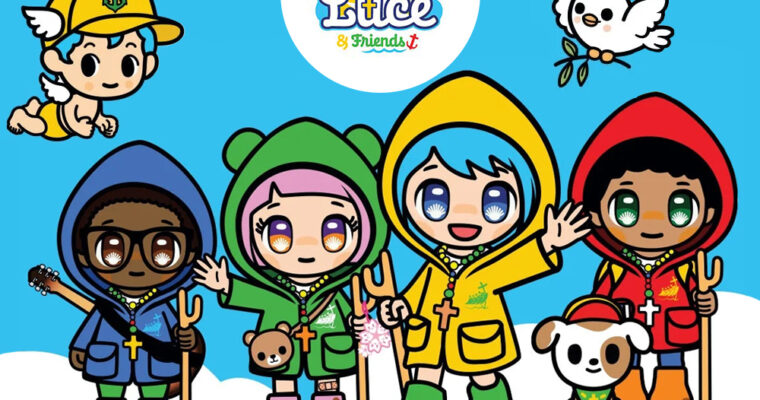
Contents1 Luce and Santino Like St. Roch and His Dog2 Fe, Xin, and Sky: Luce’s Travel Companions3 Other Symbols Accompanying Luce Luce, the mascot of Jubilee 2025, does not embark on her pilgrimage of faith and hope alone: with her are many small friends who…

The miracles of Jesus in the four Gospels

The miracles of Jesus in the four Gospels

The miracles of Jesus mentioned in the Canonical Gospels are considered historical events, although told from a theological perspective. Here are the main ones.

The Catholic Church acknowledges the existence of miracles, that is, events not attributable to natural causes but rather to divine intervention. These are occurrences that overturn the natural order of things, transcend reality, and offer a glimpse of the divine on Earth. For this reason, it has always been a priority for the Church to identify potential miracles, carefully examine them, and determine which ones are genuine and which are not. When it comes to the miracles of Jesus, particular caution has always been necessary. It is essential to distinguish between the miracles of Jesus mentioned in the Canonical Gospels, considered to be true historical facts and those narrated in the Apocryphal Gospels, which are told more like fairy tales, designed to astonish and capture the attention of readers.

Even the miracles of Jesus reported in the Canonical Gospels are regarded as historical facts, but they are imbued with a transcendent meaning and are often narrated from a theological, if not allegorical, point of view, according to some Bible scholars.

The apocryphal gospels

Read more:

The apocryphal gospels: what differentiates them from the canonical ones
The apocryphal gospels are not part of the New Testament…

We must consider these extraordinary events as signs that Jesus performed not to amaze those who followed Him or to convince the unbelievers to believe in Him. Rather, they are defences of His mission, miracles performed to help faith, to inspire greater belief.

The miracles of Christ mentioned in the four Gospels can be classified into:

– Healings from permanent disabilities,

– Healings from injuries and diseases,

– Exorcisms and liberation from evil spirits,

– Resurrection of the dead.

There are other miracles that do not fall into these categories, and according to the Evangelist John, many other miracles were not recorded.

Another classification can be made based on how many and which Gospels mention the various miracles. Some are shared in all four Gospels, while others are mentioned in only some.

Also considered miracles of Jesus are the Annunciation, His conception by the Holy Spirit, and His birth from the Virgin Mary, even though He was not directly responsible for these events, and they are only briefly mentioned in the Gospels.

The miracles of Jesus shared by all four Gospels

The miracles of Jesus mentioned in all four Canonical Gospels are: His Baptism, the Multiplication of the loaves, and the Predictions of the Last Supper.

In the Baptism of Jesus, the miraculous element is the descent of the Holy Spirit in the form of a dove: while John the Baptist baptises Jesus in the waters of the Jordan, the sky opens, and a dove descends, accompanied by a Voice recognising Jesus as the beloved Son. In the Gospel according to John, there is no mention of the Baptism, only of the descent of the dove.

The four Gospels also recount the Last Supper and the institution of the Eucharist, that is, the miraculous transformation of the bread into the Body and the wine into the Blood of Christ, and His predictions about Judas’s betrayal and His own end.

Additionally, all four Evangelists speak of the Appearances of Jesus after the Resurrection and before the Ascension. Each of them gives a different account, especially regarding the people involved, the duration, and the locations where these appearances took place.

The multiplication of loaves and fishes

In fact, the Gospels mention two multiplication events of loaves and fishes.

The first multiplication is recorded by all four Evangelists: Jesus was preaching in a desert place where those listening were unable to buy food. He asked His disciples to gather whatever they could, and they returned with only 5 loaves and 2 fish, with which Jesus fed five thousand people.

On another occasion, Jesus fed four thousand men who had not eaten for three days to stay and listen to Him, using seven loaves which He broke and gave to His disciples to distribute, along with a few small fish which He blessed. There was so much leftover food that seven baskets were collected. Only Matthew (Matthew 15:32-39) and Mark (Mark 8:1-10) mention this second episode.

In both cases, the symbolic message is clear: it is a kind of foreshadowing of the Eucharist, a miraculous food that can nourish and give life to anyone who believes in Christ and lives in Him.

The Last Supper

Read more:

The Last Supper by Leonardo da Vinci
The Last Supper by Leonardo da Vinci, in Santa Maria delle Grazie, is one of the most famous works in the world…

The resurrections: Lazarus and the daughter of Jairus

Before the Resurrection of Lazarus, the three Synoptic Gospels (Mark, Matthew, Luke) mention the resurrection of the daughter of Jairus, a synagogue leader. The man prayed to Jesus to save his sick daughter, but when they arrived at the house where she lay, she had already died. Christ then told the relatives to wake her up, as she was only sleeping, and He resurrected her.

We also include here the healing of the woman with a haemorrhage, which occurred at the same time as the resurrection of the daughter of Jairus. In fact, reading Mark’s Gospel, we get the impression that, in order to heal the woman who had been suffering from terrible haemorrhages, Jesus delayed and did not manage to reach Jairus’s house before his daughter died. In reality, both episodes show the healing power of Faith: the faith of Jairus in the first case, who does not give up and continues to pray to Jesus, even after his relatives urge him to stop because it is too late; and the faith of the woman in the second, who secretly touches Jesus, knowing that this alone could be enough to save her.

Of course, the Resurrection of Jesus Himself is a miracle, though it cannot be compared to the resurrections in the Gospels: Jesus returns to life to ascend to Heaven and eternity, while Lazarus and the daughter of Jairus return to their earthly lives and are still destined to grow old and die one day.

Healings and exorcisms

Among the miracles of Jesus described in the Gospels, many are healing miracles from diseases or severe disabilities. The way in which Jesus heals the sick varies each time: sometimes He merely speaks with them, other times He needs to touch them, and so on. For example, to the blind man encountered in Bethsaida, He put saliva on his eyes, while John speaks of a man who had been blind from birth, healed by the mud that Jesus had spat on. Mark’s Gospel tells of a deaf-mute man whom Jesus healed by touching his ears and then his tongue with His own saliva.

Jesus healed many lepers, to the point that He had to flee from their increasingly pressing requests.

In the Gospels of Matthew (Matthew 8:28-34) and Luke (Luke 8:26-39), the exorcism performed by Jesus on the demoniac of Gerasa is recounted. This man, who lived in the region of the Gerasenes, was possessed by a legion of demons. Jesus was able to free him by sending the demons into a herd of pigs, which He then made a rush into the sea.

How to Ask for a Miracle: A Journey of Faith and Prayer

How to Ask for a Miracle: A Journey of Faith and Prayer

How can we ask God for a miracle? Prayer and Faith are the most powerful tools we have to invoke His help. Here’s how to offer them to Him. The Catholic Church acknowledges the existence of miracles—events that transcend the laws of nature, escape human…

Bottega Tifernate: pictography and Italian craftsmanship

Bottega Tifernate: pictography and Italian craftsmanship

Contents1 History of Bottega Tifernate2 The Pictography Technique3 The Essential and Retouch Finishes4 Bottega Artigiana Tifernate Catalogue Thanks to the pictographic technique, applied in the Essential and Retouch finishes, Bottega Tifernate in CittĆ  di Castello combines the aesthetic and artisanal excellence of the Renaissance artistic…

Cross of Hope designed by Stefano Lazzari for the Jubilee 2025

Cross of Hope designed by Stefano Lazzari for the Jubilee 2025

The Cross of Hope, created by Stefano Lazzari for the Jubilee 2025, combines medieval tradition and innovation, symbolising the journey of faith. Made of brass with an antique gold finish, it represents excellence in Italian craftsmanship.

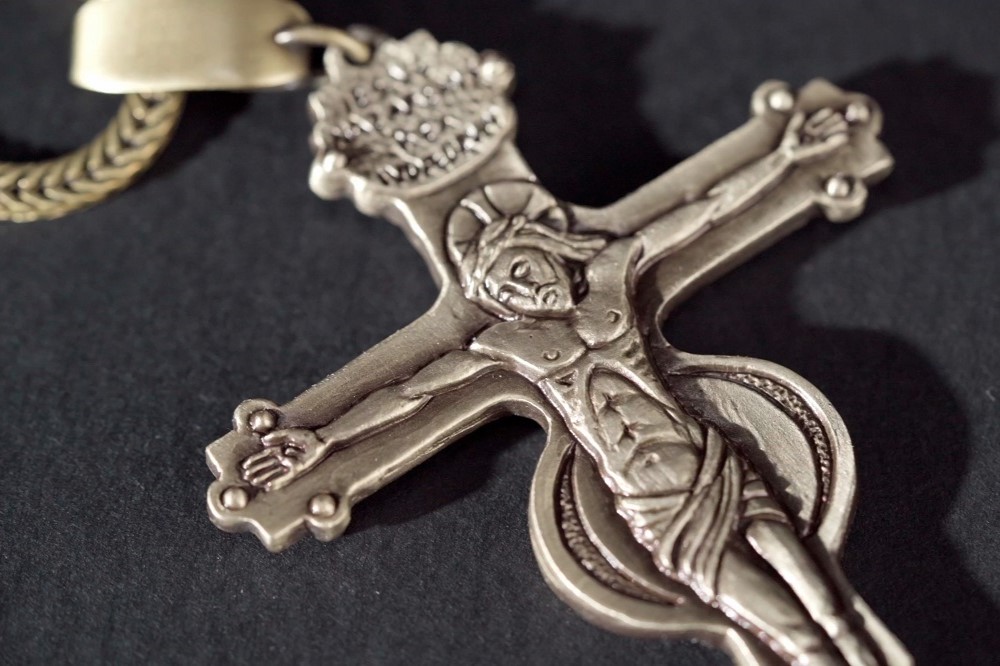
Among the many initiatives linked to the celebrations for the Jubilee 2025, marked by the motto “Pilgrims of Hope,” there is also a precious crucifix, a true work of sacred art created specifically for this significant event. This is the Cross of Hope, designed and crafted by the Umbrian master artisan Stefano Lazzari of Bottega Tifernate, and it is available exclusively online in the Holyart store. This double-sided crucifix, which embodies the fascination of medieval tradition and technical innovation—a combination that has always distinguished Bottega Tifernate—captures the essence of the spiritual pilgrimage, which is the central theme of this Holy Year, through a visual language rich in symbolism.

The Jubilee 2025 Events Calendar

Read more:

The Jubilee 2025 Events Calendar
The calendar of events for the Jubilee 2025 has been published, twelve months of events and occasions to deepen faith, live fraternal…

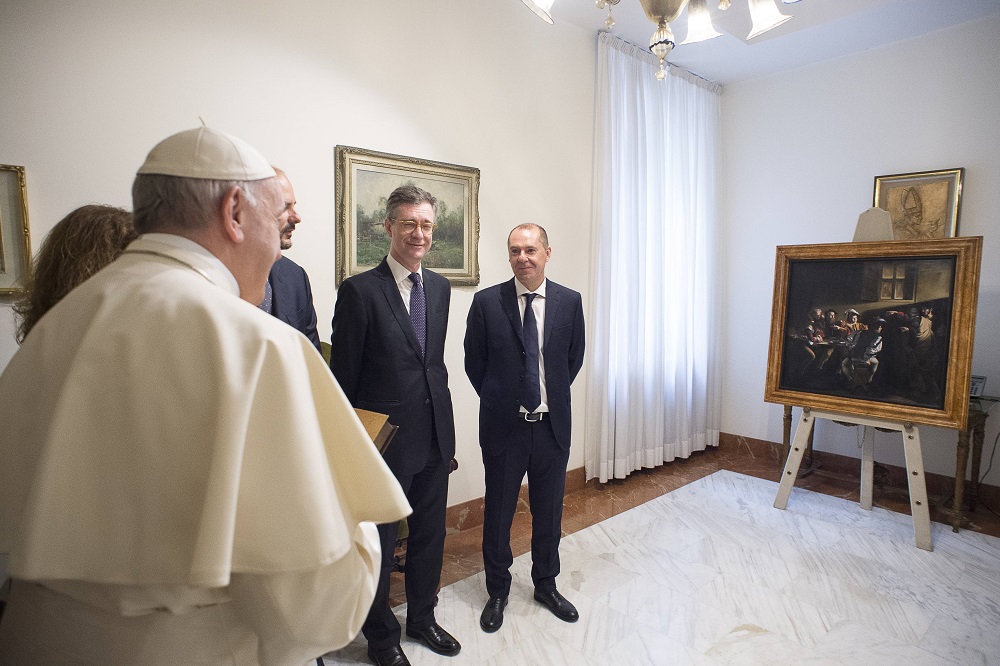
Bottega Tifernate, founded in 1995 by Stefano Lazzari together with his sister Francesca and his father Romolo, is a global leader in the reproduction of sacred artworks. With a team of young artists specialised in techniques ranging from chiselling to carving, the workshop has built a strong reputation, excelling in the ability to recreate artworks identical to the originals. Today, it boasts many prestigious commissions, including the reproduction of a Caravaggio in 2018 and Marc Chagall’s White Crucifixion in 2019, both for Pope Francis. The Cross of Hope follows this tradition of medieval inspiration and contemporary renewal, promoted by the Lazzari family, which has quickly become an internationally recognised Italian excellence.

reproduction of a Caravaggio

The uniqueness of the Cross of Hope lies in its dual nature: to commemorate Christ’s supreme sacrifice and to affirm the importance of the journey of faith undertaken by every pilgrim preparing to experience the Holy Year. The double-sided cross was conceived with the layout of St Peter’s Basilica and Square in mind. The front depicts a Renaissance-style Christ, dead yet portrayed with a serene and conscious expression, already evoking His resurrection and thus differing from traditional representations of suffering. This artistic choice is deliberate, aiming to convey a message of hope and redemption. The carefully sculpted Mount Golgotha at the foot of the cross recalls His supreme sacrifice of love for humanity.

Turning the cross reveals an equally powerful image: a pilgrim arriving at St Peter’s Square, symbolising the spiritual journey that every believer is called to undertake. This representation transforms the cross into a tangible metaphor for the path of faith, linking the past of tradition to the present of the Jubilee pilgrimage, echoing the motto of Jubilee 2025, ā€œPilgrims of Hope.ā€

The excellence of Italian craftsmanship is evident in every stage of its creation. Bottega Tifernate brought together two masters of Italian art: sculptor Fausto Schirato, whose expert hands shaped every detail in the original plaster, and founder Marino Vigolo, who brought the work to life using the ancient technique of lost-wax casting. Lost-wax casting is an ancient metal-forming technique that enables the creation of objects with exceptionally fine details. The process involves crafting a wax model, which is then coated with a refractory ceramic shell. Once heated, the wax melts away, leaving a hollow space into which molten metal is poured. After cooling, the ceramic shell is broken to extract the piece, which is then refined. Used since antiquity for sculptures and ritual objects, this technique is now also applied in advanced fields such as aerospace, biomedical engineering, and jewellery-making, integrating modern technologies like 3D printing and artificial intelligence. The production process exemplifies how traditional craftsmanship can merge with contemporary precision. From the creation of the rubber mould to the brass casting, each phase is meticulously controlled. Manual finishing, burnishing, and patination enhance the play of light and shadow, accentuating the three-dimensionality of the piece and ensuring its uniqueness.

The pectoral version of the Cross of Hope is 10 centimetres high and is accompanied by a refined brass necklace, whose design echoes the layout of St Peter’s Basilica. Available in two lengths, 80 or 90 centimetres, the foxtail chain completes the piece with elegance and symbolic significance. Attention to detail extends to the presentation as well: each cross is delivered in an elegant red box, numbered and certified. The inclusion of a QR code provides access to a wealth of additional information, bridging traditional craftsmanship with modern technology. Several versions of the same cross have been created: in addition to the pectoral version, a larger one has been made for display as an ornamental piece or wall decoration, as well as one for liturgical celebrations on the altar.

Within the context of Jubilee 2025, the Cross of Hope takes on a profound meaning. It is not just an ornament but a silent witness of faith, a companion for pilgrims preparing to experience this extraordinary moment.

Here are the best films to watch at Easter

Here are the best films to watch at Easter

Contents1 The Passion of the Christ2 The Last Temptation of Christ3 Jesus Christ Superstar4 King of Kings5 The Gospel According to St. Matthew6 The Greatest Story Ever Told From The Greatest Story Ever Told to The Passion of the Christ, including Jesus Christ Superstar. Films…

The story of Pontius Pilate and his involvement in the condemnation of Jesus

The story of Pontius Pilate and his involvement in the condemnation of Jesus

Contents1 Who was Pontius Pilate?2 Jesus’ entry into Jerusalem3 The trial of Jesus4 Pontius Pilate washes his hands5 Exile and suicide A controversial and tragic figure, Pontius Pilate has gone down in history as the man who condemned Jesus to death. But who was he…

Lenten fasting: what it means and how to practice it

Lenten fasting: what it means and how to practice it

Lenten fasting is a practice of preparation for Easter that should be accompanied by prayer and almsgiving, as Pope Francis wrote in the 2019 Lenten Message.

What does Lent mean? It is the period of purification, abstinence, and fasting that every Christian must observe during the forty days leading up to Easter. It symbolically coincides with the 40 days that Jesus, after being baptised by John the Baptist, spent in the desert to prepare for his public ministry through prayer, purification, and fasting. It also coincides with the end of Carnival, from the Latin “carnem levare”, “to deprive oneself of meat”. Lent represents a very particular and important moment for every Christian. The soul prepares to welcome the Paschal mystery, and for this reason, it is necessary for it to be purified from thoughts and distractions. Prayer and meditation are increased, small Lenten sacrifices are offered, giving up something particularly dear, and charity work is undertaken. The body also needs to be prepared for this unique and solemn feast. Hence, Lenten fasting is proposed to us, with a few simple rules of abstinence and moderation that, on the one hand, allow us to purify the body, and on the other, help us exercise control over ourselves, learn to be less attached to our comforts, and become less selfish.

Lenten Fioretti

Read more:

Lenten Fioretti: 5 ideas on small sacrifices or things to do
Lent, a time of penance, prayer and devotion. What are the most suitable Lenten florets to prepare for Easter in the best way?

Fasting, however, is not a practice that belongs solely to the Lenten period. Christians fast on certain days of the year, particularly in conjunction with solemn holidays. It should be part of the faithful’s life, just like prayer, almsgiving, and works of charity. It has always been this way, even in the Old Testament, and was widespread among the Jewish people long before the birth of Jesus, as was the obligation of absolute rest. When Moses had to prepare to receive the Ten Commandments, he fasted for forty days in the desert to present himself to God in purity. The Jews also practiced the ā€œgreat fastā€ on the Day of Atonement (Yom Kippur).

Returning to Lenten fasting, for Christians, not only Catholics, Ash Wednesday marks the beginning of the Lenten period.

The practice of fasting is not shared by Protestants, except for Anglicans, because mandatory fasting during certain periods is seen as an outward and useless practice. Each believer asserts the right and duty to fast when they deem it appropriate, and not in conjunction with specific occasions. In the Orthodox Church, fasting is regularly practiced twice a week, on Wednesday and Friday, and more strictly in conjunction with particular feasts. During Orthodox Lent, the fasting is particularly strict.

Ash Wednesday

Read more:

Ash Wednesday: what it is about
Carnival is about to end. After Shrove Tuesday there is Ash Wednesday, which marks the beginning of Lent.

Who is required to fast during Lent?

According to the Code of Canon Law, all practicing Christians are required to observe fasting and abstinence from meat at least twice a year: on Ash Wednesday (which, for the Ambrosian rite, becomes the first Friday of Lent) and Good Friday. More generally, one should avoid eating meat on “fasting days”, that is, on Fridays and other prohibited days, as indicated in the apostolic constitution “Paenitemini” by Pope Paul VI in 1966. These precepts should generally be observed on Good Friday and all Fridays of Lent, to prepare for Easter in the best and most Christian way.

According to Canon 1252 of the Code of Canon Law, the age for starting the obligation of fasting is set at 18, while the end is at 60. Those who suffer from particular illnesses or have a just cause, usually related to health reasons, can be exempted and substitute fasting with works of charity. The obligation of abstinence from meat applies, however, from the age of 14.

During Lent, in addition to fasting, Italian bishops encourage the faithful to practice other forms of abstinence or at least moderation, as forms of penance and purification: abstaining from smoking, alcohol, excessive use of mobile phones, and so on. These are always privations that can be included in the small sacrifices for Lent.

Anyone wishing to receive Communion is required to abstain from any food or drink for at least one hour beforehand, as stated in Canon 919 of the Code of Canon Law.

How to fast during Lent

First of all, we must distinguish between fasting and abstinence: fasting concerns the quantity of food, while abstinence refers to what can be eaten.

Lenten fasting allows only one full meal throughout the day. Small amounts of food are allowed in the morning and evening, along with necessary water and medicine for health. Lenten fasting allows the consumption of all types of vegetarian food, such as vegetables, cereals, and legumes, but also fish, eggs, and dairy products in moderate quantities.

Abstinence occurs on Fridays during Lent and involves excluding meat, although it can be replaced with fish, provided it is simple fish and cooked in an uncomplicated manner.

What is not allowed to be eaten on Fridays during Lent?

As we have seen, the Code of Canon Law, particularly Canon 1251, defines the rules of fasting and abstinence: Abstinence from meat or other foods shall be observed, according to the provisions of the Bishops’ Conference, on all Fridays of the year, except when they coincide with a solemnity; fasting and abstinence, however, shall be observed on Ash Wednesday and Good Friday.”

The rule of abstinence from meat in the strict sense applies to Ash Wednesday and all Fridays during Lent, especially Good Friday. It is also recommended on Holy Saturday.

On these days, meat of any kind, red or white, is prohibited, as well as non-meat dishes that are very elaborate or fancy, such as shellfish or seafood.

the Easter Lamb

Read more:

The symbolism of the Easter Lamb
Easter is getting closer, carrying its solemn suggestions and symbols full of spirituality. The Easter Cross, candles, lamb.

Who is Simone Legno, the Designer of the Jubilee 2025 Mascot

Who is Simone Legno, the Designer of the Jubilee 2025 Mascot

Contents1 Simone Legno, Founder of the Tokidoki Brand2 Simone Legno and Luce: The Birth of the Mascot3 The Mascot’s Presentation to Pope Francis Let’s get to know Simone Legno, the eclectic Italian artist and creator of Luce, the mascot of Jubilee 2025 In recent months,…
How Filigree Jewellery is Made

How Filigree Jewellery is Made

Contents1 What is the filigree technique?2 Melting3 Rolling and Drawing4 Twisting, Shaping, and Filling5 How is filigree worked?6 What materials are used to make filigree jewellery?7 Holyart’s catalogue of filigree products8 Filigree jewellery on Holyart9 Chalices, Ciboria, and Patens decorated with filigree on Holyart Filigree…

The symbols of the Evangelists and their meaning

The symbols of the Evangelists and their meaning

Winged man, ox, lion, and eagle. The symbols of the Evangelists have been part of the history of sacred art and theology for centuries. Here is how they originated and why they were attributed to them.

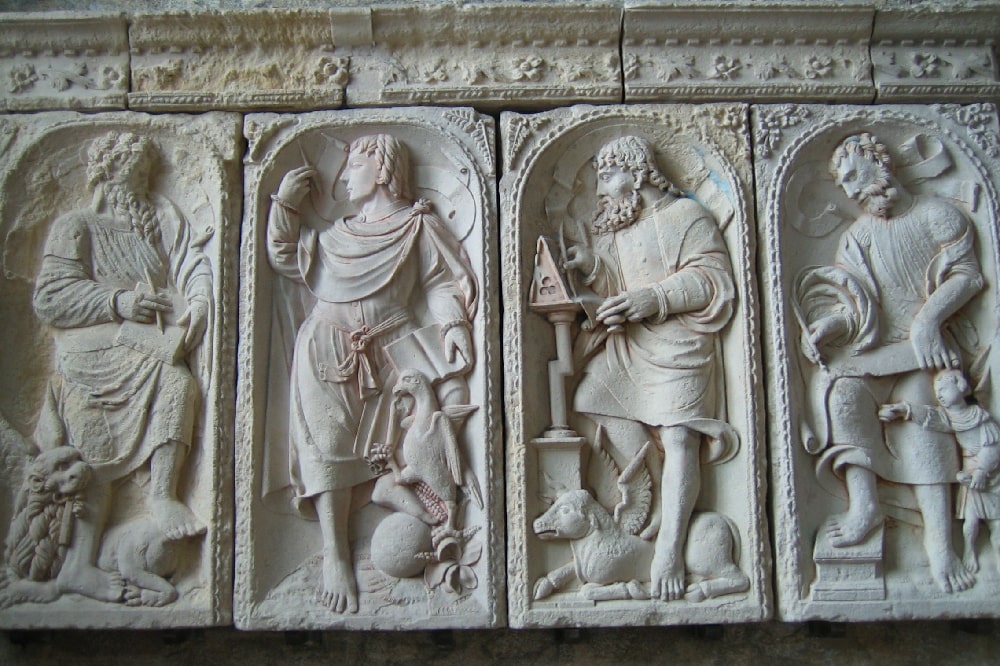
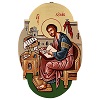
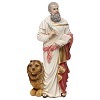
With the term tetramorph, of Greek origin and indicating an iconographic representation made up of four figures or elements since ancient times, we refer to an image composed of four symbols associated with the four Evangelists: a winged man (Gospel of Matthew), a lion (Gospel of Mark), an ox or calf (Gospel of Luke), and an eagle (Gospel of John). The first to define what would become the symbols of the Evangelists was Irenaeus of Lyon. A bishop, theologian, and Father of the Church, he interpreted the vision described by the Hebrew prophet Ezekiel in the Old Testament (Ezekiel 1:10), which he had during the deportation to Babylon in 593 BC. Ezekiel recounted seeing a great cloud surrounded by radiance, and in the midst of that cloud, four creatures—later identified as cherubim—each with four wings. One figure had the face of a man, one of a lion, one of a calf, and the last of an eagle. These creatures stood at the foot of God’s throne and seemingly helped move it with wheels placed beside them.

In his work Adversus Haereses, Saint Irenaeus introduced the idea of a tetramorphic or quadriform Gospel. For him, the four winged beings seen by Ezekiel could be identified with the seraphim, which, according to Isaiah (Isaiah 6:3), occupy the highest ranks of the angelic hierarchy. At the same time, they symbolise the four canonical Gospels, the true spiritual pillars of the Church and the entire world. To each Evangelist, Saint Irenaeus assigned a specific symbol, also referring to Revelation (Revelation 4:6–8), where the “four living creatures, full of eyes in front and behind,” are described as being at the foot of God’s throne: “the first living creature was like a lion, the second like an ox, the third had a face like a man, and the fourth was like a flying eagle.”

Each of the four Gospels focuses on a specific aspect of Christ’s figure:

Gospel of Matthew (man or angel): His Incarnation

– Gospel of Mark (lion): His victorious power (the Resurrection)

– Gospel of Luke (ox or calf): His sacrifice (the Passion)

– Gospel of John (eagle): The outpouring of the Holy Spirit (Pentecost)

Saint Matthew, apostle, evangelist and martyr

Read more:

Saint Matthew, apostle, evangelist and martyr
On 21 September, Saint Matthew is celebrated evangelist, apostle and martyr. Who was he and how did he become an apostle?

According to Irenaeus, even from the prologue of each Gospel, one can derive the symbol of each Evangelist, the core of the fourfold evangelical message, and the particular aspect of Christ highlighted in the text.

Saint Jerome also embraced the symbolism identified by Irenaeus, applying it not only to four aspects of Jesus’ figure but also to four phases of His mortal life. According to Jerome, Christ:

– was born as a man (Incarnation, winged man, Gospel of Matthew);

– died as a sacrificial calf (Passion, ox or calf, Gospel of Luke);

– rose from death with the strength of a lion (Resurrection, lion, Gospel of Mark);

– ascended to Heaven like an eagle (Ascension, eagle, Gospel of John).

Over the centuries, other scholars and men of faith have examined the Evangelists and their symbols, defining various sequences and combinations. The tetramorph, an iconographic depiction of four elements already present in Middle Eastern symbology (consider the protective spirits guarding the royal palaces of Babylon), has been widely used in Christian iconography and sacred art.

Not only that, but the symbols of the four Evangelists also determine the order in which the Gospels are arranged in both ancient manuscripts and modern editions of the Bible, following the sequence codified by Ezekiel: man (Matthew), lion (Mark), ox (Luke), eagle (John).

Saint Matthew the Evangelist

The Gospel of Matthew begins with the genealogy of Jesus, a list of men, followed by the account of Jesus’ birth and childhood. According to some biblical scholars, it may have been the first Gospel to be written and served as a source for the Gospels of Mark and Luke, while others suggest it borrowed heavily from the Gospel of Mark.

What is certain is that the Evangelist Matthew devoted considerable attention to Jesus as a man, starting with His genealogy and highlighting His human story. For this reason, he has been associated with the tetramorph figure of the man or angel, where the angel symbolises the union between the human aspect and the divine nature.

Saint Mark the Evangelist

The Gospel of Mark, on the other hand, begins with John the Baptist, who took on the mission of preparing the way for the Messiah. Dressed in animal skins and deeply devoted to his role, John the Baptist can easily be imagined as a lion, with a voice as powerful as a roar, announcing that the Time was near. In the Middle Ages, the lion symbolised justice. Its majestic head indicated divine nature, while its body and paws represented human nature.

The Evangelist Mark does not mention Jesus’ childhood but focuses significantly on His Passion, inspiring many works of art depicting this episode.

Saint Luke the Evangelist

The Gospel of Luke opens with a sacrifice: Zechariah, the husband of Elizabeth, a relative of the Virgin Mary, offers an ox to God. Then he has a vision in which he is told that his wife will bear a child, who must be named John. That child would become the Baptist.

From the beginning, we see how the Evangelist Luke focuses on the theme of sacrifice—not only that of Christ but also that of Mary, whose story Luke examines in detail.

Saint John the Evangelist

From the Gospel of John, we understand that this Evangelist was likely the favourite among the apostles who followed Jesus. Deeply mystical, his Gospel is infused with spirituality and is less concerned with human events than with their deeper, religious significance.

In the prologue to his Gospel, John reflects on the concept of the Word, the Word of God, capable of dispelling darkness. It was believed that the eagle could stare at the sun without being blinded, and for this reason, Saint John, who sought to gaze deeply into God, was attributed this symbol.

The Beloved Disciple

Read more:

The Beloved Disciple: Who was the disciple ā€œlovedā€ by Jesus
Giovanni, the beloved disciple of Jesus. A fisherman, like the brothers Simon Peter and Andrew, he had a special relationship with Christ.