Author: Redazione

Types of Crosses and their meanings

Types of Crosses and their meanings

Contents1 Latin Cross2 Greek cross3 Tau cross, also known as Saint Anthony the Abbot cross or Crux Commissa.4 Tree of Life Cross5 Eight pointed Cross6 Cross of Saint Aemilian of Cogolla7 The Coptic Cross8 Cross with trilobed terminals9 Russian Cross10 Marian Cross11 Papal Triple Cross12…
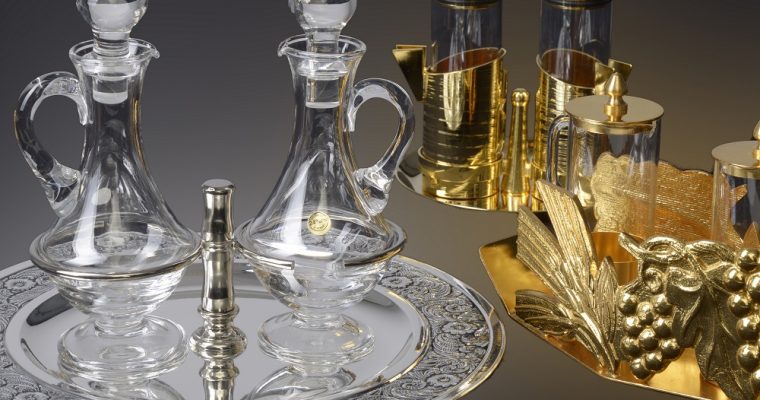
Ampullas for celebrations: small vases with precious contents

Ampullas for celebrations: small vases with precious contents

Contents1 Why does the priest mix water and wine during the Offertory?2 History of the ampullas for liturgy3 The altar servers4 Holy Water What are the ampullas for celebrations for? Let’s find out about the history and use of two small and precious sacred objects,…
The Pie: sweetness and devotion

The Pie: sweetness and devotion

The pie is an ancient dessert, but still very much appreciated by everyone, especially when it is filled with quality jams and marmalades. Let’s find out about its origins and its religious meanings hidden in the version from Campania, which is typical during Easter: the Neapolitan pastiera.

Tradition and history of an Italian dessert

How many desserts can boast legendary origins? Not many. This pie can boast even more than one. In fact, this dessert typical of the Italian tradition made of a base of exquisite shortcrust pastry with a generous layer of jam, marmalade, cream or fresh fruit spread onto, and then covered with thin strips of braided pastry, is the main character of many popular legends. The pie shares these legends with another typical dessert, which is actually just a variation on the original: the Neapolitan pastiera, that is, a pie whose filling is made of ricotta cheese, candied fruit, sugar, eggs and wheat boiled in milk.

The first legend concerning the origins of the pie tells about a beautiful mermaid who lived in the Gulf of Naples, and each spring she used to delight the people living on the coast with her mellifluous singing. To thank her for such beauty, they sent seven girls, each one carrying a very precious gift: wheat, ricotta cheese, eggs, soft wheat boiled in milk, the water of orange flowers, spices and sugar. The mermaid joyfully accepted those gifts and brought them before the gods, who mixed them and created a wonderful cake, which she gave to the generous people as a gift. If we examine each single ingredient mentioned in the legend, we immediately see that they can be interpreted in various ways, and can easily be connected to the Christian tradition. In fact, ricotta cheese and sugar recall milk and honey, typical votive offers of the first Christian ceremonies. Egg has always had a strong symbolism of rebirth, and in the Christian sphere, of resurrection; together with the orange flowers they are a symbol of the return of spring and the triumph of life. Then, even though the legend is set in a pre-Christian era, the references to Christianism disclose a different truth.

But let’s look at another legend. Some fishermen, after a sudden storm, were left at sea unable to go back to the haven. Once they got back, and were asked how they could survive in the open sea, they replied they ate ‘Yesterday’s pasta’ (“Pasta di ieri”, which leads to “Pastiera”), made of ricotta cheese, eggs, wheat and spices. Even in this case, the Pastiera can be interpreted as a symbol of rebirth, because it saved the life of the four fishermen. A real fairytale dessert!

On a less fairy level, already after the year 1000 in Venice, there was a recipe based on shortcrust pastry that could be compared to the pie. In order to make it, they used sugar coming from the East. The first official recipe was included in a cooking essay of the XIV century by Guillaume Tirel, known as Taillevent (wind-cutter), the famous French chef who served Philipp VI, Charles V and Charles VI, author of the renowned cooking handwriting Le Viandier.

The birth of the modern pastiera is attributed to a nun of the convent of S. Gregorio Armeno; she was the first to use the ingredients necessary for this dessert, maybe drawing inspiration from a previous recipe. As expected, we owe her the deep mystic meaning of the pastiera, that is, Christ Resurrection, which made it one of the Easter dessert par excellences. That is why the pastiera is baked on Holy Friday and eaten during Easter.

We like to think that the credit for the creation of such a delicious and irresistible dessert goes to a nun. After all, nuns are known to be always busy with many other occupations than prayers and meditation. On the contrary, they were never behind men even in heavy work. Also artisanal handcrafting produced by nuns are famous and appreciated still today. For example, the monastery of Caux, France, hosts the atelier d’art de Bethlehem. The monks in the male section take care of the creation of wooden sculptures, while female monks take care of paintings and reproductions made of Pyrenean stone (dolomite).

The order of the Barefoot Carmelites

Read more:

The order of the Barefoot Carmelites
The Barefoot Carmelites (or Discalced Carmelites) are nuns whose life is devoted to God by solemn vows. The order was founded in 1560…

Or, the Discalced Carmelites: even though they are cloistered monks and dedicate mainly to contemplative prayer, they spend their time between prayers and jobs inside the house, in the garden and the orchard. Some of them produce delicious jams and marmalades and other products coming from their plants and trees, which they later sell in the monastery shop, distribute to some Italian shops, and even sell online, contributing to the sustenance and management of the monastery itself.

Online monasteries products – Jams and marmalades

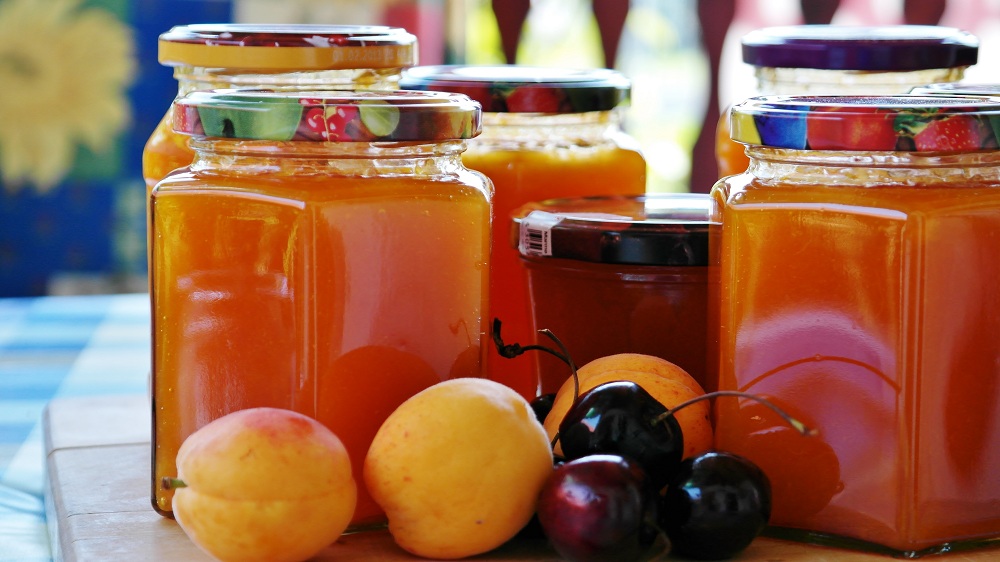
About monasteries products, jams and marmalades are a very important part in Holyart online store. They are of course produced with the utmost care following ancient recipes, such as those made by the Discalced Carmelites indeed. All phases of the production, from the picking to the packaging, follow artisanal methods, in order to guarantee a tasty and natural result.

In the Holyart catalog, you will find 46 different types of jams and marmalades, traditional or more particular flavors, such as the green tomatoes and fall fruits. All marmalades, jams and fruit compotes in our online store are produced following traditional methods, starting from high quality raw materials with no additives. The nuns and monks produce them consciously and with responsibility, with the utmost care for the clients’ health and satisfaction. They are 100% natural products, tasty, simple and natural.

Red Ribes Jam of the Vitorchiano Trappist Nuns
Buy Now
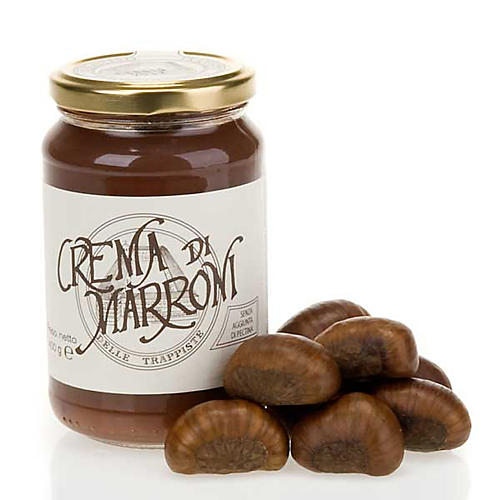
Chestnut cream 400 gr of the Vitorchiano Trappist nuns
Red Ribes Jam of the Vitorchiano Trappist Nuns
Buy Now
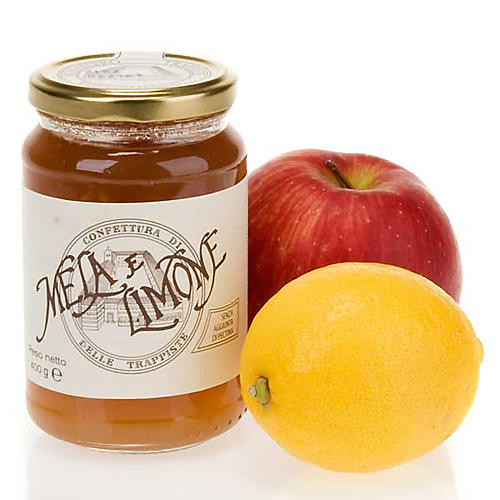
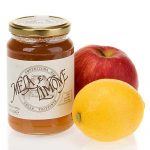
Apple and Lemon jam 400 gr of the Vitorchiano Trappist nuns
Buy Now
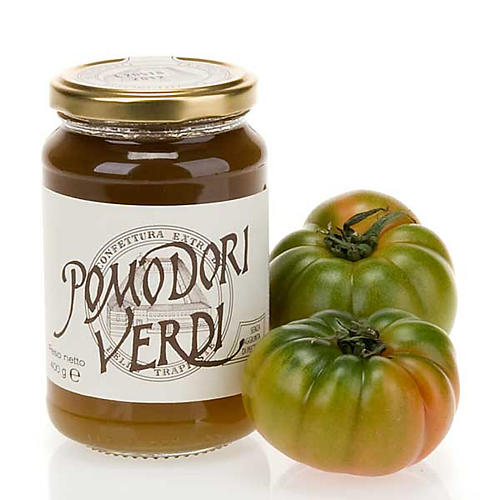
Green tomatoes jam 400 gr of the Vitorchiano Trappist nuns
Buy Now
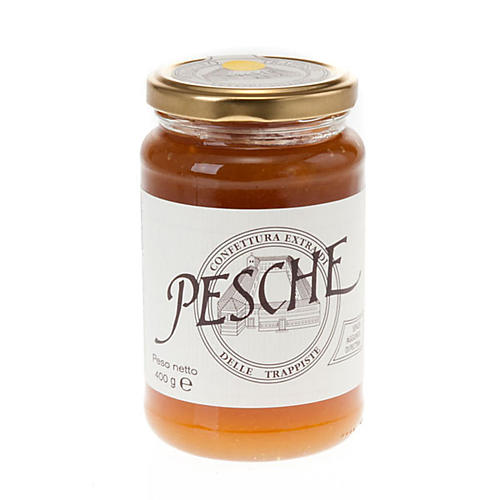
Peaches jam extra 400 gr - Vitorchiano Trappists
Buy Now

What is the difference between jams and marmalades?

The difference between the two was stated by the European directive 79/693 of 1979, included in the Italian legislation in 1982 with DPR of June 8 1982 n.401, which regulates the production and distribution of jams, marmalades, fruit jelly and chestnut cream.

In such directive, it is established that marmalade is a product made of sugar, pulp, juice, puree, watery extracts and zest, obtained only from citruses. In order to make 1 Kg of final product, the quantity of citrus fruits needed must be at least 200 g, of which at least 75 g must come from the endocarp, which is the typical skin that envelops the segments and that contains juice and seeds.

Jam on the contrary, according to the above-mentioned directive, is made using sugar and pulp (or puree) of all other kinds of fruits. It can be made of only one type of fruit, or two or more types of fruits. In order to make 1 kg of final product, the quantity of the pulp or puree used must be at least 350 g in general, with slightly different doses for fruits such as black currant, ginger or quince.

jams and marmalades

Let’s make a nice pie now!

Now that we know the origins of the pie and know where to get the most delicious jams and marmalades to fill it with, what about trying to make one at home? Here is a traditional and easy recipe that will help you make a traditional pie in just a few steps. Of course, you choose the most natural ingredients!

You’ll need:

  • 300 gr (2 cups) wheat 00
  • 150 gr (1 cup) sugar
  • 100 gr (1/2 cup) cold butter
  • 1 egg
  • 1 egg yolk
  • 1 teaspoon baking powder
  • 1 pinch of salt
  • 1 pot of marmalade or jam

In a large bowl, pour wheat, baking powder, sugar and salt, and then stir.

Add the cold butter in small pieces and work the ingredients with your fingertips. You will need to obtain a sandy mixture.

Add the egg and the egg yolk and keep kneading until you get a soft dough. Be careful, if you knead for too long, the shortcrust pastry will be too soft and sticky!

Make a ball with the shortcrust pastry and wrap it up in plastic film. Let chill in the fridge for at least half an hour.

After the ball is out of the fridge, roll out 2/3 of the dough on a baking paper. It will have to be about 3-4 mm thick and 30 cm diameter. Once you’re done, carefully lift the paper and put it all in a round baking tray of about 24 cm diameter and 3 cm high on the side. Cover the sides thoroughly, and cut the exceeding pastry.

Make holes on the base of the tart with a form, and then spread the chosen jam or marmalade.

Now take the pastry you left out earlier, the exceeding part you cut and roll it out. Cut some strips about 2 cm wide with a pasta cutter, smooth or notched, which you will use to refine the external edge of the pie and create the typical grid over the filling.

Bake the pie in a pre-heated ventilated oven at 180 °C (356 °F) for 30 minutes. When the surface turns brown, take it out of the oven and let it cool in its tray.

In order to obtain a more crumbly pie, you can use 250 gr of wheat 00 and add 30 gr of cornstarch. Or else, you can use 120 gr of butter instead of 100, and 100 gr of sugar. Now enjoy it in good company!

Olive oil: an excellence that has to be preserved

Olive oil: an excellence that has to be preserved

Contents1 History of olive oil2 The olive oil in Christian religion: symbolism and meaning3 Online monasteries products Considered as food for millennia, but also as a cosmetic and healing ally, olive oil has so many beneficial properties that it is considered as an elixir of…

Bible bookmark: read the verse that gives you strength

Bible bookmark: read the verse that gives you strength

Bible bookmark: a simple object that can come in use in hard times, letting us quickly find a sentence that gives us strength and hope. Reading the Bible is a precious and important habit for any Christian. Such practice induces a dialog with God, but…

Animated statues in the Neapolitan Nativity scene

Animated statues in the Neapolitan Nativity scene

The Nativity scene is one of the most famous and spread traditions connected to Christmas. At least in our country, there are very few homes that have no box containing the wood and cork hut, small rocks and pieces of bark, moss turned gray because of time and thin because of usage.

And then, of course, the little statues of the Nativity, Mary and Joseph first of all; she wears blue and pink clothes, with a veil on her head and the sweet attitude you would expect from a mother. He is standing, leaning on its cane, protecting and watching over his new family. And then the little Jesus, with blond hair and blue eyes, safe in the manger that was his cradle in the first and cold night in the world of men.

When the tradition of Nativity scenes was born, in the medieval age, they were the only characters of this reenactment, with the ox and the donkey.

Only later, around the XVII century, the Nativity scene began to host many more characters, turning from a simple representation of the Nativity event into some sort of fresco of popular life. This mixture of sacred and profane, of religious celebration and mundane representation is surely one of the most suggestive aspects of the Nativity scene, and that’s what makes it pleasant for non believers as well.

The Neapolitan Nativity scene

Naples was one of the center points of development and spread of this particular art from the beginning. Because it is art indeed, when we talk about the Neapolitan Nativity scene, called “o’ Presebbio” by the locals. The creation of settings and statues for the Nativity, and the whole apparatus that is typical of this kind of Nativity, was at the beginning a prerogative of excellent artists and artisans, who passed on techniques and secrets from father to son, generation after generation.

In addition, many famous painters and sculptors decided to try this type of art, for which rich families were willing to pay lots of money in order to have the biggest and most beautiful setting they could show off to friends.

Still today, there is a whole neighborhood in Naples dedicated to Nativity scenes, Via San Gregorio Armeno, which lures many curious tourists from all over the world every year. Here you can find all you need to create your own perfect Nativity scene, such as supports, buildings, many architectural and landscape details, besides an almost endless number of figures, from the most ancient traditions to the most modern characters, which renovate every year, as politicians, singers, football players, and so on.

The materials used for the Neapolitan Nativity scene were poor, such as wood, stones, cork, straw, and that also shows the popular dimension of this unique form of art. Statues were made of wood or terracotta. Later, during the Baroque age, articulated dummies made of wood, wires and tow began to show up, dressed with fabrics and made even more realistic with amazing details.

What makes the Neapolitan Nativity scene so special, compared to other good traditions of our country?

For sure, theatricality, the fact that it so vividly and picturesquely reproduces real life and common people such as merchants, artisans, shepherds, and all the other colorful and mixed people in the scene, making it at the same time realistic and ironic.

In the Neapolitan Nativity there is all mankind, authentic mankind, made of faces that seem real, and in most cases they probably are, and that represent at the same time real men and women, and symbols, ancient legends, passed on by the people, taking their roots from religion, history, stories, mixing all up in a bowl of suggestions that are rich in charm and folklore.

The world of Neapolitan Nativities is the profane world of streets, taverns, workshops that is amazed by the myracle of Nativity. Shepherds, merchants, beggars, but also dwarfs, hunchbacks, the lowest among the lowest, all of them witness the Savior’s coming, who was born for them, to bring hope to all men with no exceptions. This is probably the true spirit of Nativity scenes, this wait, this mood of common celebration that makes all men the same for one night, all equelly witnesses of the ultimate Mystery. The Neapolitan Nativity scene is a joyful hymn to equality, to the universal right to rejoice and enjoy the light of Jesus become man.

Holyart statues

Holyart just cannot forget leaving a special place for the tradition of the Neapolitan Nativity scene in its catalogue, and with Christmas coming up, will propose its precious new and old statues. Precious because all of the statues of the Neapolitan Nativity are handmade in Italy, in Naples to be exact, where else?

Unique and unrepeatable pieces, worth of an art collection. Each statue is defined to the smallest details, from its base of terracotta, to the clothes in shaped fabric, created following ancient artisanal techinques to give them a sense of harmony and realism. The hand-painted faces are absolutely expressive and realistic, as the tradition demands.

The characters you can find in Holyart catalogue for the Neapolitan Nativity are many. There are of course the classic characters of Nativity: Baby Jesus, Mary, Joseph, the ox, the donkey and the Three Wise Men.

There is then a wider choice of shepherds, in various positions and behaviors, joined by sheeps covered in real wool, to give an even greater realism.

But the variety provided by Holyart is not over here, as the Neapolitan Nativity tradition demands. You will find statues representing any profession, sheep shearers, bagpipers, water carriers, chestnut collectors, bakers, weavers, farmers, fishermen, street musicians, and also the drunkards, the cat lady and the hunchback, pictoresque people typical of Naples folklore and now symbols of a humanity that goes beyond the centuries.

Besides the little statues representing people, there are many big and small animals, such as chicks and camels, to enrich your Neapolitan Nativity scene with countless details and animate small everyday life scenes.

Animated statues in the Neapolitan Nativity scene

The desire for realism that characterized the Neapolitan Nativity form its origing found a further evolution with the arrival of animated Nativities.

Also in this case, Holyart can boast a rich and varied catalogue of moving statues. Holyart statues are moved by motorised systems, and all of a sudden the whole scene comes to life, showing a working town, with farmers hoeing the ground, shepherds leading the herd, women sweeping in front of their doors, and so on.

Ancient actions, ancient professions, that are brought back to life thanks to the magic of tiny electric engines hidden among the folds of the clothes, handmade gears by artisans with a long expertise, to recreate a unique magic, a timeless atmosphere. Don’t you believe that? Look at the video here below, and you’ll think you can touch that extremely tiny, but really perfect, world with your own hands!

VIDEO OF A MOVING STATUE OF YOUR CHOICE!

Each statue is a unique piece to be collected, refined to the smallest details: clothes are sawn with real fabrics and the hand painted faces show great expressiveness.

So here we have the chair repairman for example, a moving statue 14 cm tall that represents an old artisan while he’s reparing a chair with straw. The character’s hand goes up and down thanks to the electric engine, simulating the movement in a very realistic way, and the serene expression of the old man is really priceless. Like all other statues of the Holyart Neapolitan Nativity, it is made of terracotta and dressed with fabrics. Clothes are shaped so that they respect the lines of the body and improve the feeling of movement and naturalness.

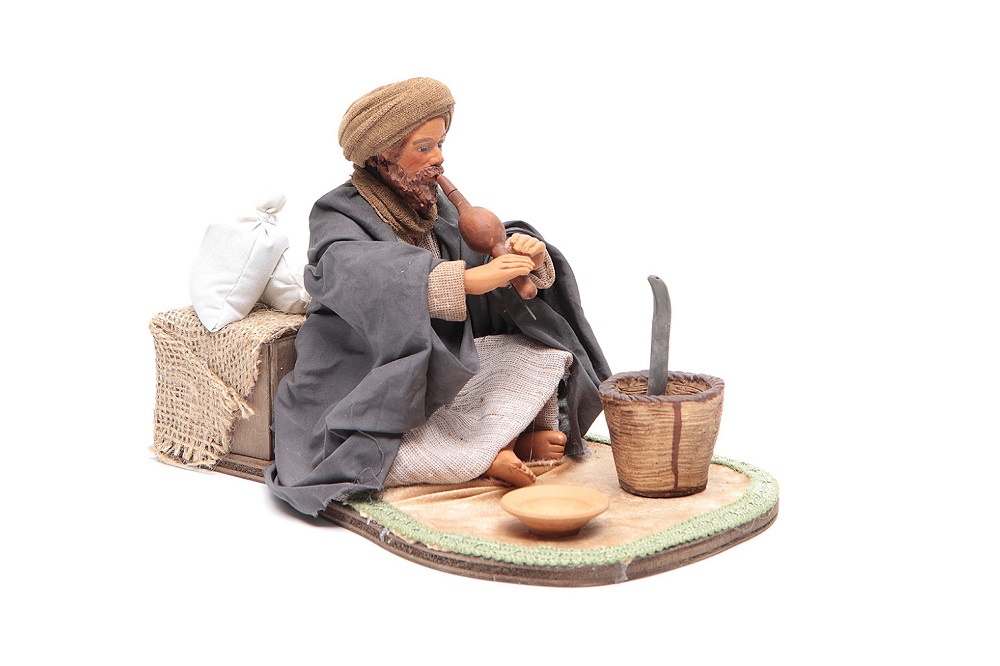
Another example that shows extreme realism is the snake charmer, a man sitting on the floor with his legs crossed, playing the flute to calm down a snake coming out from a vase in front of him. The statue moves to the right and to the left, with a very natural flow. Clothes, made of natural fibers, give that extra touch of realism to the scene.

The washerwoman washing clothes in the fountain is particular for the amount of details in the setting, besides her realistic movements. The woman is next to a small structure with a roof and real wooden beams, and a cork wall imitating red bricks. The clothes are hanging on a clothesline, while others that haven’t been washed yet are on the ground. On the edge of the basin there is a piece of saop that seems to be just put there by the woman’s achy hand. A warm light lights up the whole scene and water gushes out from the fountain thanks to a recirculating pump powered by an electric engine. A statue that is only 8 cm tall, but gains a whole life while immersed in this rich and redefined setting.

Let’s close our list with a statue that is emblematic to some extent, a Nativity artisan making a Nativity scene, a very special statue, handmade of terracotta. It is about 12 cm tall, and represents a Nativity artist while he’s creating a Nativity scene leaned on a table. You can see tools, wood, colors and moss. Some sort of meta-representation: the Nativity scenes reproducing a character making a Nativity scene. Just another magic of the moving Neapolitan Nativity scene, signed by Holyart!

Christmas home decorations – do-it-yourself

Christmas home decorations – do-it-yourself

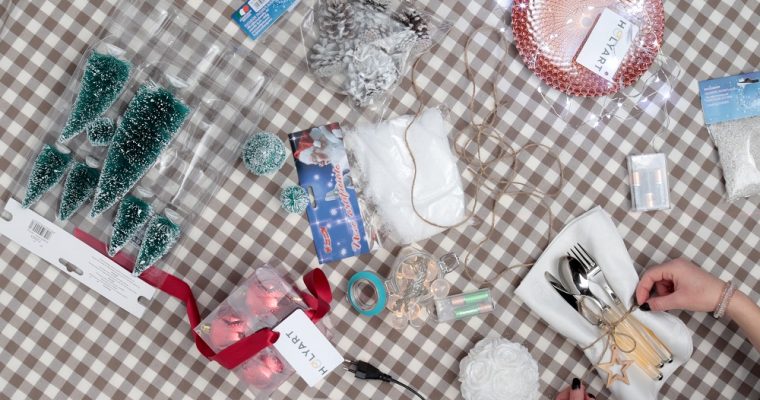
Let the do-it-yourself mood get to you this Christmas. It doesn’t matter if you’re good at it or not, just put a lot of fantasy and emphasis in it. You can recreate enchanting atmospheres to add that extra touch of elegance to your Christmas. Decorating your…

Christmas Lights Projectors: characteristics

Christmas Lights Projectors: characteristics

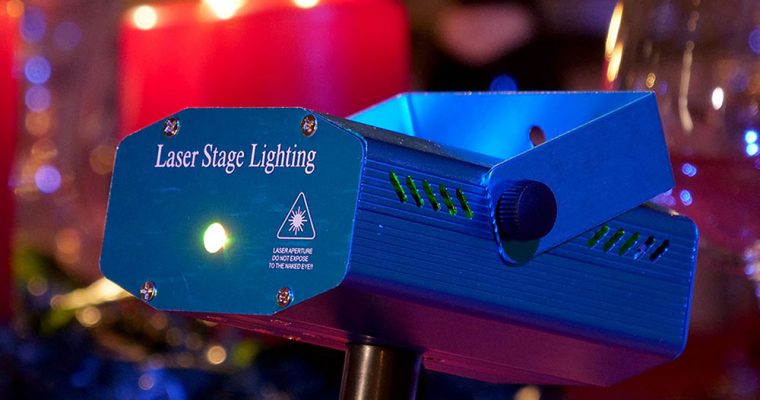
Christmas light projectors are very impressive machines with many possible options for decorations. These objects let us create a nice atmosphere in an inside or outside enironment immediately and with not much effort. They are perfect to create the right atmosphere in joyful events such…

Advent time

Advent time

Advent has always been one of the most important moments of the year for Catholics all over the world. It is the time we get ready for Christ’s coming, for the renovation of his miracolous birth, which will be celebrated on Christmas, but not just that. Advent is also the lithurgical time when devotees reaffirm their hope, the wait for Jesus’ second coming, the one that will establish the end of the world as we know it, the end of time.

The word Advent comes from Latin adventus, “coming”, but also “wait”. It comes from the Greek word parousía, or epiphaneia, words that were used in ancient cults to indicate the descent of the god to the temple to meet his devotees, his manifestation on the same ground of men.

So, by celebrating the Advent we prepare for Christmas on one side, to the solemnity of Jesus first coming, made man and descended among mortals, born in a manger by a common girl, a carpenter putative father; at the same time we express our hope, the joyful wait for his second coming, the so called parusia, when he will descend again among men wrapped in glory and the power of Heaven.

A moment of joy and hope, not suffering, as Lent before Easter is, but which involves a daily spiritual attention, the progressive awareness of the event that is about to come.

Origins of the celebration

Christian authors, since the first centuries after Jesus’ birth, described His coming in their texts, talking about the mystery of his conception in Mary’s lap, in mortal flesh, but also the promise, hidden in His becoming a man, of what would be His second, final coming. Unlike pagans, Jesus decided to abandon the temples men made, their stone columns, and become a man Himself, to be wrapped in a temple of flesh and blood, mortal and subject to pain, to scarifice, to suffering.

The Advent began being celebrated in the western world aorund the VI century, even though at the beginning its value resembled more the Lent: by celebrating the birth of Jesus they actually celebrated his Resurrection. This is why the weeks before the advent were characterized by fasts and penances besides prayers.

Celebrations of the Advent

The Advent begins four weeks before Christmas, aproximately between November 27th and December 3rd. In the Ambrosian Ritual the weeks are six. The Advent begins with the Vespers on the first Sunday, and ends with Christmas Vespers. It involves a path of prayer both on weekdays and on Sundays, but it is especially on Sundays that the devotion of the believers is concentrated. Each one of the four Sundays of the advent is called with a traditional name taken from the first four words of the Intriot, the Antiphone that introduces the Mass: Ad te levavi (First Sunday, from Ad te levavi animam meam “To you, O Lord, I lift up my soul”, Psalm 24); Populus Sion (Second Sunday, from Populus Sion, ecce Dominus veniet ad salvandas gentes “People of Sion, the Lord will save the people”, Isaiah 30,19.30); Gaudete (Third Sunday, from Gaudete in Domino semper “Rejoyce in the lord always”, Filippesi 4,4.5); Rorate (Fourth Sunday, from Rorate, coeli desuper, et nubes pluant iustum “Drop down dew, ye heavens, from above, and let the clouds rain the just”, Isaiah 45,8).

During Advent weeks priests wear purple lithurgical vestments, which can be pink in the third week, color that symbolizes the joy for the imminent Christ’s coming.

The Lithurgy of the firts three weeks, until December 16th, is focused on the wait for the parusia, Christ’s second coming, and involves the reading of some extracts from Gospel of Matthew (Matthew 24, 37-44: “Watch therefore, for you do not know on what day your Lord is coming“; Matthew 3,1-12: “Repent, for the kingdom of heaven is at hand!“; Matthew 11, 2-11: “Are you the one who is to come, or should we expect someone else?“). On the last Sunday of the Advent there are readings on how Jesus would be conceived in Mary’s breast and was born among men (Matthew 1, 18-24), concentrating then on Jesus’ birth and Christmas.

So, the first three weeks focus on Jesus second coming, while getting closer to Christmas, the attention shifts on His miracolous conception and His birth in Bethlehem.

The celebrations of the advent involve singing hymns, different ones according to the period, and seven antiphones, called the Great or or the O Antiphons, because they all begin with the vocative ‘O’: O Sapientia, O Adonai, and so on… They are seven Latin antiphons typical of the Lithurgy of the Hours. They are sung on the Vespers, before the Magnificat, during the biggest holidays of the Advent, from December 17th to 23rd.

The Gloria is not recited anymore until the Midnight Christmas Mass, where it becomes the real symbol of Jesus’ triumphal birth.

Mary and the Advent

The gospel passages read during the firts three weeks of the Advent refer respectively to the coming of the Lord at the end of times and to Joseph Baptist, while the one on the last Sunday refers to all events and people that will lead to Jesus birth, Mary first of all. It is not by chance that the fourth Sunday of the Advent is traditionally considered as the one when she visited Saint Elizabeth, already carrying Joseph Baptist’s child, to give her the good news of the imminent Jesus birth. Mary can be considered as the symbol of Advent itself, of humanity that after wandering for so long is ready to welcome God and his promise again, accepting his will with full faith and hope.

Mary is at the same time an instrument of God’s will and the spokesperson of men, because she willingly accepted her destiny and was of service for the great and wonderful God’s plan. Her model of humility and joy runs through the centuries, warming the ultimate wait, the greatest of mysteries, year after year: a young girl, fully aware, was expecting a baby that would represent the salvation for her and the whole mankind. Mary, instrument and loving mother of God, keeps the flame of alleagiance alive, waiting for Jesus’ new coming and His triumph among worthy men.

The Advent Wreath

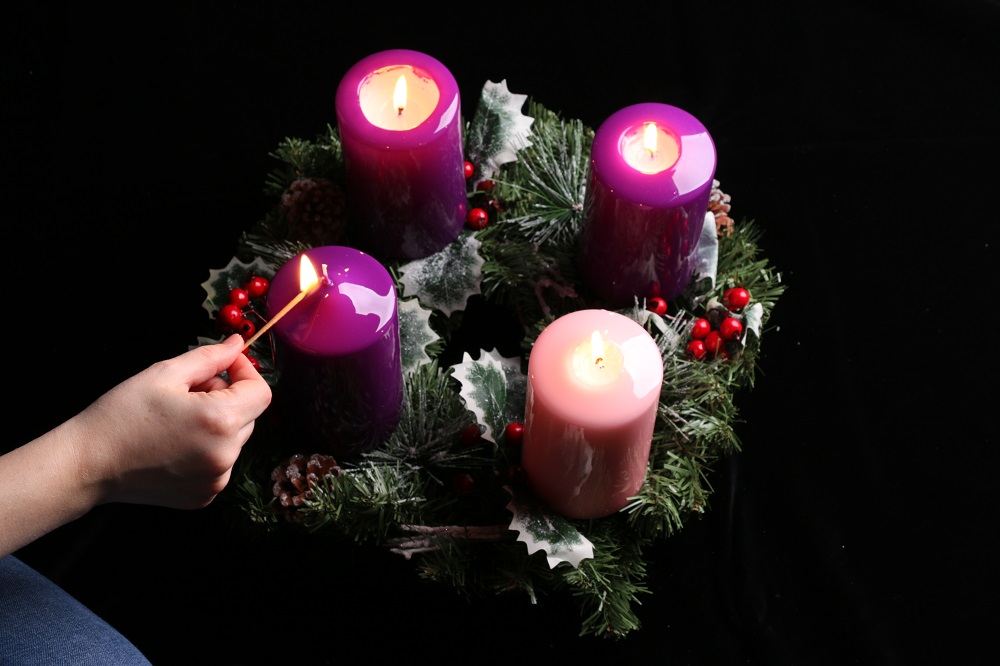
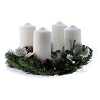
The succession of the Advent Sundays is celebrated in many churches and homes by lighting up the candles on the advent Wreath; it’s a ring of evergreen branches, inside which there are four candles that are lit one by one to celebrate the victory of light over darkness, and the hope tied to the coming of the Messiah. Each candle in fact symbolizes respectively: Hope, Peace, Joy and Love. The round shape of the ring itself recalls eternity, the wholeness of the world, while evergreen trees symbolize hope. It is a Germanc tradition, dated back to the early XIX century. In the first Advent Wreaths there was one candle for each day of the Advent, while today there are usually four, maximum five if we count the candle that must be lit on Christmas.

Each candle has its particular symbolic meaning: the first, called ‘the Prophet’s candle’, refers to the prophecies conerning Jesus’ birth; the second, called ‘Betlehem candle’, recalls the city where He was born; the third, called the ‘Shepherds’ candle’, recalls those who worshipped Jesus first; the fourth, called ‘the Angels’ candle’, celebrates the messengers that brought the news of the miracolous birth into the world.

Advent for children

Even for children, Advent is an important moment, and it should be a good occasion to make them understand the deepest and most spiritual meaning of Christmas. This holiday, so precious and sacred, is too often impoverished of its actual value in this modern world, to gain a more pagan and consumer dimension. Children should understand that the wait is not just for Christmas gifts, but most of all for BabyJesus’ birth, who came to Earth for us all. Sunday after Sunday we can make the path to the Advent more fun and exciting, representing the various passages from the Gospel and the message they carry with drawings and reenactments.

It is of course good to give them an Advent calendar, with small gifts and sweets to discover every day, but we should join them while they learn the special moments that draw them closer to such an important event. Bringing home an Advent Wreath and let the kids light up the candle each Sunday could be another way to let them feel involved and aware of the great holiday that is coming, and what it entails for all men.

Some original ideas for your DIY Nativity scene

Some original ideas for your DIY Nativity scene

The Nativity scene is an ancient and everlasting tradition, especially in our counrty, but in general in all Catholic countries. It is a reenactment of the birth of Jesus Christ in Bethlehem set during Christmas. The setting includes the hut, the manger where the statue…

How to place the lights on your Christmas tree

How to place the lights on your Christmas tree

We are almost there. Winter hit us after a long and hot summer, and fall seemed hesitant to drive away the warm season. It will soon be the time to begin thinking about how to decorate our home in view to Christmas, the ultimate holiday.…

Holyart miniature Christmas villages

Holyart miniature Christmas villages

Christmas is a multi-faceted holiday. Besides its religious meaning, that is, recalling Our Lord Jesus’ birth every year, it is also filled with remainders from more ancient traditions, which transformed thoughout the centuries and adapted to the Christian message, gaining a new value. In fact, in the past, December 25th was the winter solstice, which in many cultures involved celebrations connected to the cult of the Sun. Traces of those celebrations can still be seen in what are now characteristics of the Christian Christmas. Christmas tree, holly, sacred hymns, Santa Claus, all come from pagan traditions. All of those images stay to enrich the Christmas atmosphere, making it unique, magic and unmistakable.

Among the many traditions that give your house a proper atmosphere, there is one that is particularly fascinating: setting up a Christmas village.

Watch out, it’s not Nativity scenes we are talking about. Miniature Christmas villages are not necessarily inspired by the wish to reenact the miracolous Jesus’ birth.

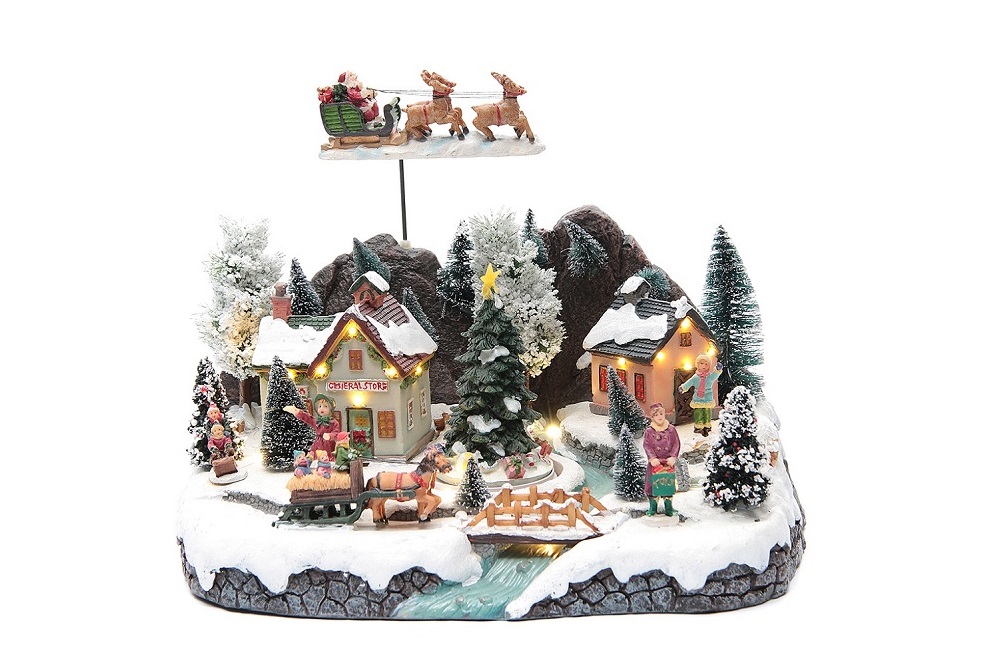
Everyone can set up their own Christman village as they please, taking inspiration from the style they like the most, personalizing it with details, accessories and many little characters. The final aim of these creations, that can be very big and full of items like real works of art, is to create a world of magic, where dreams and youth memories are brought to life. It is something connected to spirituality in its wider sense, to our most secret and deep sensitivity, and that’s exactly what makes Christmas villages so special: they bring us back to a golden age, when it was nice to project our inside imagination into a scenery of tiny little houses and figures, where everything was charming and colored.

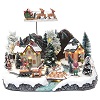
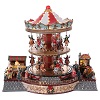
That was a game we never got tired of: making up stories and setting them in that world made of cute little lights, pastel houses, small mills and horse carousels… Those are the recurring elements in Christmas villages. Everything is thought to be gracious, cozy, colorful and perfectly reenacted in a style that smells like past and nostalgia. In those enchanted villages, tiny little characters such as skiers, skaters and small Santa Claus move around.

It is possible to buy buildings, merry-go-rounds and landscapes according to one’s personal taste and the style that one wants to reproduce. All those elements are made of resin, often have lights, can move and sometimes have music, which makes them look like enchanted carousels. Furthermore, the village can be personalized with an infinity of details that will make each one unique. Christamas villages are usually set on cork, wood and moss basements, with sprayed or painted backgrounds, but everyone can follow their own imagination and flair.

Christmas villages: a hobby for grown-ups

Christmas villages are not only for kids. On the contrary, grown-ups are the most fascinated, and put more effort in creating and setting them up with sounds and moving elements, seeking the best realism and most of all the magic of Christmas. Making Christmas villages has bacome a very popular hobby among collectors all over the world, and even in Italy, birthplace of Nativity scenes, there are people who like this new trend more than the old traditions.

The fact that everyone can create a Christmas village piece by piece makes it accessible to everyone. The village may also grow in time, year after year, with new buildings and creative accessories.

One of the biggest companies that contributed to the spread of Christmas villages is Lemax. Their catalogue offers a variety of constructions, accessories, characters but also light and movement effects, water games, sound effects and even fireworks! Their magic settings inspired to North European villages, to Victorian age London or to America in the Sixties are very fascinating and recall unique atmospheres. Merry-go-rounds, wheels, trains, lit porcelain houses, realistic trees covered in snow or decorates with rhinestones: countless are the possibilities to make your village special.

Building your own Christmas village

As we wrote above, there is no written rule on how to make one, everyone just have to follow their own creativity and fantasy, and of course consider their own manual skills. Actually, anyone can discover this wonderful world; you just need passion, and a couple of fundamental requirements.

First, you’ll need to choose the style for your village. Among the countless options of constructions and accessories available on the market, you need to think about the pieces you wan to buy, and the right combinations to obtain the best result. It is usually possible to find some style coherence among the various brands, which offer main buildings as well as all the details, characters and coordinated effects. It all depends on what you like, what you feel is your style, among a Victorian village, an old-style magic theme Park, a mountain village, Santa Claus’ village, and so on. Once you’ve decided your setting, you can move on to the next stage of your project.

A project is in fact necessary before starting, also to avoid useless expenses. A little investment at the beginning will allow you to create something really beautiful, which can grow and become bigger in time. You may begin with the village square, or a small market, the church porch or Santa’s house, and then build all you have in mind around that core. The characters and small details in it will make everything beautiful and realistic. You can reenact dynamic and cuorious moments of daily life. Those who will look at your creation will be overwhelmed by the amount of details that will catch their attention.

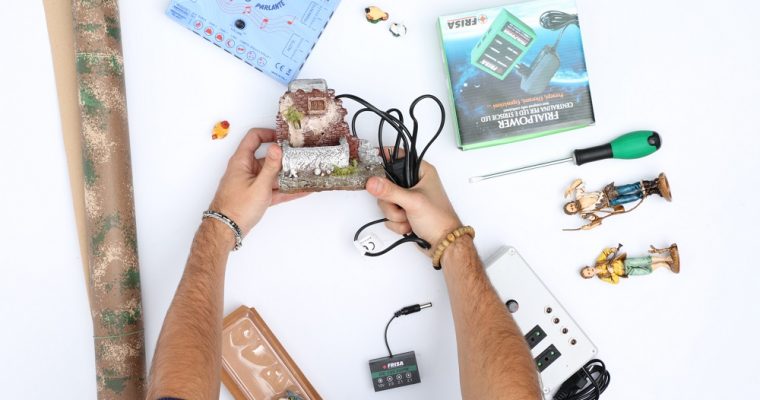
The planning and design also imply a thought on the space you want and are able to take up with your village. It must be a free area, that allows enough space for whatever you have in mind, where you can easily reach the plug and hide wires and all the other elements that are necessary to create light, water and sound effects. You will have to set up a wooden or cork house, maybe finding some spotlights that will create more light games in addition to those already in the buildings. Even mountain-paper can be a useful background to cover up the “tricks”.  It is also importat to divide the different scenes on different grounds, using panels and supports or boxes, to create a prespective effect and a realistic depth: that way you will avoid overlapping elements. On the background, you can put trees or mountains, leaving your favourite and most spectacular items in the foreground.

Besides the objects you can buy, you can have fun creating many small special details with your own hands. A piece of Styrofoam enriched with the right light and accessories can become a beautiful ski slope where your figures can race or a pond for your little skaters.  Resin, colors and many other materials that you can easily find in DIY stores can offer you cues for other creations, such as rivers or falls; mirrors, cotton and other stuff you can find in your home, with the help of good manual skills, will turn out to be special treasures.

The characters are the last thing, maybe fixing them in their positions with some glue so that they won’t fall.

About all the rest, just let your fantasy guide you through your memories and suggestions, to help you recreate scenes you dreamt about, or lived a long time ago. Your Christmas village can become some kind of theater for your dreams, inspirations, ideals, and will give your home incomparable warmth and atmosphere because it was born from something intimately yours.

How to decorate your Christmas tree

How to decorate your Christmas tree

When we think about Christmas, the first image we have in our minds is probably a spruce decorated with bright lights and colorful hangings, full of delicate and shiny knick-knacks, golden and silver garlands, red ribbons, and crowned with a pointy or star-shaped tree topper.…

Anniversary of the election of Pope Francis

Anniversary of the election of Pope Francis

Contents1 Pope Francis and Love2 A humble Pope3 Theological studies and communication Pope Francis’ pacific revolution. On the fifth anniversary of his election, recently celebrated, let’s see how the Church has changed and if it is changing under the lead of this special man. ‘There…

Plexiglas or wooden lecterns? Your commodity is priceless

Plexiglas or wooden lecterns? Your commodity is priceless

Have you ever been fascinated by a wooden lectern holding a ponderous, ancient tome? Fine objects, today lecterns are not only a prerogative of churches. We can find wooden or even plexiglass lecterns in libraries, museums, restaurants and even private homes.

What is a lectern for?

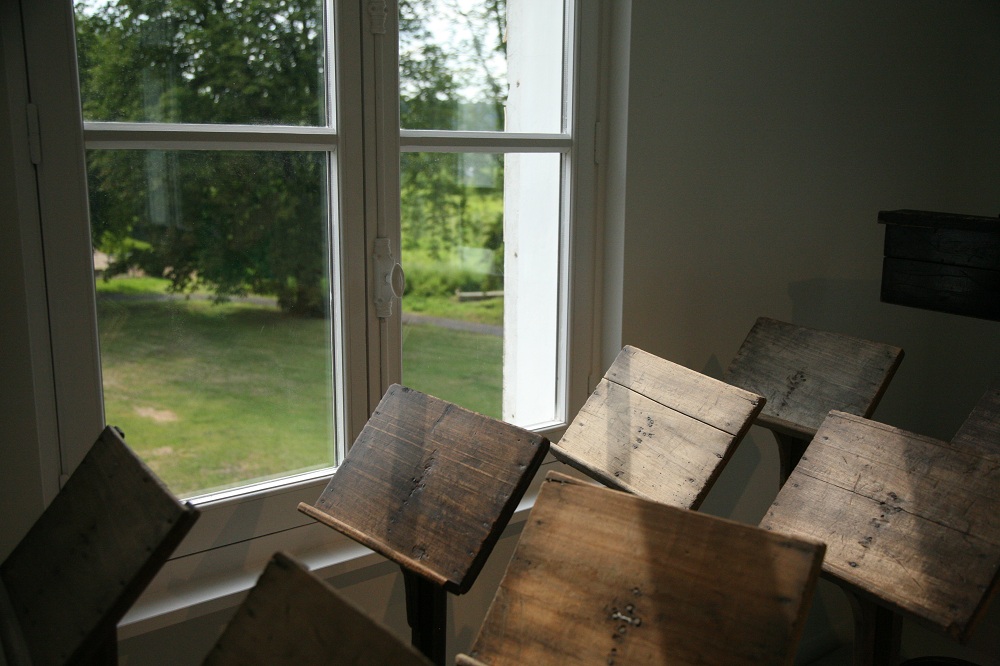
In order to understand the usefulness of this objects, it is enough to read its definition in any dictionary: ‘lectern’, from the Greek λογεῖον «pulpit», crossed with the verb ‘to read’, it is a piece of wooden or metal furniture of various shapes, sizes and manufacture, destined to hold an open book, a musical score or other publications on a slightly inclined plane, so that the readers can read without having to hold anything in their hands, whether standing or seating.

sacred furniture
Sacred furniture: typical decors of every Christian church

Therefore, the purpose of a lectern is to be a support for something. The definition goes on specifying that there are altar, orchestra and library lecterns. The ambon in some churches (that is, the podium for evangelical readings) is provided with a lectern, or in some cases, it is replaced with one, and there is often one also in the pulpit.

If we think about a lectern, we think of a church or an ancient scriptorium, where industrious monks bend over to copy precious codices or paint precious miniatures. But, as we anticipated, today lecterns are not only used as liturgical elements. Have you ever noticed the lecterns at the entrance of museums as support for guests, or even in restaurants showing the menu of the day or the reservations? Or even during ceremonies, holding the register that will collect all the signatures from the guests? A lectern is not only beautiful, but has also many other surprising uses.

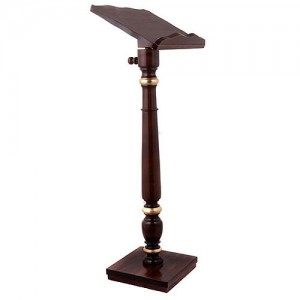
Golden decorated wood lectern

A table lectern cannot miss in a house with many books or musical scores, or actually any other publication you care about. It will not just make your reading more comfortable, whether it is the Bible or other sacred books, but it will also represent an elegant piece of furniture, a fine detail that can fit into any interior design. A particular object with a timeless charm. Rediscover the pleasure of reading comfortably, with an adequate reading light, holding your favorite book on a comfortable table lectern. The uses of lecterns are not limited to that.

At Holyart, we know that very well; you just need to browse our catalog to find out the many uses of our wonderful classical and modern lecterns. Some of our lecterns can even rotate, to give you the best comfort possible. Holyart also offers a wide variety of lecterns for any use and style: from the classical altar lecterns, many of which are embellished by decorations in gilded or silver-plated brass, to antiquated ones. You can find carved wood lecterns and others decorated with golden leaves, the most precious ones; models that are more modern are those made of shiny and transparent plexiglass, almost invisible, discreet and light.

Classical or modern?

Placed on a table or a piece of furniture, a lectern will give an extra touch to your home design.

5 sacred objects
5 sacred objects that cannot miss in our homes

For those who love classic, and are looking for furnishing accessories that are linear and simple, choose wooden lecterns. The tones and veining of walnut, beech, ash or cherry-tree wood will warm up the ambient and will give it a unique look.

Those who prefer modern or daring contrasts in a classic environment, table lecterns in plexiglass are the best solution to play with accessories in a new and surprising way.

Materials: wood or plexiglass?

Going back to the choice of the material, wood is surely a fine material, for many declinations and uses. In order to create table lecterns, the most used wood is usually beech, often used also to make pieces of furniture and accessories not only in homes but also bars and shops. It is resistant and easy to work, and is therefore an excellent material for the structure and frame of chairs and furniture, but it is also ideal as plywood, veneer and also to make wonderful handcrafted objects, furnishing accessories and musical instruments. Floors and parquet stairs are often made with such exceptional wood type.
Even walnut wood offers the many advantages of an easy work and cut. Furthermore, its composition itself makes it particularly apt to be smoothed, varnished and polished. An adequate finishing will make any walnut wooden piece of furniture or object very precious. The dark brown color with shades of grey and lines that can go up to black, offer many aesthetic solutions. Walnut is therefore indicated for luxury furnishing, but also for those looking for mechanical resistance, durability and a feeling of solidity and eternity.

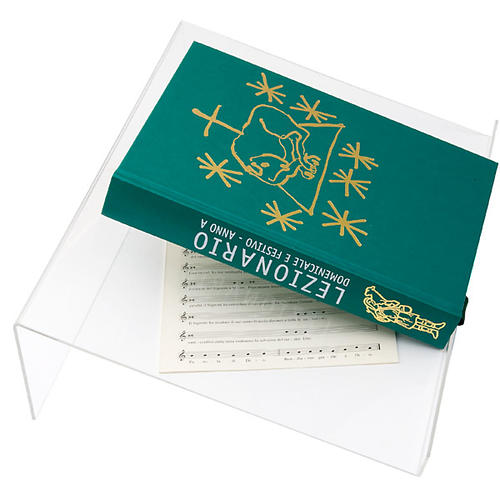
Of a very different nature and versatility is plexiglass, used for our modern and innovative table lecterns. It is one of the most used plastic materials today. It is more transparent than glass, but that does not prevent it from being highly shockproof, bad weather and humidity. Plus, plexiglass lecterns are very resistant also against chemicals, therefore they can turn out to be the perfect solution for labs and kitchens. We are basically talking of a shatterproof material when used inside homes, because if it is exposed to bad weather, with time it can become hard and crack.

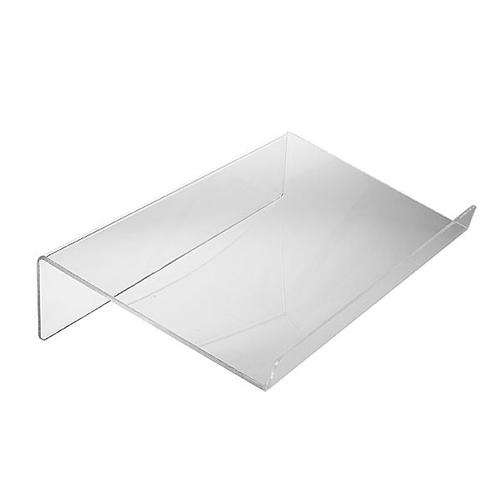
Plexiglass book-stand
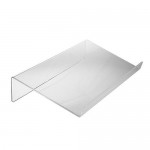
Transparent plexiglass book-stand, suitable for any liturgical and standard use.
Buy on Holyart
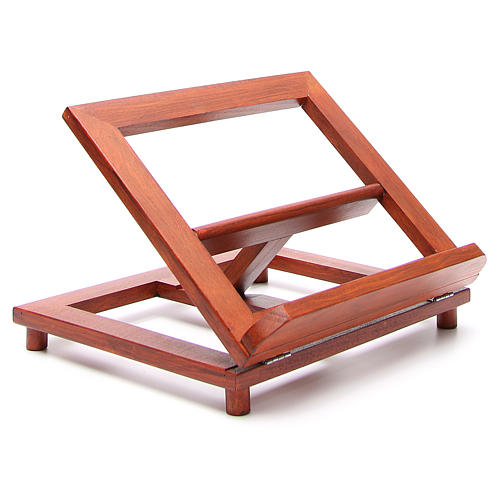
3 position book-stand
Wooden book-stand, essential and solid, available in the following sizes: Medium H 28 x W 34 cm Large H 32 x W 40 cm
Buy on Holyart
Book stand with cushion in brass with cross
Book stand with cushion in brass with cross. This book stand is made of brass with a red cushion and two golden and silver crosses on the front. This is a unique and refined object. This article is hand made in a small Italian company with a long tradition.
Buy on Holyart
Book stand in plexiglass
Book stand in plexiglass, shiny and transparent. It's really thin and light and practically invisible, yet very strong and resistant. Suitable for different styles and uses (libraries, hotels, kitchens, shows...) It's rounded on the edges and available in 2 different sizes: - 30 x 45 cm - 60 x 30 cm.
Buy on Holyart
The art of decoupage on cardboard boxes

The art of decoupage on cardboard boxes

Decoupage is an art that merges relatively new techniques with artisanal mastery. Russian decoupage boxes are an example of how ancient sacred and famous images can be reinterpreted in an original way to create beautiful furnishing accessories that fit into any house. There are many…

Saint Teresa of Avila: Spanish nun and mystic

Saint Teresa of Avila: Spanish nun and mystic

Saint Teresa of Avila was a Spanish nun and mystic. One of the few women declared a Doctor of the Church, she reformed the Carmelite order and proposed a model of faith based on the friendship between man and God and on a deeply human…

Sacred Icons: the ultimate guide

Sacred Icons: the ultimate guide

Sacred Icons. Only mentioning them evokes exotic and charming suggestions, a way to live religion that is far from the modern concept only at first glance. Let’s find out all the secrets of this ancient and exciting art.

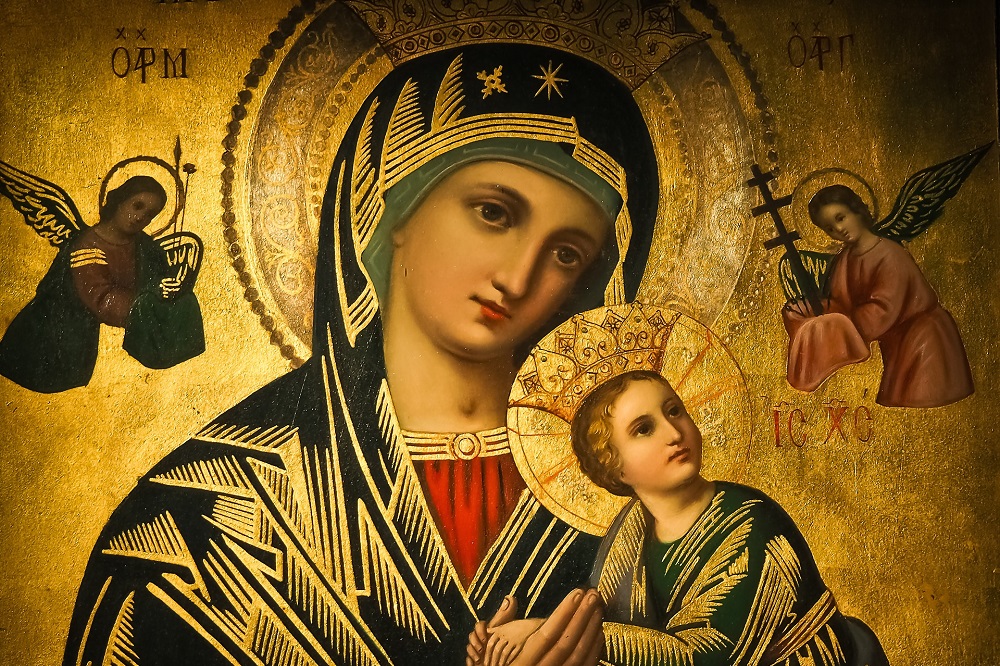
Holyart already talked about sacred icons in the past. How could it be otherwise? Few art displays can be compared to those representations, real expression of medieval religion, permeated with a deep symbolism that goes beyond the substance. In a previous article about Greek icons, we talked about how each detail in a sacred icon expresses a concept, a higher meaning. We described the creator of icons more like a writer than a painter, given the ability to link the constant references to evangelical episodes including spiritual messages hidden in each detail of the work. A sacred icon is the result of a mission that is theological before artistic.

Artisans and painters that master the art of icons use the ancient and strict rules of Byzantine iconography still today, following the techniques reported in the specific manuals, the hermeneia, which have to be followed verbatim. Each icon is unique, unrepeatable, and it draws its value exactly from this uniqueness.

What is an icon exactly?

It is a sacred representation painted on a table, typical of the Byzantine and Slavic art. The word ‘icon’ comes from the Russian ‘икона’, which comes from the ancient Greek εἰκών –όνος, from the verb eikénai, ‘resemble’, ‘look’. Another derivation is from the Byzantine Greek word eikóna, which can be translated as ‘image’.

In particular, the ancient Russian icons were usually reproduced on basswood, larch or fir tables. The necessary working to create the perfect base for sacred icons was long and arduous. In fact, the wood needed to be covered with multiple layers of rabbit-skin glue and chalk which were later smoothed with dried fish skin or sandpaper. The result was the so-called levaks, a smooth surface with no porosity, perfect to lay paint and gold plating. About colors, they were all natural, obtained from plants and minerals mixed with egg yolks. The frame was a fundamental element, because it was part of the painting as well, underlining the distance between earth and sky, between terrestrial and divine grounds. Even gold plating allowed obtaining amazing tridimensional effects.

Sacred icons

Like Russian icons, also Romanian sacred icons come from the ancient Byzantine art. Their characteristics are warm and intense colors, and their characters are depicted with movable and human features. That makes them a bit closer to the Western sensitivity and aesthetic perception. They are painted on wooden or glass tables with tempera colors, embellished with fine decors in gold leaves.

How is the value of an icon assessed?

It’s not easy. We need to understand how to do that, or at least the basics of it, if we want to get closer to this wonderful world. Many websites sell sacred Icons without any warranty concerning their authenticity nor any explanation justifying their value.

When you evaluate a sacred icon, you need to keep in mind several parameters, such as the techniques used to make it, which ranges from a total handcrafting to silk-screen printing; the ‘school’ it comes from; the stroke of the artist; the size.

About techniques, we can easily sum up the current icons on the market as follows:

  • silk-screen printing icons
  • handmade sacred icons
  • hand painted icons according to the traditional method, with golden painted background (that is, no gold nor silver leaves)
  • hand painted icons according to the traditional method, with golden background made of a thin non-precious metal sheet (similar to gold or silver)
  • hand painted icons according to the traditional method and using a precious metal sheet (gold or silver)

About schools, the sacred icons on the market today come mainly from Russia, Greece (those are the two most popular and appreciated schools), but also from Romania.

The distinctive stroke of the artist is the main element in an icon, regardless of its origin or materials. In particular, it shows through the way the faces are painted, in the use of colors and light.

The sizes of the icons can be many, but usually these three formats are the most commons:

  • 18 x 22 cm (7×8.5 inches)
  • 22 x 32 cm (8.5×12.5 inches)
  • 32 x 44 cm (12.5×17 inches)

In Holyart catalog, you will find many types of icons, created with different techniques and materials, coming from all three mentioned schools.

Handmade sacred icons

In Holyart catalog, among all handmade sacred icons, we suggest the Russian icons hand painted on ancient tables in particular. They are icons made by master artisans coming from the various Russian iconography school, painted on tables from the previous century. The icons are made with the technique of egg tempera on wooden tables, levkas and golden background. Each icon comes with a warranty and originality certificate released by the experts of the Russian Minister of Cultural Heritage, and export documents.

Even painted Russian icons maintain the traditional techniques and are entirely handmade with tempera on basswood tables and decorated with gold leaves.

painted Russian icons

The hand painted icons coming from Romania by Holyart are unique pieces, entirely handmade on wooden tables using the technique of the golden leaves and tempera. Romanian artisans and painters follow the ancient and strict rules of the Byzantine iconography to create unique and unrepeatable masterpieces.

Of course, in Holyart store, you will also find wonderful silk-screen printed icons, cross-shaped icons and icons with silver and golden plate with RIZA.

The images of sacred icons

What do sacred icons depict? Russian icons in particular take inspiration from the portraits of Mary attributed to the Apostle Luke, to the Shroud and other very ancient representations of Jesus and Mary.

The subjects of the Romanian icons are often tied to Mary as sweet and loving mother, such as in the icons depicting her as Mother of God of Tolga, from the monastery of Tolga, located where the original icon was found, and to Jesus depicted as a Good Shepherd and protector. However, there is plenty of representations of the Sacred Family, saints and martyrs. A very popular one is the Mother of God of Korsun, named after the Russian city of Korsun, where according to the tradition, the evangelist Luke painted the first icon.

Greek icons can be divided according to the subjects represented:

  • Icons of the Most Holy Mother of God
  • Icons of the Most Holy Savior
  • Melikte icons, of a Middle East setting, with Christ, the angels and the saints with Arabic skin tone and features.
  • Icons of the movable feasts
  • Icons of the fixed feasts

The working techniques of sacred icons

We already mentioned the various working techniques that are necessary to create a sacred icon worth of such definition, how the production time can be very long and the many required passages.
First of all, we need to find the right table.
Wood must be soft, such as basswood or fir, used in Russia, or beech wood. The table must be cleaned from all knots and smoothed very thoroughly. On the smoothed table is placed a linen or cotton cloth; upon the cloth, many layers of chalk melted with animal glue. Before performing each passage, we need to wait for the previous layer to be completely dry.
Then, the table must be smoothed with sandpaper, in order to obtain a perfectly smooth and white surface. This is the levaks we mentioned above.
Usually, the artisan accurately copies the icon from another existing one. Each stroke of the pencil is pressed with an awl to maintain the drawing even after layers of color and gilding. The gold leaves are placed on the parts that are meant to be golden, and then smoothed with agate stone.
After the gilding, the tempera made of natural pigment mixed with egg yolks is applied. The most recurring colors are red, blue, green, ocher, white and black. First go the dark colors, then the light ones, in a progressive clearing of the drawing, recalling also a symbolic passage from darkness to light.
As final layer, the olifa is applied. It is a mixture of boiled linseed oil and preservative materials that preserve the paint and enhance the transparency and the depth of colors.

Russian eggs

Russian eggs

A special mention goes to Russian eggs. They are wooden eggs with hand painted and silk-screen painted icons, made in Russia. The techniques of decoupage is often used to make the eggs.
The hand painted Russian eggs are created by the best icon painters of the tradition of miniatures, an ancient technique born in Russia and characterized by the expressive details of the faces and the settings; they are made using a magnifying glass and using just one brush bristle. They are real small masterpieces, because the shape itself of an egg makes the working quite hard and only a few competent painters can actually paint and silk-screen paint icons on such a surface.