Author: Redazione

Miracles: what they are and how they are classified

Miracles: what they are and how they are classified

Contents1 What miracles are2 Miracles in the Bible3 The first miracle of Jesus Healings and exorcisms, apparitions, mastery over nature, even the resurrection of the dead. Jesus and his miracles, a legacy of history and Faith that remains ever relevant. For the Catholic Church, miracles…

The History of the Dogmas of the Catholic Church

The History of the Dogmas of the Catholic Church

Contents1 Dogma: the Etymology of the Word2 The Dogmas of the Catholic Church in History3 What Are the Principal Catholic Dogmas? Dogmas are absolute and essential truths to which every Christian must adhere by virtue of their faith. Here is how they have been defined…

The Holy Shroud: What We Know So Far

The Holy Shroud: What We Know So Far

It is said to be the cloth that wrapped the body of Christ after His burial. Between faith and science, the Holy Shroud divides and fascinates people of all ages with its immortal mystery

Among the symbols of Christ’s Passion, the Holy Shroud is one of the most emblematic and mysterious. Although it may seem out of place to speak of mysteries when discussing the Death of Jesus, it is undoubtedly the greatest mystery in the history of humanity. Among the relics handed down from this unparalleled event, the Shroud is certainly one of those around which the most myths and legends have arisen, along with ancient cults and modern devotions.

But what exactly is the Holy Shroud, and why is it so important for the history of Christianity?

Easter: 10 curiosities about the symbols of the Passion of Christ

Read more:

Easter: 10 curiosities about the symbols of the Passion of Christ
The symbols of the Passion of Christ are an integral part of the Solemnity…

It is said to be the burial cloth of Jesus, the linen sheet in which His body was wrapped at the moment of deposition from the Cross. On this ancient herringbone-patterned linen, measuring approximately 4.41 metres by 1.13 metres, there is indeed the faint imprint of a life-sized man, bearing marks of wounds and mutilations consistent with those inflicted on Jesus in the final tragic moments of His life, up to the Crucifixion. The image is double, front and back, joined at the height of the head.

The Gospels make reference to this cloth. Matthew, Mark, and Luke openly mention a linen cloth (sindòn), with which Joseph of Arimathea wrapped Jesus’ body before laying it in the tomb, as was customary Jewish funeral practice at the time. The deceased’s eyes would be closed, the chin tied with a cloth knotted at the crown of the head to keep the mouth closed, then the body washed, anointed with fragrant oils, and clothed in linen garments or wrapped in a linen sheet prior to burial.

Other relics and sacred objects are linked to the Shroud or share common features with it, such as the Sudarium kept in the Cathedral of Oviedo, Spain, stained with what could be the blood of Christ. It is thought to be the cloth placed under His head at the time of deposition; the Mandylion of Edessa, a cloth bearing the face of Jesus, now lost; and the Veil of Veronica, said to have been used by the woman who wiped Christ’s face as He carried the Cross, as recounted in one of the Stations of the Cross.

Many make pilgrimages to see the Holy Shroud in Turin during the occasions when it is publicly displayed. These exhibitions are known as ostensions, from the Latin ostendere, meaning “to show.” Beyond those who visit the Shroud for reasons of faith, it has been the subject of scientific study and analysis for centuries by scholars worldwide and remains one of the most debated sacred objects ever.

The mystery of the Veil of Veronica, the cloth with the imprint of the face of Jesus

Read more:

The mystery of the Veil of Veronica, the cloth with the imprint of the face of Jesus
The Veil of Veronica is one of the most mysterious and fascinating relics…

Where the Holy Shroud Is Kept

The Holy Shroud is housed in the Cathedral of Turin, in Piazza San Giovanni, in the last chapel of the left nave, beneath the Royal Tribune. It is contained in a special preservation case, itself enclosed within a metal box, and so can only be seen during the aforementioned public ostensions. However, visitors may enter the chapel to pray in the pews placed in front of the case holding this precious relic.Cathedral of Turin

The History of the Holy Shroud

The earliest historical record regarding the Holy Shroud dates to 1353. It is said that a knight named Geoffroi de Charny brought it from the Holy Land to the town of Lirey, where he lived and had a church built to house it. Here, the first ostensions were held for the devotion of the faithful. A descendant later sold it to the Dukes of Savoy, who took it to their capital Chambéry, placing it in a specially constructed chapel.

The story of the sacred cloth is, in a way, woven into its very fibres. Pollen from plants native to Palestine has been found among its threads, and scientific dating of the fabric has suggested it could originate from the first century AD. Until 1532, it was kept in the Sainte-Chapelle du Saint-Suaire in Chambéry, showing burn marks caused by a fire that nearly destroyed it. Notably, traces of molten silver, fallen from the reliquary that contained it, are also visible.

Duke Charles III of Savoy removed the Shroud from Chambéry and, after various relocations, the precious relic was brought to Turin in 1563, first housed in the Chapel of the Holy Shroud between the Cathedral and the Royal Palace, then moved to the Cathedral of Turin, in the chapel where it still resides today.

In 2002, a conservation restoration removed the supporting cloths applied after the Chambéry fire, as well as burnt portions of fabric, and cleaned the Shroud.

Dating the Holy Shroud

Given the Shroud’s symbolic importance, its authenticity has been questioned since the time of Geoffroi de Charny, who brought it from the Holy Land to Europe. Following numerous photographic studies, spectrometry, chemical analyses of bloodstains, and tests conducted under the supervision of witnesses and notaries, in 1988 a sample of the Shroud’s fabric underwent radiocarbon dating (carbon-14 technique) by three laboratories: Tucson, Oxford, and Zurich. This dating placed the cloth’s origin between 1260 and 1390, the period when it was brought to Europe. Those who consider the Shroud authentic reject this result, claiming it to have an older provenance, consistent with the story of Jesus as we know it.

Historical and archaeological analyses also suggest a later date for the Turin cloth, as Jewish burial linens from the first century were different in fabric, weave, and the way bodies were wrapped.

More recently, however, further measurements using a new technique called Wide-Angle X-ray Scattering (WAXS) have challenged previously accepted theories: the Holy Shroud could indeed date back to the time of Christ’s death. This would be demonstrated by the ageing of the linen’s cellulose, which according to Liberato De Caro, a physicist and Shroud researcher at the Institute of Crystallography of the National Research Council in Bari, places the Shroud’s date at around 2,000 years ago.

In truth, the mystery of the Shroud continues to captivate and divide the scientific world and humanity as a whole.

Bartolo Longo: His Spiritual Legacy and Canonisation in the Jubilee 2025

Bartolo Longo: His Spiritual Legacy and Canonisation in the Jubilee 2025

Contents1 Who is Blessed Bartolo Longo?2 Bartolo Longo and the Sanctuary of Pompeii3 The Supplica to Our Lady of the Rosary: The Heart of Devotion4 Bartolo Longo, Saint in the Jubilee 20255 Prayer to Bartolo Longo Bartolo Longo: The man who rose again in Pompeii.…

Thun and its Limited Edition Nativity Dedicated to the 2025 Jubilee

Thun and its Limited Edition Nativity Dedicated to the 2025 Jubilee

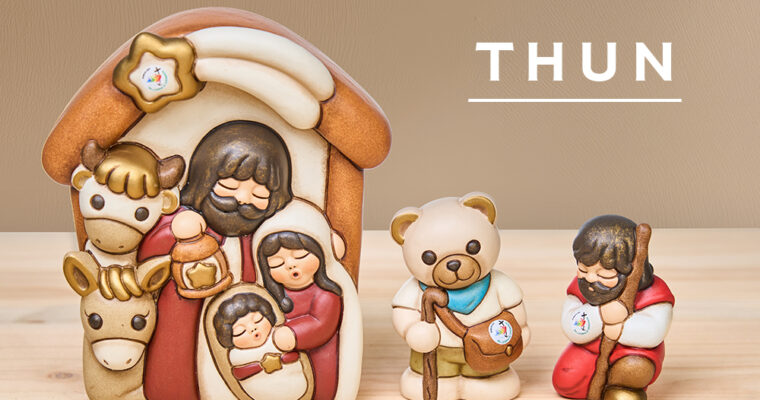
Contents1 A nativity that welcomes humanity on its journey2 THUN: when art becomes a caress for the soul3 When beauty becomes a gift: art that heals, art that unites THUN Nativity Jubilee 2025: when faith takes shape in the hands of angels In the silence…

2 October: Feast of the Guardian Angels

2 October: Feast of the Guardian Angels

Guardian Angels have always accompanied the existence of human beings, acting as messengers, counsellors in everyday life, and protectors against temptations and the snares of evil

On 2 October each year, millions of people around the world celebrate the Feast of the Guardian Angels – a special occasion to honour and thank these celestial and ethereal beings who watch over us, serving as intermediaries between each individual and Heaven, as protectors, confidants, and guardians of our secrets and most intimate fears.
It is believed that each person is assigned a Guardian Angel who prays for them, protects them from danger, and guides them along life’s path.
This feast holds significance in the Christian religious tradition and has deep roots in the history of the Catholic Church. It offers a special opportunity for those who believe in the existence of Guardian Angels to dedicate the day to reflecting on their protection and guidance in everyday life.

The existence of Angels is a recognised dogma of faith, and the celebration of Guardian Angels has a long history that dates back to the early years of Christianity. However, the feast as we know it today was officially established in 1670 under the papacy of Pope Clement X. It was originally celebrated in September, but the date was soon changed to 2 October, where it remains today. For this reason, September is still often considered the month dedicated to angels.

The Feast of the Guardian Angels is celebrated with prayers and reflections on the presence and protection of these Angels, and many Catholic churches hold special Masses in their honour. Some people choose to perform acts of kindness on 2 October in honour of their Guardian Angels, such as helping others, making donations, or simply being more compassionate and caring.

The idea of Guardian Angels comes from Holy Scripture. In the Bible, they appear in several passages as protectors and guardians of the men and women dear to God, who sends them to guard against the snares of demons. In this sense, faith in Guardian Angels has always belonged to Christianity, as well as to many other religious traditions, which likewise recognise the existence of spiritual beings tasked with watching over people and helping them face their daily challenges.
The veneration of Angels predates that of Saints, and their worship is an ancient practice that has evolved over the ages.
With the evolution of Christianity in both East and West, the bond between Guardian Angels and humanity has grown ever stronger. In the medieval era, monks frequently invoked Guardian Angels in their prayers and supplications. During the Renaissance, their stories and invocations were largely directed towards children. But after the Council of Trent, devotion to Guardian Angels regained strength, to the point that it became necessary to create a specific field of study: angelology, a doctrine dedicated to angels, which illustrates what the Bible says about them and studies how they have acted and continue to act as intermediaries between humanity and God through the centuries.

The Feast of the Guardian Angels and Grandparents’ Day

In Italy, 2 October is not only a special day dedicated to Guardian Angels. On this date, we also celebrate GrandparentsDay, which was added to the Italian calendar through a specific law published in the Official Gazette on 12 August 2005, recognising “the importance of the role played by grandparents within families and society at large.” Other countries also celebrate Grandparents’ Day, though on different dates.

It is noteworthy that this date coincides with the religious feast of the Guardian Angels, further highlighting the importance of grandparents. Grandparents are often seen as true Guardian Angels in the flesh. However, while their role was once widely recognised and respected, this is less often the case today.
Keepers of ancient wisdom passed down orally from generation to generation, people once turned to them for advice and guidance when faced with difficult decisions. But the modern world, with its fast pace and focus on efficiency and success at all costs, has led to a decline in some of these traditions.
That is why Grandparents’ Day on 2 October is so important. The Italian Parliament wanted to formalise the importance of grandparents – not only as an economic support (as they often help families save on childcare and babysitting costs), but also as custodians of wisdom and knowledge that must be passed down to younger generations.
They carry with them a treasure trove of knowledge, lived experiences, and stories that intertwine with recent history, often overlooked in school textbooks. This heritage is invaluable for the education of the young, helping them to develop a strong civic and historical awareness.

Who Are the Guardian Angels in Christian Tradition?

According to tradition, angels are divided into hosts and hierarchies, outlined in ancient classifications such as the famous De coelesti hierarchia by Pseudo-Dionysius, who defined three main hierarchies, each of which includes three orders or choirs – for a total of nine types of angels:

In the First Hierarchy: Seraphim, Cherubim, and Thrones
In the Second Hierarchy: Dominions, Virtues, and Powers
In the Third Hierarchy: Principalities, Archangels, and Angels

This same classification was later adopted by Saint Thomas Aquinas in his Summa Theologica.

Guardian Angels therefore fall under the Third Hierarchy – the lowest – but they form a special order within this very hierarchy, as they are the closest to human beings and their daily lives. They reside in the cosmic space nearest to Earth, a place symbolised by the Moon, and their presence is intimate and constant.
They are also considered divine messengers, tasked with communicating with humankind. The word “angel” itself comes from the Greek anghelos, meaning “messenger.”

Prayer to the Guardian Angel

From childhood, we learn the Angel of God prayer – perhaps the most famous invocation to the Guardian Angel. In truth, there are many other prayers invoking the various angelic hierarchies, such as the Angelic Crown, also known as the Rosary of Saint Michael, which is recited in honour of Saint Michael the Archangel and the heavenly choirs, asking them to intercede with God for blessings and graces.

Angel of God

Also known as Angele Dei in Latin, the Angel of God prayer is deeply rooted in the Catholic religious tradition.
This ancient prayer, dating back to the medieval period, is widespread throughout the Catholic world and holds a special place in the hearts of the faithful due to its simplicity and effectiveness.
It is often taught to children as a way to help them understand how to speak to their Guardian Angel – their guide, companion, and protector against temptation and sin.
Reciting the Angel of God prayer opens a direct channel of dialogue with God – an intimate and profound way to communicate with one’s assigned Guardian Angel, and with the One who placed that angel by our side.

Angel of God
who are my guardian,
enlighten me, guard me,
direct and govern me,
who was entrusted to you
by Heavenly Mercy.
Amen.

Guardian Angel Prayer by Padre Pio

Padre Pio of Pietrelcina often spoke with his own Guardian Angel and claimed to have felt his presence beside him since childhood.
To him we owe a beautiful prayer to the Guardian Angel, one that can be recited by children in the evening, but is suitable for all ages:

O Holy Guardian Angel,
take care of my soul and my body.
Enlighten my mind so that I may know the Lord better
and love Him with all my heart.
Assist me in my prayers so I do not give in to distractions,
but pay the greatest attention.
Help me with your advice so that I may see the good
and carry it out generously.
Defend me from the snares of the infernal enemy and support me in temptations,
so that I may always emerge victorious.
Make up for my coldness in the worship of the Lord:
do not cease to watch over me
until you have brought me to Heaven,
where we shall praise the Good God together for all eternity.

padre pio

Read more:

Padre Pio and his favorite prayer
Padre Pio is a figure that was controversial and debated in the Catholic Church sphere for a long time. Even after his canonization…

From Don Bosco to Pier Giorgio Frassati: Who are the social saints

From Don Bosco to Pier Giorgio Frassati: Who are the social saints

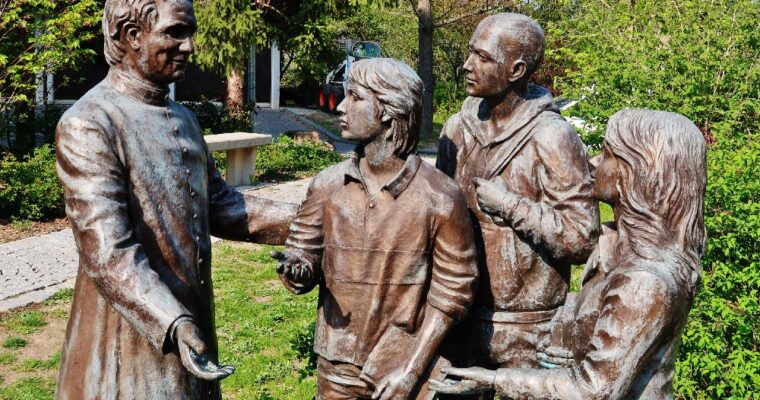
Contents1 Who are the social saints2 Don Bosco3 Pier Giorgio Frassati4 Giuseppe Benedetto Cottolengo5 Giulia di Barolo6 Giuseppe Cafasso From Don Bosco to Pier Giorgio Frassati: Who are the social saints who have changed the world In the heart of Piedmont, in that nineteenth-century Turin…

The Story of Saint Vincent de Paul and His Work of Charity

The Story of Saint Vincent de Paul and His Work of Charity

Contents1 Saint Vincent de Paul and the Fight Against the Divide Between Rich and Poor2 The Daughters of Charity3 The Regulae of Saint Vincent Saint Vincent de Paul made charity his mission, preaching the model of Christ, equality among men, and greater social justice. Today,…

Padre Pio’s Prayer Groups: A Strong Devotion to the Saint in England

Padre Pio’s Prayer Groups: A Strong Devotion to the Saint in England

Padre Pio’s Prayer Groups are widespread in Italy and across the world. In the United Kingdom in particular, they bring together devoted followers united by the message of charity of the Friar from Pietrelcina, who, in his name, rediscover a stronger sense of belonging to the Church

On 23 September, the Church celebrates the liturgical memorial of Saint Pio of Pietrelcina, one of the most loved and venerated saints in our country. His life was dedicated to prayer, sacrifice, and complete devotion to others, to patient listening, and to a constant desire to relieve the suffering of others. These exceptional gifts of charity and mercy, together with his miraculous gifts as a healer, gave rise to an extraordinary popular devotion to the Saint, which began during his lifetime. His example is heroic, as Pope Francis described it, which explains why even today there are so many Padre Pio prayer groups in Italy and abroad. These groups gather Christians who see in the Saint of Pietrelcina a model to imitate in becoming “instruments of God’s love towards the weakest” (Pope Francis in Pietrelcina, 17 March 2018).

religion Padre Pio

Read more:

Padre Pio’s devotion to Our Lady of Pompeii and the gift of the rose
May 5 is the feast day of the Saint of Pietrelcina. Discover the evocative…

Born in Pietrelcina, in the province of Benevento, on 25 May 1887, Padre Pio displayed an early religious faith, which led him to enter the Capuchin Order at a very young age. In addition to his inclination for charity, Padre Pio’s life was marked by miraculous events and frequent dialogues with God, which would lead him to receive the stigmata, experience mystical visions, be involved in episodes of bilocation, and emit a sweet floral fragrance – a miraculous sign perceptible to those who approached him. Above all, the Saint had the marvellous gift of reading the minds and hearts of his followers. Even during his lifetime, Padre Pio was a figure of extraordinary devotion and affection, and after his death, the convent of San Giovanni Rotondo, where he lived, became a place of pilgrimage for people from all over the world.

father Pio

Read more:

Padre Pio and the Order of Friars Minor Capuchin
What makes Padre Pio, known today as Saint Pio from Pietralcina, such an adored and celebrated figure since he was still alive…

In this regard, it is interesting to note that Padre Pio is also greatly loved and venerated in the United Kingdom, where both clergy and lay people have organised themselves into prayer groups dedicated to him throughout the country – from Northern Ireland to Wales and Cornwall. In particular, the shrine of Walsingham, the heart of Marian devotion in England, is a significant place for prayer communities, which gather there under the guidance of Franciscan friars to promote a return to communal prayer. But in general, all the English seem particularly receptive to devotion to this Saint, who was so attentive to the suffering of others, so outward-looking in thought, action and feeling. According to testimonies, praying to him and with him fosters in the people of the United Kingdom a strong sense of belonging to the Church as a community of faith and humanity.

Padre Pio’s Prayer Groups: What They Are and What They Do

Padre Pio’s Prayer Groups continue to carry forward the spiritual legacy of Padre Pio, offering a space for prayer, meditation and spiritual growth for those who wish to draw closer to God and strengthen their faith within a community of believers. These Groups arose directly from the primary importance that Padre Pio gave to prayer, recommending his followers practise it as much as possible. Members of the Prayer Groups meet regularly, usually once a month on the same day. In addition to communal prayer and spiritual meditation, they attend Mass and reflect on the Holy Scriptures. Sharing prayer and spiritual experience promotes the growth of each participant, both within the group and in their private experience as a person and as a Christian.

Each Padre Pio Prayer Group is led by a priest appointed by the Bishop, who acts as the spiritual guide for all members, who are also encouraged to manage themselves independently, deciding on the Group’s programmes and activities in line with availability and adapting to the needs of each individual.

Padre Pio in the World

Devotion to Padre Pio has spread throughout the world, touching the hearts of millions of people from different cultures and beliefs. His holiness has always inspired deep veneration and admiration among the faithful. One need only look at how many Prayer Groups are dedicated to him – groups born as a result of his priestly ministry – which have helped to spread his spiritual message. Across the globe, many devotees gather in his name, in private homes, care homes, hospitals, and many of these groups are coordinated from San Giovanni Rotondo by a commission created specifically: the International Centre for Padre Pio Prayer Groups of San Giovanni Rotondo. This centre also publishes a magazine, Casa Sollievo della Sofferenza, which since September 1949 has served, among other things, as a bulletin for the activities of the Prayer Groups spread throughout the world. The magazine is monthly and serves as the official publication of the Prayer Groups to spread Padre Pio’s teaching.
National and international conferences are also held in San Giovanni Rotondo, bringing together representatives of Padre Pio’s Prayer Groups from all over Italy and other countries.

Shrine of Padre Pio in San Giovanni Rotondo

Read more:

The Shrine of Padre Pio in San Giovanni Rotondo
What drives thousands of people to visit the Shrine of Padre Pio in San Giovanni Rotondo…

The Padre Pio Prayer Group in the United Kingdom

In the United Kingdom, there are over seventy Padre Pio Prayer Groups.
The Padre Pio Prayer Group in Derry, near Belfast, for example, meets on the evening of the first Tuesday of every month. Those who cannot attend in person follow online, as they did during the pandemic. Together, they recite the Holy Rosary, follow Holy Mass, and say prayers to Saint Pio, along with other prayers and the Novena in his name.
In the United Kingdom, compared to other countries, it can be more difficult for associations of the faithful to obtain the bishop’s approval and to find a priest available to guide them, but this does not deter Padre Pio’s devotees. A simple Google search for Padre Pio Prayer Groups reveals just how widespread the love for the Saint of Pietrelcina is across the Channel, in cities and small communities alike. This helps us understand the reach of his message of love and charity, and the spiritual legacy he left behind.

How to apply for the Pope’s Apostolic Blessing

How to apply for the Pope’s Apostolic Blessing

The Papal Blessing, also known as the Apostolic Blessing, is a special blessing bestowed for specific occasions. It is often associated with plenary indulgence, the remission of all temporal penalties due to sins. The Apostolic Blessing, also known as the Papal Blessing, is a special blessing recognised…

History and Meaning of the Feast of the Most Holy Name of Mary

History and Meaning of the Feast of the Most Holy Name of Mary

Invoked by every believer in the sweetest and most terrible moments of life, the Most Holy Name of Mary carries within its very sound a symbol of sweetness and hope Each year, on 12th September, the Catholic Church celebrates the Feast of the Most Holy…

The Madonna’s Birthday: Was She Born on 5 August or 8 September?

The Madonna’s Birthday: Was She Born on 5 August or 8 September?

The birthday of the Madonna: 5 August or 8 September? Let’s discover when and why the Church celebrates the Nativity of Mary, Mother of Jesus.

It is never easy to imagine what the lives of the protagonists of Christian history might have been like. If we think of the lives of the Saints, we can draw on numerous hagiographic and historical documents, which become increasingly numerous and comprehensive the closer we come to our own era. Some Saints, such as Saint Augustine, to name just one, have told the story of their own human and spiritual journey directly in their most famous writings. But things become more complicated when we pause to reflect on the lives of Jesus, the Madonna, and other figures central to the Gospels. Although the Gospels themselves provide us with precious information to reconstruct events, it is also true that some parts of their lives are completely left out, or almost so. Think of the lost years of Jesus, those years of His childhood and youth before He began to preach.

The Story of Jesus at the Last Supper

Read more:

The story of Jesus: the most important events of His life
The story of Jesus, between the Gospel story, historical reality and devotional legend. In view …

Even in the case of the Virgin Mary, it is difficult to reconstruct the events of her life after the Annunciation and the birth of Jesus, up to that fateful day at the foot of the Cross on Calvary. For example, have you ever wondered when the Madonna’s birthday is? We have previously dwelt on the figure of Saint Anne, Mary’s mother, and on Saint Joachim, her father, but it is important for Christians to reflect on the Nativity of the Madonna herself, celebrated on 8 September, for her role in being and remaining over time the symbol of a renewed covenant between God and mankind, a new Eve come to wash away Original Sin and carry within her own womb the Salvation for all. Blessed among women, just as Eve was cursed by God for her disobedience.

The Story of Saint Anne, Mother of Mary

Read more:

The story of Saint Anne Mother of Mary
On July 26, St. Anne and St. Joachim, the parents of the Virgin Mary, are celebrated. Let’s find out why…

Why do we sometimes hear the 5th of August referred to as the Madonna’s birthday? As we have written, the Nativity of the Virgin is celebrated on 8 September, but the choice of this date is purely conventional, as there are no precise indications regarding the date of the Madonna’s birth. The main reason this date was chosen is that it coincides with the feast of the dedication of the Basilica of Saint Anne in Jerusalem, built in the 4th century AD on the site where the house of Mary’s parents once stood. It is here that still today, every year on 8 September, the Franciscans of the Custody of the Holy Land – the Franciscan Order that since the beginning of the 13th century has been responsible for promoting and encouraging pilgrimages to the Holy Places – celebrate the birth of the Blessed Virgin Mary. Initially celebrated only in the East, the feast of the Nativity of Mary was later introduced in the West by Pope Sergius I in the 7th century AD.

However, there are other traditions that associate the Madonna’s birthday with different dates. For example, on 5 August the feast of Our Lady of the Snows is celebrated. She is said to have appeared during the night of 4 August in the year 352 AD to a Roman patrician named John and his wife, and asked them to build a basilica in her name at the place where snow would fall the following day. And indeed, that August, snow did fall on the Esquiline Hill, and here, faithful to the promise made, John and his wife built what would become the Basilica of Saint Mary Major.

The Madonna’s Birthday in Medjugorje

The Madonna’s birthday is also celebrated on 5 August in Medjugorje. It is said that the Virgin herself indicated this date to the visionaries as her birthday, during the apparition of 1 August 1984, asking that three days of prayer and fasting be offered in preparation:
“On the next 5 August, the second millennium of my birth will be celebrated. On that day God allows me to grant you special graces and to give the world a special blessing. I ask you to prepare yourselves intensely with three days dedicated exclusively to me. During those days do not work. Take your rosary and pray. Fast on bread and water. Throughout all these centuries I have dedicated myself completely to you: is it too much if I now ask you to dedicate at least three days to me?”

The same date is said to have been indicated by the Madonna to other holy men during various apparitions.

The Nativity of the Blessed Virgin Mary According to the Church

The Church therefore recognises 8 September as the conventional date of Mary’s Nativity, and although devotion to the Child Mary has always existed, in 1572 Charles Borromeo consecrated the Cathedral of Milan, then nearing completion, precisely to the “Nascent Mary.”

Also in Milan, in 1720, the devotion to the Child Mary is said to have originated, linked to a small wax figure representing the newborn Madonna who was the protagonist of a miraculous healing. It was donated by the Franciscan nun Sister Chiara Isabella Fornari to the Capuchin Sisters of Saint Mary of the Angels. Still today, the sisters of the Congregation of the Sisters of Charity of Lovere in Milan are called the Sisters of the Child Mary.

Prayer to the Child Mary

We now present the Novena to the Child Mary, which grants partial indulgence once a day to those who recite it:

Holy Child of the royal lineage of David, Queen of the Angels, Mother of grace and love, I greet you with all the affection of my heart. Obtain for me from the Lord the grace to love Him with generous fidelity all the days of my life and grant me a most tender devotion to you, who are the Firstborn of Divine Love.
(Hail Mary,…)

O heavenly Little One, who like a white dove came into the world Immaculate and beautiful, my soul exults before You, true marvel of the wisdom and goodness of God. Unblemished and pure, help me to guard jealously, at the cost of any sacrifice, the angelic virtue of holy purity.
(Hail Mary,…)

Hail, gracious and Holy Child, spiritual paradise of delights where, on the day of the Incarnation, the true Tree of Life, the Saviour of the world, was planted. Since You love me so much, help me to flee and detest the poisoned fruits of worldly vanities and pleasures. Inspire in my soul the thoughts, affections, and virtues of Your Divine Son, most sweet fruits of immortal life.
(Hail Mary,…)

Hail, admirable Little One, enclosed garden, impenetrable to creatures, open only to the heavenly Spouse who delights in resting among the flowers of your exalted virtues. O lily of Paradise, marvellous example of a humble and hidden life: grant that the heavenly Spouse may always find the door of my heart open to the loving visits of His graces and inspirations.
(Hail Mary,…)

O Holy Child, mystical dawn, happy gate of Heaven, in You my soul trusts and hopes. How deep is my tepidity in the service of God! How great is the danger of my damnation! O powerful Advocate, from your little cradle stretch out your kind hand, awaken me from my painful lethargy, sustain me on the path of life… Grant that I may dedicate myself to the service of the Lord with fervour and perseverance until death, and so attain the eternal crown.
(Hail Mary,…)

But there are many prayers linked to the Nativity of Mary, to be recited on the occasion of the Madonna’s birthday or whenever one feels the need:

“O Most Holy Mary, chosen and destined to be the Mother of the Only-Begotten Son of the Father, foretold by the Prophets, awaited by the Patriarchs and desired by all peoples, shrine and living temple of the Holy Spirit, spotless sun, because conceived without sin, Lady of Heaven and earth, Queen of Angels, we humbly prostrate ourselves before you and rejoice in the annual commemoration of your most happy birth.
We beg you to be spiritually born in our souls, so that, captivated by your loveliness and gentleness, they may always remain united to your sweetest and most lovable Heart.”

The Missionaries of Charity of Mother Teresa of Calcutta

The Missionaries of Charity of Mother Teresa of Calcutta

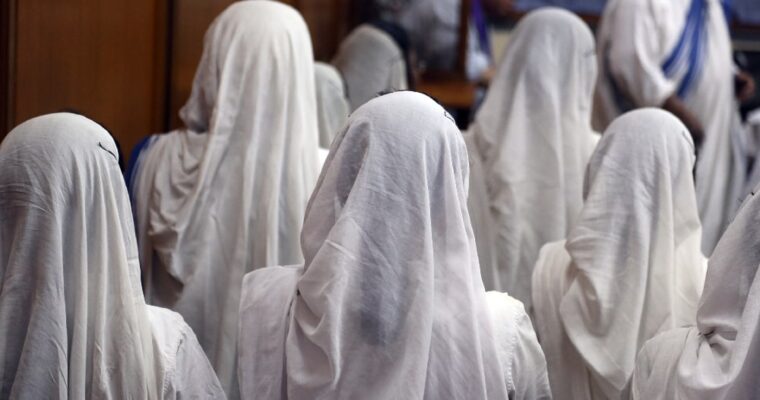
Contents1 The History of the Missionaries of Charity2 The Attire of the Missionaries of Charity3 The Missionaries of Charity Around the World The Missionaries of Charity of Mother Teresa of Calcutta live daily the legacy of love and compassion promoted by their foundress, Mother Teresa…

Saint Corbinian, the Saint Who Travelled to Rome with a Bear

Saint Corbinian, the Saint Who Travelled to Rome with a Bear

Contents1 Who Was Saint Corbinian2 The Bear of Saint Corbinian3 The Bond Between Pope Benedict XVI and Saint Corbinian Much beloved by Pope Benedict XVI, Saint Corbinian was a monk, hermit, and Bishop of Freising. At the Pope’s request, he evangelised Bavaria and even convinced…

Acutis and Frassati: the first canonisations of Pope Leo XIV

Acutis and Frassati: the first canonisations of Pope Leo XIV

Pope Leo XIV chose his first Saints. They are Carlo Acutis and Piergiorgio Frassati, two bright lives for the restless heart of the Third Millennium

In the vibrant silence of St. Peter’s Basilica, among the aisles full of songs and expectations, the names of two young men resound as promises kept. On 7 September 2025, Pope Leo XIV will consecrate his pontificate with a gesture that tastes of revolution and memory, of the future and roots: the canonisation of: Carlo Acutis, saint and beatified Piergiorgio Frassatihis “first” saints, two young souls who speak with a prophetic voice to a world in search of light.

Carlo and Pier Giorgio. Two young men. Two centuries. One Holiness, two lifestyles.
One speaks the language of the cloud, the other that of mountain trails. One evangelises with a keyboard, the other with a sandwich given to a poor person. But they both have the same burning heart, the same fixed gaze on Christ, the same scandalous joy of holiness. Carlo and Pier Giorgio are two saints for the third millennium, two models that do not inspire awe, but that attract. They don’t make you feel guilty, but they call for something bigger. The lotus message is powerful, revolutionary, as only youth can be: you can be young, in love with life, immersed in modernity… and at the same time deeply holy.

Carlo Acutis

Read more:

Carlo Acutis: The Blessed of the Digital Age
Carlo Acutis, the millennial saint who dedicated his short life to Jesus and helping the poor and needy, reminds …

On 7 September 2025, when Carlo Acutis and Pier Giorgio Frassati are canonised, the young people of the world will feel a little less alone.
Pope Leo XIV, with this gesture, does not canonise only two people: he canonises a vision. A Church that looks forward without forgetting, that recognises beauty in fragility, that is not satisfied with nostalgia, but seeks living faces. Saint Carlo Acutis and Saint Pier Giorgio Frassati will be the polar stars of a pontificate that aims to speak to TikTok and the Alpine peaks, students and people experiencing poverty, volunteers and coders, mystics and creatives. In a tired and disillusioned time, these canonisations are a caress and a challenge. A caress for those seeking meaning. A challenge for those who are content with the minimum.
On 7 September 2025, the Church will not only add two names to its calendar; it will also illuminate two powerful and luminous signs for humanity on the way.
Carlo and Pier Giorgio, pray for us. And most importantly, stay with us. The world needs your light.

Pier Giorgio Frassati

Read more:

From the mountain to the sky: the life and message of Pier Giorgio Frassati
From the mountains to heaven: the life and message of Pier Giorgio Frassati, the boy who loved the mountains…

A Pope for young people and the future

Some gestures are not just decisions, but visions.
Pope Leo XIV chose to begin his journey as Pope with a celebration that looks to the future, yet is rooted in the lives of two individuals who have already flourished in holiness: Carlo Acutis and Pier Giorgio Frassati. An ad that doesn’t come out of nowhere. Back in November 2024, during one of his last general audiences,  Pope Francis, with his weary but still vibrant voice, warmed the hearts of the crowd in St. Peter’s Square, revealing the future canonisation of the two young men. A long applause had broken out between Bernini’s columns, like a wave of joy rushing up to the sky. Carlo, the boy of the Net and the Rosary, would be proclaimed a saint on 27 April, on Divine Mercy Sunday, within the Jubilee of Adolescents; Pier Giorgio, the saint with muddy shoes and his heart looking upwards, would receive the halo during the Jubilee of Youth, at the end of July. But time has messed up the dates: Bergoglio’s sudden death, on 21 April, cancelled everything, leaving the dream pending, and with it thousands of hearts waiting. Then, silence had fallen on Frassati. No communiqué, no hint. As if his canonisation had vanished into the void, like certain sunsets that never become night.

Pope Francis

Read more:

How Pope Francis transformed the Church during his pontificate
What did Pope Francis do that was important? His pontificate was a revolution of mercy that transformed…

Then, like a flash in the still sky, came the announcement of Pope Leo XIV. With a choice that feels more like prophecy than a program, he combined the two dates into a single, powerful liturgy on 7 September. Not to simplify, but to seal: two young saints, of different centuries and paths, proclaimed on the same day, as spiritual brothers, as sentinels of the same dawn. A decision that is not just a date in the calendar, but an act of love towards a Church that wants to be young in heart, in voice, in faith. And that finds, in Carlo and Pier Giorgio, two lighthouses lit for those who still seek God within the walls of the school, in the peripheries of the world, or the silence of a sunset in the mountains.
It is not a neutral or diplomatic choice. A declaration of intent. Pope Leo XIV, elected by surprise in a conclave marked by fears and desires, chose to start from youth, from two smiling and restless faces, from two stories burned in a hurry, but which left traces of fire. With the decision to unify the canonisations foreseen by Pope Francis in a single celebration, Leo XIV wanted to send a strong signal: holiness is not a museum of relics, but a living current that transcends generations, a call that resonates today in university classrooms and among the servers of the network. Now to the questions “When will there be the canonisation of Carlo Acutis?” and “When will Pier Giorgio Frassati be canonised?” we have only one answer: 7 September 2025, the feast of youth and sanctity incarnate, in the embrace of a single liturgy.

Leone XIV

Read more:

Pope Leo XIV: everything there is to know about the new Pontiff
Pope Leo XIV: The New Face of the Catholic Church in the Third Millennium…

Carlo Acutis: The Saint of the Net and the Eucharist

He was only 15 years old when a fulminant leukaemia ripped his life. But Carlo Acutis, born in London and raised in Milan, had already charted his way to heaven, leaving behind not just pain, but a trail of grace. But what did Carlo Acutis do to become a saint? He loved. With intensity. With simplicity. With creativity.
He made the Eucharist the centre of his existence, “my highway to heaven,” he said, and information technology is his pulpit. He created an exhibition on Eucharistic miracles that has toured the world, touching hearts, even those distant from faith. He did not preach: he narrated, with the codes and images of his time. The miracles of Carlo Acutis are not only those officially recognised (such as the healing of little Matheus in Brazil): they are also those that are silent, daily, invisible. How many teenagers have approached the sacraments thanks to him? How many conversions were born from a video, a photo, or a phrase? But above all, Carlo showed that holiness is possible for anyone: that you can attend school, love video games, have friends, and volunteer… and in the meantime, walk towards Heaven in giant steps. Today, he rests in Assisi, in the Sanctuary of the Renunciation. And from there, he continues to speak with sweetness and strength to the young people of our time.

Carlo Acutis statue in painted resin 30 cm
Statue Carlo Acutis with Rosary painted resin 30 cm Buy on Holyart
Carlo Acutis 35x40 cm APE Social Wear Shopper Bag Buy on Holyart
Carlo Acutis fabric cross 14x10 cm
Carlo Acutis fabric cross 14x10 cm Buy on Holyart
Wooden rosary with Carlo Acutis medal
Wooden rosary with Carlo Acutis medal Buy on Holyart

Pier Giorgio Frassati: The Saint who came down from the peaks to serve

One hundred years before Carlo, another young man died too soon. He was Pier Giorgio Frassati, from Turin, son of senators, engineering student, mountain enthusiast, but above all, a tireless lover of the poor. For decades, since he was declared beatified in 1990, the question has been bouncing incessantly in the Vatican halls and in the memory of those who have made him a model for life and faith: “When will Pier Giorgio Frassati become a saint?”
Now we have an answer written in solemn letters: on 7 September 2025, together with Carlo.

Pier Giorgio Frassati will be a saint because he has made charity his extreme sport. He came down from the peaks to bring medicine, clothes, and comfort. He entered the slums, the alleys, the hospital wards. Without clamour. Without rhetoric. He was a cheerful young man, full of life, a friend of the last. Enrolled in Catholic Action, a Vincentian Dominican tertiary. He prayed, he walked, he laughed. He wrote passionate letters, was moved by an icon, and took strong positions against fascism and injustice.
He died in 1925, at the age of 24, of fulminant polio contracted during one of his visits to the sick.
It was John Paul II who beatified him in 1990, calling him “the man of the beatitudes”. And finally, he will be proclaimed a saint by a Church that needs everyday prophets, revolutionaries of kindness. When Pier Giorgio Frassati is canonised, it will no longer be a question. It’s going to be a day of celebration.

Blessed Pier Giorgio Frassati statue 20 cm in hand-painted resin
Hand-painted Pier Giorgio Frassati resin statue, 20 cm Buy on Holyart
Stole Pier Giorgio Frassati
Stole Pier Giorgio Frassati Cotton Blend Buy on Holyart
Tapestry Pier Giorgio Frassati, 45x30 cm Buy on Holyart


The rules for granting indulgences during the 2025 Jubilee

The rules for granting indulgences during the 2025 Jubilee

Contents1 The Apostolic Penitentiary2 When a plenary indulgence is given3 Works of mercy and penance4 Penitence on Friday5 Abstinence from real and virtual distractions6 Voluntary service The Apostolic Penitentiary has published the Norms for obtaining indulgences during the 2025 Jubilee. Pilgrimages, penance, works of charity,…

Wooden relief maps of the city of Rome and the Vatican: a reminder of the 2025 Jubilee

Wooden relief maps of the city of Rome and the Vatican: a reminder of the 2025 Jubilee

Contents1 Maps of Rome and the Vatican for the Jubilee2 The technique of laser engraving on wood3 Ideal wood for laser engraving On the occasion of the 2025 Jubilee, give or treat yourself to one of the beautiful relief maps of Rome or the Vatican.…

The Perpetua Pencil, the official 2025 Jubilee gadget

The Perpetua Pencil, the official 2025 Jubilee gadget

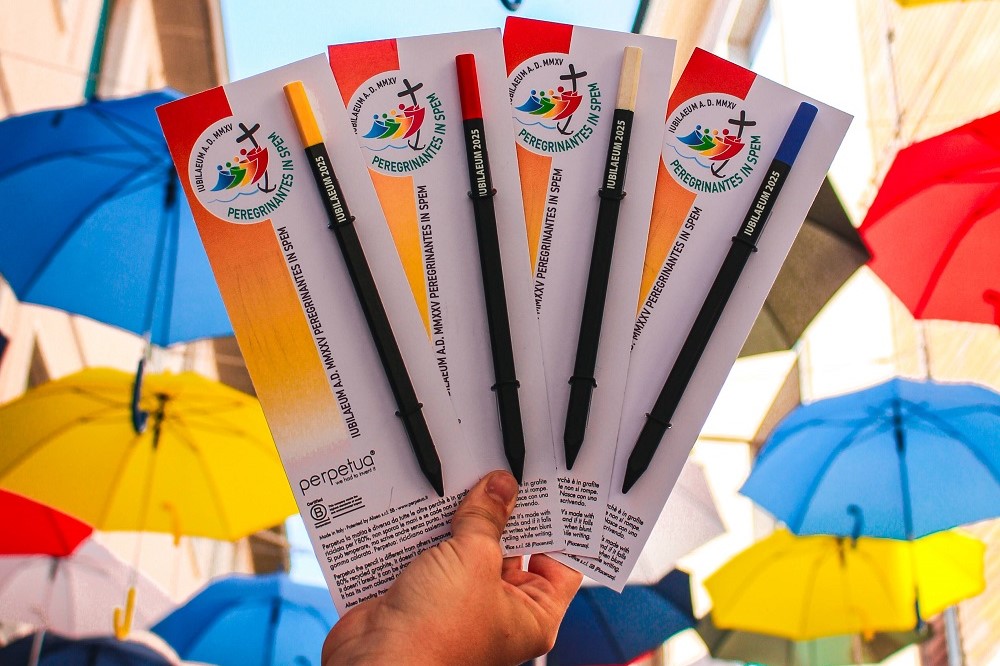
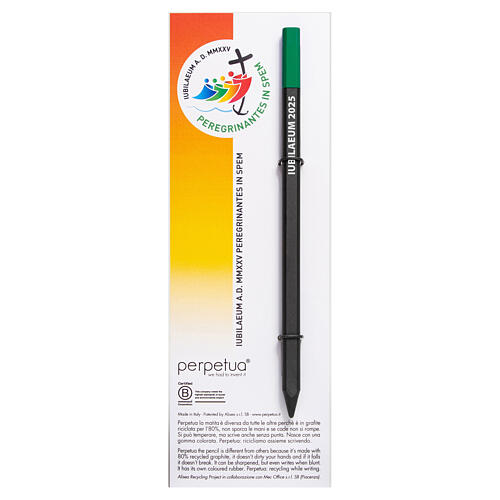
The Perpetua pencil is made with Zantech, composed of 80% recycled graphite. Innovative and sustainable, you can find it on Holyart in a special edition for the 2025 Jubilee

A pencil that writes forever and never wears out? It seems a subject worthy of a story, or a story of magic. And being close to Christmas, a little magic doesn’t hurt. But, in this case, we are not telling you any fairy tales. The Perpetua pencil, created by Alisea, represents an innovation in the world of writing. This pencil is made of 80% recycled graphite, which makes it a unique product. It is defined as the pencil that never ends because, unlike traditional pencils, it is not consumed conventionally. In addition, thanks to its innovative design, the Perpetua pencil can write even without a tip and does not break if it falls.

The pencil that is not consumed has been produced and patented by Alisea, a company from Vicenza that operates stores throughout Italy and also serves as a contemporary art gallery. Since 1994, Alisea has stood out for creating innovative objects designed for corporate communication, and has built its identity exclusively around the concept of reusing and recycling materials. This has made it a unique reference point in our country. Often, the recycled materials used for its production are supplied by the same customer companies, which are happy to deliver objects that are no longer needed to the capable hands of Alisea’s designers and craftsmen, and that will be returned to them in the form of unique design products. Every object produced is the result of a creative process that gives life to something new, valuable and sustainable.
All Alisea products are created in full compliance with the circular economy, thanks to ethical supply chains 100% made in Italy. The company’s commitment extends not only to sustainable production but also to promoting a new conscious design model, where every waste is transformed into a resource and every creation tells a story of sustainability and innovation.perpetua pencil official jubilee gadget

The pencil that does not wear out

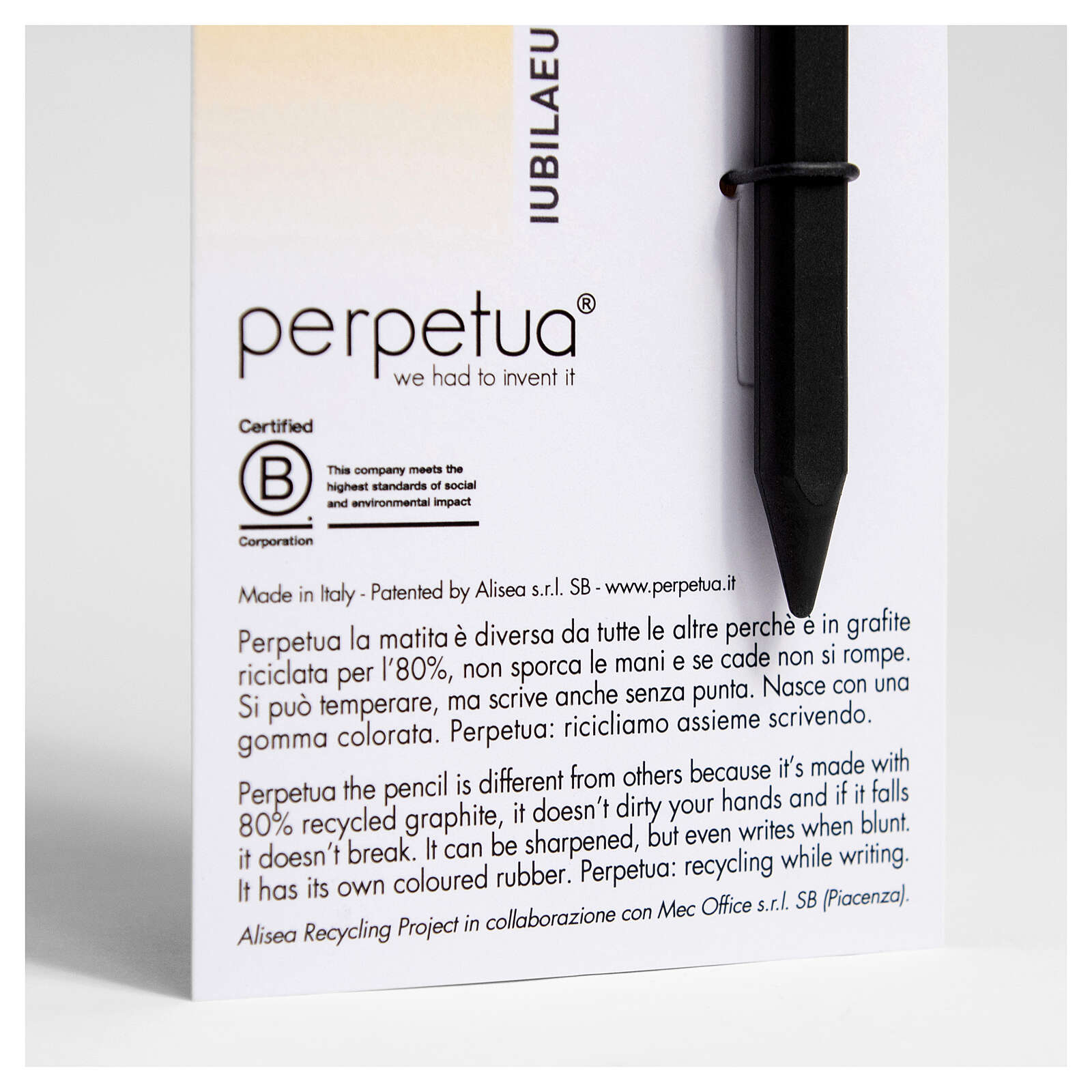
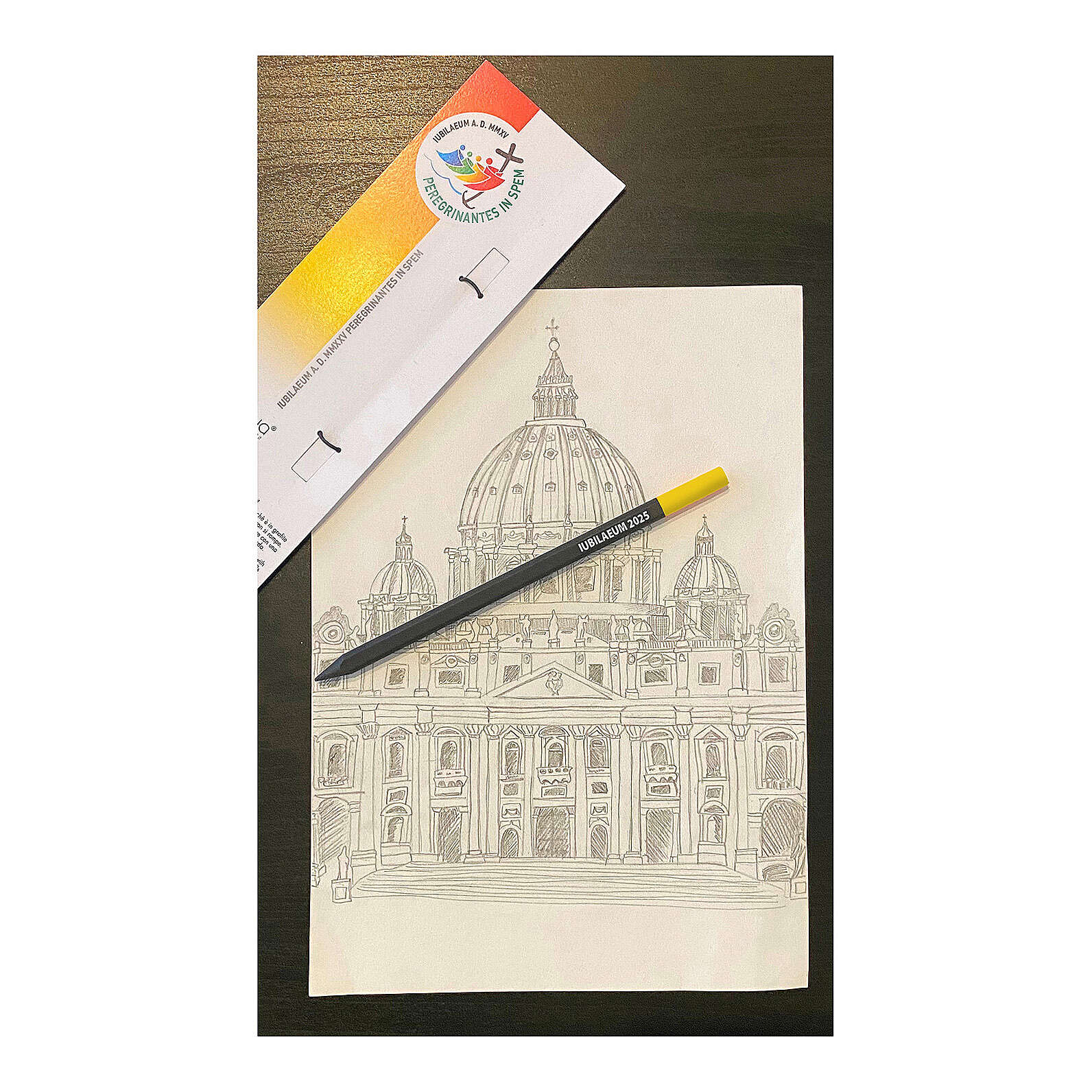
The Perpetua pure graphite pencil is a durable and environmentally friendly product, composed mainly of recycled graphite from the waste of electrode processing for the EDM process, resulting in a patented and certified material known as Zantech. This approach not only reduces waste but also contributes to a circular economy, transforming materials destined for landfill into functional design objects. Its production not only reduces waste, as the dust discarded during electrode processing must be disposed of, but also offers a sustainable alternative to traditional pencils, which, having graphite covered by wood, require the felling of trees. Perpetua writes for over 1120 km and does not soil hands during use, because it is made without protective paints or glues. It writes even if snapped in half and even without a tip. It really is a pencil that never ends! The flat side prevents it from rolling, and in any case, if it falls, it does not break, because it is not fragile like regular pencils. In addition, the Zantech writes well not only on paper, but can also be used safely on smartphone and tablet screens. The feeding rubber that Perpetua surmounts, available in different shades, is also integrated without the need for glue or other elements.

100% Made in Italy design

The Perpetua pencil is entirely designed and produced in Italy. The pencil features an ergonomic design with a unique body that resists breaking, unlike traditional pencils that contain the lead inside. This innovative approach not only enhances the durability of the product but also facilitates its everyday use. Perpetua was first presented to the public in June 2013 at the Paris-Le Bourget International Air and Space Show. For Perpetua’s innovative design, designer Marta Giardini, the creative mind behind the pencil project, received a prestigious Honourable Mention during the twenty-fourth edition of the Compasso d’Oro award, the most prestigious recognition in the field of industrial design in Italy and one of the oldest in the world. Established in 1954 in Milan, the award aims to enhance the quality and innovation of Italian design products. Managed by the Association for Industrial Design (ADI), the Compasso d’Oro has awarded over 350 projects over the years, establishing itself as a reference point for designers and companies.perpetua pencil made in italy

The perpetual pencil of the Jubilee exclusively on Holyart

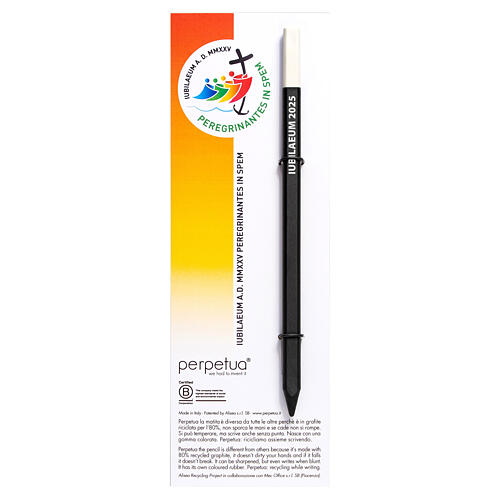
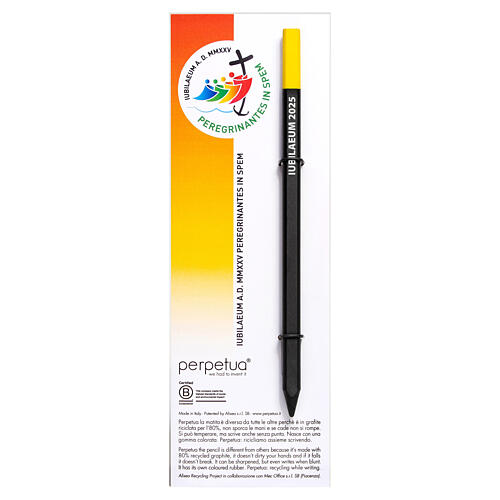
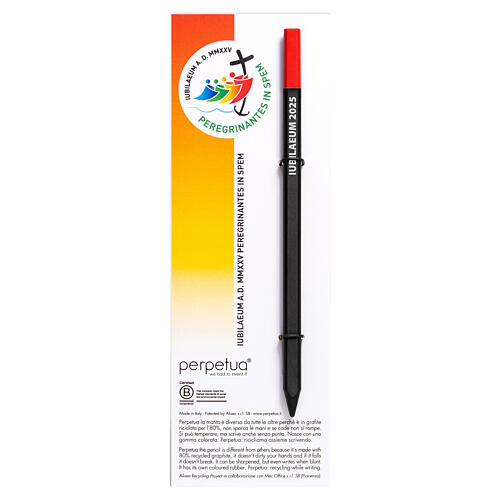
On the occasion of the 2025 Jubilee, Alisea launched a special edition of the Perpetua pencil. This edition is dedicated to pilgrims of hope, protagonists of the Holy Year logo. The pencil will be available exclusively on our store, and we at Holyart are proud to contribute to making known what cannot be considered a simple gadget, but a piece of Italian design that, in addition to celebrating the Jubilee, enhances both the art of writing and respect for the environment. Additionally, the production of the Perpetua pencil involves the Agape Social Cooperative, which provides job opportunities for people with disabilities. This social aspect makes the pencil not only an ecological product but also a symbol of inclusion and solidarity.

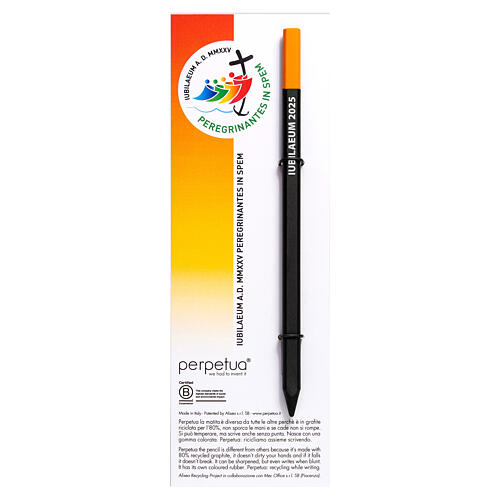
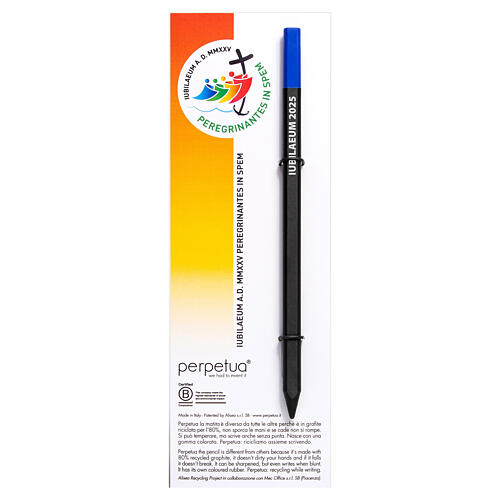
In the Holyart store, you can find the Perpetua pencils in a special edition Jubilee 2025, available in six colours: white, orange, blue, yellow, red, and green.

A precious and original gift, which cannot be missing in the pilgrim’s backpack, in view of the Holy Year.

perpetua the pencil with official jubilee 2025 logo white eraser
Perpetual pencil official Jubilee 2025 white graphite eraser Buy on Holyart
perpetua the pencil official jubilee 2025 memento orange eraser
Perpetual pencil official Jubilee 2025 orange graphite eraser Buy on Holyart
perpetua the pencil with official jubilee 2025 logo blue eraser
Perpetual pencil official Jubilee 2025 blue graphite eraser Buy on Holyart
perpetua the pencil of jubilee 2025 with logo and yellow eraser
Perpetual pencil official Jubilee 2025 yellow graphite eraser Buy on Holyart
perpetua the pencil with official jubilee 2025 logo red eraser
Perpetual pencil official Jubilee 2025 red graphite eraser Buy on Holyart
perpetua the pencil official jubilee 2025 logo green eraser
Perpetual pencil official Jubilee 2025 green graphite eraser Buy on Holyart